PART 1
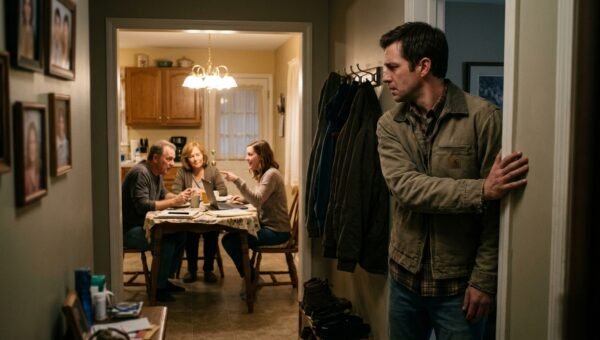
After eighteen years of marriage, my husband stood in the front doorway with his arms crossed and told me I had no claim to our home.
“You’re leaving tonight, Sharon,” Greg said. His voice was completely flat, the way a person talks when they have spent weeks practicing an argument in their head. “She’s moving in tomorrow morning. The deed has only ever had my name on it, and the sheriff won’t help you. Take the kids’ coats and go.”
It was a Tuesday evening in late October. The wind coming off the street was cold enough to bite through our sweaters. My fourteen-year-old daughter, Chloe, was clutching her backpack against her chest, and our nine-year-old son, Toby, was crying so hard he had hiccups. Greg had already tossed two duffel bags onto the porch steps. Inside were some school uniforms, a few folded shirts, and Toby’s inhaler.
Greg looked down at Toby, then looked back at me without blinking. “I don’t want a scene in front of the neighbors. If you’re still on the curb in ten minutes, I’ll call the county patrol for trespassing.”
He closed the front door. The heavy deadbolt clicked into place.
I stood on the front walk, listening to the furnace hum inside the house we had shared for nearly two decades. My mind was racing. I had forty-six dollars in checking and less than twelve dollars in cash.
My own parents passed away years ago, and my sister lived across the country in Oregon. Every joint account we had was drained three days earlier, though Greg had claimed it was a temporary banking error. Now I understood why.
I loaded the two duffel bags into the back of my ten-year-old sedan. Toby climbed into the backseat, shivering, and Chloe sat beside him, pulling the zipper of her thin jacket all the way to her chin.
“Mom,” Chloe whispered, “where are we going to sleep?”
“Give me a minute, sweetheart,” I told her. “Just let Mom think.”
I backed out of the driveway. I knew calling Greg’s family was useless. His mother had never liked me, and his brother would only take Greg’s side. But as I stopped at the traffic light by the edge of town, one specific conversation from seventeen years ago came back to me.
It was the summer after Chloe was born. Greg had come home from an old brick office downtown, sweating through his collar, carrying a cashier’s check stub.
We had just bought the house, or so I had thought back then. Greg told me that an uncle had lent him money, but when I pressed him on who gave it to him, he snapped at me and told me never to speak of it again. A few weeks later, he said the money had vanished in a bad real estate investment.
The name on that stub had belonged to a man named Arthur Vance.
Arthur Vance was a quiet, retired civil surveyor who lived in an old stone house out near the county reservoir. He was thirty years older than Greg. To the rest of the town, he was just a reclusive widower who kept his gravel driveway lined with cedar trees and rarely came into town except for groceries. But seventeen years ago, Arthur Vance had signed over eighty thousand dollars.
I turned the steering wheel north, away from the highway motels I couldn’t afford anyway.
Twenty minutes later, the sedan’s headlights swept across Arthur’s long gravel driveway.
The porch light was off, but a single floor lamp was glowing through the front bay window. I put the car in park, turned around to the kids, and told them to stay inside with the doors locked until I came back.
My boots crunched against the wet gravel. I stepped onto the wide wooden porch and knocked on the screen door three times.
It took two minutes before the inner door cracked open. Arthur Vance stood behind the brass chain lock. He had gray, thinning hair, wire-rimmed glasses resting halfway down his nose, and a thick woolen cardigan buttoned over a flannel shirt. He looked at me through the screen, his expression cautious and guarded.
“Sharon?” he said, his voice gravelly from sleep. “What on earth are you doing out here at nine o’clock at night?”
“Greg threw us out, Arthur,” I said. My voice trembled, but I forced myself to hold his gaze. “He’s moving another woman in tomorrow. He locked the doors and told me we have no right to the house. I have nowhere else to take my children tonight.”
Arthur’s face stiffened. “Sharon, I’m sorry to hear that, but I don’t get involved in family disputes. You need to call your relatives.”
“I don’t have anyone else within five hundred miles,” I whispered, stepping closer to the mesh. “If you let us stay tonight, I’ll work for every hour of it. I’ll cook, clean, patch the siding, organize your records, anything. I just need my children to be warm and safe for the night.”
Arthur frowned and began to shake his head, preparing to shut the door. “I’m an old man living alone. It wouldn’t be appropriate, Sharon. You should find a shelter in the city.”
“What about the eighty thousand dollars from seventeen years ago?” I said.
Arthur stopped completely. His hand froze on the edge of the heavy oak door. The color drained from his cheeks until he looked gray under the yellow porch light.
He slowly unlocked the brass chain. He pushed the door open two inches wider, leaning in until I could hear his shallow breath.
“Where,” he whispered, “did you hear about that money?”
I looked directly into his eyes. “My husband told me it was lost in a bad deal. But I kept the stub. I know exactly where that money came from.”
Arthur stared at me in absolute silence for five long seconds. Then he stepped back into the hallway, pulled the screen door wide open, and told me to bring the children inside.
He didn’t say another word until Toby and Chloe were settled on the living room sofa with two wool blankets and cups of warm milk. Once the kids’ eyes grew heavy and they drifted off, Arthur gestured for me to follow him into his study at the back of the house.
The room smelled of old paper, leather, and woodsmoke. Arthur walked over to a heavy oak desk in the corner, reached into his trouser pocket for a small brass key, and unlocked the bottom right drawer.
PART 2
Arthur reached deep into the back of the drawer. His hand emerged with a thick manila folder tied shut with faded green twine. He set it on the blotter between us, but he kept one broad palm flat on top of the cover.
“You think Greg stole from me, don’t you?” Arthur asked quietly.
“I don’t know what he did,” I said, keeping my voice low so the children wouldn’t stir in the front room. “All I know is that when we bought the house on Elm Street seventeen years ago, eighty thousand dollars appeared in our account. Greg told me it was a private loan from an investor. Two months later, he told me the investment had collapsed, that we were broke, and that the house was in his name alone because his credit had absorbed the blow. He’s held that house over my head for eighteen years. Tonight, he threw me out like an intruder.”
Arthur looked down at the folder. He pulled his hand back slowly, as if the paper were hot.
“It wasn’t an investment, Sharon,” Arthur said. “And it wasn’t a loan.”
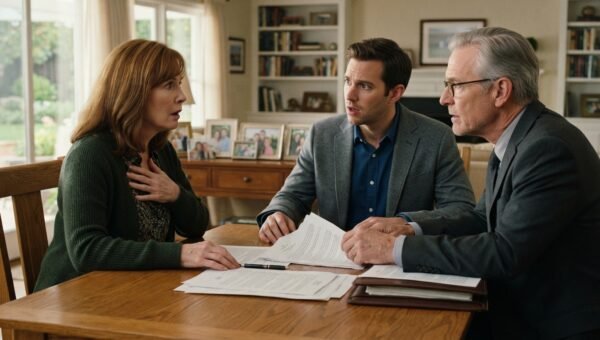
He untied the twine. Inside were bank ledgers from 2009, carbon copies of cashier’s checks, and a handwritten contract stamped with a county notary seal.
“Seventeen years ago, Greg didn’t buy that house from a developer,” Arthur said. “He bought it from me. That house belonged to my sister, Clara. When she passed away, she left the property to me. Greg came to my office three times a week for a month, begging me to sell it to him on an installment deed. He said he had a young wife and a baby on the way, and that the banks wouldn’t give him a conventional mortgage.”
I shook my head, trying to process the words. “Greg told me he built our mortgage through the credit union.”
“There was no credit union mortgage,” Arthur replied, pointing a weathered finger at the notarized contract. “I financed the purchase personally. The total price was two hundred and forty thousand dollars. Greg paid eighty thousand dollars down. But that eighty thousand didn’t come from an outside lender. It was your money.”
I caught my breath. “My money?”
“Look at the wire transfer receipt,” Arthur said, turning the third page toward me.
My eyes scanned the faded bank stamp. The funds had been transferred from an estate account in my late father’s name. In the spring of 2009, just after my father died, Greg had told me that my father’s small life insurance policy and the sale of his pickup truck had been swallowed up by medical debts. Greg had handled all the probate paperwork because I was bedridden with complications after having Chloe. I had signed whatever Greg put in front of me, trusting my husband to protect our newborn family.
Greg hadn’t settled any debts. He had redirected the eighty thousand dollars from my father’s estate into Arthur’s escrow account as the down payment on the house.
“He told me the eighty thousand was his personal savings,” Arthur said, his voice heavy with regret. “He said you had agreed to let him manage the title until the private note was paid in full. I didn’t question it. In those days, I took a man at his word if the cash cleared. But here is the part Greg forgot.”
Arthur turned to the final page of the contract. It was a formal deed of trust with a survivorship covenant.
“Under the terms of our contract,” Arthur explained, tapping the paper, “the property deed would only be transferred upon the final payment. Until that final payment was made, legal ownership remained with me. And paragraph twelve clearly states that if the buyer attempts to encumber, lease, or transfer residency without full payoff, or fails to maintain the household for the named family units, the installment contract defaults immediately.”
“Has he made the final payment?” I asked, my heart pounding against my ribs.
“He owes the final twenty-two thousand dollars,” Arthur said. “He was due to pay it off this December. For seventeen years, Greg has been writing me monthly checks. But he doesn’t own that house, Sharon. I do. And legally, you are the person whose inheritance funded the foundation of that deed.”
The room fell quiet. The ticking of a grandfather clock in the corner sounded loud in the cold air.
“Why didn’t you ever reach out to me?” I asked, looking up from the contract.
Arthur took off his glasses and rubbed his eyes. “Because Greg told me you were emotionally unstable after the baby. He told me you didn’t want anything to do with business matters. I was a foolish old man who didn’t want to get involved in someone else’s marriage as long as the checks arrived on the first of the month. I should have verified it with you back then. I didn’t, and that was my failing.”
He looked toward the study door, where Toby’s quiet breathing could be heard from the living room sofa.
“Tomorrow morning,” Arthur said firmly, “Greg is expecting to welcome someone else into that home. He thinks he holds all the cards because your name isn’t on a county recording. But I still hold the master title. And we are going to pay him a visit before eight o’clock.”
PART 3
At seven-thirty the next morning, my sedan followed Arthur’s dark blue pickup truck back into town. The streets were quiet. The autumn leaves were plastered against the wet asphalt from the night’s rain.
When we pulled onto Elm Street, Greg’s silver SUV was parked in the driveway. Parked right behind it was a compact red car with out-of-state plates. Two large matching suitcases sat near the front porch stairs, waiting to be carried inside.
I stepped out of my car. Chloe and Toby stayed inside with the doors locked, watching through the rolled-up window. Arthur stepped out of his truck, holding the manila folder under his left arm. He walked with a slight limp, leaning on a dark wooden cane, but his jaw was set like iron.
We walked up the front steps together. Arthur didn’t knock politely; he took the head of his cane and rapped hard against the front door three times.
The door swung open a moment later. Greg was wearing a clean polo shirt, holding a mug of coffee. When he saw me, his forehead creased with anger.
“Sharon, I told you last night what would happen if you came back here,” Greg began, stepping onto the threshold. “I will call the sheriff this second. You have no legal standing on this—”
He stopped mid-sentence when he saw Arthur standing beside me on the porch.
Greg’s hand jerked slightly, sloshing coffee over the rim of his mug. “Mr. Vance? What are you doing here?”
A woman with dyed blonde hair appeared behind Greg in the foyer, holding a cardboard moving box. She looked between Greg and Arthur, sensing the tension instantly. “Greg? Who is this?”
Arthur didn’t look at her. He kept his eyes locked on Greg.
“Put the coffee down, Gregory,” Arthur said in a level, commanding voice. “We have business to settle on this porch.”
“Look, Arthur, my monthly payment isn’t due until the fifteenth,” Greg stammered, his bravado crumbling. “The balloon payment of twenty-two thousand is coming in December, just like we agreed. I told you I’d wire it—”
“There will be no wire,” Arthur interrupted. “And you will not be completing the purchase.”
Arthur opened the manila folder and pulled out the county-certified contract, holding it right in front of Greg’s face.
“You signed this installment deed in June of 2009,” Arthur stated clearly. “Section twelve, clause B. Default triggers upon any unauthorized transfer of primary occupancy, or fraudulent representation of the source funds. You certified under penalty of perjury that the eighty-thousand-dollar down payment was your personal capital. It was not. It was Sharon’s inheritance from her father, which you unlawfully converted.”
The woman behind Greg set her moving box down on the hallway bench. “Greg, what is he talking about? You told me you owned this house outright.”
“Be quiet, Brenda!” Greg snapped, his face turning dark red. He turned back to Arthur, lowering his voice into a desperate hiss. “Arthur, be reasonable. I’ve paid you on time for seventeen years. You can’t just void an installment contract over a domestic issue. Any judge in the county will give me thirty days to cure!”
“No judge will cure a contract rooted in documented fraud,” Arthur replied calmly. “I had my attorney review the original paperwork at six o’clock this morning. Because the deed never transferred out of my name, this property remains under my sole legal authority until the final conveyance is executed. Furthermore, I have already signed an immediate Notice of Default and Revocation of Occupancy based on your breach.”
Arthur pulled a second paper from the folder and held it out. It was a formal legal notice stamped by a notary from the local bank branch that opened early on Main Street.
“You have until five o’clock this afternoon to remove your personal clothing, your vehicle, and your guest,” Arthur said. “If you are not off the premises by five, the sheriff will indeed be called, Gregory. But he will be here to enforce my property rights, not yours.”
Greg stared at the paper. His hands were shaking. He looked at me, his eyes wide with disbelief and panic.
“Sharon,” Greg muttered, his voice cracking. “Sharon, you can’t do this. I worked for this house for eighteen years. We can talk about this. We can work out an arrangement.”
“You threw your children onto the street in the freezing cold twelve hours ago,” I said, my voice steady and cold. “You didn’t care where we slept. You didn’t care that Toby was crying. You thought you could erase eighteen years of my life with a locked door.”
“I paid the monthly notes!” Greg yelled, losing his composure completely. “I paid every single month!”
“With money earned during our marriage,” I said. “While you hid the fact that my father bought the first third of this roof over our heads.”
Brenda grabbed her purse from the entryway table, looked at Greg with disgust, and walked past us down the steps toward her red car without saying another word.
Greg watched her go, completely paralyzed.
“Five o’clock, Gregory,” Arthur repeated quietly. “Not a minute later.”
ENDING
By four in the afternoon, a rented utility trailer was parked in the driveway. Greg worked alone, carrying out his clothes, his golf clubs, and his tools. He didn’t look at me once as he loaded the trailer. When he finally climbed into his SUV and pulled away from the curb, he didn’t look back through the rearview mirror.
Arthur arrived twenty minutes later with a locksmith.
We stood on the front porch as the locksmith replaced the deadbolts on the front and back doors, handing Arthur two shiny brass keys. Arthur didn’t put them in his pocket. He turned around and placed both keys into my palm.
“What is this?” I asked, looking at the metal resting against my skin.
“The installment contract is voided as to Greg,” Arthur said gently. “My attorney is drafting a revised conveyance this week. The eighty thousand dollars your father provided, plus the marital equity paid over seventeen years, credits more than eighty-five percent of this property to you. You will assume the remaining twenty-two thousand dollar balance under a simple five-year note with zero interest. The house belongs to you and your children, Sharon.”
Tears welled in my eyes, but for the first time in years, they weren’t tears of terror or exhaustion.
“I don’t know how to repay you for this, Arthur,” I said.
“You don’t need to repay me,” Arthur replied, buttoning his coat against the evening chill. “I should have asked the right questions seventeen years ago when that young man walked into my office with an inheritance check that didn’t have his name on it. Correcting an old mistake is just an old man’s duty.”
He tipped his hat, walked down the porch steps, and drove his truck back toward the reservoir.
Inside the house, Toby had already dumped his toy cars onto the living room rug, and Chloe was upstairs in her bedroom, putting her school books back onto her desk.
I walked into the kitchen and set the two new keys on the counter. The house was warm, the furnace was humming steadily in the basement, and the front door was locked from the inside.