PART 1
Nobody from my family showed up to my wedding. Not my mother, not my brother Kevin, and not my father. There was not a single phone call, not a card, not even a two-word text wishing us well.
Mark and I had kept the ceremony small in the backyard of the three-bedroom ranch house we bought together two years ago. We set out fifty folding chairs on the grass under the maple tree, but the front row stayed completely empty.
Every time a car slowed down on our road, I caught myself looking past the arbor, hoping my father had simply gotten lost or changed his mind. But by four o’clock, the pastor took his place, Mark squeezed my cold fingers, and we said our vows in front of thirty coworkers and neighbors who had stepped in to help.
My father had made his feelings clear three months earlier when Mark and I announced our engagement. He called Mark an outsider who did not fit our family, but the real issue was simple: Mark was an independent contractor who refused to do free renovations on my father’s rental properties. When I stood by Mark, my father told me I was turning my back on my own blood. Still, a daughter always holds out a stubborn, foolish hope that her parents will not throw away a milestone just to prove a point. They threw it away without blinking.
Three weeks passed in absolute silence. Mark and I went back to work, sent out thank-you notes, and began settling into married life. Then, on a Tuesday morning while I was standing at the kitchen counter packing my lunch, my phone buzzed with a message from my father.
There was no greeting. No apology. No mention of the wedding he had skipped. He texted as if we had spoken just yesterday: “We need $8,400 for your brother’s wedding venue deposit by Friday. Send it to my checking account.”
I stared at the screen for a long time. My thumb hovered over the keypad. For years, I had been the reliable child, the one who bailed Kevin out of missed car payments and covered the family insurance deductibles whenever my father pleaded hardship. But looking at that number, something clicked into place. Kevin was twenty-six, living rent-free in my father’s guest suite, and planning an elaborate banquet while I had served sheet cake in my backyard.
I opened my banking app, typed in my father’s account number, and entered the transfer amount: $1.00. In the memo line, I typed two words: “Best wishes.”
I hit send, set the phone face down on the counter, and turned to Mark, who was lacing his work boots by the back door.
“Mark,” I said, my voice steadier than I felt inside. “We need to call the locksmith right now. I want every single lock on this house changed before noon.”
Mark looked at me, saw my face, and did not ask a single question. He picked up his phone and made the call.
My father had possessed an emergency key to our house since the day we closed on it. He always insisted on having one for what he called family safety, though he mostly used it to drop off tools he wanted Mark to store or to inspect work we had done on the weekends.
By eleven that morning, the locksmith had replaced the deadbolts on the front door, the side garage entry, and the back slider.
The response from my father came much faster than I expected.
At two in the afternoon, a heavy fist pounded on our front door. The brass knocker rattled against the wood with enough force to vibrate the hallway floor.
I walked to the entryway, looked through the small glass pane, and saw my father standing on the porch. His jaw was set, and his face was red. But he was not alone.
Standing on the bottom step right behind him was a uniformed county sheriff’s deputy.
PART 2
I kept the deadbolt turned and opened the front door just four inches, leaving the security latch firmly engaged.
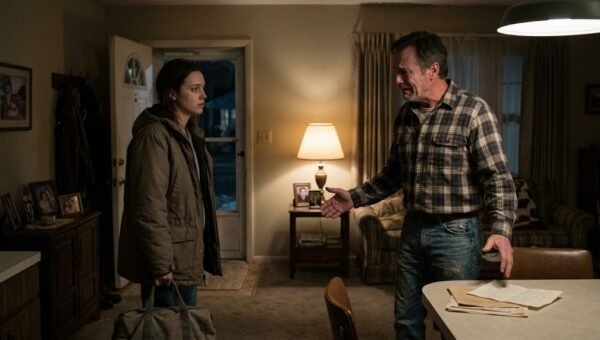
“You’ve got five seconds to take that chain off, Sarah,” my father barked. He held a brass key between his thumb and forefinger, shaking it at me. “I came by to collect what you owe this family, and my key doesn’t work. What kind of game are you playing?”
The deputy took a slow step up onto the porch. He was an older man with gray hair under his brimmed hat, holding a clipboard in one hand. “Ma’am,” the officer said in a calm, flat voice. “We received a call regarding an unlawful lock change and withheld family property at this residence.”
I looked past my father directly at the officer. “Deputy, this is my house. My husband and I are the only names on the deed. My father does not live here, he has never lived here, and he does not own anything inside.”
My father pushed his face closer to the opening. “You stole from Kevin! You sent me a one-dollar insult after promising to support your brother’s future! And you’re holding three thousand dollars’ worth of commercial equipment in your garage that belongs to my contracting company!”
Hearing that lie come out of his mouth made the air in the entryway feel thin. The equipment in our garage was Mark’s. Mark had bought every compressor, saw, and nail gun with his own business earnings over the last seven years. My father had tried to borrow them two months ago for Kevin to use on a side job, and Mark had politely refused because Kevin had previously ruined a five-hundred-dollar generator and never replaced it.
“Wait right here,” I told the deputy.
I closed the door, engaged the deadbolt, and walked into the home office. My hands were shaking, but my mind was completely clear. I pulled two blue folders from the file cabinet. In the first folder was our county property tax statement and the recorded warranty deed showing only my name and Mark’s name. In the second folder were the receipts, serial numbers, and equipment insurance policies registered under Mark’s commercial LLC.
I took my phone, unlocked it, and pulled up my banking app. I took a screenshot of the text message my father had sent at eight in the morning, along with my one-dollar transfer receipt.
When I went back to the front door, I disengaged the latch and stepped out onto the porch, closing the door behind me.
“Here is the deed to this property, Deputy,” I said, handing the paperwork to the officer. “And here are the purchase receipts and registered serial numbers for every single power tool stored in that garage. All of them belong to my husband’s business. My father has zero ownership.”
The deputy took the papers, adjusting his glasses. He spent two full minutes reading through the county seal and the serial numbers. Then he looked up at my father.
“Mr. Miller,” the deputy said, his tone shifting from neutral to stern. “You told dispatch you co-owned this property and were being illegally locked out of your primary storage facility. This deed says otherwise.”
“She’s my daughter!” my father said, his voice cracking with indignation. “Everything in this family is shared! She agreed to help her brother, and now she’s hiding behind pieces of paper because she married a man who doesn’t respect us!”
“Did she sign a contract to give you money?” the deputy asked.
“She’s his sister! She owes him!” my father shouted.
“No, sir,” the officer replied, handing the documents back to me. “Family expectations are not legal obligations. You filed a false report about property access. If you do not step off this porch right now, I will cite you for criminal trespass.”
My father stood frozen for a second, his mouth open. He looked at the deputy, then glared at me with an intensity that told me everything I needed to know about where I had stood in his life for thirty years.
“You think you’re clever,” he whispered, pointing a thick finger at my face. “You just cut yourself off from your mother and your brother forever. Don’t you ever come crying to us when your little marriage falls apart.”
He turned on his heel and stomped down the driveway toward his truck. The deputy stayed on the porch, waiting until my father pulled away from the curb before he turned to me.
“Keep those doors locked, ma’am,” the officer said quietly. “If he comes back, call dispatch immediately. We will take him in.”
I thanked him and walked back inside. The house was quiet. The new brass deadbolts caught the afternoon sun coming through the sidelights. I sat down at the kitchen table, waiting for the relief to hit, but all I felt was an ache in my chest that had nothing to do with fear and everything to do with grief.
Two hours later, my phone rang. It was not my father.
The caller ID showed Kevin’s name.
PART 3
I picked up the call on the third ring. I did not say hello. I just pressed the phone against my ear and waited.
“Sarah?” Kevin’s voice was uneven, higher than usual. “Dad just got home. He was screaming so loud the neighbors came out. What did you do?”
“I changed the locks on my house, Kevin,” I said. “And I gave the deputy proof that Mark owns his own tools. That is what I did.”
There was a long silence on the line. I could hear Kevin breathing, followed by the faint sound of a television in the background.
“Did Dad really call the cops on you?” Kevin asked softly.
“He brought an officer to my front porch to intimidate me into giving him $8,400,” I said. “For your wedding venue deposit. That is what he told the deputy, and that is what he texted me this morning.”
Kevin let out a ragged breath that sounded like a choke. “Sarah… what are you talking about? What wedding venue?”
A cold stillness settled over the kitchen. “The deposit he said was due by Friday. For your wedding.”
“Sarah, Amber and I broke up three weeks ago,” Kevin said, his voice dropping to a whisper. “We canceled everything. There is no wedding.”
I sat up straight in my chair. “What did you say?”
“Amber called it off the week before your wedding,” Kevin confessed, the shame heavy in his words. “She said she couldn’t marry into this family with how Dad controls every single dollar and every single decision. That’s why none of us came to your wedding, Sarah. Dad told us that if we went to your house and celebrated while my life was falling apart, we were traitors. He took my car keys and swore he’d kick me out on the street if I went to your backyard.”
The truth did not crash down with a sudden noise; it settled in like lead. My father had not boycotted my wedding out of simple disapproval for Mark. He had used Kevin’s heartbreak as a weapon to punish me for being happy, and then he had invented an $8,400 emergency to extract cash from me under the guise of family loyalty.
“If there’s no venue deposit,” I asked, keeping my voice very quiet, “why did Dad demand $8,400 by Friday?”
Kevin hesitated. “Last month, Dad took out a short-term commercial loan against his rental duplex to cover some back taxes. The payment was due on the first, and he told me two days ago that the bank was getting ready to initiate foreclosure proceedings if he didn’t wire the exact balance by the end of this week. It was $8,400, Sarah. He was using my canceled wedding as a cover story so he wouldn’t have to admit he was going under.”
I closed my eyes. For ten years, my father had played the patriarch, the self-made provider who demanded absolute obedience from his children while quietly leaning on my savings account whenever his poor business choices caught up with him. He had convinced Kevin that family meant blind compliance, and he had tried to convince me that my boundaries made me a bad daughter.
“Kevin,” I said gently. “Did you know he sent that text to me today?”
“No,” Kevin said, his voice cracking. “I swear on Mom’s life, Sarah, I didn’t know. He just told me this morning that he was going to handle the finances and that I needed to stay out of it. When he came home raving about the police, I had to call you.”
“Listen to me carefully,” I said. “I love you. You are my brother. But Dad brought law enforcement to my front door to extort money from me using your name. I will never speak to him again. And if you stay in that house letting him run your life, he will pull you down with him.”
“I don’t know where else to go,” Kevin whispered.
“You’re twenty-six years old,” I told him. “You find an apartment, you get a second job, and you learn how to stand on your own two feet. Just like Mark and I did.”
I did not wait for him to argue. I ended the call.
Ten minutes later, I opened my phone settings. I selected my father’s number and pressed block. Then I selected my mother’s number and blocked it as well. She had sat in that house for thirty years, watching him manipulate their children, nodding along with every lie to keep her own comfort secure.
When Mark walked through the back door an hour later, carrying a bag of groceries, he looked at me across the kitchen island. He saw the folders on the counter and the quiet in my eyes.
“Everything okay?” he asked softly, setting the bags down.
“Everything is settled,” I said.
I told him the entire conversation with Kevin. I told him about the foreclosure, the fake venue deposit, and the canceled wedding. Mark listened without interrupting once. When I finished, he did not offer anger or hollow platitudes. He simply walked around the island, pulled me close, and kissed the top of my head.
“We are going to be just fine,” he said against my hair.
And for the first time in weeks, I knew that was the absolute truth.
ENDING
Six months have passed since the day the locks were changed.
The bank eventually foreclosed on my father’s rental duplex after he failed to come up with the funds. Without the rental income to prop up his personal accounts, he had to downsize, selling off his older work truck and cutting his expenses to the bone. He tried reaching out once through a mutual cousin, asking if I would be willing to sit down for family mediation, but I sent back a short message through that same cousin: there is nothing left to mediate.
Kevin did not stay with him. Two weeks after our phone call, Kevin packed his clothes into his car and moved two towns over to share a modest two-bedroom apartment with an old high school friend. He works long hours at an auto parts warehouse now, and he pays his own rent every single month. We talk once every couple of weeks on Sunday afternoons. Our conversations are still careful, but they are honest. He has never asked me for a single dollar, and I have never offered one. We are learning how to be brother and sister without my father standing between us directing the script.
Mark and I spent this past weekend staining the back deck. On Saturday afternoon, while the cedar was drying in the warm breeze, we sat on the porch steps drinking iced tea. The maple tree in the yard was full of green leaves, shading the exact spot where our wedding chairs had stood six months ago.
I looked down at my keychain resting on the wooden step beside my knee. The old, worn brass house key my father had given me when I first moved out was long gone, tossed into a trash can at the hardware store. On the ring now was a single silver key that turns smoothly in our new deadbolts, opening only the home that Mark and I built with our own hands, protected by boundaries that will never be unlocked again.