PART 1
My son called three days before Christmas, and his voice had that smooth, practiced tone he used when firing people.
“Mom, about Christmas this year,” Thomas said. “It’s really more of a professional networking event. High-stakes clients. You’d probably be more comfortable at home.”
I stood in my Minnesota kitchen, phone pressed to my ear, staring at twenty-three crayon drawings on my refrigerator, secret gifts from my granddaughter Abigail, who already knew her parents wouldn’t approve of her loving me.
“I see,” I whispered. That’s all I said.
Because at fifty-nine, I’d learned arguing only made it worse.
“I knew you’d understand,” relief smoothing out the edges of his voice. “Claire agreed it would be less stress on you with the winter roads. We’ll drop off your present sometime in January.”
The line went dead before I could answer.
I didn’t cry. When your only child treats you like an embarrassing piece of old furniture, crying stops helping around the third or fourth year. Thomas was thirty-four, a junior partner at a private wealth management firm in Wayzata, married to Claire, whose family owned three different auto dealerships in the Twin Cities. For four years, ever since my husband Robert died and Thomas took over managing family accounts, Claire had slowly nudged me out of their picture. I dressed too plain. I drove a ten-year-old Buick. I had spent thirty-one years working customer service at the local water department, which did not fit into their Saturday night dinner parties.
The worst part was eight-year-old Abigail. Whenever Claire dropped her off here for emergency babysitting, Abigail would slip a drawing under my flour canister or behind the cookie jar. “Don’t tell Mom,” she had whispered last month. “Mom says Grandma’s house isn’t on our level.”
I looked at the counter. I had already baked three tins of Norwegian butter cookies, packed Abigail’s knitted sweater into a gift box with red ribbon, and set aside the honey-baked ham I had ordered from the butcher in St. Cloud.
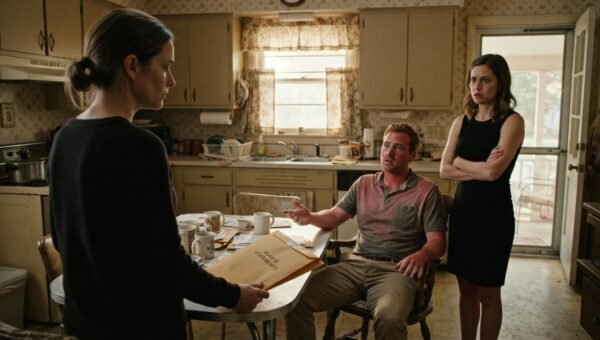
I sat down at the kitchen table and pulled out the manila envelope I had brought home from the county records office two weeks ago.
I hadn’t planned on using it. I had pulled the file simply because my property tax assessment notice hadn’t arrived in November, and the clerk at the Hennepin County office had printed out the full registry packet for me. I had tucked it under my coupon binder and left it there, hoping I was just being a suspicious old woman who couldn’t accept that her boy had outgrown her.
The deed on my table wasn’t for my little house in St. Cloud. It was for the four-bedroom colonial on Lake Minnetonka, the house Thomas and Claire lived in, the house where their high-stakes Christmas party was happening in seventy-two hours.
On page four, stamped in blue ink from seven years ago, was Robert’s signature, my signature, and a specific life-estate trust clause Thomas had begged his father to set up before Robert passed.
Thomas had told me last spring that the final refinance had transferred the title entirely into his LLC.
He had lied.
PART 2
The document in my hands showed the trust had never been dissolved.
Back in 2019, when Robert was sick, Thomas told us he needed our credit and Robert’s equity to secure the purchase of that colonial. We put down $140,000 from Robert’s life savings. To protect us, Robert insisted that forty percent of the property remain tied directly to my personal trust, with a strict occupancy stipulation: the property could not be refinanced, leased, or transferred without my written, notarized signature in front of the trustee bank in Minneapolis.
Last April, Thomas brought me three pages to sign while I was recovering from pneumonia.
He told me it was an escrow release to lower their insurance premium. I signed it because he was my son, and mothers want to believe their children are decent.
I took the papers to my kitchen counter, put on my reading glasses, and called Arthur Vance. Arthur had been Robert’s attorney for thirty years before retiring to write mystery novels, but his nephew David had taken over the firm in Edina.
“Ruth,” David said after I faxed the county documents to his secure portal. “Where did you get these?”
“The county clerk gave them to me when I went to ask about my homestead papers,” I said. “Thomas told me in April that my name was off their deed.”
David was quiet for nearly twenty seconds. “Your name isn’t off the deed. Thomas filed an amended agreement with a signature page, but the county recorder flagged it as non-conforming because there was no trustee seal. The title is clouded. Legally, you still hold a forty percent life-estate claim on that house, and according to paragraph eight, you retain full rights of primary entry.”
“What does that mean?”
“It means,” David said, his voice dropping, “Thomas couldn’t legally hold an event, secure a commercial business loan against the house, or list it as corporate collateral without your formal sign-off. And according to this registry update from last Friday, he just listed the Lake Minnetonka house as the primary holding for his new independent firm, Vance Capital.”
“He used my equity to start his own company,” I said.
“He used your forty percent share as the physical asset base to convince his seed investors he had two million dollars in unencumbered residential collateral,” David replied. “Ruth, the investors he’s hosting on Christmas Eve? They aren’t just firm clients. They’re the board members who are funding his buyout. If they find out the asset is clouded, the whole partnership agreement fails.”
I held the phone against my chest. All those years of Thomas telling me I was unsophisticated, all those holidays spent sitting in the corner while Claire introduced me as “Thomas’s mother from up north,” and all the while, their four-car garage and stone patio rested on Robert’s union pension and my water department wages.
“David,” I said. “Send me the certified title abstract. Right to my email.”
On Christmas Eve, the temperature in Minnetonka fell to twelve degrees. Snow fell in thin, dry sheets across the lake. At six o’clock, black sedans and luxury SUVs began lining the circular driveway of the stone house I had paid for.
I drove my Buick right past the gate, parked behind a black Mercedes, and carried Abigail’s present and the manila folder up the heated front steps.
PART 3
A young woman in a black caterer’s apron opened the heavy oak door. Inside, warm air smelled of pine garland, prime rib, and expensive cologne. A string quartet was playing near the grand staircase.
Claire spotted me first from across the foyer. She was wearing an emerald green silk dress, holding a glass of champagne, talking to an older couple in tailored wool. Her smile vanished like water down a drain.
She excused herself and crossed the marble floor, her heels clicking sharply.
“Ruth,” she hissed under her breath, grabbing my elbow and pulling me toward the side coat closet. “What are you doing here? Thomas specifically told you we had private clients tonight. You’re tracking salt onto the rugs.”
“I came to bring Abigail her sweater,” I said, keeping my voice level.
“We told you January,” Claire snapped, her cheeks flushing red under her foundation. “You cannot be here. We have the managing directors from the Chicago office in the library right now. Go back to your car, Ruth. Thomas will call you tomorrow.”
“Thomas can talk to me now,” I said.
Thomas came out of the dining room carrying two glasses. When he saw me standing there in my winter coat, holding a wrapped box and a yellow folder, his mouth tightened into that cold, defensive line he used whenever he was caught in a mistake.
“Mom,” he said, stepping between Claire and me. “I thought we had an understanding.”
“We didn’t have an understanding, Thomas. You gave me an instruction,” I said clearly. Two men near the bar turned their heads. One of them was Richard Vance, David’s second cousin and one of the primary angel investors in the Twin Cities financial district.
“Let’s go into the study,” Thomas whispered, panic flickering in his eyes as Richard Vance looked our way.
“No,” I said. “The living room has better light.”
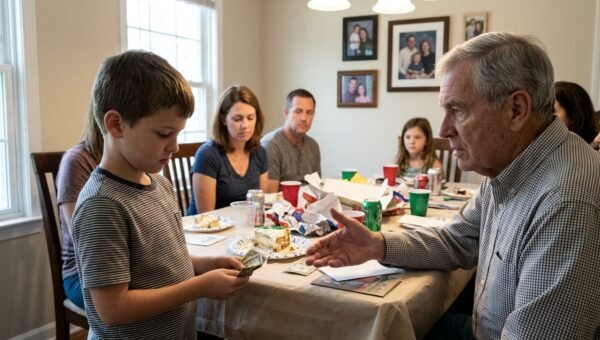
I walked right past him into the formal living room. Abigail was sitting on the bottom step of the staircase in a red velvet dress, looking bored and miserable among fifty adults who weren’t paying her any attention. When she saw me, her face lit up.
“Grandma!” she yelled, running toward me.
Claire tried to intercept her, but Abigail slipped past and wrapped her arms around my coat. I handed her the box.
“Go take that up to your room, sweetheart,” I told her softly. “I need to talk to your father about business.”
The room had gone quiet. People with that much money are polite, but they love a train wreck.
Thomas stepped up to me, his voice shaking with anger. “You are embarrassing me in front of the people who make or break my future. Leave right now, or I’m calling security.”
“You can’t call security on the owner of the house, Thomas,” I said.
I pulled the certified abstract from the envelope and set it on the polished mahogany buffet table right next to the shrimp cocktail.
“Page four,” I said, loud enough for Richard Vance and his associates to hear. “Your father’s trust retains forty percent undivided ownership. You filed an amended deed in April without the trustee’s seal. Hennepin County rejected the recording. That means the $1.2 million equity you pledged as your commercial reserve for the buyout doesn’t belong to your LLC. It belongs to me.”
Thomas stared at the county stamp. The color drained from his face until he looked like the scared twenty-two-year-old who used to call me when his car broke down on Interstate 94.
“Mom,” he stammered, dropping the professional tone completely. “We were going to fix the paperwork after the holiday closing. It was just a placeholder.”
“It wasn’t a placeholder,” I said. “It was theft. You told me I wasn’t good enough to sit in this room, while you were standing on my floor to ask these men for money.”
Richard Vance stepped forward, put on his reading glasses, and glanced down at the certified sheet. He didn’t say a word. He just looked at Thomas, set his champagne flute down on the table, and said, “We need to talk about our term sheet on Monday morning, Thomas.”
ENDING
I didn’t stay for the party.
I walked back down the front steps into the cold Minnesota air, got into my Buick, and drove home to St. Cloud. The house was quiet when I got there, smelling faintly of the butter cookies I had baked two days earlier.
On the day after Christmas, Thomas showed up at my front door alone. He looked like he hadn’t slept in forty-eight hours. His firm’s buyout deal was renegotiated under far harsher terms because the board required a verified cash guarantee, but he didn’t lose his license. I didn’t want him ruined; I just wanted him honest.
He sat at my kitchen table, the same table where his father used to help him with long division, and he signed the legal separation of the trust. David handled the restructuring: Thomas had to buy out my forty percent share in certified funds over thirty-six months at the fair market valuation of $480,000, deposited directly into an independent annuity that he had no authority to touch.
“Claire is furious with me,” Thomas said quietly, staring into a mug of black coffee.
“Claire married the man you pretended to be,” I told him. “That’s between the two of you.”
“Are you going to forgive me?” he asked.
“Someday, maybe,” I said. “When you figure out who paid for your life.”
He left an hour later.
Three weeks into January, a small white envelope arrived in my mailbox with no return address. Inside was a piece of construction paper folded into fourths. Abigail had drawn my kitchen table with two coffee mugs on it, and underneath, in crooked purple letters, she had written: *I’m wearing the sweater every day.*
I took down an old coupon from the refrigerator door, smoothed the paper flat, and used a yellow magnet to stick drawing number twenty-four right in the center.