PART 1
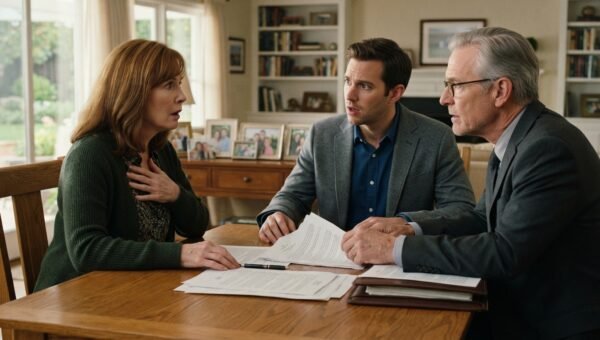
The loan officer slid the printout across the desk and tapped the bottom line with the tip of his pen. I had come into First Community Bank on a rainy Tuesday morning just hoping to get pre-approved for an eleven-thousand-dollar loan on a used Subaru. I was twenty-nine, working thirty-five hours a week at a regional dental supply office, and driving a sedan whose alternator whined whenever the headlights were on.
“Miss Miller,” he said, adjusting his glasses. “Before we run the financing for the vehicle, I need to verify your prior accounts with us. There is an inactive file attached to your Social Security number that has a flag on it.”
“I only have my checking account here,” I told him. “I opened that four years ago.”
“This is older,” he said. He turned the screen toward me. “A custodial savings account opened in November 1998 by Evelyn Miller. Does that name ring a bell?”
“That was my grandmother,” I said. My voice went thin. “She died when I was twelve. But she didn’t have money. My brother told me she put fifty or a hundred dollars in a book for each of us when we were babies, and by the time she passed, the maintenance fees ate it up.”
The loan officer shook his head slowly. “There were no maintenance fees. In October 2015, the balance on this account was $47,000.”
I sat back against the vinyl chair. The furnace in the bank lobby kicked on, sending a draft of dry heat across my ankles. Forty-seven thousand dollars. When I turned eighteen, my brother Kevin helped me move into a shared apartment near the community college. I slept on an air mattress that leaked by three in the morning, and I ate eggs for dinner five nights a week because my tuition bill was four hundred dollars past due. Kevin had told me back then that our family was built on bad luck and empty pockets, and that I had to learn to work double shifts like he did.
“That can’t be right,” I said. “Where did forty-seven thousand dollars come from?”
“Your grandmother set up a certificates-of-deposit rollover tied to a small farm parcel she sold in Mercer County,” he explained, reading the ledger. “It grew quietly for fifteen years. But the account was closed out.”
“When?”
“October 11, 2015,” he said.
I felt a sudden knot tighten in my stomach. October 12, 2015 was my eighteenth birthday.
“Someone took it the day before I became an adult,” I said.
The loan officer looked down at the file, his expression changing from routine professional patience to something more uncomfortable. “A custodial account under that specific old trust charter allowed early liquidation before the beneficiary’s eighteenth birthday only under narrow conditions. It required the signature of an authorized adult custodian, plus a certified family witness registered at the time of opening. If you had reached eighteen, the custodian would have lost unilateral control, and the funds would have rolled directly into your sole name.”
“Who was the custodian?” I asked.
“Your father was listed as primary custodian on the signature card,” he said. “And the designated family witness was your great-uncle, Harlan Miller.”
“My father died when I was sixteen,” I whispered. “Two years before that withdrawal.”
The loan officer stopped. He took his glasses off and set them quietly on the blotter. “If the primary custodian was deceased, a legal guardian or representative would have had to present documentation alongside the designated witness.
Let me call branch operations. This was handled at our downtown location on 4th Street.”
He left his office for twenty minutes. I sat alone listening to the muted clicking of keyboards from the teller line. In 2015, Kevin had suddenly put a down payment on a two-bay auto repair garage on the south side of town. He had told our mother and me that he took out a high-interest private loan from an older mechanic he used to work for. He spent years telling everyone at Thanksgiving how hard he had scrambled to build his business from zero while I dragged my feet finishing an associate degree.
When the manager came back into the room, an older woman with silver hair followed him. Her badge read Helen Vance, Senior Risk Manager. She closed the door firmly behind her.
“Miss Miller, I pulled the archived vault records from 2015 for that branch,” she said. “The transaction slip shows a cashier’s check made payable to cash for the full balance of $47,000. Harlan Miller’s signature is on the witness line.”
“Uncle Harlan died three weeks ago,” I said. “He had severe dementia for the last five years of his life. Did he come in alone?”
“No,” Mrs. Vance said. “Harlan was eighty-one at the time. The teller notes indicate he had someone with him. Our downtown branch had lobby security cameras covering both the teller line and the vestibule. Because an account closure over ten thousand dollars requires an audit retention hold, the digital archive was preserved on our secondary server.”
She turned a small monitor toward me and typed a password.
A grainy black-and-white video began to play. The timestamp in the corner read October 11, 2015, 2:14 PM.
The screen showed Uncle Harlan sitting in a low armchair near the customer counter. He looked frail, his hands resting on the handle of his wooden cane, staring blankly at the floor. But by the inner glass vestibule door, another figure stood waiting.
The camera angle was high, looking down across the marble floor. The person by the door was tall, with broad shoulders, leaning against the glass with his face turned completely away from the lens, looking out toward the street as if watching for traffic.
“Can you zoom in on him?” I asked.
Mrs. Vance touched the mouse, cropping the frame tightly around the figure.
His face was hidden by the collar and the angle of the glass. But the coat was unmistakable. It was a heavy brown wool car coat with wide notched lapels, dark horn buttons, and a frayed leather patch on the right elbow where the seam had split twenty years ago.
It was my father’s coat.
My father had worn that coat every winter of my childhood until the day he had his fatal stroke on the back porch. After the funeral, my mother had packed all his clothes into cardboard boxes in the attic, except for that coat. Kevin had taken it down from the hall closet that very afternoon, put it on, and said it was his now because he was the man of the house.
PART 2
I stared at the screen until my eyes burned. The man by the vestibule shifted his weight from one boot to the other. It was Kevin’s habit, dropping his heel first whenever he grew impatient.
“Did this man come up to the counter?” I asked.
Mrs. Vance forwarded the footage. The teller called Uncle Harlan over. Uncle Harlan struggled to stand, wobbling on his cane. The man by the door did not walk over to help the old man. Instead, he stepped into the vestibule, took something out of his pocket, and handed a manila envelope through the glass door to Harlan before stepping back outside onto the sidewalk. Harlan carried the envelope to the counter, signed the slip with a trembling hand, and pushed the envelope forward. Inside was my father’s death certificate, an outdated power of attorney form that had never been revoked, and an authorization letter.
The teller counted out nothing in bills. She printed a cashier’s check, slipped it into an envelope, and handed it to Harlan. Harlan walked out through the heavy doors. On the exterior street camera, the man in my father’s coat met him at the curb, took the envelope directly out of Harlan’s coat pocket, guided the old man into the passenger side of an older blue pickup truck, and drove away.
Kevin drove a blue 1997 Ford Ranger back then. He kept it until 2018.
“Miss Miller,” Mrs. Vance said gently. “Harlan Miller signed the document as the certified family witness. The authorization letter purported to bear your father’s signature, dated prior to his death, requesting liquidation of the funds into a family trust upon Harlan’s direction. Given that your father had been deceased for two years, that letter was fraudulent. Because Harlan Miller is deceased, pursuing criminal fraud against him is impossible. But the person who received those funds or uttered the forged document is another matter.”
“How long do I have to decide what to do?” I asked.
“We have to log this internally now that the archive has been opened,” she said. “If you wish to file a formal fraud affidavit with local law enforcement, we will supply the footage, the transaction records, and the signature cards to the detectives. But once the bank’s legal department takes custody of the file, it cannot be withdrawn.”
I left the bank without the car loan. I walked out into the cold drizzle and sat in my car in the parking lot. The dashboard clock read eleven forty.
My mind went back to October 2015. On my eighteenth birthday, Kevin had brought an ordinary sheet cake from the grocery store to our mother’s house. The icing had blue roses on it. When I blew out the candles, Kevin gave me an old set of jumper cables and an envelope containing forty dollars. He told me, “You have to be smart with every dollar, Sarah. Nobody is ever going to hand you anything in this life.”
Two months later, Kevin signed the lease on his auto repair shop. Whenever I stopped by to ask if he could check my brakes or look at a leak, he always charged me for parts at cost and made a point of reminding me that rent on a commercial building was sixteen hundred dollars a month.
I started the engine, put the car in gear, and drove across town to the industrial park on 14th Street.
Kevin’s shop was called Miller Automotive. The sign over the gravel lot was faded, but the bays were full. Through the open bay door, I saw two trucks on the hydraulic lifts and heard the loud ratcheting whine of an air wrench.
I parked near the office door and walked in. The small waiting room smelled of grease, cold coffee, and stale rubber tires. Kevin was behind the counter, leaning over an open parts ledger with a pencil behind his ear. At thirty-four, his hair was thinning at the temples, but he still had our father’s broad jaw and heavy shoulders.
He looked up, surprised to see me on a weekday. “Sarah? What’s going on? Car making that noise again?”
“No,” I said. “The car is fine.”
He looked at my face, sensed something, and set his pencil down on the counter. “You look pale. Did something happen with Mom?”
“Mom is fine,” I said. I laid my purse on the vinyl counter between us. “I was at First Community Bank this morning. I applied for a car loan.”
Kevin did not flinch, but his eyes narrowed slightly. “Did they turn you down? I told you your credit was too thin. You should have let me co-sign for you like I offered last year.”
“They didn’t turn me down because of my credit, Kevin. They found an old savings account.”
The shop outside suddenly went quiet as one of his mechanics shut off a compressor. In the silence, the small refrigerator in the corner hummed.
“What savings account?” he asked. His voice remained flat, careful.
“The one Grandma Evelyn opened for me when I was a baby,” I said. “The one you told me had fifty dollars in it that got eaten up by fees.”
Kevin looked at me for three full seconds without blinking. “Sarah, Grandma didn’t leave money. You know how she lived. She gave away whatever she had to the church.”
“It had $47,000 in it,” I said. “And it was closed on October 11, 2015. The afternoon before my eighteenth birthday.”
PART 3
Kevin did not ask who closed it. He did not say the bank must have made an error. He simply put both hands flat on the wooden counter, his knuckles turning white against the scarred surface.
“Who told you that number?” he asked.
“The branch risk manager,” I said. “She pulled the video from the lobby camera. They keep audit footage for large cash disbursements.”
A faint flush of red crept up the side of Kevin’s neck, spreading under his collar. “That was eleven years ago.”
“I saw Uncle Harlan sitting in the chair,” I said. “And I saw you standing by the glass doors wearing Dad’s coat.”
Kevin let out a short, rough breath. He didn’t deny it. He didn’t even look toward the window. He walked over to the office door that led into the garage, pulled it shut, and clicked the lock so the mechanics couldn’t hear us.
“You don’t understand how things were back then,” he said, turning around. His tone wasn’t angry; it was defensive, loaded with the old authority he always used whenever he wanted me to back down. “Dad died leaving twenty-two thousand dollars in unpaid medical debt from the county hospital. Mom was three months behind on the mortgage. The sheriff’s office came to the house twice while you were at high school track practice.”
“Dad’s debt was not attached to my savings account,” I said.
“That money was from Grandma’s land sale,” he said, taking a step toward the counter. “Grandma thought she was setting up a college fund for her favorite granddaughter, but the rest of the family was sinking. When Dad got sick, he couldn’t work for fourteen months. Who do you think bought groceries? Who do you think paid the heating oil bill that whole winter?”
“You didn’t use that forty-seven thousand dollars for heating oil, Kevin,” I said. “I lived in that house. Mom’s mortgage was modified through the county housing program. I remember the paperwork she signed at the kitchen table. And you opened this shop in December 2015.”
He stopped. The excuse collapsed right there on the counter between us.
“I needed six months of operating capital and a security deposit for the lift equipment,” he muttered, looking down at his boots. “The bank wouldn’t lend to a twenty-three-year-old kid with no collateral. I was trying to build something that would support all of us. If I didn’t open this place, Mom would have lost the house anyway two years later when her pension got cut.”
“You used Uncle Harlan,” I said. “He had memory problems even then. You took him down there, had him hand over a fake letter with Dad’s name on it, and you waited by the door so the teller wouldn’t ask you for ID.”
“Harlan knew what we were doing,” Kevin said quickly, but his voice cracked on the name. “I gave Harlan three thousand dollars in cash for his roof repairs. He agreed to it.”
“Uncle Harlan was eighty-one years old and couldn’t remember what day of the week it was,” I said. “And you drained every cent I had twenty-four hours before I would have gained control of it. You knew if I turned eighteen, the money was mine legally and you couldn’t touch it without my signature.”
Kevin grabbed the edge of the counter. “And what would you have done with forty-seven thousand dollars at eighteen, Sarah? You would have blown it! You were an eighteen-year-old kid living with two roommates who couldn’t even keep a part-time job at the mall!”
“I worked thirty hours a week while taking eighteen credits,” I said, my voice shaking now. “I walked two miles in the snow because I couldn’t afford bus fare and a sandwich on the same day. I sat in that freezing apartment wrapped in two blankets while you drove by in your new truck to check on your business. You let me believe I was poor because our family had nothing. You let me feel ashamed every time I had to ask for an extension on my tuition.”
“I was going to pay you back,” he said.
“It has been eleven years, Kevin.”
“I was waiting until the shop was clear,” he said. He reached out to touch my arm, but I stepped back toward the exit. “Sarah, listen to me. If you go to the police, they will shut this place down. I have three guys working out there with families. Mom will find out. It will destroy her to know what happened with Dad’s coat and Harlan. You want to drag our whole family through the courthouse over something that happened in 2015?”
“The bank already has the file,” I told him. “The risk manager asked me if I wanted to sign the fraud affidavit.”
The color drained from his face completely. For the first time in my life, Kevin looked small to me. He wasn’t the older brother who knew how the world worked. He wasn’t the man of the house. He was just a thief who had used an old man and a dead father’s jacket to rob his little sister.
“What do you want?” he asked in a low whisper. “Tell me what you want.”
ENDING
I stood by the door of the office for a long time. Outside, rain tapped against the corrugated metal siding of the garage.
If I signed the affidavit, Kevin would likely face felony charges for forgery and grand larceny. The shop would close. My mother, who was seventy-one now and had a weak heart, would spend her remaining years listening to relatives whisper about her sons and daughters in the church pews. The shame would poison whatever peace she had left.
But I was done being the family member who swallowed the loss so everyone else could pretend we were decent people.
“Forty-seven thousand dollars,” I said. “Plus interest at three percent across eleven years. That comes out to sixty-two thousand five hundred dollars.”
Kevin opened his mouth to object, but I cut him off.
“You will go to your attorney tomorrow morning,” I said. “You will draw up a legally binding promissory note secured by the title to your equipment in this garage. You will pay me eight hundred dollars on the first of every month, direct deposit, until the balance is zero. If you miss one payment by more than five days, I will walk into the county prosecutor’s office with the bank’s file.”
Kevin swallowed hard. “Eight hundred a month will make payroll tight.”
“Then you can work the weekend shifts yourself,” I said. “Like you always told me to do.”
He looked at me, realizing there was no room left to negotiate. He nodded once, slowly. “All right. I’ll call the lawyer tomorrow.”
“And one more thing,” I said.
He looked up.
“Give me Dad’s coat.”
Kevin blinked, confused for a second. Then he walked to the pegboard behind his desk where a metal hook held a dark bundle. He pulled my father’s brown wool coat off the hook and brought it to the counter. The cloth smelled of motor oil and sawdust, but the heavy horn buttons were still there, and the worn leather patch remained on the right elbow.
I took the coat over my arm. I didn’t say goodbye, and I didn’t look back at the service bays as I walked out to my car.
Two days later, the documents from Kevin’s lawyer arrived by certified courier. I signed them at my dining room table and mailed a copy back along with a letter to the bank’s risk department stating that the matter was being resolved privately through civil restitution, asking them to keep the file archived.
On the first of the next month, eight hundred dollars appeared in my checking account.
I took my father’s coat to an old dry cleaner on Oak Street. The woman behind the counter spent three days steaming out the grease and brushing the wool until the dark brown fibers looked rich and clean again. I brought it home and hung it in the front closet of my apartment.
I bought the used Subaru two weeks later, using my own savings for the down payment and handling the small monthly note myself. Whenever I open my closet door in the morning to leave for work, the first thing I see is that heavy wool coat. It reminds me that family cannot be bought with silence, and that I finally know the exact price of the truth.