PART 1
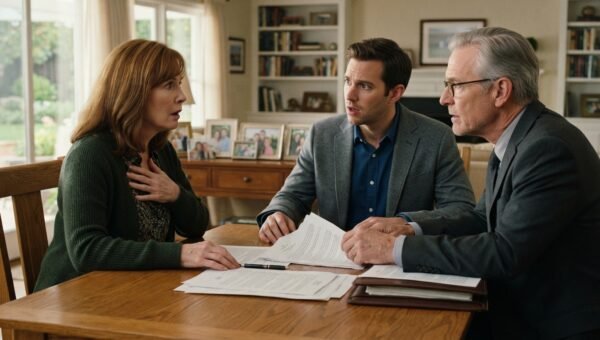
When Daddy’s will was read in Mr. Miller’s back office, my brothers split the two hundred acres of bottomland and the $90,000 in CDs. The lawyer folded his glasses, looked over the desk at me, and read the single sentence Daddy had added at the bottom.
“To my daughter, Evelyn, I leave my maple fiddle and its case.”
My older brother, Wayne, let out a short snort from the row of chairs behind me. “Always were the sentimental one, Evie. Daddy knew you’d rather have keepsakes than tractor payments.”
Dennis, my younger brother, didn’t say a word. He just tapped his manicured fingers on his knee, waiting for the paperwork to sign over his half of the certificates.
I sat there in the Sunday dress I had ironed that morning. I did not yell. I did not cry in front of them. The truth was, I felt too tired to argue. For four years, I had lived in Daddy’s back bedroom after his first stroke took the strength from his right side. I had cooked his soft oats every morning, emptied his bedpan, changed the bandages on his swollen legs, and tracked every dose of heart medicine in a five-cent spiral notebook. Wayne and Dennis showed up twice a year. They came on Thanksgiving for forty-five minutes to eat my pie, and they came on Christmas Eve with store-bought fruitcakes they left on the counter.
The day Daddy died, Dennis took the truck keys off the hook before the county coroner even backed out of the gravel driveway.
I carried the fiddle out of Daddy’s house two days after the funeral. The black leatherette case was split along the bottom seam, showing the gray cardboard underneath. The brass latch on the right side was missing its spring, so I had to hold the whole thing against my ribs like a sack of groceries to keep the lid shut.
When I brought it home to my little rental on Elm Street, I put it on the top shelf of my bedroom closet behind two shoeboxes of winter scarves. I didn’t open it. Looking at it just brought back the smell of menthol rub and the sound of Wayne laughing in that lawyer’s office while Dennis counted up his share of the $90,000.
A month went by. My nine-year-old grandson, Toby, came over on a Saturday morning while my daughter picked up an extra shift at the clinic.
He was sitting on my hallway rug with his legs crossed, poking his finger through a hole in his blue sneakers.
“Grandma,” Toby said, looking up at the ceiling. “Mom said great-grandpa used to play songs on a wooden box.”
“It wasn’t a box,” I told him, setting down my dish towel. “It was a fiddle.”
“Can I see it?”
I told myself no, but the house felt too quiet, and Toby had Daddy’s round chin. I went back into the bedroom, reached up past the wool scarves, and pulled down the case. Dust came off on my apron.
We sat together on the sofa. When I snapped the one good latch, the smell that came out was pine rosin, old velvet, and Daddy’s sweet pipe tobacco. The strings were slack and curled up at the tailpiece like dried vines. The front wood was dark amber, scarred by decades of rosin dust, but there wasn’t a crack in the belly.
Toby touched the chin rest with one small thumb. “Does it make noise?”
“Not like this,” I said. “The strings are dead.”
“Can we fix it? The school has an orchestra next fall. Mr. Palmer said anyone with an instrument can join.”
I looked at his face. I had sixty-two dollars left in my checking account to last until the first of the month, but a set of student strings couldn’t cost more than twenty.
On Tuesday afternoon, I drove across town to the old brick district behind the rail depot. Henderson’s String Shop had been there since I was a girl. The front window had three upright cellos in wooden stands and a row of yellowed paper signs advertising private lessons.
A bell clinked over the door when we walked in. The air inside smelled like wood shavings and hot glue. An older man with thick silver hair and round wire-rimmed glasses came out from behind a green curtain. His sleeves were rolled up to his elbows, and his knuckles were swollen with the same kind of arthritis Daddy used to complain about every winter.
“Afternoon,” he said, resting two broad palms on the glass countertop.
“Good afternoon,” I said. “My grandson wants to play in the school band. We just need some plain strings put on this old thing, if it won’t run too dear.”
I set the case down on the counter. The broken seam popped open a quarter of an inch.
The man unlatched the brass clip without looking at me. But the second his hand touched the neck of the instrument, his shoulders went completely still. He didn’t pick it up right away. He slid two fingers under the scroll, turned it toward the window light, and looked down into the right f-hole.
He stood there for five full seconds without taking a breath.
Then he reached into his front pocket, pulled out a small black magnifier, and leaned so close to the wood his forehead nearly touched the strings.
When he stood back up, he didn’t look at the instrument anymore. He looked right at me.
“Ma’am,” he said, and his voice was so quiet Toby stopped kicking the counter stool. “Where did you get this violin?”
PART 2
“It was my daddy’s,” I told him, keeping my purse tucked tight under my arm. “Arthur Vance. He farmed out in the bottomland near Red Creek.”
The man stared at me through his round lenses. He took them off, wiped the glass with his cotton apron, and set them back on his nose.
“Arthur Vance,” he repeated. It was not a question. “Your father was Arthur.”
“Yes, sir. He passed five weeks back. He kept this in the bottom of his cedar wardrobe. My brothers took the land, but Daddy gave me this.”
The old man shook his head once, very slowly. He didn’t touch the strings. Instead, he reached behind the counter, picked up a clean linen cloth, and laid it over the instrument like someone covering a sleeping baby.
“I am Samuel Henderson,” he said. “My father opened this shop in 1948. Sit down, Mrs. Vance.”
“It’s Evelyn Miller now,” I said, but I sat on the low wooden bench by the door. Toby squeezed in right next to me, his knees bumping mine.
Mr. Henderson walked back behind the green curtain. We heard a heavy metal drawer slide open, papers rustling, and the dull snap of an old binder ring. When he walked back out, he wasn’t holding tools. He was carrying a brown cardstock file with two faded rubber bands holding it together.
He laid the file flat on the glass next to the fiddle.
“Twelve years ago,” Mr. Henderson said, “in the spring of 2014, your father walked through that front door. He had that exact case under his arm.”
My throat tightened. “Daddy came here?”
“He came by bus,” Mr. Henderson said. “He told me his knees were hurting him too much to drive into the city, so he took the morning coach from the junction. He sat right where you are sitting now. He set that case on my counter and said, ‘Sam, my grandfather bought this off a traveling player in St. Louis in 1912 for eighteen dollars. Tell me if it’s worth keeping, or if I should let the boys use it for target practice behind the barn.'”
Mr. Henderson slipped the rubber bands off the file and turned the first page toward me. It was a receipt form from this very shop, dated April 14, 2014. Daddy’s jagged signature was at the bottom, written in the black ballpoint ink he always used for milk tallies.
“What did you tell him?” I asked.
“I told him what my father would have told him,” Mr. Henderson said. “This is not a barn-dance fiddle. It was made in 1784 in Mirecourt, France, by Didier Nicolas. The varnish is original. The maple back is a single piece with a fiddleback curl you do not see twice in a career. I told your father that day it was worth $110,000 at public auction.”
The shop went dead quiet. Out on the street, a coal truck rumbled past the tracks, rattling the glass bottles in the front window.
Toby looked between me and the counter. “Grandma? Is that a lot of money?”
I couldn’t answer him. My tongue felt dry, stuck against the roof of my mouth.
“Your father sat on that bench for twenty minutes,” Mr. Henderson said, his voice level and steady. “He asked me to write an official appraisal. I offered to help him consign it to an auction house in Boston or Chicago. You know what he told me?”
Mr. Henderson turned another page in the folder. Clipped to the yellow paper was a small white envelope with my name written across the front in pencil: *Evelyn.*
“He told me, ‘If I sell it now, Wayne and Dennis will take every dime to buy more combines they can’t afford, and then they’ll stick me in the county home when my legs give out. If I leave it in the will as money, they’ll hire lawyers to take it from the girl.’ He looked me dead in the eye, Mrs. Miller. He said, ‘Wayne and Dennis don’t care about anything that doesn’t burn diesel or pay interest at the bank. They think this fiddle is junk because the case is split.'”
PART 3
Mr. Henderson slid the white envelope across the glass counter toward me.
“Your father paid me two hundred dollars to keep the certified valuation in my safe,” the old man said. “He told me, ‘One day, Evelyn will walk in here with that broken case. She’s the only one who ever took care of me without asking what was in it for her. When she brings it in, give her the papers.'”
My hands shook so hard I could barely lift the envelope. The paper was soft at the edges, worn from twelve years in a metal drawer. Inside was a single folded sheet of legal pad paper, torn roughly from the binding.
Daddy’s handwriting was shaky, written two years before his stroke took his good hand:
*Evie,*
*The boys think they are smart because they know the price of corn per bushel. They don’t know the difference between what’s cheap and what lasts. Wayne has three mortgages on his equipment, and Dennis spends his bank draw before the wheat is cut. If I gave you the land, they would have made your life a misery in county court. Take the fiddle to Sam. Pay off your house. Take Toby fishing. You earned every cent of this forty times over, girl. Don’t you give them one nickel.*
*Daddy*
I held that paper against my chest and closed my eyes. Four years of scrubbing kitchen floors, turning mattresses, and listening to Wayne tell the church folks how “good” it was of Evelyn to stay home with Daddy while the men worked the land. The boys had taken the two hundred acres and the $90,000 in CDs, thinking they had left me with trash to sweep up.
“Mrs. Miller,” Mr. Henderson said gently. “I can have the strings replaced today so your grandson can see how it sounds. But this instrument should not go into a fifth-grade classroom. If you wish, I can contact the fine instrument department at Skinner in Boston tomorrow morning. They will send an insured courier to inspect the bridge and verify the label.”
“How much will that cost?” I whispered.
“Not a penny out of your pocket,” he said. “They take their commission on the sale. Given the condition of the neck, I expect it will bring between $115,000 and $125,000.”
I didn’t answer right away. I looked at Toby. His big brown eyes were fixed on the worn amber wood under the linen cloth.
“Mr. Henderson,” I said. “Put the strings on it first. I want to hear it make a sound.”
The old man nodded. He didn’t charge me for the shop time. He sat at his bench with a pair of silver pliers and four silver-wound gut strings, winding each peg with slow, practiced care. Toby stood right beside his elbow, watching every turn of the wood.
When the last string was tuned to pitch, Mr. Henderson picked up a horsehair bow, rubbed a cake of yellow rosin across the fibers, and handed the fiddle to me.
I hadn’t held one under my chin since I was fourteen, sitting on Daddy’s front porch while the evening bugs hit the screen door. My fingers were stiff, but my muscle remembered the spot. I drew the bow across the middle two strings.
The sound that came out filled that narrow brick shop. It was deep, dark, and clear as clean spring water running over flat stones. Toby broke into a wide grin, showing the gap where his front tooth was coming in.
“We’re going to keep it safe,” I told the boy. “And tomorrow, we’re going to get you your own student fiddle from Mr. Henderson’s front rack.”
ENDING
Three weeks later, the courier from Boston arrived at the First National Bank in town with an armored case and two notary witnesses. The paperwork took two hours. The final settlement after the catalog sale was $118,400.
I paid off the remaining $44,000 on my little house on Elm Street before the month was out. I set aside $30,000 in an education trust for Toby that requires two signatures to touch until he turns twenty-one. The rest went into a money market account under my own name at a different bank across the county line.
Wayne found out around Thanksgiving. The gossip in our county travels faster than a ditch fire, and old Mr. Miller’s secretary must have mentioned the Boston courier to her sister at the dry cleaners.
Wayne drove his pickup into my gravel driveway on a Sunday afternoon while I was raking sweetgum leaves. He didn’t turn the engine off. He rolled down his window, rested his elbow on the door frame, and stared at me.
“Dennis and I heard about that fiddle,” Wayne said, his voice flat and tight. “You knew what it was worth when we were sitting in Miller’s office.”
“I didn’t know a thing,” I said, leaning my hands on the rake handle. “Daddy knew.”
“That was family property, Evelyn. The farm had back taxes Dennis and I had to cover out of that $90,000. It isn’t right for you to walk off with more than your third.”
“Daddy wrote a note, Wayne. Mr. Henderson had it in his safe for twelve years. He told me to tell you that you boys already got your share in bottomland.”
Wayne’s mouth worked, but no words came out. His face turned dark red under his cap. He knew as well as I did that if he filed a petition to reopen the probate, Daddy’s letter and the shop’s 2014 receipt would end up on the judge’s bench for the whole town to read.
He put his truck in reverse, backed hard onto the asphalt, and tore off toward the highway without saying another word. Neither he nor Dennis has called my phone since that afternoon, and for the first time in five years, my house stays quiet because I want it to be.
Yesterday afternoon, I sat on my front porch steps with a glass of sweet tea. Inside the living room, Toby was running through his beginner scales on a little three-quarter maple violin Mr. Henderson set up for him. The notes were squeaky and rough around the edges, but every time he hit an open D string, the sound carried clear across the yard, clean and bright in the evening air.