PART 1
In 1968 my brother and our father had a fight that shook the rafters, and by morning Danny was gone. We heard he went out west, then we heard nothing at all, for so long that Mama put his name in her prayers the way you pray for the dead.
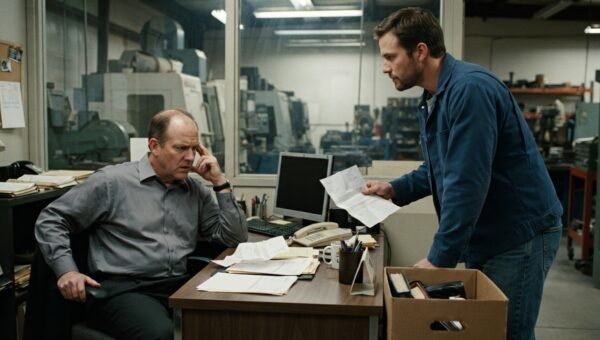
The night he left, the shouting started over three hundred dollars missing from the cashbox at Dad’s feed store.
Dad backed Danny against the kitchen icebox and called him a common thief. Danny was nineteen, stubborn as hickory, and had our grandfather’s temper. He swore on our mother’s Bible that he had never touched a cent of that money. Dad wouldn’t hear it. He told Danny that if he stayed under his roof, he would march him down to the sheriff by sunrise. Danny walked out into the October rain with only the army jacket Grandpa bought him and forty dollars of his own lawn-mowing money in his boot.
Four months after Danny left, Dad found the missing three hundred dollars. It was tucked behind the bottom drawer of the store desk, slipped through a cracked runner where Dad had pushed an old receipts ledger. Dad brought the three hundred-dollar bills home, laid them flat on the kitchen table in front of Mama, and didn’t say a word. But Danny was already vanished.
We called relatives in Oregon, checked bus stations, and put notices in county papers across two states. Nobody had seen him.
Mama passed away in 1989, and Dad followed seven years later. Every Sunday of my adult life, I sat in the second pew from the back at Grace Methodist, looking at the flower arrangements and wondering if my brother was lying in an unmarked grave somewhere past the Rockies.
Then, this past April, our church nursery committee gathered to clean out the basement storage room. A young couple who had recently joined the congregation brought in a hand-built walnut cradle to donate. When I wiped the dust off the headboard with a damp rag, something stopped me cold.
The dovetail joints along the sides were tight and even, cut by hand with an old-style narrow bevel. But it was the headboard that made my fingers shake. Right in the center was a five-point star, burned into the grain with a hot iron triangular tip.
Our grandfather had built tobacco barns and cabinets with that exact mark. He had arthritis bad by the time Danny was twelve, and he sat on an upturned nail keg in the shed teaching only Danny how to heat the iron and turn the corner of the tip so the edges wouldn’t char crooked. Grandpa never showed me, and he never showed our cousins.
I tracked down the couple who brought it in. The husband told me he had bought the cradle two weeks earlier from a retired carpenter up in Pine Grove, two towns north. He gave me the address written on a yellow hardware receipt: 412 Ridge Road.
On Thursday morning, I drove up the ridge. The house was a low cedar-shingle place with a gravel driveway lined with stacked rounds of white oak. A small hand-painted sign near the mailbox said Custom Furniture and Joinery.
I stood on the front porch for five minutes just listening to the wind through the pines and gathering myself.
My chest felt so tight I could barely breathe. Just as I lifted my knuckles to knock, the latch clicked, and the door swung open.
PART 2
A woman in her late thirties stood in the doorway holding a coffee mug. She had dark hair tied back in a clip and eyes so much like our mother’s that I nearly stepped backward off the porch.
“Can I help you?” she asked.
“I’m looking for the man who built the cradle,” I said. My voice was thin and dry. “The walnut one with the star burned into the wood.”
The woman looked at me closely. The polite stranger look on her face softened into curiosity. “That’s my dad’s work. He’s around back in the shop. He doesn’t hear the bell when the planer is running.”
She walked me down a flagstone path around the side of the house toward an old pole barn. The smell of cedar shavings and paste wax came out through the double sliding doors. Inside, an older man with thick gray hair and rolled-up flannel sleeves was bent over a workbench, running a hand plane across the edge of a cherry board. He wore wire-rim reading glasses down on his nose and had an old wooden pencil tucked behind his right ear.
He looked up when our shadows crossed the work table.
Fifty-six years changes a face. His hair was silver instead of dark brown, his shoulders were heavier, and deep lines ran down his cheeks. But when he pushed his glasses up to his forehead and looked directly at me, I was back in the hallway of our childhood home on Mercer Street.
“Danny?” I said.
The plane stopped in his hand. He didn’t drop it. He set it down on its side so the blade wouldn’t dull against the bench, just like Grandpa always drilled into him. He wiped both palms down the front of his canvas apron.
“Martha?” he said. His voice was lower than I remembered, rough from sawdust and age, but the cadence was our people.
His daughter looked between the two of us, confused. “Dad? Who is this?”
Danny didn’t answer her right away. He stood by the bench, looking at my gray hair, my coat, and my hands. “This is your Aunt Martha, Sarah. My sister.”
Sarah stepped back, her mouth slightly open. It was clear she knew the name, but she looked as if she had just met someone stepping out of a black-and-white photograph.
“You’re two towns away,” I said. It was the only thing that came out of my mouth. Fifty-six years of silence, and that was all I could manage. “You’ve been thirty miles from Mercer Street?”
Danny looked down at the cherry board on his bench, his jaw set hard. “Not the whole time. Only the last twenty years.”
“Mama looked for you until she couldn’t walk,” I told him. “We looked everywhere. Why didn’t you write? Why didn’t you pick up a telephone?”
Danny reached into his apron pocket and pulled out a clean rag, twisting it slowly in his thick fingers. “Dad told me what I was. He said there wasn’t a place for a thief in his family. I swore I wouldn’t come back until I owned my own shop, free and clear, with my own name on the deed and nothing owed to anybody.”
PART 3
“He found the money, Danny,” I said.
The shop went dead quiet. Out in the trees, a crow called twice, but inside the barn neither of us moved.
Danny frowned. “What are you talking about?”
“The three hundred dollars,” I said, walking closer until I was standing right at the edge of the wood shavings by his bench. “Four months after you ran. It fell behind the runner of the bottom desk drawer at the store. Dad found it when he cleaned out the tax files. He brought it to the kitchen table. He put the cash right in front of Mama.”
Danny’s fingers stopped moving on the rag. “He knew?”
“He knew before the winter was over,” I said. “He spent eight hundred dollars hiring an investigator out in St. Louis because someone said they saw you working a railyard there. Dad drove all the way to Missouri twice in that old Dodge. He never said he was sorry out loud, because you know how he was, but he spent eight years driving to bus stations every time a runaway was reported in the county.”
Danny stood completely still. A muscle in his cheek twitched once, twice. He turned his back to me and rested both hands on the edge of the workbench, leaning his weight onto his palms.
Sarah took a step toward him, but he held up one finger, asking for quiet. His shoulders rose and fell slowly.
“I stayed in Utah for twelve years,” Danny said quietly, speaking to the tool wall. “Framing tract houses. I slept in a camper shell on the back of a truck for three winters to save four thousand dollars. I kept thinking, if I get ten thousand together, I’ll drive back. I’ll throw the cash on his kitchen table and tell him I never needed his nickel. Then I met Sarah’s mother. We had Sarah. Times got lean in seventy-nine, and the savings went to rent and doctor bills. Every time I thought about calling, I thought about Dad looking at me like dirt.”
“He kept your tackle box,” I told him. “When he died in ninety-six, I had to clean the attic. Your baseball glove from junior high was in his cedar chest, right on top of his discharge papers from the Navy. He kept it wrapped in an oiled rag so the leather wouldn’t dry out.”
Danny bowed his head. A single rough sound came out of his throat, not quite a sob, like a man taking a punch he had seen coming from miles away.
Sarah walked over and placed her hand flat against her father’s back.
He didn’t speak for a long time. When he finally turned back around, his eyes were wet, but his voice was steady. “I moved back to the state after Mary died in 2004. Sarah wanted to be near the hills. I bought this five-acre cut because the timber was good and the shop was already wired. I went to the cemetery in Mercer once, about ten years back. I saw Mama’s stone. I saw his.”
“You didn’t look for me?” I asked. The question carried all the lonely Sundays I had spent wondering about him.
“I thought you’d be married with your own life,” he said. “I figured you blamed me for Mama’s grief. I figured by then, it was cleaner to let the dead stay dead.”
ENDING
We didn’t have an easy afternoon of catching up. When fifty years sit between two people, you don’t erase them over a pot of coffee. Too many birthdays had passed, too many funerals had happened with empty chairs, and too much stubborn pride had eaten up the best years of our lives.
Sarah made a pot of vegetable soup and brought out bread, and the three of us sat at Danny’s kitchen table. The table was solid quarter-sawn white oak, beautifully joined, built by his own hands. We went through names one by one. Uncle Ray, Aunt Evelyn, Cousin Tommy who took over the lumberyard. Most of the people Danny asked about were buried on the hill behind the church.
Before I left that evening, Danny walked me out to my car. The sun was going down behind the ridge, throwing long blue shadows across the gravel.
He reached into his pocket and handed me a small piece of sanded walnut, no bigger than a matchbook. It was smoothed down with fine paper until it felt like soapstone. On one face, clean and crisp, was the five-point star, burned into the wood with that same tilted corner Grandpa had taught him.
“I made that cradle for a neighbor girl whose husband was out of work,” Danny said. “I didn’t know they gave it to your church.”
“I knew the joints the second I touched them,” I said.
He leaned against my car door, looking down the gravel road toward the highway that led back to Mercer Street. “You coming back next week?”
“I am,” I told him. “And you’re coming down the ridge for Sunday dinner. I’m making Mama’s pot roast, and you’re going to sit at her table.”
Danny looked at me for a long moment, then nodded once. “All right, Martha. I’ll be there.”
I drove the thirty miles home with the little wooden star sitting on the passenger seat next to my purse. For the first time since 1968, when I laid my head down on my pillow that night, I didn’t have to pray for Danny among the dead.