PART 1
“Don’t you dare take her in,” my son Reid said on the phone. “She made her bed.”
His daughter Paige was 17, three months along, standing on my porch with a trash bag of clothes and $14 in her pocket. Reid said if I helped her, he’d cut me off too, and mean it this time. I raised three kids on a waitress wage. I know how fast a girl can fall.
I also know what being soft once cost me long ago. Paige stared at the porch boards and whispered, “I’ll go, Grandma. I just didn’t know where else.” My chest ached. The last bus to the shelter left in 40 minutes. I picked up my car keys and told Reid through the screen door that I was taking her in. He hung up so hard the phone rattled in my hand.
That night, the house felt too small and too quiet. Paige sat at my kitchen table, her fingers tracing the rim of a mug of chamomile tea. She didn’t cry anymore. She had that dry-eyed, hollow look young girls get when they realize the adults who are supposed to protect them have stepped back. I brought her a spare pillow and the heavy quilt my mother stitched by hand fifty years ago.
“We’ll figure it out tomorrow,” I told her, smoothing the quilt over her shoulders. “You’re safe here, Paige. No one is throwing you out.”
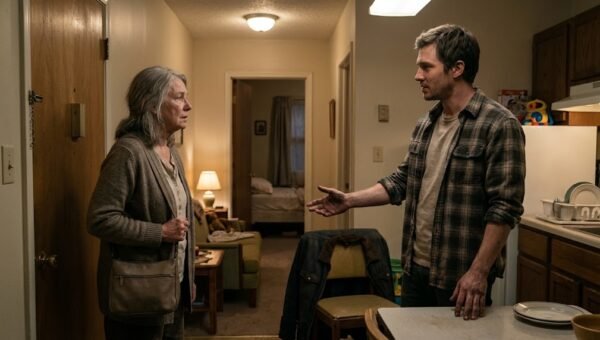
The next morning, the trouble started early. Reid didn’t call. Instead, he showed up at my front door at seven o’clock while I was brewing coffee. He walked right past me into the living room, his face dark and tight. Reid is forty-two, a regional manager for a commercial supply company, and he wears his authority like a cheap suit. He looked at Paige, who was sitting on the sofa with a piece of toast, and his jaw worked.
“Pack your bag, Paige,” Reid said, his voice flat and cold. “You are not turning my mother’s home into a shelter for your mistakes.”
“Reid, leave her be,” I said, stepping between them. “She is my granddaughter. She isn’t going anywhere.”
“You have no idea what you’re doing, Mom,” Reid snapped, turning his glare on me. “She got herself into this mess with some boy from her high school who already skipped town.
If you bail her out now, she will drag you down with her. I worked hard to make sure you had a comfortable retirement in this house, and I am not watching you waste it on a teenager who won’t even finish high school.”
“My retirement is my business, Reid,” I said, my voice hardening. “And my house is my business. You raised your voice in my home. Now you need to leave.”
Reid stared at me as if I had slapped him. He pointed a finger at Paige. “You mark my words. She’ll take everything you have before the baby is even born.” Then he spun around, slammed the front door so hard the glass rattled in the frame, and sped out of the driveway in his company truck.
For the next two weeks, the silence from Reid was absolute. No Sunday calls, no check-ins, nothing. Paige enrolled in the local continuation high school to finish her diploma online and started helping around the house, cooking simple meals and sweeping the kitchen floor.
But the stress was eating at her. I could see it in the dark circles under her eyes and the way she flinched whenever a car door slammed outside.
Then came the letter from the bank.
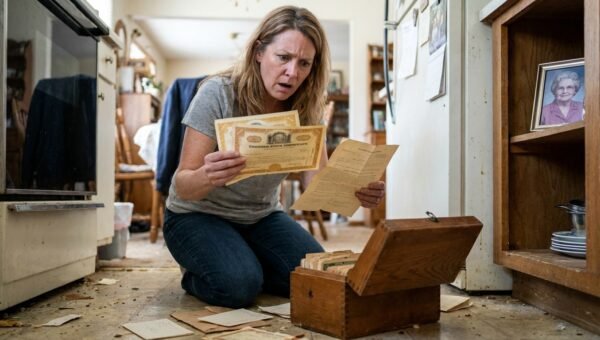
It was addressed to me, sitting right in the mailbox on a Tuesday afternoon. I opened it while standing at the kitchen counter. It was a notice regarding a home equity line of credit application. My name was on it, but the signature line contained a cursive scrawl that looked nothing like mine. My heart hammered against my ribs. I sat down heavily at the table, spreading the papers out. Someone had applied for a forty thousand dollar line of credit against my house, using my property tax statements and my identification numbers.
And the primary authorized secondary user listed on the account was my son, Reid.
PART 2
I stared at the paperwork until the lines of text blurred together. Forty thousand dollars. My little house in Ohio, paid off brick by brick after thirty years of working double shifts at the diner, was sitting as collateral for a loan I never signed.
Paige walked into the kitchen, holding a folder of schoolwork. She saw my face and stopped dead. “Grandma? What is it? Are you okay?”
“Bring me the cordless phone, honey,” I said, my voice shaking in a way I hated.
I called the bank directly, bypassing the local branch and going straight to their fraud division. I had to wait on hold for twenty minutes, listening to that tinny classical music while my hands grew cold. When a woman with a brisk, professional voice finally came on the line, I explained who I was and read her the reference number from the top of the notice.
“Ma’am, according to our records, this home equity application was submitted online with a verified digital signature and uploaded copies of your driver’s license and utility bills,” the representative said.
“I didn’t submit it,” I said, feeling the heat rise in my chest. “I don’t even use a computer for banking. Someone else did this.”
“Because the secondary applicant, a Mr. Reid Bennett, provided matching familial documentation and a notarized power-of-attorney affidavit—”
“A power of attorney?” I interrupted. “I never signed a power of attorney for Reid. Not ever.”
There was a pause on the other end of the line, the rustle of papers. “Well, ma’am, if you’re stating this is fraudulent, we will have to freeze the application and open an internal fraud investigation. But because a notarized document was submitted, you’ll need to file a police report within forty-eight hours to keep the freeze active.”
I thanked her, hung up, and sat frozen at the table. Paige knelt beside my chair, her young face pale and frightened. “Was it Dad?” she whispered. “Did my dad do that?”
“He put his name on it,” I said quietly. “He used my house.”
I didn’t wait for Reid to call. I drove straight down to the local police precinct twenty minutes later with the bank notice in my purse. Filing a report against your own child feels like swallowing broken glass. The desk officer, an older man with graying hair and tired eyes named Sergeant Miller, listened to my story without interrupting. He looked at the paperwork, checked the signature, and shook his head.
“We see this more often than you’d think, Mrs. Bennett,” Sergeant Miller said gently. “Usually family members who think they’ll pay it back before anyone notices. We’ll issue a formal inquiry to the bank and pay Mr. Bennett a visit.”
Two days later, Reid showed up at my front door unannounced again. This time, he didn’t knock. He twisted the handle, walked right in, and slammed a folded newspaper onto the kitchen table. He looked frantic, his tie loosened and his face flushed a dull, angry red.
“What in God’s name is wrong with you?” Reid yelled, his voice echoing off the plaster walls. “The police showed up at my office today! At my office, in front of my regional director!”
Paige came out of the back hallway, stopping by the doorway with her arms crossed over her stomach. “You stole from her, Dad,” she said, her voice steady despite her trembling hands. “You tried to take her house.”
PART 3
Reid whipped around to face his daughter, his expression twisting into pure venom. “You shut your mouth, you ungrateful little brat! This is all because of you! If you hadn’t shown up on her doorstep like a stray dog, none of this would be happening!”
“Don’t you dare talk to her that way in my house,” I said, standing up from the kitchen table. I wasn’t shaking anymore. Cold, hard anger had replaced the fear. “You forged my signature, Reid. You tried to borrow forty thousand dollars against the roof over my head.”
“I didn’t steal anything!” Reid shouted, stepping closer to me and waving his hands. “It was a bridge loan! I had a commercial supply contract falling through, and I needed quick capital to save my division. I was going to pay it back in six months, long before you ever needed a dime! You don’t understand how business works, Mom. You’re sitting here in a house that’s worth three times what you bought it for, doing nothing, while my career—everything I built—was going down the drain!”
“So you decided to risk my home without asking me?” I asked, my voice dangerously low. “You decided my life’s work was your personal safety net?”
“You would have said no!” Reid snarled. “You’re too sentimental. You care more about lecturing people than keeping this family secure.” He pointed a trembling finger at Paige again. “And now you’re letting her move in, enabling her, while she ruins her future. I did what I had to do to protect our family’s interests.”
“No, Reid,” I said, looking right into his eyes and seeing a stranger I had somehow raised. “You protected yourself. You used my name because you knew no bank would lend to you on your own merits.”
Reid stared at me, his chest heaving. For a second, I thought he might swing his fist, or break something against the wall. Instead, he backed toward the front door, his face twisting into a bitter sneer.
“Fine,” Reid spat out. “You want to play the martyr for a pregnant teenager who won’t amount to anything? Go ahead. But don’t ever call me again. As far as I’m concerned, you chose your granddaughter over your own son. You’re on your own.”
He yanked the door open, slammed it behind him with a force that rattled the windowpanes, and drove away.
Paige stood in the doorway, tears finally spilling down her cheeks. She wiped them away angrily with the back of her hand. “He’s not coming back, Grandma. Because of me.”
“He’s not coming back because of what he chose to do,” I said, walking over and putting my arm around her thin shoulders. “Don’t you ever let anyone make you feel like you are a burden, Paige. We are going to be just fine.”
ENDING
The fraud investigation took nearly three months to wind its way through the legal system. Because Reid had used a forged power-of-attorney affidavit, the bank dropped the loan application entirely, but the police report remained on file. Reid never contacted me again, not even through text or email. He changed his phone number and blocked mine. I heard through my sister that he managed to keep his job by the skin of his teeth, though his reputation at the company took a permanent hit. He didn’t come to my seventy-fourth birthday, and he didn’t send a card when Paige gave birth to a healthy little boy whom she named Leo.
That was two years ago now.
My house is still mine, every shingle and floorboard paid for by thirty years of sore feet and late nights at the diner. Paige finished her high school diploma with honors and started classes at the community college down the road, studying paralegal work so she knows her rights and no one ever pulls the wool over her eyes again.
Sometimes, late at night after little Leo is asleep in his crib down the hall and the house is quiet, I sit at the kitchen table with a cup of tea. I look out the window at the empty driveway where Reid’s truck used to park. A dull ache lingers in my chest, because a mother never stops missing her child, no matter how terribly he fails. But then I hear soft footsteps coming down the hall, and Paige walks in to grab a glass of water, smiling sleepily at me as she passes.
I know what being soft cost me long ago, and I know what standing firm cost me this time. I would make the exact same choice again, every single day of the week.