PART 1
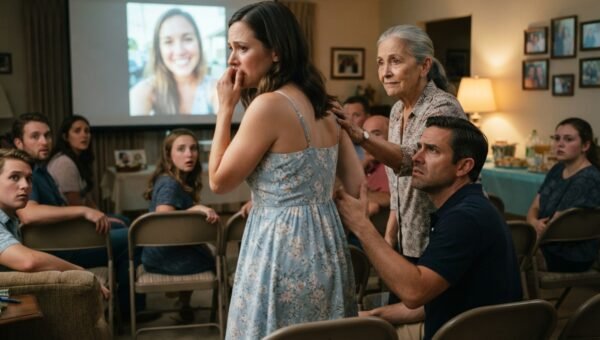
The knife she was holding was an eight-inch serrated cake server with a fake crystal handle, tied with a pale yellow satin ribbon. My mother-in-law, Evelyn, had brought it from her own china cabinet. She tapped the edge against the side of the punch bowl twice, loud enough to cut through the noise of eighteen women laughing over ribbon corsages and melted miniature candy bars.
“Before Nora cuts into this lovely lemon cream,” Evelyn said, her voice carrying that polished Sunday-morning choir ring, “I want to share a little maternal observation with the ladies.”
She smiled down at the table. She looked straight at her cousin Martha, then turned her eyes to Mrs. Gable, the organist, and finally let them rest on me.
I was sitting in the high-backed wicker armchair they had decorated with tulle and blue hydrangeas, thirty-two weeks pregnant, my ankles swollen inside my flat canvas shoes.
“God gives us children on His own calendar,” Evelyn said, smoothing the front of her pressed lavender cardigan. “Even when young women decide to rush the schedule. That girl trapped my son. Count the months yourselves.”
The parlor went so quiet I could hear the hum of the refrigerator compressor all the way from the kitchen.
A paper napkin fluttered off my sister Sarah’s lap and hit the rug. Nobody bent to pick it up.
“Evelyn,” Sarah began, her face going white-hot, “what in God’s name is wrong with you?”
“I am simply speaking what every Christian woman with an ounce of arithmetic already knows,” Evelyn said smoothly, laying the server on the lace tablecloth with deliberate care. “David was raised with high expectations.
When a boy is cornered into duty, a mother does not look away and call it romance. But we will love this little one regardless. Even if the foundation was built on shame.”
I sat frozen in that wicker chair, holding a stack of pastel gift envelopes against my stomach. My ears were ringing so loudly I could barely hear my own breathing. I looked at Mrs. Gable. She looked down instantly into her paper cup of ginger ale. I looked at Linda, who lived three doors down from us and whose little girl came over every Tuesday for preschool storytime on my front porch. Linda looked away too, her jaw tight, staring intently at the floral arrangement in the center of the coffee table.
I married David at five months pregnant. That was the only fact Evelyn gave them, and it was the only fact they kept.
What she omitted was the truth David and I had lived through since the previous winter.
We had been together three years. David had proposed on Christmas Eve by the frozen lake behind his father’s workshop, with his father’s blessing before Donald passed away that January. On the second Sunday of February, four whole months before I ever bought an early response pregnancy test, David and I sat across the desk from Pastor Kenneth in the rectory office. Pastor Kenneth had pulled down the heavy leather parish binder, opened it to November, and written our names in fountain pen ink on the line for November fourteenth.
David’s family had always carried money in Oak Creek. His grandfather had started the commercial lumber yard down by the rail spur, and while the business had passed through three sets of hands since, the surname still bought Evelyn front-row pews and the final say on the altar guild committee. When David took a job as a salaried estimator for a regional contractor instead of staying under her roof and running errands for her rental properties, Evelyn treated it like an act of betrayal.
And when David chose me, a girl whose mother worked third shift at the county hospital and whose father had left us with a mortgaged trailer when I was twelve, Evelyn treated me like a thief who had broken through her basement window.
When I found out in June that we were expecting, we didn’t rush anything. We didn’t move the November date. In fact, when we sat Evelyn down in her kitchen to share the news, she didn’t yell. She just folded her hands on her clean kitchen table, looked at David’s hands, and said, “We will see how solid your plans actually are.”
In August, David was offered a promotion that required four months of regional travel starting in late September. We talked to Pastor Kenneth. The pastor had an opening on the fourth Saturday of August because an older couple had moved their vows to a chapel in Georgia. We moved the date forward by twelve weeks so we could be legally settled before David began driving four hundred miles a week between job sites, and so my pregnancy would be covered under his contractor group insurance without an open-enrollment lapse.
We stood at that altar on August twenty-fourth. I wore an ivory empire-waist dress that showed my gentle bump plain as day. Pastor Kenneth blessed us. Evelyn sat in the mother’s pew in charcoal silk and wept into an embroidered linen handkerchief, looking like a woman following a casket to an open grave.
Now, on a Saturday afternoon in late October, she stood beside my lemon sheet cake and laid a public brand across my forehead.
The shower cleared out in less than fifteen minutes.
Women who had brought hand-knitted booties and pacifier sets made hurried excuses about pot roasts in the oven and husbands needing the car. Martha left without her umbrella. Linda mumbled that her daughter had an earache coming on and hurried out the front screen door before I could even hand her a slice of cake in a foil wrap.
By four o’clock, the only people left in the living room were Sarah, me, and forty-two unopened registry items stacked along the wall like silent witnesses.
David got home from his supply run at five. When he walked through the side door carrying two bags of cedar nursery trim, Sarah was in the kitchen washing punch glasses with so much anger she cracked one against the porcelain sink.
“What happened?” David asked, setting the lumber against the hall bench. He looked between Sarah’s red eyes and my face. “Nora? What’s going on?”
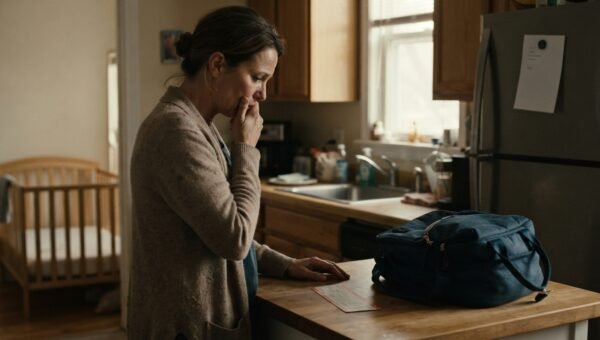
I told him. I didn’t cry while I said it. The shock had settled into a cold, dull weight right in the center of my chest.
David’s face darkened. His jaw went tight, the muscle jumping near his ear the way it only did when he was completely pushed to his limit. He grabbed his keys off the counter without taking his work boots off.
“Where are you going?” I asked, grabbing his forearm.
“I am going to my mother’s house,” he said, his voice shaking with a quiet rage I had never heard from him before. “She doesn’t get to do this. Not to you. Not to our son.”
“David, wait,” I whispered. “She wants you to go over there and yell. If you go over there screaming, she will tell the whole neighborhood that the girl you knocked up turned you against your own mother.”
“I don’t care what she tells them,” David said.
“I care,” I told him, looking at the half-eaten cake on our table. “She said it in front of the whole town. She made it about character. You yelling at her in her driveway won’t undo what Linda and Mrs. Gable took home in their purses.”
David stayed, but the poison had already seeped into the ground.
By Monday morning, the silence was absolute.
I walked to the local grocery store to pick up milk and iron tablets. When I turned down the produce aisle, Mrs. Gable saw my cart, wheeled hers abruptly around, and hurried toward the bakery counter without a word. At noon, the three mothers who brought their toddlers to my front porch every Tuesday sent identical text messages within twenty minutes of each other. Linda’s text was the bluntest: *Nora, with everything going on right now, we think it’s best if we pause storytime until after your baby arrives. We want to give you space.*
Space wasn’t what they were giving me. They were giving me quarantine.
The local prayer chain, an automated phone tree run by the older women at the chapel, sent out a recorded update on Tuesday evening. The voice was Evelyn’s close friend Brenda: *Please hold David and Nora in your prayers as they navigate an unconventional and hurried beginning to their family life, asking the Lord to grant them repentance, humility, and proper guidance.*
David called his mother that night. He didn’t yell. He stood in our narrow hallway and told her, plainly and coldly, that until she apologized to me publicly for what she said at the shower, she would not be welcome in our home, nor would she be holding our child when he arrived.
Evelyn didn’t raise her voice either. Her reply came through the receiver clear enough for me to hear it from the sofa.
“David, darling,” she said, calm as water in a bucket, “you are under a great deal of pressure, and I forgive you. But if Nora expects to use the family christening gown for that child, she will come to my parlor, look me in the eye, and apologize for making a mockery of your father’s name. Until then, the chest stays locked.”
The call ended. The line went dead. And the silence in our town closed over us like dirty river water.
PART 2
The christening gown Evelyn referred to was not just a dress. It had been made in 1912 by David’s great-grandmother from hand-spun Belgian lace and fine lawn cotton. David had worn it. His father had worn it. Every boy born under that family name for four generations had been carried to the stone font wearing that garment, and their initials were stitched in tiny blue thread inside the lower hem.
When David and I had first announced we were having a boy, Evelyn had brought out the cedar box, let me touch the dry, paper-thin lace, and told me it was the only heirloom left from Donald’s side of the family. Now she was using it as a collar to bring me to my knees.
David wanted to drive over, take the spare key he still had on his ring, and retrieve the box from the hall closet.
“No,” I told him, sitting at the kitchen table with a legal pad in front of me. “If you take it, she files a police report. You know she will. She’ll tell Sheriff Miller you broke in to steal family property for your pregnant wife. We don’t touch her house.”
“Then we buy our own gown,” David said, his eyes hollow with exhaustion. “We go down to the department store in the county seat, we spend forty dollars on a white cotton gown, and we tell Kenneth to baptize him in that.”
“We could,” I said. “And for the rest of his life, every woman who walked out of that baby shower will whisper that Evelyn held the real gown back because our son wasn’t legitimate enough to wear it.”
I looked down at the pad. I had begun writing a timeline, date by date, receipt by receipt.
The next morning, while David was at a framing site twenty miles south, I put on my coat and walked the four blocks down to the rectory.
Oak Creek Community Church was an old stone building with heavy oak doors and a damp, clean smell of polished wood and furnace oil. Pastor Kenneth was sixty-three, a quiet man who had buried both my grandfather and David’s father. When I knocked on his frosted-glass office door, he looked up from a stack of funeral bulletins and pushed his reading glasses onto his forehead.
“Nora,” he said gently, standing up to pull an armchair out for me. “Come in. Sit down. You look like you’ve been carrying the world on your shoulders.”
“I need you to show me the parish register, Pastor,” I said, keeping both hands flat on my lap.
His expression changed slightly. He looked down at his desk blotter, then folded his hands together. In a town this size, nothing stayed hidden for seventy-two hours; he had already received calls from the prayer chain ladies.
“Nora,” he sighed, “Evelyn has a very traditional view of family order. She feels things deeply, especially with Donald gone. If this is about the hurt from Saturday, perhaps the best path is patience. Time has a way of smoothing these waters.”
“I am not asking for smooth water,” I said. “I am asking for the truth. Evelyn stood in front of eighteen women and told them I trapped your deacon’s son, and that we scrambled to get married because of a positive test. Did we come to you in February, or didn’t we?”
Pastor Kenneth was quiet for a long moment. He looked at me, then stood up and walked to the tall metal fire cabinet against the back wall. He unlocked it with a small brass key from his pocket, pulled out the heavy, cloth-bound parish register for the current year, and set it flat on the desk between us.
He flipped past the spring confirmations, past the summer baptisms, and stopped at the late winter entries.
There it was.
February 11. In Pastor Kenneth’s neat, slanted script: *David Robert Vance and Nora Mae Sullivan. Consultation for Holy Matrimony. Target Date: November 14. Deposit received for sanctuary use and organist services.*
And there, right below our names, was an initialed note from Evelyn Vance herself, dated February 18, reserving the church fellowship hall for the November reception.
She had reserved the hall nine months before my baby was due. She had known about our November wedding long before any child was conceived, long before David took his travel contract, long before we ever had a reason to shift the calendar.
“She knew,” I said, my voice barely above a whisper. “She didn’t count the months and get confused. She knew the wedding was already on the books before I was ever pregnant.”
“Evelyn handles change poorly,” Pastor Kenneth said softly. “When David decided not to take over Donald’s lumber accounts, she felt abandoned. When you two decided to move the date to August on your own, without consulting her on the reception details, she took it as an insult.”
“So she decided to destroy my reputation instead,” I said.
I looked at the ledger. “Pastor Kenneth, I need an official certified copy of this entry. Church seal, your signature, and the date.”
Pastor Kenneth hesitated. “Nora, what are you going to do with this?”
“I am going to stop being the town’s scandal,” I told him. “And you are the only one who can sign it.”
He looked at the open page for nearly a minute. Then he reached into his top drawer, took out the heavy round parish embossing seal, aligned it over the bottom corner of our reservation form, and pressed down until the paper gave a sharp, dry crack.
PART 3
When I walked out of the church with the embossed certificate in my canvas bag, I didn’t go home. I walked straight down Elm Street toward Evelyn’s house.
It was an imposing two-story brick colonial with painted white shutters and a lawn so manicured it looked like artificial turf. When I climbed the porch steps, I could see Evelyn through the sheer curtains of the front window, sitting at her mahogany bureau, writing notes.
I didn’t ring the bell. I knocked twice, hard, on the heavy oak door.
When she opened it, she was holding a pair of gold-rimmed bifocals in her hand. Her hair was perfectly set in soft gray waves, not a strand out of place. She looked at me, then at my stomach, and her eyes chilled.
“Nora,” she said, resting one hand on the door frame to block the threshold. “If David sent you, you can tell him what I already said. I am not ready to discuss the gown until certain understandings are reached.”
“David doesn’t know I’m here,” I said, keeping my voice steady and low. “And you are going to let me in.”
Something in my tone made her pause. She looked down the quiet street, saw the mail carrier turning the corner, and stepped back just enough for me to enter.
The inside of her house smelled of lavender furniture wax and old wool rugs. Everything was in its exact place: the silver tea service on the sideboard, the framed photographs of Donald and David on the piano, the grandfather clock ticking with heavy, rhythmic thumps in the corner.
“I assume you came to apologize,” Evelyn said, walking over to the fireplace mantle and turning to face me. “You embarrassed our family, Nora. Marrying in such an obvious condition, forcing us to explain things to people who have known David’s father for forty years. If you want the christening gown, you need to show some respect for the heritage you married into.”
“Open the cedar chest, Evelyn,” I said.
She gave a short, condescending laugh. “I beg your pardon?”
“Open the chest,” I repeated, reaching into my bag. “Because if you don’t hand me that gown right now, you are going to be explaining a whole lot more than my wedding date to the ladies in your circle.”
I pulled out the certified document from Pastor Kenneth and laid it flat on her polished mahogany dining table. Right beside it, I laid a second document: the signed receipt from the printer in the county seat, dated March 3, showing an order for one hundred and fifty wedding invitations bearing our original November date, paid for by David’s debit card.
Evelyn didn’t move for several seconds. Then she walked to the table, put on her reading glasses, and looked down.
Her hand trembled slightly as her fingers touched the embossed seal of Oak Creek Community Church.
“You went to Kenneth,” she whispered, her voice tightening.
“I did,” I said. “And look at the date right under mine. February eighteenth. That’s your signature, Evelyn. You paid forty-five dollars to reserve the fellowship hall for our November reception three full months before I conceived our son.”
She didn’t look up. Her knuckles were white against the dark wood of the table.
“You knew David and I were getting married,” I continued, stepping closer so she had to look at me. “You knew the date was set. You knew we moved it forward to August so David could travel for his promotion and have us on his health insurance. You knew all of it. And you stood in my living room on Saturday, took a knife in your hand, and told Linda and Mrs. Gable that I cornered your son into a shotgun wedding.”
“It was inappropriate,” she hissed, her eyes finally coming up to meet mine, hard and defensive. “You were showing! In the house of God! My husband was an elder in that church! What was I supposed to tell people when they saw you five months along at an altar?”
“The truth,” I said. “You were supposed to tell them the truth. But you didn’t want the truth, did you? You wanted them to think I was cheap. You wanted them to think I trapped him so they would feel sorry for you instead of seeing that your son chose me over your control.”
“Take those off my table,” she said, her voice dropping into a raspy whisper. “Get out of my house.”
“I will,” I said, picking up the papers. “And at ten o’clock tomorrow morning, right before the altar guild meeting in the church basement, I am going to hand a copy of this certified ledger page to Mrs. Gable. Then I’m going to walk over to Linda’s house and give one to her. And then I am going to give the third copy to Brenda to read over the evening prayer chain.”
Evelyn went rigid. Her face drained of all color, leaving the pink rouge on her cheekbones looking like two painted circles on a chalk wall.
The church basement was her entire life. Her status on the committee, her seat at the head of the charity drive, her standing as the widow of Donald Vance—it all rested on the assumption that she was the moral anchor of Elm Street. If those women found out that she had weaponized a false accusation against her own grandchild to settle a petty grudge, she would never be able to hold her head up in that fellowship hall again.
“You wouldn’t,” she breathed.
“Try me,” I said, holding her gaze. “I spent four days being treated like dirt in this town because you wanted to play the grieving, honorable mother. I don’t care about your reputation anymore, Evelyn. But I care about my son’s.”
We stood there in the quiet parlor, the grandfather clock ticking off five full seconds.
She didn’t say another word. She turned on her heel, walked down the narrow back hallway toward the linen closet, and came back sixty seconds later carrying the cedar box.
She set it on the dining table between us. The wood was aromatic, smooth, and heavy.
“Take it,” she said, her voice completely dead, looking past my shoulder at the wall. “Take it and leave.”
“One more thing,” I said, resting my hand on the box. “You are going to call Mrs. Gable, Linda, and Martha before dinner tonight. You are going to tell them that you spoke out of turn on Saturday. You are going to tell them that our wedding had been planned since the winter, and that you let your personal grief over Donald make you say something cruel and untrue.”
“Nora—”
“If Linda doesn’t text me an apology by eight o’clock tonight,” I said, lifting the cedar box off the table, “Mrs. Gable gets the church ledger tomorrow morning.”
ENDING
At seven-fifteen that evening, David was sitting at the kitchen table, watching me carefully wash the hundred-year-old lace gown in a basin of distilled water and gentle soap. The water was turning slightly yellow from decades of cedar oils, revealing the brilliant, clean ivory of the original threads.
My phone buzzed on the counter.
It was a text from Linda: *Nora, Evelyn called me this afternoon. She explained how upset she was about everything and admitted she was completely wrong about your wedding timeline. I feel terrible for how I handled Saturday. The girls miss their storytime so much. Can we please bring them over tomorrow like usual?*
Three minutes later, a notification popped up on David’s phone from the automated prayer chain. Brenda’s voice was different this time—hurried, slightly flustered, and very careful: *A special clarification regarding the Vance family. Please join us in rejoicing for David and Nora as they prepare for the birth of their son, honoring their steadfast commitment and the long-planned union of their household.*
David looked up at me from the screen, completely stunned. “What did you do?”
“I gave your mother a choice between being honest or being exposed,” I told him, laying the wet gown flat on a clean white bath towel to dry. “She chose her pride.”
Our son, Donald Robert Vance, was born three weeks later on November nineteenth. He weighed eight pounds, four ounces, with dark hair like his father’s and eyes that looked right through you.
On the second Sunday of January, we carried him into Oak Creek Community Church. The sanctuary was packed. Linda sat three pews back with her little girl, who waved at me as we walked down the center aisle. Mrs. Gable played the prelude with extra warmth, nodding politely to me as I passed the organ.
Evelyn sat in her usual pew, wearing her dark wool coat, completely alone. She did not sit with us. When Pastor Kenneth took Donnie into his arms at the stone font, the long lace of the 1912 gown fell nearly to the floor, clean and bright under the stained-glass light.
When the service ended, Evelyn waited in the foyer until the crowd thinned out. She walked over to where David and I were bundling Donnie into his winter bunting. She looked down at the baby’s face, then at the hem of the gown, where her own father’s initials were embroidered in faded thread.
“He looks like Donald,” she said, her voice thin, stripped of all its former authority.
“He does,” David said, his arm firm around my shoulder.
She reached out a gloved finger, hesitated, and then gently touched Donnie’s cheek. She looked at me for the first time since that morning in her dining room. There was no warmth in her eyes, but the cruelty was gone, replaced by a permanent, wary caution. She knew exactly what I was capable of when pushed, and she knew the paper was still in my lockbox at home.
“He has the Vance chin,” she murmured, pulling her hand back.
“He has a lot of things, Evelyn,” I said, looking her straight in the eye. “And every single one of them is legitimate.”
She nodded once, tightened her wool scarf around her neck, and walked out down the church steps into the cold winter air. We watched her go, and then we turned back inside, toward the warm light of the fellowship hall where our friends were waiting.