PART 1
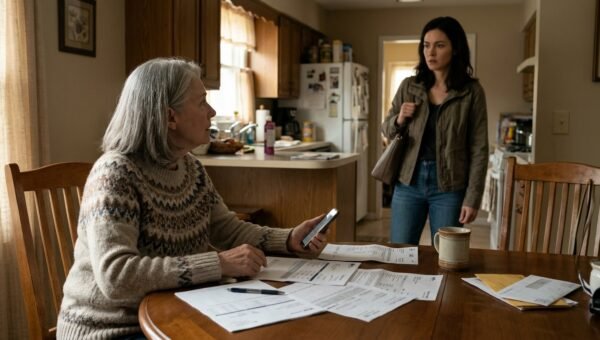
The bill came on a Tuesday in the regular mail, sitting in the white envelope between a supermarket flyer and a dental reminder. When I opened it, the balance said $850.
I lived alone in a one-bedroom apartment on Elm Street. My power bill had never been more than $65, even in July when the window unit ran day and night. I set my reading glasses on the counter and dialed the customer service number on the top left corner, certain someone in billing had keyed in an extra zero.
“Electric service, my name is Brenda,” the woman on the other end said after three minutes on hold.
“Hello, Brenda. I think there is an error on my statement,” I told her, reading off my account number. “My bill is eight hundred and fifty dollars, but my apartment is only six hundred square feet.”
I heard keys clicking on her end. The silence went on long enough that I checked my phone screen to make sure the call hadn’t dropped.
“Ma’am, the eight hundred and fifty isn’t from your current meter reading,” Brenda said. Her voice changed, dropping into that careful tone people use when they deliver bad news. “Your current month is fifty-two dollars and ten cents. The rest is an outstanding balance tied to the address.”
“That can’t be right,” I said. “I pay every statement in full on the third of each month.”
“The old balance was rolled over into this account,” she explained. “Our records show this service agreement has been active under this name and location since 2007.”
I sat down on the kitchen stool. “That is impossible. I didn’t move into Elm Street until October of 2021.
In 2007, I was married and living twenty miles away in another county. Who had the apartment before me?”
“I cannot give you personal information about prior tenants,” Brenda said. “Company privacy regulations.”
“Then why am I being asked to pay it?”
“Because your identity documents match the original file,” she said quietly. Then she paused, looking at her screen. “There is something unusual here. A payment was logged against this old balance right before you took occupancy. Fifty dollars was paid in cash at our downtown branch in July of 2021.”
July of 2021 was three months before I signed the lease. It was the same summer my husband, Donald, passed away after a long illness, leaving me to sell our family home and downsize into town.
“I need this cleared up,” I told her.
“You’ll have to come downtown to the regional branch,” Brenda replied. “Bring your driver’s license and your original lease. Ask for supervisor review.”
I hung up, feeling unsettled. My landlord, Mr. Henderson, ran a small hardware store two blocks away. He owned the brick four-unit building I lived in. I walked down to the store right away, finding him behind the counter checking stock on copper fittings.
“Arthur,” I said, leaning close so the customers buying paint wouldn’t overhear. “Did someone live in apartment 2B before me who shared my name?”
Arthur pushed his wire glasses up his nose. “No, Martha. Before you, a retired postal worker named George lived there for eight years until he moved to an assisted living home in Dayton. Before George, it was a young schoolteacher. Why are you asking?”
“The power company says I opened an account on that apartment in 2007, and that someone paid fifty dollars on it right before I moved in.”
Arthur frowned and shook his head. “I bought that building in 2012 from an estate.
I don’t know anything about 2007, and I sure didn’t make any fifty-dollar payment. You go talk to their office. They probably crossed a meter wire.”
Two days later, an official letter arrived from the utility company’s legal compliance desk. It wasn’t an ordinary bill. It was a formal summons asking me to report in person to the district customer center on 4th Street within ten business days to resolve an unresolved liability claim.
The next morning, I took the bus downtown. The district office was cold, smelling of floor wax and old paper. A woman behind window four took my driver’s license, looked at the photo, checked the name, and asked me to follow her into an interview room down the hall.
A man in a navy tie was waiting behind a metal desk. A manila folder sat open in front of him.
“Mrs. Martha Albright?” he asked.
“Yes,” I said, keeping my purse tightly in my lap. “I’m here to fix this $850 mistake.”
He didn’t argue. He just turned the yellowed file toward me and slid one document across the laminate tabletop. It was a carbon copy of an application for residential service dated September 14, 2007.
At the bottom of the page, my full legal name was printed clearly in black ink. Underneath it was a signature that looked nearly identical to my own handwriting, dated fourteen years before I ever stepped foot into that building.
PART 2
I stared at the black ink on the carbon copy. The cursive was small and angled slightly to the right, just the way I had formed my letters ever since middle school.
“Look at the bottom line, Mrs. Albright,” the man said. His name badge read Mr. Miller. “Do you see the Social Security digits listed?”
I leaned forward. Only the last four digits were visible, but they matched mine.
“I didn’t sign this,” I said, looking straight at him. “In September of 2007, I was living with my husband in our house on Oak Creek Road. I had no reason to rent an apartment in town. I was working part-time at the clinic and taking care of our home.”
Mr. Miller tapped a ballpoint pen against the folder. “The company doesn’t claim you occupied the unit, Mrs. Albright. This document is a third-party co-signer guarantee. Back in 2007, our policy permitted a guarantor to establish electric service on behalf of another party if that person had poor credit or past default.”
“Who was the service for?” I asked, my throat dry. “Show me the primary name.”
Mr. Miller turned the page over. The primary applicant line was filled in with block letters: David Albright.
David was my son.
In the autumn of 2007, David was twenty-four. He had dropped out of community college two years earlier and was drifting from one warehouse job to another, always short on rent, always asking his father for loans he promised to repay the following Friday. My husband, Donald, had handled all of David’s financial troubles back then. Donald always told me, “Don’t worry about it, Martha. I’ll get the boy sorted out. Keep your nose out of his bank account so we don’t start a fight.”
I had stayed out of it. I had trusted Donald to manage it.
“David lived there?” I asked.
“For roughly eleven months,” Mr. Miller said, checking the service ledger. “Service was established in September 2007 and disconnected for non-payment in August 2008. The account was closed with an unpaid balance of eight hundred dollars, plus meter charges. Because the primary holder had no assets, the liability remained attached to the guarantor profile under your Social Security number.”
“Eight hundred dollars from 2008?” I said. “Why are you coming to me now, nearly fifteen years later?”
“A debt of that age is typically uncollectible under state statutes,” Mr. Miller said calmly. “It would have expired from our recovery system entirely. But state law resets the statute of limitations on an old debt if an affirmative payment is made on the account.”
I remembered what Brenda had said on the telephone. “The fifty-dollar payment.”
“Yes,” Mr. Miller said. “On July 12, 2021, an in-person payment of fifty dollars was deposited toward this closed balance at our drive-through window. Because the payment was logged against your Social Security profile and referenced this specific account, the entire balance was legally revived and transferred to your active residential account at the same physical address.”
July 12, 2021 was three weeks after Donald’s funeral.
During those terrible weeks, David had spent days helping me clean out his father’s home office. He had gone through Donald’s metal filing cabinet, taking boxes of old receipts and tax folders out to his truck, telling me he was shredding them so I wouldn’t have to carry the burden.
I left the utility building without paying the money. I walked to the corner bench and sat in the pale autumn air, watching the cars go by.
David hadn’t lived in our town for over two years. He had moved an hour north to Columbus, working as an independent contractor, only calling me on major holidays or when he needed help covering his insurance.
I took out my mobile phone and called him. He answered on the fourth ring, the sound of traffic loud in his background.
“Mom? Is something wrong?”
“David,” I said, keeping my words steady. “I am sitting outside the electric company office on 4th Street.”
The line went completely quiet.
PART 3
“Why are you down there?” David asked. His voice lost its easy rhythm.
“An $850 bill arrived at my apartment,” I told him. “They pulled a file from September 2007 for Elm Street. Your name was on the lease. My name was signed as your guarantee.”
David cleared his throat. “Mom, that was fifteen years ago. Dad took care of all that when I moved out.”
“Your father didn’t take care of it,” I said. “It was never paid. And my name was on the guarantee with my Social Security number. Did you forge my signature, David?”
He didn’t answer right away. When he spoke, his tone was defensive, the way he always sounded when Donald used to corner him about missing cash from the dresser drawer. “Dad gave me your number. Dad said you wouldn’t care as long as I had a place to sleep. He signed it because his own credit was tied up in the truck loan.”
“Your father signed my name?”
“He said it was fine,” David muttered. “We planned to pay it off when my commission check came in, but the job fell through. It was an old mistake, Mom. Nobody cares about an electric bill from 2007.”
“The company cares,” I said. “And they didn’t come after me because of 2007. They came after me because someone walked up to their counter on July 12, 2021, and paid fifty dollars in cash. Who made that payment, David?”
The silence on the other end lasted so long that I heard the blinker clicking in his truck.
“David. Answer me.”
“I was trying to fix it,” he said, his voice cracking slightly. “After Dad died, I found that old utility envelope in his metal strongbox. It had a collection notice inside from 2008 with your name on it. Then you told me you were signing a lease for an apartment in that exact same building on Elm Street.”
“You knew I was moving into that building?”
“You showed me the lease paperwork the week before,” David said. “I got scared, Mom. I thought when you hooked up the power in your name at that address, they’d run a credit check, see that old collection flag, and deny your apartment application. The paper said an active balance stops a new account from opening. I had fifty bucks in my pocket. I went to the window and gave them the account number from Dad’s paper and fifty dollars to show good faith. The teller didn’t ask questions. She just took the cash and stamped the slip.”
I closed my eyes. The pieces settled into their true, ugly shape.
There was no grand fraud by an outsider. It was a chain of cowardice and bad judgment stretching across fifteen years. Donald had forged my name to shelter our son. David had hidden the debt when it went bad. And then, trying to cover up his past tracks after Donald died, David had walked up to that window with fifty dollars, completely ignorant that he was resetting a legal trap under my feet.
“Do you know what that fifty dollars did?” I asked.
“No,” he said, sounding small.
“It took an expired debt that could never touch me, and it made it my legal responsibility all over again. They attached the remaining eight hundred dollars to my home meter. If I don’t pay it, they cut off my electricity.”
“Mom, I don’t have eight hundred dollars,” David said quickly. “Business has been slow all month. My truck needs two new tires.”
“I am not asking you if you have it,” I said. “I am telling you what you are going to do.”
ENDING
I did not yell at my son. At seventy-one, I had learned that anger rarely collects a debt or heals a broken trust.
“You will be at my apartment this Saturday at ten in the morning,” I told him over the phone. “Bring your bank card. We will go down to the customer service desk together. You will set up an automated monthly payment plan under your own bank account for the remaining balance. If they require my consent to keep my power on while you pay it, I will sign the agreement. But the funds will come out of your pocket every thirty days until the eight hundred dollars is gone.”
“Mom, can’t we just dispute it?”
“No,” I said. “Your father spent thirty years cleaning up your messes in secret, and it ended with my name on a collection docket. That stops today.”
I hung up before he could give me another excuse.
On Saturday morning, David pulled up in his gray pickup at a quarter to ten. He looked tired. He carried a cashier’s check for two hundred dollars that he had managed to pull together, along with his checkbook for the remaining balance. We went down to the branch on 4th Street, sat with Mr. Miller, and transferred the debt liability into a formal, binding repayment schedule signed by David.
The utility company removed the $850 balance from my active monthly billing statement that same afternoon.
When we walked out of the building into the parking lot, David stood beside his truck door with his hands shoved deep into his coat pockets. He looked at the sidewalk, waiting for me to tell him everything was fine, waiting for the easy forgiveness Donald had always given him over a cup of coffee.
I didn’t offer it.
“Drive safely back to Columbus,” I told him.
I walked the four blocks back to Elm Street alone. Inside my apartment, the rooms were quiet. The refrigerator hummed steadily in the kitchen corner, and the small digital clock on the stove glowed green.
I took the revised zero-balance utility receipt from my coat pocket and slid it into the drawer where I keep my lease, knowing exactly what belonged to me, and what never would again.