PART 1
My son called three days before Christmas, and his voice had that smooth, practiced tone he used when firing people.
“Mom, about Christmas this year,” Thomas said. “It’s really more of a professional networking event. High-stakes clients. You’d probably be more comfortable at home.”
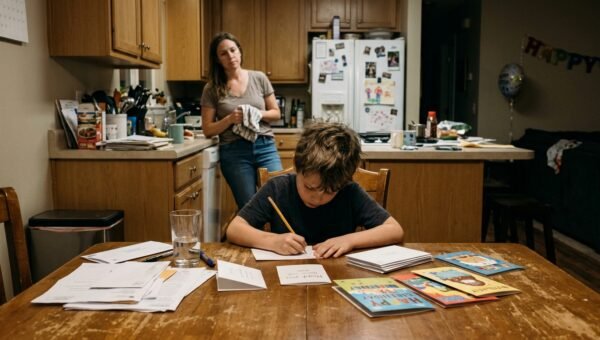
I stood in my Minnesota kitchen, phone pressed to my ear, staring at twenty-three crayon drawings on my refrigerator. They were secret gifts from my eight-year-old granddaughter Abigail.
She sent them to me inside brown paper grocery bags she folded flat and stuffed into the mailbox when her mother was not looking.
“I see,” I whispered. That was all I said. Because at fifty-nine, I had learned that arguing with Thomas only made his voice tighter and his walls higher.
“I knew you’d understand,” relief washed over his voice, fast and careless. “Courtney has the caterers coming at four on Christmas Eve. We just have too many people flying in from the Chicago office. We’ll drive up to Duluth sometime in January. Promise.”
“Take care of Abigail,” I said, and I hung up before he could answer.
The line went dead, leaving only the hum of my refrigerator and the winter wind rattling the storm window above the sink.
I looked down at the counter. I had already wrapped Abigail’s gifts. A collection of classic books I bought second-hand and cleaned myself, and a thick, forest-green wool sweater I spent four months knitting during the long northern autumn.
I had also set aside two jars of homemade strawberry preserves for Courtney, and a tin of spiced pecans Thomas had loved ever since he was seven years old.
Thomas worked as a senior vice president at a boutique commercial wealth management firm in Wayzata, an upscale suburb on the west side of Minneapolis. He had moved there five years ago after marrying Courtney, whose father owned three car dealerships.
Over the last three years, Thomas had slowly trimmed me out of his public life. First it was little things. He told me not to bring casseroles to their house because Courtney was on a clean-eating protocol. Then he suggested I buy a new coat before visiting because my winter parka looked like something from an army surplus store. Then the invitations to family dinners stopped altogether, replaced by quick twenty-minute lunches at chain restaurants halfway between our towns.
I took a breath and sat down at the table. I told myself it did not matter. I told myself adult sons had their own lives.
Then the mail truck rumbled down our gravel road and stopped at the box by the driveway.
I walked out in my boots to get the mail. The wind cut right through my flannel shirt. There was a gas bill, two grocery store flyers, and a thick, white square envelope addressed to me in rounded pencil printing.
It was from Abigail.
I took it inside, stamped the snow off my boots, and sliced open the envelope with a paring knife.
Inside was a folded piece of yellow construction paper. On the front, Abigail had drawn a picture of me sitting on my front porch swing, wearing my red slippers.
Tucked into the fold was a heavy cream card with gold foil lettering. It was the formal invitation Thomas and Courtney had printed for their Christmas Eve open house.
I flipped the card over. On the back, in faint blue pencil, Abigail had written five crooked lines:
“Grandma, Daddy told Aunt Sarah you couldn’t come because you are very sick at a home in Florida. But you sent me strawberry jam last week from Duluth. Are you sick? I miss you.”
I stared at the pencil words until the paper began to tremble in my hands.
Thomas had not told his guests that his mother lived two hours north in a quiet house near Lake Superior. He had told them I was sick in a facility fifteen hundred miles away, out of sight, where no one would ever ask to meet me.
PART 2
I did not call Thomas. I did not text him.
If I called, he would give me another smooth speech. He would tell me Abigail misunderstood. He would tell me it was just a misunderstanding among adults.
Instead, I sat at my kitchen table for an hour with my hands wrapped around a mug of black coffee.
My husband David died nine years ago of a sudden heart attack while shoveling our front walk. When David died, he left behind a paid-off house and a $120,000 life insurance policy.
Six years ago, Thomas came to this exact kitchen table. He was twenty-eight then, full of ambition, working sixty hours a week as a junior analyst. He told me he had an opportunity to buy a five-percent equity partnership in his firm, but he needed cash up front.
“Mom, this changes my whole career,” he told me that night, his eyes shining. “If I have equity, I’m not just an employee. I’m an owner. I will pay you back every single cent.”
I gave him $70,000 from David’s life insurance. It was more than half of everything I had in the world. I did not ask for a formal promissory note. I did not take a share of the firm. I wrote a check from my credit union account because he was my son, and I believed in his future.
Since then, Thomas had paid back exactly $14,000. Whenever I gently asked about the rest over the last three years, he brushed me off. He said his money was tied up in real estate. He said private school tuition for Abigail took every dollar of liquidity he had.
Yet here he was, throwing a catered gala in a four-thousand-square-foot house, telling his partners that his mother was locked away in a southern nursing home so they would not see my hands, which were worn from thirty years of clerking at the county courthouse.
On the morning of Christmas Eve, I got dressed. I put on my navy wool slacks, a clean cream blouse, and my neat, plain black shoes. I packed Abigail’s books and her knitted sweater into a simple gift bag.
Then I went to my hall closet, pulled down David’s old metal filing box, and took out the canceled cashier’s check from six years ago. It had my signature on the front, David’s pension account number stamped on the corner, and Thomas’s bold signature on the back, where he had deposited it directly into his firm’s capital account.
I placed the check into my purse alongside the invitation Abigail had mailed me.
I walked out to my ten-year-old station wagon, turned the key, and backed down the driveway into the cold grey morning.
The drive south on Interstate 35 took two hours. The sky hung low with heavy winter clouds, but the highway was salted and clear.
I reached Thomas’s neighborhood in Wayzata at half past two in the afternoon. The houses sat behind stone pillars and iron gates, surrounded by towering pine trees dusted with fresh snow.
Thomas’s driveway was wide and circular. Two white catering vans were parked near the three-car garage. A shiny black town car was already sitting by the front walkway.
I parked my station wagon near the curb, turned off the engine, and took a slow breath. I was not there to scream. I was not there to throw a glass against a wall. I just wanted my son to look at me in the daylight.
I carried Abigail’s gift bag up the stone steps and pressed the doorbell.
The chime rang deep inside the house. A minute later, the heavy oak door swung open.
Thomas stood in the doorway. He was wearing an expensive charcoal suit, a dark red silk tie, and polished shoes.
When his eyes landed on me, the smile he had prepared for an early guest vanished completely. His throat jumped.
“Mom?” he whispered. His eyes darted past my shoulder toward the empty street, as if checking to see who had seen me pull up. “What are you doing here? I told you we had clients.”
“I drove down to give Abigail her Christmas present,” I said quietly. My voice was completely steady. “It will only take five minutes.”
“You can’t be here right now,” he hissed, stepping halfway onto the porch and pulling the door mostly shut behind him. “Courtney’s parents are in the kitchen. Richard Henderson is already in the study. Do you know who Richard Henderson is? He is the managing partner. If he sees you standing here with grocery bags and an old coat, do you know what that looks like?”
“I look like your mother,” I said.
“Mom, please,” he said through his teeth. “You don’t understand how this world works. Image matters. Status matters. I’ll take the bag. Just give me the bag and go home. I’ll Venmo you some money tonight.”
He reached out his hand to grab the gift bag from my arm.
Before he could touch it, the front door swung all the way open.
PART 3
A tall, white-haired man in a navy blazer stood in the wide, warm hallway. He held a glass of mineral water with a slice of lime.
“Thomas?” the older man asked, looking between us. “Is everything alright out here? The wind is coming right through the foyer.”
Thomas pulled his hand back instantly. His face went stiff.
“Everything is fine, Mr. Henderson,” Thomas said, his voice jumping up an octave. “Just an unexpected delivery. A neighbor dropping something off.”
I looked at the older man. He had silver hair, sharp grey eyes, and deep lines around his mouth.
I knew that face.
“Richard?” I said.
The older man blinked. He stepped forward onto the welcome mat and looked closely at my face.
“Martha?” he asked. The confusion on his face broke into complete surprise. “Martha Miller? From the St. Louis County recorder’s office?”
“It has been a long time, Richard,” I said.
Thomas stood between us, his mouth slightly open, looking back and forth like a man who had suddenly stepped off a curb into traffic.
“You two know each other?” Thomas stammered.
“Your mother processed every single commercial title deed for my father’s development company for twenty-five years,” Richard Henderson said. He stepped right past Thomas onto the stone porch and took both of my cold hands into his warm ones. “Martha, what on earth are you doing standing in the freezing cold? Come inside!”
“I don’t think Thomas wants me inside, Richard,” I said plainly. “He told his guests I was in a nursing home in Florida.”
Richard stopped. His grip on my hands loosened, and he turned his head slowly to look at Thomas.
Thomas looked at the ground. A bright, ugly red crept up his neck and flooded his cheeks.
“Is that a fact?” Richard asked quietly.
“It was just… it was a miscommunication,” Thomas muttered, staring at the stone steps. “I thought…”
“He told Aunt Sarah,” a small voice called out.
We all looked inside. Abigail was standing at the base of the wide curved staircase in a dark velvet dress, holding a stuffed rabbit by its ear. Her big brown eyes were fixed directly on me.
“Grandma!” she yelled.
She ran down the hallway, completely ignoring her father, and threw her arms around my waist. The cold of my coat did not bother her at all. She buried her face into my wool sweater and squeezed with everything she had.
“I knew you weren’t sick,” she whispered into my coat. “I knew you were in Duluth.”
Courtney came out of the dining room then, carrying a silver tray of glassware. When she saw me standing in the foyer with Abigail clinging to my legs and Richard Henderson watching silently from the door, she stopped dead.
“Martha,” Courtney said, her voice dropping. “We didn’t expect you.”
“I know,” I said. “Thomas told me I was too inconvenient for the guest list.”
I knelt down on the hardwood floor and set the paper gift bag in Abigail’s hands.
“I made this for you, sweetheart,” I told her. “Try it on later. It has real wooden buttons.”
Abigail beamed, clutching the bag to her chest like it was pure gold.
I stood back up. I reached into my purse, took out the canceled cashier’s check from six years ago, and laid it flat on the marble console table right beneath the mirror.
Thomas glanced down at the paper. His eyes widened when he recognized his own signature on the back.
“Thomas,” I said, keeping my voice low and calm. “You owe my personal account fifty-six thousand dollars. You used David’s life insurance money to buy your seat at Richard’s firm.”
Richard Henderson looked down at the check on the marble table. He saw the date. He saw the amount. He saw his own firm’s account number on the deposit stamp.
“Thomas told the executive committee that capital came from his own investment portfolio,” Richard said, his voice flat and cold as pond ice.
“He lied to you about that,” I said, looking Richard in the eye. “Just like he lied to his friends about me being in a home.”
Thomas looked like he could not draw a full breath. “Mom, please. Let’s talk about this in the other room. Please.”
“There is nothing to talk about,” I said. “You have until the first of February to wire the remaining fifty-six thousand dollars to my credit union. If it is not there by five o’clock on February first, I will file a formal claim with the county court and deliver a copy of this check directly to your compliance officer.”
I looked at Courtney. Her face was pale, her lips pressed into a thin, tight line.
“Merry Christmas, Courtney,” I said.
Then I kissed the top of Abigail’s head. “I love you, Abby. Keep sending your drawings.”
“I will, Grandma,” she promised.
I turned around, walked out the front door, and did not look back once as I walked down the stone path to my car.
ENDING
The drive back to Duluth was long and quiet.
By the time I reached Hinckley, the snow began to fall in thick, silent flakes. The wipers moved back and forth with a steady rhythm.
My phone rang four times while I was on the highway. I did not pick it up.
When I reached my house, the front porch light was shining across the white yard. I walked inside, kicked off my boots, and hung my coat in the hall closet.
The house was empty, but for the first time in three years, it did not feel lonely. It felt clean. The knot that had been sitting behind my ribs since David died seemed to loosen.
On January twenty-eighth, three days before my deadline, my credit union called me. The teller told me a wire transfer of fifty-six thousand dollars had just arrived from an account in Minneapolis.
Thomas sent a short text an hour later: “It’s done. I hope you’re happy.”
I did not reply. I took forty thousand dollars of that money and placed it directly into an irrevocable college savings trust under Abigail’s legal name, with a local bank officer named as the sole trustee until she turns twenty-one. The rest went into my own retirement fund.
In February, a mutual friend told me Thomas had been quietly reassigned to an internal research desk at his firm. He no longer handled client-facing networking events. Richard Henderson was a man who valued honest ledgers, and Thomas had shown him exactly what kind of bookkeeper he really was.
Last Tuesday, another square white envelope arrived in my mailbox.
Inside was a sheet of yellow paper with three pine trees drawn in green crayon, and a small red bird sitting on the middle branch.
Tucked inside was a tiny note in pencil: “The sweater fits perfect. I wear it to bed. Love, Abby.”
I walked over to the refrigerator, pulled down an old magnet from the hardware store, and pressed the new drawing firmly into place beside the others.
Then I put the kettle on the stove and sat down by the window to watch the snow fall over the lake.