PART 1
When my husband cracked my ribs and walked out the door, my five-year-old son did not cry first.
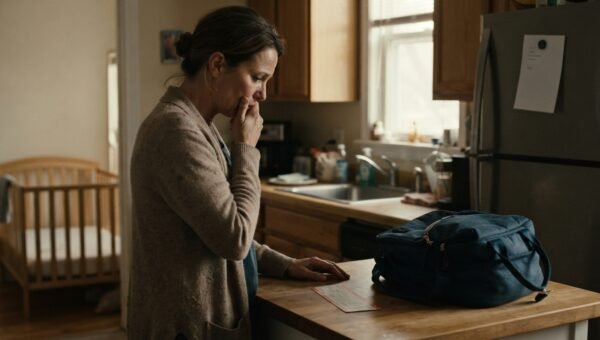
He stood frozen in the narrow doorway between the kitchen and the living room. His blue pajamas had little yellow airplanes on them. The kitchen linoleum was cold beneath my cheek, and every tiny sip of air felt like someone was dragging a serrated blade across the right side of my chest.
Darren had slammed the heavy oak front door so hard the glass pane inside the storm door rattled. His truck engine roared to life in the driveway, gravel spun against the garage siding, and then the street went dead quiet. All that was left in the house was the hum of the refrigerator and the sound of my ragged, shallow wheezing.
I tried to push my shoulders up off the floor with my left hand. A sharp, white-hot spike ripped through my side, and a choked cry slipped past my lips before I could bite it back.
“Mama,” Leo whispered.
“Stay there, baby,” I tried to say, but it barely came out as a whisper. “Stay right there. Don’t look.”
He did not stay there. He padded softly across the yellow linoleum in his stocking feet. He did not look at the overturned wooden chair, or Darren’s spilled coffee pooling dark against the baseboards.
He looked right into my eyes. His little face was completely pale, his lower lip trembling, but his hands were steady.
My phone had slid under the kitchen table when Darren shoved me back against the counter edge.
Leo dropped to his knees, slid under the table, and pulled the phone out by its red rubber case. He tapped the screen to wake it up. He already knew the four-digit code because I always let him pick out songs on the grocery runs.
I thought he was going to dial 911. My heart seized with sudden terror, because Darren was a lieutenant in our county road maintenance department. His uncle was the former magistrate, and every time Darren lost control, he always leaned over me and warned me about what would happen if I ever brought the county deputies to our porch. He said they would treat it like a domestic spat, take him down to the station for two hours, and then let him come right back home twice as angry.
“Leo, no,” I gasped out, clutching my ribs with one trembling hand. “Baby, put it down.”
Leo shook his head. His eyes were wide and dark with a stubborn clarity no five-year-old child should ever have to carry.
“This is what Grandpa is for,” he said.
He scrolled straight past the emergency keypad and tapped the photo of my father holding a catfish on the dock at Lake Cumberland.
The phone rang twice on speaker. Every ring echoed through the silent house like a gunshot.
“Arthur here,” my dad’s gravelly voice came through the small speaker. It was five in the morning. Dad was always awake by four, drinking black coffee in his workshop out in Finchville, thirty minutes down the state highway.
Leo brought the phone right up to his mouth. Then his tiny voice shook as he whispered, “Grandpa, come now. Mama can’t breathe.”
PART 2
There was a three-second silence on the line that felt like eternity.
In those three seconds, my father did not ask what had happened. He did not ask if we had called an ambulance. He knew Darren, and he had spent three years biting his tongue while watching bruises I always blamed on garden tools and basement stairs.
“Leo,” Dad said, his voice flat, steady, and terrifyingly calm. “Is Darren in that house?”
“No,” Leo whispered, pressing one small hand against my forehead. “He drove away in the red truck.”
“I am in the truck right now,” Dad told him. “Put the phone next to your mama’s ear and do not touch the front door until you see my green Ford. Do you hear me, buddy?”
“Yes, Grandpa.”
Leo laid the phone on the linoleum right against my cheek. I heard the grinding roar of Dad’s old diesel engine catching, followed by the clinking of keys and the heavy slam of a truck door.
“Ruthie,” Dad said.
“Dad,” I choked out, tears finally spilling hot down into my hair. “It hurts. I think something is broken.”
“Don’t move. Don’t try to get up. Take the smallest breaths you can. I’m twenty-four minutes out. If you feel like you’re passing out, you tell Leo to press the red button and dial nine-one-one immediately. Otherwise, you wait for me. I am bringing Tom.”
Tom was my father’s younger brother, a retired state trooper who lived two farms over.
Hearing those two names together did something to the panic trapped in my throat. For four years, Darren had carefully severed every line I had to the world. He had convinced me that my family thought I was dramatic, that my father was too old to care, and that if I ever left, Darren would take Leo and make sure the local family court saw me as unstable. I had stayed because fear had made the four walls of that house feel like the only boundary keeping my son safe.
While we waited, Leo sat cross-legged on the floor beside me. He took a dish towel off the oven handle, folded it into a messy square, and gently slid it under my head so my cheek wasn’t resting on the cold floor. He didn’t cry. He just kept his small hand resting on my wrist, feeling my pulse.
Twenty-one minutes later, two sets of headlights swept across the kitchen ceiling.
A heavy diesel engine idled down outside, followed by two truck doors closing firmly. There was no screeching of tires, no frantic running. Just the deliberate, heavy footsteps of two older men coming up the gravel walkway.
The front door opened. Dad walked into the kitchen first, wearing his faded denim work coat and work boots. Uncle Tom was two steps behind him, carrying an old canvas duffel bag and a heavy winter blanket.
Dad took one look at me on the floor, took in the broken chair, and dropped to his knees with an agility that surprised me for a man seventy-one years old. His rough, calloused hands were gentler than anything I had felt in years as he checked my collarbone and the side of my ribcage.
“Right side,” I whispered, wincing as fresh pain tore through me. “Sixth or seventh rib, I think.”
“Tom, call Doc Miller at the regional clinic in Shelbyville,” Dad said, not taking his eyes off mine. “Tell him we’re bringing Ruthie in through the private drive behind the annex. Tell him I don’t want county records pulled until we have her x-rays and an official state police complaint drafted in Tom’s handwriting.”
Uncle Tom pulled his flip phone out and immediately stepped onto the back porch.
Dad looked at Leo. He reached out with one broad arm, pulled my little boy against his chest, and kissed the top of his head.
“You did the right thing, son,” Dad told him quietly. “You saved your mama.”
Leo buried his face into the collar of Dad’s coat, and for the first time since Darren had shoved me to the floor, his little shoulders began to shake with silent, heavy sobs.
PART 3
Uncle Tom helped Dad wrap me tightly in the wool blanket and lift me between them. Every movement made the world go gray around the edges, but they moved with military precision. They carried me out to the front seat of Dad’s truck, reclining the passenger seat back so I didn’t have to sit upright. Leo climbed into the extended cab behind me, holding tightly to Uncle Tom’s hand.
Doc Miller was waiting by the back doors of the clinic in Shelbyville with a wheelchair. He had known my father for forty years. He didn’t ask questions in the hallway; he wheeled me straight into the imaging room.
The x-rays showed two clean fractures on my sixth and seventh ribs, along with severe contusions across my right shoulder blade. Doc Miller gave me an injection for the pain, wrapped my torso to stabilize the bone, and then shut the exam room door behind him.
“Ruth,” Doc Miller said, looking at me over the top of his wire-rimmed glasses. “These aren’t from falling down the cellar stairs. If I report this through normal county dispatch, Darren’s buddies on the night desk are going to see the blotter before noon.”
“I’m filing it through the district state police post in Frankfort,” Uncle Tom spoke up from the corner of the room. He had already laid out three carbon-copy report sheets on the stainless steel counter. “I called Captain Vance twenty minutes ago. Darren doesn’t have friends in Frankfort. The emergency protective order will be signed by Judge Reynolds before Darren even wakes up from whatever motel he parked his truck behind.”
I looked down at my hands. They were trembling. “He said he’d take Leo. He said he has the house in his name and he’d tell them I was unfit.”
Dad stood beside my bed. He reached into his coat pocket and pulled out a manila envelope, creased from years of sitting in his safe at home.
“The house is sitting on the two-acre parcel your mother and I deeded to you when you got married,” Dad said, his voice quiet and completely unyielding. “Darren had you sign a mortgage refinance three years ago, but he never cleared the title with the county clerk because my name is still on the underlying deed of trust. He doesn’t own that ground, Ruthie. He never did.”
I stared at my father. “Why didn’t you ever tell me?”
“Because you were trying to make it work, and you weren’t ready to hear that you had married a wolf,” Dad said softly. “I told Tom three years ago that the day you called, we weren’t going to negotiate. We were going to cut the cord.”
“I didn’t call,” I whispered, fresh tears burning my eyes. “Leo did.”
Dad looked over at the chair by the window. Leo had curled up under Uncle Tom’s jacket and fallen fast asleep, completely worn out.
“He called,” Dad said, “because he knew where safety lived.”
At seven in the morning, Darren started blowing up my phone.
I watched the screen light up on the bedside table: six missed calls, then seven, then a text message.
*Where the hell are you? The kitchen chair is broken and you left the front door unlocked. Get your ass back here before I call the sheriff and report you taking my son.*
Dad didn’t ask for permission. He picked up my phone, pressed the call button, and put it on speaker.
Darren’s voice came through instantly, loud, harsh, and arrogant. “Where are you, Ruth? You think you can just walk out with my kid after the fit you threw this morning?”
“Darren,” Dad said.
The line went completely silent. Darren’s breath caught in his throat.
“Arthur?” Darren stammered, his bravado dropping an octave. “What… why do you have her phone?”
“Ruth is at the regional hospital with two broken ribs,” Dad said, his voice cold as a frozen pond. “Tom has already filed the felony domestic battery paperwork with State Police Post Twelve. Judge Reynolds has already entered the emergency order. If your truck comes within five hundred yards of that farm, or anywhere near Ruthie and that boy, Tom’s troopers will pick you up within ten minutes.”
“Now wait a minute, Arthur, you don’t know what happened, she was screaming and—”
“Do not speak to me,” Dad cut him off, without raising his voice by even a fraction. “Pack your clothes out of that house by noon. My truck will be sitting at the end of the driveway while you do it. If you touch one piece of furniture, or if you leave one drawer open, I will personally hand the district attorney every single photograph Doc Miller just took.”
Dad hung up the phone and laid it back down on the table.
ENDING
We went back to the house at eleven o’clock that morning.
Uncle Tom parked his state police cruiser right across the mouth of the gravel driveway, lights dark, sitting behind the steering wheel in uniform with the engine idling. Dad parked his truck near the porch.
Darren was already there, throwing garbage bags full of work clothes into the bed of his red pickup. When he saw Dad step out of the truck, he stopped with a bag in his hands, his face red and mottled with anger. He looked over toward the passenger side where I was sitting, trying to catch my eye, trying to see if the old fear was still keeping me captive.
I didn’t look down. I rolled the passenger window down just two inches, enough to speak clearly into the cool morning air.
“Leave the house keys on the railing, Darren,” I said.
He took a step toward my side of the truck, his fists clenching. “Ruth, you’re letting your old man run your life. We can talk about this like adults.”
Before he could take another step, Uncle Tom stepped out of the cruiser, resting his right hand lightly on his duty belt.
Darren froze. He looked at Tom, looked at my father who was standing by the porch steps with a heavy pipe wrench resting loosely against his leg, and finally realized that the small, private kingdom of terror he had built inside those four walls was completely gone.
He threw the last trash bag into the bed, pulled the ring of house keys off his carabiner, and threw them onto the gravel.
“You’ll go broke trying to keep this place,” Darren spat, climbing into the cab. “You won’t last six months on your own.”
He backed down the drive, turned onto the county blacktop, and sped away toward the interstate. He didn’t look back.
Two weeks later, the bruises on my ribs had faded from black to an ugly yellow-green. Breathing still caught in my chest if I moved too quickly, but the air inside the house didn’t feel heavy anymore.
Dad had spent the weekend replacing the broken chair, changing every deadbolt on the exterior doors, and helping me pack the remainder of Darren’s forgotten tools into boxes for his lawyer to pick up. The family court judge in Frankfort granted full temporary custody without Darren even daring to show his face in the courtroom; Uncle Tom’s official state report and Doc Miller’s medical files had closed that door before Darren’s attorney could even file an objection.
On Sunday evening, Dad was sitting at the kitchen table, helping Leo glue together a balsa wood model airplane.
The kitchen linoleum was clean. The late afternoon sunlight poured through the window above the sink, making the whole room warm.
I brought two mugs of black coffee over and set one down in front of Dad. He looked up at me, his weathered face softening into the kind of quiet pride he had carried my entire life, even when I had been too blind to see it.
“You sleeping through the night yet, Ruthie?” he asked.
“Mostly,” I said, sitting down next to Leo. “The house feels different.”
“It’s yours,” Dad said simply. “Always was.”
Leo carefully laid the little wooden wing down on a piece of wax paper. He looked up at Dad, then reached over and put his small, sticky hand over mine, right against the knuckle where my wedding ring had been until three days ago.
“Mama,” he said, his voice clear and untroubled. “Does your side still hurt?”
“Only a little bit, baby,” I smiled, leaning down to press my cheek against his hair. “Hardly at all now.”
He nodded once, completely satisfied, and went right back to his airplane. He didn’t carry the fear anymore. He had carried the whole world on his small shoulders for twenty-four minutes on a cold kitchen floor, but the moment he put that phone into his grandfather’s hands, he had been allowed to become a five-year-old boy again.
And I had finally learned that you never have to stay broken just to keep the peace.