PART 1
It started with laundry, like so many ordinary disasters do.
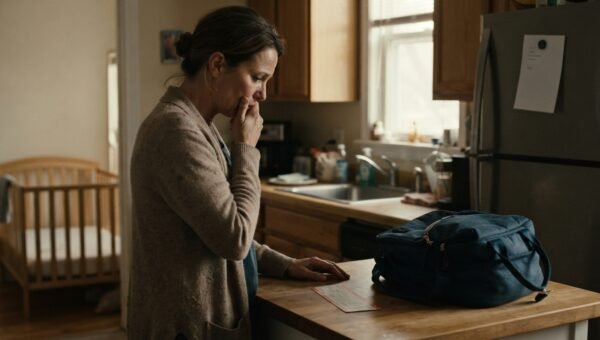
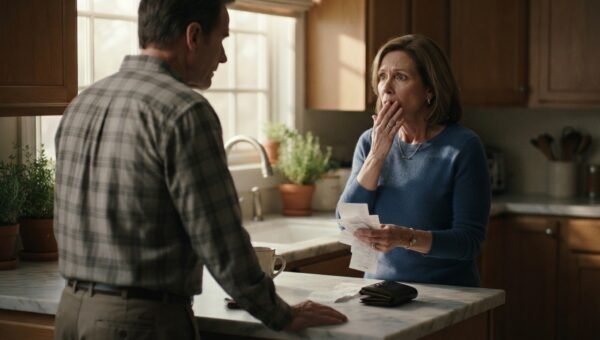
David had come home from work around five on a Tuesday afternoon, complained of a headache, and gone straight up to bed. His wool trench coat was draped over the back of the kitchen chair instead of hung in the hall closet where it belonged. I picked it up by the shoulders to hang it up properly. When I shook it out, something light and plastic slipped from an inner breast pocket and clattered onto the hardwood floor.
I bent down and picked it up. It was a white plastic key card sleeve with a navy blue logo: Hilton Garden Inn.
I turned it over in my hand. Inside was the magnetic key card itself. On the paper sleeve, written in bold purple ink from a desk clerk’s ballpoint pen, were two numbers: 718. Below that was a date stamped from the previous week.
David worked as an independent commercial insurance appraiser. His territory was strictly local, covering two counties. There was no legitimate reason on earth for him to stay at a hotel twenty-two miles down the turnpike from our suburban home of thirty-one years.
I stood in the quiet hallway with the little plastic card resting against my palm. My thumb rubbed the smooth edge. I did not want to be a suspicious woman. We were fifty-four years old. We had put two children through college.
Our mortgage was paid off. We had a life that felt settled, solid, and safe. Yet my chest went tight and cold.
The next morning, after David kissed my cheek and left the house at seven sharp, I sat down at the kitchen island with my coffee and my cell phone. I dialed the front desk of the Hilton Garden Inn off Route 9.
A young man answered. “Hilton Garden Inn, how may I direct your call?”
I cleared my throat and tried to keep my voice light, breezy, and completely normal. “Hello. My husband and I were reviewing our travel receipts for his taxes. He stayed with you recently under the name David Miller, Room 718. But we seem to have misplaced a couple of dates. Could you confirm his recent check-ins?”
The clerk paused, typing on a keyboard. “David Miller… yes, ma’am. Let me check the folio history.
I see Room 718. Actually, Mr. Miller has a recurring corporate profile with us. He has been checking in every Wednesday afternoon.”
My breath caught in my throat. “Every Wednesday?”
“Yes, ma’am. The reservation is set under a recurring hold. It shows every Wednesday for the last eleven months. The checkout is always before nine o’clock the same evening.”
“And the billing?” I managed to ask, my fingers gripping the edge of the granite counter. “Was that charged to his Visa?”
“No, ma’am,” the clerk answered without hesitation. “It notes here each week that payment is settled at the counter upon arrival in cash. The rate is $149 plus tax. A flat $148 or $149 with the corporate daytime discount. Total on that account is right around $6,512 across the past eleven months.”
Eleven months. Cash payments. Never once showing up on our joint checking or credit accounts.
I hung up the phone. The house was dead quiet.
I pulled out our laptop and logged into our bank records. I knew our finances down to the penny.
David didn’t have a secret bank account; I handled all our tax returns. So where was $150 in cash coming from every single week?
I dug through our monthly statements. There were regular withdrawals of $300 every two weeks from a regional bank ATM down near his field office, listed simply as miscellaneous spending. I had never questioned it. For nearly a year, David had been skimming cash from his personal allowance to pay for an afternoon hotel room less than half an hour from our front door.
I did not confront him that night. I sat across from him at dinner, watching him cut his chicken breast, watching his hands, watching his eyes. He looked tired. He looked ordinary. He complained about his lower back and asked if we needed more mulch for the front flowerbeds. I looked at the man I had shared a bed with for three decades and felt like I was looking at a stranger wearing his skin.
The following Wednesday, I waited until five o’clock.
I told myself I was crazy. I told myself there was some bizarre, harmless explanation. But I got into my sedan anyway, merged onto the turnpike, and drove the twenty-two miles south.
The hotel was a generic five-story brick building tucked between an office park and a steakhouse. I parked in the far back corner of the lot, behind a row of delivery vans, where my car wouldn’t be easily spotted.
At 6:15 PM, David’s silver sedan pulled off the access road. He parked three rows away from the main entrance, stepped out, zipped his jacket, and walked inside through the automatic sliding doors. He was carrying nothing. No briefcase, no overnight bag.
Three minutes later, at 6:18 PM, a second car turned into the lot. A dark blue crossover.
A woman got out. She wore a beige trench coat with a silk scarf tied loosely over her hair. She kept her head down, walked briskly toward the side entrance, and slipped inside using an exterior key scanner.
They walked in separately.
I sat in my car with my hands gripping the steering wheel so hard my knuckles turned white. My heart pounded against my ribs like a trapped bird. For thirty agonizing minutes, I sat in the cold car, watching the lobby windows, waiting to see if they would come back out.
They didn’t.
At 6:50 PM, I opened my car door, walked into the warm, carpeted lobby, and walked straight past the front desk toward the elevators. Nobody stopped me.
I rode the elevator up to the seventh floor. The hallway smelled of industrial cleaning lemon and stale carpet. I walked down the long corridor until I stood directly in front of the door with the brass numbers: 718.
I raised my hand. I knocked. Three firm, deliberate raps.
From inside, I heard rustling. Footsteps approached slowly. The peephole went dark. Then the deadbolt turned with a heavy, metallic click.
The door opened.
David stood there. His tie was gone. His white dress shirt was completely untucked, unbuttoned at the collar, his hair slightly disheveled.
He looked at my face. His mouth parted, but no sound came out. He didn’t speak for twelve whole seconds. The color drained from his face until his skin looked like wet paper.
Slowly, without a word, he stepped aside and opened the door wider.
I stepped into the room.
Sitting on the edge of the unmade king bed was the woman in the beige coat. Her scarf was off now. Her dark brown hair fell past her shoulders. She looked up at me, her eyes wide with shock.
I felt the floor tilt beneath my boots.
I recognized her instantly. It was Sarah.
Sarah was the thirty-two-year-old widow of my younger brother, Mark. Mark had passed away in a motorcycle crash two years earlier, leaving Sarah alone with their young son. David and I had sat in the front pew with her at Mark’s funeral. We had helped her sort Mark’s estate.
David swallowed hard. His voice cracked as he broke the awful silence.
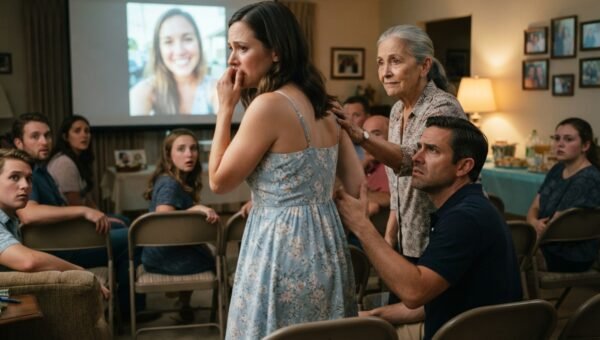
“Maggie, wait,” he stammered, raising both hands toward me. “Please. It’s not what you think. She came to me. She said if I didn’t meet her here every week, she would tell you what really happened between her and Mark.”
PART 2
The room was suffocatingly quiet. The low hum of the wall air conditioner sounded like a jet engine.
I stared back and forth between them. Sarah sat frozen on the corner of the mattress, her fingers clutching her small leather purse. Her eyes were red-rimmed, but she didn’t look guilty the way an caught lover looks guilty. She looked exhausted, trapped, and furious.
“What are you talking about?” My voice didn’t even sound like my own. It was a dry, raspy whisper. “What happened with Mark?”
David stepped closer to me, his hands still raised in an appeasing gesture. “Maggie, listen to me. After Mark died, Sarah was going through his personal things. She found letters. She found financial statements. She came to my office eleven months ago and said Mark had left behind a massive mess, and that he had done things that would completely destroy your memory of him. She said if I didn’t pay her living expenses and meet her here to hand over the cash, she was going to bring all of Mark’s private papers straight to you and your parents.”
“You liar,” Sarah said clearly from the bed.
David spun around on his heel. “Shut up, Sarah!”
“I will not shut up,” Sarah said, standing up. She wasn’t trembling anymore. She pointed a trembling finger straight at David’s chest. “You are still lying to her. Even right now, with her standing in this room, you are still trying to pin this on a dead man.”
“Get out,” David snarled, his face suddenly dark and red with a rage I had never seen in thirty years of marriage. “Get your coat and get out of here!”
“No,” I said, stepping firmly between them. I looked directly at Sarah. “Sit back down. Neither of you is leaving this room until I get the truth.”
Sarah looked at me, her lower lip quivering. “Maggie, I never blackmailed him about Mark. Mark was completely clean. Mark loved you.”
“Then why are you here?” I demanded, the room spinning around me. “Why has my husband been handing you $150 every single Wednesday in a cheap motel room for nearly a year?”
Sarah reached into her purse. David lunged forward to grab it from her, but I threw my arm out and shoved his shoulder back with every ounce of strength I had. He stumbled against the desk, knocking over an ice bucket.
“Don’t you touch her,” I warned him.
Sarah pulled out a folded legal envelope and handed it to me. Her hand was shaking violently now.
“Three years ago, before Mark’s accident, your husband convinced Mark to invest his entire life savings into a commercial real estate syndication,” Sarah said, tears finally spilling over her cheeks. “Mark put in two hundred and forty thousand dollars. It was his retirement, his equity from his first house, everything we had saved for our little boy’s college. David swore it was guaranteed. He told Mark it was off-the-books, an exclusive pre-market deal through one of his commercial appraisal clients.”
I opened the envelope. Inside were copies of cashier’s checks signed by my brother Mark, payable to an LLC I had never heard of. Attached to them were private promissory notes bearing David’s unmistakable handwriting and his legal signature.
“The investment was completely fake,” Sarah whispered. “There was no commercial property. David took the money to cover his own gambling losses at the riverboat casino across state lines. Mark found out three days before his accident. They had a screaming fight in David’s office. Mark was going to the police on Monday morning. But on Saturday night, Mark’s bike was hit by a drunk driver on the highway.”
My chest seized. I looked at David.
He was pressed back against the desk, his head down, staring at the carpet. The defensive anger had vanished from his face, replaced by a hollow, sickening guilt.
“Mark was gone,” Sarah continued, wiping her face with the back of her hand. “David came to my house the week after the funeral. He told me that if I ever tried to cash those promissory notes or take them to an attorney, he would declare personal bankruptcy immediately. He told me you and he had no liquid assets, that the house was tied up in debt, and that I wouldn’t get a single penny for my son. But he said if I kept quiet and didn’t tell you, he would slowly pay me back under the table.”
“He told you to meet him here?” I asked, my voice breaking.
“He refused to do it electronically,” Sarah said. “He refused to send checks in the mail. He said he had to control the paper trail. He made me drive out here every Wednesday to collect whatever scraps he claimed he could squeeze out of his weekly spending money. A hundred and fifty dollars. Two hundred dollars. He held it over my head like a dog treat. Sometimes he would make me sit in this room for an hour while he lectured me about being patient, reminding me that if you ever found out, you’d file for divorce, freeze the marital accounts, and I’d end up with nothing.”
I looked at the paperwork in my hands. The dates, the signatures, the amounts. It was all there. My husband hadn’t just been hiding an affair. He had robbed my dead brother, bankrolled a gambling habit, and used my brother’s grieving widow as a hostage to protect his comfortable suburban reputation.
PART 3
I didn’t yell. I didn’t throw anything. An eerie, ice-cold calm settled over my body.
“Is this true, David?” I asked.
David slowly lifted his head. “Maggie… the market went bad. I didn’t set out to hurt Mark. I made a bad call with some private poker debts, and I thought I could turn the money over quickly and pay him back before anyone noticed. I panicked.”
“You let my brother die thinking his family was ruined,” I said.
“I was trying to fix it!” he cried out, his voice cracking into a pathetic whine. “I’ve been giving her money every week! I didn’t want you to lose the house. I was trying to protect our family!”
“You were protecting yourself,” I said.
I turned to Sarah. “Take your things. Go home to your son.”
Sarah hesitated, looking nervously at the papers in my hand. “Maggie, those copies…”
“I’m keeping them,” I said. “And you will get every single dollar my brother gave him. Every cent. I give you my word as Mark’s sister. Now go.”
Sarah nodded, grabbed her trench coat from the bed, and walked out the door without looking back. The latch clicked shut behind her.
David took a step toward me. “Maggie, please. Let’s go home. We can talk about this at the kitchen table. We can figure out a repayment plan. We have equity. Nobody else has to know.”
“Do not come home tonight,” I said evenly.
“Maggie—”
“If you come to the house tonight, David, I will call the county sheriff and hand them these signed promissory notes,” I said, looking him dead in the eyes. “Stay in your hotel room. You paid cash for it anyway.”
I turned and walked out of Room 718.
I took the elevator down, walked across the brightly lit lobby, and got into my car. I sat in the front seat for twenty minutes until the violent shaking in my hands stopped. Then I drove home.
The moment I walked through the front door of our dark house, I didn’t go to bed. I went straight to David’s home office. I spent the next six hours pulling every file drawer open. I found his tax records, his insurance appraisal logs, and our property deeds. Hidden beneath a stack of old boat manuals in the bottom desk drawer, I found what I was looking for: a ledger notebook with handwritten dates, numbers, and casino receipts from the riverboat across the state border.
He hadn’t stopped gambling three years ago. The withdrawals were still happening.
At eight o’clock the next morning, I was sitting in the conference room of a senior partner at a reputable family law firm in town, an attorney who had handled Mark’s estate probate two years earlier. I laid the promissory notes, the cashier’s checks, and the gambling ledger across the polished oak table.
“My husband owes my brother’s estate two hundred and forty thousand dollars,” I told the lawyer. “And I am filing for divorce immediately.”
By noon, the attorney had filed an emergency motion for a financial restraining order to freeze all joint bank accounts, brokerage funds, and credit lines, preventing David from liquidating or hiding any remaining assets.
When David finally tried to return to the house at two o’clock that afternoon, he found the locks changed. A locksmith was just finishing up his tools on the front porch. When David began banging furiously on the front door, shouting my name, our local police cruiser pulled into the driveway. My attorney had already notified them of the civil freeze and our intent to pursue criminal fraud charges if he caused a disturbance.
The officer handed David a copy of the temporary protection order and told him he had ten minutes to gather his personal clothing under supervision.
David stood on the driveway in his rumpled suit, looking at me through the front window. For the first time in thirty-one years, I looked at him and felt absolutely nothing.
ENDING
The legal process was brutal, but the paper trail was airtight.
Because the promissory notes bore David’s personal signature and detailed the exact funds he had taken from Mark under the false pretenses of an unlicensed investment, David had no defense. My attorney made it crystal clear: either David cooperated fully with a fast-track financial settlement, or we would hand the entire case over to the state attorney general’s financial crimes division.
Facing potential prison time for wire fraud and theft by deception, David folded.
Under the final divorce and settlement decree signed six months later, our marital home—the house we had fully paid off—was placed on the market. It sold for $485,000.
Every single penny of David’s half of the house equity, along with the liquidated cash value of his commercial appraisal business vehicle and his private retirement annuity, was seized and transferred directly into an irrevocable trust fund set up for Sarah and her son. The full principal of $240,000 was restored to Mark’s family, along with statutory interest to cover the two years David had spent dodging his debt.
David was left with virtually nothing. He moved into a run-down one-bedroom rental apartment near the interstate and had to take a job working as an hourly desk adjuster for an auto insurance firm. His reputation among the local real estate and appraisal community was completely ruined once the court filings became public record.
As for me, I took my half of the house sale proceeds and purchased a modest, sun-filled two-bedroom townhouse fifteen minutes away.
Last Sunday, I had Sarah and my little nephew, Toby, over for dinner. Toby is six now, with Mark’s bright blue eyes and the same stubborn cowlick my brother had when we were kids. As Toby sat on my living room floor building Lego towers, Sarah came into the kitchen to help me slice the roast.
She looked rested. The dark circles under her eyes were gone. For the first time since my brother died, she looked like a young woman with a future instead of someone running on pure survival instinct.
“I was so terrified of you finding out,” Sarah said quietly, looking out the kitchen window at the small garden. “David made me believe you would hate me. He told me you’d think I was trying to extort your family.”
I put my knife down, reached out, and took her hand in mine.
“Mark was my brother,” I told her. “Protecting you and Toby is the only thing that made any of this nightmare make sense.”
She smiled through a tear and squeezed my fingers tightly.
Sometimes, an ordinary Tuesday afternoon can blow your entire life apart. You think you’re just putting away a coat, and an hour later you realize your thirty-year marriage was built on quicksand. But as I listened to my nephew laughing in the next room, I knew that the truth, no matter how much it hurts when it breaks open, is always the only thing that can set you free.