PART 1
The aluminum T-ball bat caught me right below the ribs on my left side. It was an old bat from my nephew’s elementary school days, gray with peeled yellow grip tape, and it made a dull, heavy thump when my mother swung it.
“Get your things into the basement or get out on the street,” Mom shouted, her face flushed red right up to her gray hairline. “Clara and Greg are married adults.
They need the master suite. You’re single, Beth. You don’t need a king bed, a walk-in closet, and a private bath all to yourself.”
My side throbbed with a burning, sick ache. I didn’t yell. I didn’t grab the bat out of her seventy-two-year-old hands. I just looked at her standing in the doorway of the bedroom where I had slept for the last three years. She was breathing hard, gripping the metal handle with both hands, glaring at me like I was a squatter refusing to leave a guest room.
“I asked you a simple question, Beth,” she said, tapping the bat against the doorframe. “Are you packing your clothes, or do I throw them down the cellar stairs myself?”
“I’m walking out to my car,” I said quietly.
“Good,” she snapped. “Clara’s U-Haul will be here in twenty minutes. Don’t come back until you’ve learned some respect.”
I walked down the hallway, through the kitchen, and out the side door into the driveway.
The October air was crisp, smelling like damp leaves and neighbor’s chimney smoke. Every step sent a sharp pinch into my ribs, but my mind was completely clear.
Mom truly believed this was her house.
Four years ago, Dad passed away, leaving behind eighty-six thousand dollars in unpaid medical debts and a delinquent mortgage notice from First Heritage Bank. The house was three weeks from a sheriff’s auction. Mom had sat at the Formica kitchen table, sobbing into paper napkins, begging me not to let the county take the only home she had known since 1984.
Clara, our younger sister, had refused to put in a single dollar. Clara had claimed she and Greg were saving for their first home and couldn’t risk their credit score.
So I stepped in. I didn’t just bail Mom out. The bank refused to refinance in Mom’s name because she had zero income outside her nine-hundred-dollar Social Security check.
The only way to save the property was an outright purchase. I paid off Dad’s outstanding balance, took out a new primary mortgage for one hundred sixty-four thousand dollars under my name alone, and paid nine thousand dollars in closing costs and back taxes out of my own retirement savings.
Mom signed the warranty deed at the title company in front of a notary. She cried tears of relief and hugged me in the parking lot.
Then, over the next three years, Mom’s memory started doing convenient tricks.
She told the neighbors I had moved in to help her with groceries. When relatives visited for Thanksgiving, she sat at the head of the table and talked about how hard it was keeping up with her property taxes, even though the automatic withdrawal came out of my personal checking account on the first of every month. I let her talk. I thought letting her preserve her pride was the kind thing to do.
She was getting older, her world was getting smaller, and I didn’t see the harm in letting her feel like the matriarch under her own roof.
Keeping quiet had been my biggest mistake.
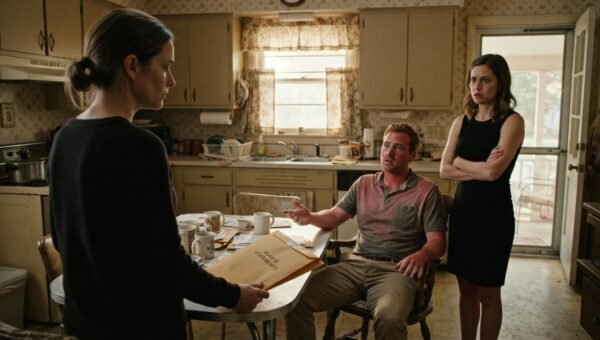
I unlocked the trunk of my sedan, opened my hard-sided work briefcase, and pulled out the thick navy blue folder from the title company. Inside was the certified deed, the title insurance policy, and the county tax receipts stamped paid in full.
I tucked the folder under my arm, pressed my left hand against my bruised side, and walked back up the front porch steps.
Mom was in the foyer, dragging a cardboard box of my winter coats toward the front door. When the screen door squeaked open, she dropped the box and stared at me.
“Why are you back?” she demanded.
PART 2
“I told you not to come back inside until you had an apology ready,” Mom said, pointing a finger toward the driveway. “Greg is driving the truck. If he sees you making a scene, he won’t be as polite as I was.”
I set the navy folder on the hall table right beside her ceramic key bowl.
“Call the police, Mom,” I said.
She blinked, her chin jerking back slightly. “What did you say?”
“I said call the police. Tell them you struck your daughter with an aluminum bat because she wouldn’t give up a bedroom. Or I can call them myself and show them the welt on my ribs.”
Mom scoffed, though her eyes darted toward the window. “Don’t you be ridiculous. A mother has every right to discipline someone in her own house. You’re forty-nine years old, acting like a spoiled teenager. Clara is family. Her husband is starting a new job in town on Monday. They need a stable place to land while they look for a house to buy. You’re being selfish, just like your father was whenever I asked for something reasonable.”
Before I could answer, a loud rumble vibrated through the floorboards. A twenty-foot moving truck pulled into the gravel driveway, followed closely by Clara’s white SUV.
Clara hopped out of the front passenger seat, wearing workout leggings and a puffy vest. She had a cardboard coffee cup in one hand and her phone in the other. Greg climbed out from the driver’s side of the cab, stretched his arms, and walked around to the roll-up back door.
“Mom!” Clara called out, pushing through the front door without knocking. “Greg backed the truck as close to the garage as he could. Where do you want us to start? We want the big dresser moved into the master bedroom before dark.”
She stopped when she saw me standing in the hallway, holding my side. Her smile vanished into a tight, impatient line.
“Oh,” Clara said, looking at Mom. “I thought you said Beth agreed to take the basement.”
“She’s being stubborn,” Mom said quickly, crossing her arms. “She’s trying to make a federal case out of a family matter.”
“Beth, come on,” Clara sighed, rolling her eyes as she set her coffee on my hall table. “Don’t do this today. We rented this truck for eight hours. We have our entire apartment packed into the back. You have plenty of space downstairs once you clear out the holiday decorations.”
“I am not moving into the basement, Clara,” I said.
“It’s just until spring,” Clara said, her tone dripping with fake sweetness. “Greg needs a quiet room with its own bathroom because he has early shifts. You work remotely on a computer all day. The basement is perfectly fine for your desk and a twin bed.”
“No,” I said.
“It isn’t your decision,” Clara snapped, her patience dropping away entirely. “Mom owns the house. She invited us. She told us last Sunday that the master bedroom was ours. You’re just living here because you couldn’t afford an apartment after your divorce.”
I looked from Clara to Mom. Mom wouldn’t meet my gaze now. She had turned toward the coat closet, pretending to straighten the wooden hangers.
“Mom,” I said, “did you tell Clara you own this house?”
Mom cleared her throat. “Beth, that isn’t the point right now.”
“Tell her,” I said.
“Mom told me the truth weeks ago,” Clara interjected, stepping between us. “She said you give her some rent money to help with groceries, but this is the family home. Dad built this place. When Mom goes, it gets split fifty-fifty between us. So stop acting like you have authority here. You don’t.”
PART 3
I opened the navy blue folder and pulled out the top three pages.
“Clara, look at this,” I said, holding the paper out.
Clara crossed her arms, refusing to take it. “I don’t care about your spreadsheets, Beth.”
“It’s not a spreadsheet. It’s the county deed from three years ago.”
Greg walked through the open front door carrying two large plastic storage bins. “Where do these go?” he grunted, his face red from the weight. “Master bedroom?”
“Hold on, Greg,” Clara said, her eyes finally dropping to the official seal at the top of the paper in my hand.
I read the text out loud, plain and clear.
“Grantor: Evelyn Miller, widow. Grantee: Elizabeth Miller, an unmarried woman. For the sum of one hundred sixty-four thousand dollars, full conveyance of parcel four-one-two.”
The foyer was dead quiet except for the hum of the refrigerator in the kitchen.
Greg slowly set the bins down on the linoleum floor. He looked at Clara, then at Mom. “What is that?”
“It’s the title to this property,” I said to Greg. “Mom sold the house to me three years ago to stop the bank foreclosure. She hasn’t owned a single square foot of this lot since November 2023. I hold the mortgage. I pay the property taxes. I pay the water, the electric, and the homeowner’s insurance. Mom lives here under my permission, free of charge.”
Clara’s face turned mottled red. She wheeled on Mom. “What is she talking about? You told me you held the deed!”
Mom’s hands trembled as she clutched her sweater at her throat. “I had to sign some papers at the bank, Clara! The banker told me it was just temporary paperwork so Beth could secure the loan. It was always supposed to be our house. Beth took advantage of my grief after your father died!”
The lie was so smooth, so practiced, that for a second I couldn’t even speak.
Then I reached back into the folder. I pulled out the closing statement, the disbursement checks, and the four separate notices from the collection agency from four years ago, all stamped with Dad’s delinquent signature.
“You knew exactly what you signed, Mom,” I said, my voice steady. “The attorney sat with you in the conference room for forty-five minutes and explained that you were relinquishing all title and interest. You cried and thanked me for saving you from moving into senior subsidized housing.”
Clara grabbed the deed from my hands. She read the notary stamp, her mouth opening and closing like a fish on a dock.
“You lied to me,” Clara whispered to Mom. “We broke our lease in town. We paid twelve hundred dollars to break the contract because you said we could live here rent-free for two years!”
“I thought Beth would understand family loyalty,” Mom cried, tears finally spilling down her cheeks. “You’re my baby, Clara. You’re starting a marriage. Beth has a good job. She doesn’t need all this room!”
“Beth,” Greg said, his voice completely flat as he wiped his forehead with the back of his arm. “Is this real? Can she really kick us out?”
“I am not kicking you out of your house, Greg,” I said. “Because you were never in it. But you are not unloading that truck into my driveway, and you are not touching a single piece of furniture in my bedroom.”
“You can’t do this to your sister!” Mom shrieked, lunging toward me again. “I will call the sheriff! I will tell them you stole my home!”
“Please do,” I said, lifting the hem of my shirt just enough to show the dark, purplish bruise rising over my ribs. “The sheriff will want to know why this aluminum bat is leaning against my front door, and they will want to see who holds the title to the property. If I call them right now, Mom, you will leave this house in the back of a cruiser.”
Mom froze. Her hands dropped to her sides. The bluster drained out of her face, leaving her looking small, frail, and suddenly very old.
ENDING
Clara didn’t say another word to Mom. She grabbed her purse off the table, marched past Greg, and walked straight out to the truck.
Greg stood in the foyer for a long moment, looking at the floor. “I’m sorry, Beth,” he muttered. “We had no idea. Clara told me it was all arranged with her mother.”
“Get the truck out of my driveway, Greg,” I said.
He nodded, picked up the two plastic bins he had set down, and carried them back down the porch steps. Within ten minutes, the moving truck backed out onto Oak Ridge Road, followed by Clara’s SUV. Neither of them looked back at the house as they drove away.
The house was completely still.
Mom stood in the living room doorway, staring down at her slippers. The grandfather clock Dad had bought thirty years ago ticked steadily in the corner.
“Where am I supposed to go?” Mom asked, her voice barely a whisper. There was no anger left in it, only defeat.
I walked over to the front door, picked up the aluminum bat by the barrel, and carried it out to the garage, placing it high on the top shelf where she couldn’t reach it. When I came back inside, I picked up my folder from the hall table.
“You’re not going anywhere tonight,” I told her. “Your bedroom at the end of the hall is still yours. But things are changing starting tomorrow.”
She looked up at me, fearful. “What do you mean?”
“You’re going to pay three hundred dollars a month toward your utilities from your Social Security check,” I said. “And the first time you raise your voice at me, or the first time you tell another neighbor that I’m a guest in your home, I will file formal eviction papers through the county court. Do you understand me?”
Mom swallowed hard and nodded once. “Yes, Beth.”
“Go to your room,” I said.
She turned and shuffled down the hallway, closing the door behind her without a sound.
I walked into my bedroom, shut the heavy oak door, and locked it. My side ached with every breath, but I didn’t reach for an ice pack right away. Instead, I set the title folder in my top dresser drawer, sat down on the edge of my bed, and listened to the quiet house. For the first time in three years, nobody was pretending. The deed was in my drawer, the roof was mine, and the truth had finally settled into the walls.