PART 1
The key sat in the bottom of Greg’s canvas gym bag, wedged under an old pair of running socks. It was brass, heavy, and brand-new, without a single scratch on the cuts.
We had lived in our split-level on Oak Ridge for twenty-six years. I knew every lock on our property by touch, right down to the sticky latch on the back utility shed. That evening, while Greg was in the shower, I walked that key to every door in the house.
I tried the front entry, the deadbolt off the kitchen, the basement door, and the padlock on the mower shed. None matched.
On Friday afternoon, I took the key to Miller Lock & Safe on Route 4. I paid the man fifteen dollars to inspect it. He set it on his counter, turned it twice in his fingers, and gave me an indifferent look. He told me it was a standard cut for a Kwikset residential deadbolt.
“Not an office cabinet,” he said. “Not a locker. Somebody put this on a house.”
I didn’t confront Greg that night. When you have been married to a man for nearly three decades, you learn how to watch before you speak. I made chicken cutlets, folded two loads of towels, and listened to him talk about his lower back hurting while he watched the ten o’clock news. He set his alarm for six.
He claimed he had an early workout scheduled with his old high school buddy, Ray.
On Saturday morning, he left at six-fifteen. I gave him a three-minute head start, then pulled my blue sedan out of the driveway.
Greg didn’t turn toward the municipal fitness center downtown. He headed straight past the highway junction, out toward the county line. I stayed three cars back, my hands locked onto the steering wheel. He drove fourteen miles out to Crane Avenue, an older neighborhood of neat, brick rental duplexes tucked behind the lumber yard.
He pulled into the gravel drive of unit 412, walked up the three porch steps, and took out the brass key. He turned it once, without knocking.
Before he could step across the threshold, a woman opened the door from the inside. She was wearing a faded blue terrycloth bathrobe, holding a ceramic coffee mug in one hand.
She was easily fifteen years younger than me. She smiled at him, stepped back, and let him walk inside. The deadbolt clicked shut behind them.
I parked fifty yards down the block, under the thin shade of an overgrown maple. I sat in my car for forty minutes. My phone felt heavy in my palm. Every time someone walked past a window or pulled back the mini-blinds, I raised the camera. I took eleven clear photographs of his gray truck in that driveway, the address numbers painted on the post, and his profile through the front picture window.
My attorney, Sarah Vance, had handled my mother’s small estate four years earlier. On Monday morning at nine, I was in her office. I laid the brass key and my printed photos on her blotter.
Sarah didn’t offer empty pity. She simply turned to her computer and pulled the county land registry and property records.
The duplex on Crane Avenue was deeded to Gregory T. Mercer. He had purchased it in November of 2023 for $167,000.
Sarah kept scrolling through the title history, then pulled the public filings on our own home. My breath caught in my chest. In October of 2023, a home equity line of credit had been taken out against our Oak Ridge house for the exact sum of $170,000.
Sarah turned the monitor toward me and printed out the signature page of the bank application.
There was Greg’s bold, slanted script. Right beneath it was my full legal name, Martha Ann Mercer, written out in careful, shaky blue ink.
I had never seen that paper in my life. I had never sat in a loan officer’s office. Someone had forged my signature to strip the paid-off equity out of the home my parents had helped us put a down payment on thirty years ago.
“Martha,” Sarah said quietly, looking up from the desk. “This isn’t just grounds for an immediate contested divorce. A forged bank document for that amount is a federal financial crime. If you sign an affidavit declaring this isn’t your handwriting, the lender will freeze the equity line immediately, and your husband will be looking at criminal fraud charges.”
PART 2
Sarah gave me two options, and neither one offered an easy way out. I could walk directly into the county prosecutor’s office and file a formal fraud report with the bank, or I could allow her to file emergency motions in family court first to freeze every liquid asset we owned before Greg realized the floor had given out beneath him.
“If the bank moves first on criminal charges,” Sarah told me, “they can put a lien across everything, and the duplex will be tied up in litigation for years. If we file the divorce petition with an emergency lis pendens on Crane Avenue, we secure your legal claim on that property before it gets foreclosed or seized.”
I chose the second path. I wanted what belonged to me, and I wanted the truth out in the open where he couldn’t lie his way through it.
That Tuesday, Sarah filed the paperwork under seal to prevent him from taking out any more money. She also subpoenaed the closing file from the title company that handled the 2023 sale.
When the closing packet arrived by email two days later, the real picture became ugly and undeniable. The notary had stamped the HELOC papers at a mobile signing service. The woman who opened the door in the bathrobe was named Brenda Cole. Brenda worked as a receptionist at an auto body shop Greg had used for years. In the closing documents, she was listed as the property manager for Crane Avenue, with a monthly management fee paid directly out of our joint checking account under an abbreviation I had mistaken for our lawn care service.
Greg had not just bought an investment property. He had set up an entire parallel household on our backs. He had used $167,000 of our home’s value to pay cash for her duplex, and he had been paying the monthly interest on that loan by siphoning off my part-time bookkeeping paychecks.
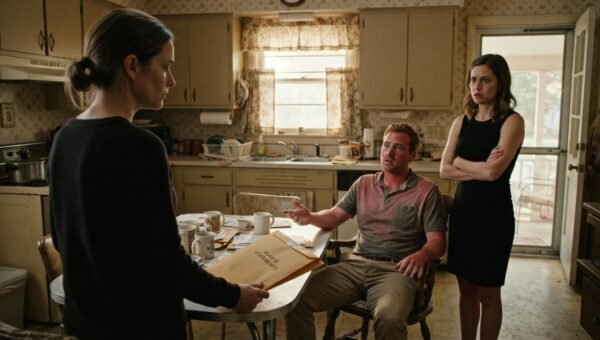
I spent Wednesday evening sitting at our dining room table, laying out thirty months of utility receipts, tax bills, and bank statements. When Greg walked through the kitchen door at six-thirty, tossing his coat over the chair, he had that comfortable, tired look he always wore after work.
“Smells like you didn’t cook tonight,” he said, opening the refrigerator.
I pushed the brass Kwikset key across the polished wood table. It made a sharp clatter against the surface.
He stopped, a carton of milk in his hand, and looked down at it.
“What’s that?” he asked.
“It costs fifteen dollars to find out what kind of lock a key fits,” I said. “And it costs about thirty dollars to pull the title deed for 412 Crane Avenue.”
The kitchen went dead quiet. Greg set the carton down on the counter. The color drained from his jaw, leaving his face looking gray and slack under the overhead fluorescent light.
“Martha,” he started, his voice dropping an octave. “You don’t understand what happened. It was a business investment. A rental. The market was hot, and I wanted something for our retirement.”
“You put Brenda Cole in that house,” I said, keeping my voice level. “You forged my name on a $170,000 equity note. You put our own roof at risk so she could have a duplex free and clear.”
“I was going to pay it back,” he said. He took two steps toward the table, his hands raised slightly like he was trying to calm a spooked dog. “I’ve been making the payments every month. Nobody lost anything. It’s a rental property, Martha. We can sell it. We can make a profit.”
“You forged my name, Greg. That isn’t an investment. That’s a felony.”
PART 3
He didn’t yell. That was the most chilling part. Instead of getting angry, he sank into the wooden chair opposite me, buried his face in his rough hands, and began to plead.
He told me Brenda had been in a bind. Her ex-husband had left her with unpaid bills, she had two young boys, and Greg had felt sorry for her. He said he had started out just helping her fix up an apartment, and then things had gotten out of hand. When the duplex came up on tax auction, he thought he could buy it, keep the equity quiet, and pay the bank back from her rent before I ever noticed.
“She doesn’t even pay rent, Greg,” I said, sliding the bank ledger across the table. “You’ve been paying her five hundred dollars a month out of our grocery money to live there.”
He had nothing to say to that. He sat there staring at his own signature beside my forged one.
“If you go to the police,” he whispered, “I lose my pension. I lose my contractor’s license. Everything we spent thirty years building is gone.”
“You already gave it away,” I told him. “You gave it to a woman in a bathrobe on Crane Avenue.”
The next morning, Sarah Vance served him with the divorce papers right at his job site. Along with the summons was a copy of the handwriting expert’s preliminary affidavit, declaring the signature on the HELOC to be a crude forgery.
Sarah laid out our terms plainly in a settlement letter. Greg would immediately quitclaim his entire sole ownership of 412 Crane Avenue over to me. He would assume sole responsibility for the $170,000 equity balance, refinancing it entirely in his own name or taking out a personal loan against his commercial equipment to pay it off in full. If he refused, the forged documents would be delivered to the bank’s fraud division and the county sheriff by Friday afternoon.
Greg’s lawyer tried to push back for three days, claiming the duplex was marital property subject to split proceeds. But Sarah didn’t budge. She sent them a single sentence in response: marital fraud voids equitable distribution claims when one spouse risks the entire family home without consent.
On Friday at two o’clock, Greg signed the quitclaim deed in Sarah’s conference room. He wouldn’t look me in the eye. His pen trembled as he wrote his name, transferring the full deed of the Crane Avenue duplex into my name alone.
Brenda Cole received a thirty-day notice to vacate the following Tuesday, delivered by a process server. She called our home phone once, screaming into the answering machine that she had children and nowhere to go, but I didn’t pick up. I saved the recording on a flash drive and handed it to Sarah. By the end of the month, a moving van was parked in the gravel drive on Crane Avenue, loading up her furniture.
ENDING
Six months later, the divorce was finalized in a brief hearing before a county judge.
Greg had to liquidate his commercial utility trailer and take a hard lien against his future retirement payouts to satisfy the home equity debt on Oak Ridge. The bank cleared my name from the HELOC, releasing the lien on my house. The house on Oak Ridge is mine now, free and clear, just as my father had always intended it to be.
I didn’t sell the duplex on Crane Avenue right away. In late spring, after Brenda had cleared out, I drove out there on a Saturday morning. The gravel was quiet. The front steps needed a coat of gray sealant, and the small patch of front yard had gone to crabgrass.
I hired a local painter to redo the trim and had Miller Lock & Safe come out to change every deadbolt on both units. The locksmith who showed up was the same older man who had looked at the brass key months earlier. He didn’t remember me, but I recognized his toolbox.
“Two new deadbolts,” he said, handing me a ring with four silver keys. “Nobody else has a copy of these.”
I listed both units for rent with a reputable management company across town. The monthly rent checks come directly to my independent account every month on the first. They more than cover my property taxes, my health insurance, and the upkeep on my home.
Greg lives in a small rented garden apartment near the highway bypass. Sometimes I see his gray truck parked outside the diner near the lumber yard, but I don’t look over.
I keep that brass Kwikset key in the small wooden jewelry box on my dresser, right next to my mother’s silver thimble. It doesn’t open a single door in this world anymore, but I keep it there anyway, sitting in the velvet, just to remind myself what it felt like when I finally learned to stop trusting a lie.