PART 1
The dining room in my grandmother’s house had the same heavy mahogany table she bought thirty years ago, polished until you could see the chandelier reflecting in the wood. Every Sunday dinner felt like an audition nobody could pass, but that evening was supposed to be a celebration for my younger sister, Chloe. She had just landed an entry-level associate job at an interior design firm in Charlotte.
My father had already popped two bottles of expensive champagne, and my grandmother, Evelyn, was presiding over the head of the table like a judge delivering sentences.
I sat near the end, between my brother-in-law and an empty chair. I was tired. I had driven two hours straight from our logistics warehouse after an eighteen-hour shift closing out our fiscal year. My hands were dry from cardboard boxes, and I was wearing a simple navy blazer over jeans because I hadn’t had time to go home and change.
“Now, Chloe,” my grandmother said, lifting her cut-crystal glass, “this is what real ambition looks like. Working with proper clients, building a real career in the city. Not running around with clipboards and dirty inventory.”
She looked straight down the table at me when she said the word inventory.
My father nodded in agreement, slicing into his prime rib. “A steady salary and prestige.
That is what our family name is built on. Quality, not tinkering around in a dusty garage.”
I took a slow breath. For five years, I had poured every dime of my savings, every weekend, and every ounce of my energy into building an industrial supply and packaging distribution business. When I started it, my father told me I was embarrassing the family. When I quit my stable desk job to rent my first small storage bay, Evelyn refused to speak to me for three months. She told everyone at her country club bridge group that I had fallen into gig work because I lacked the discipline for high society.
“Actually, Dad,” I said quietly, setting my water glass down, “speaking of the business, we officially closed our annual books this morning. We hit seven figures in gross revenue this year. Just crossed one point two million.”
The table went completely dead silent for two seconds. Then Evelyn laughed.
It was not a polite chuckle. It was a sharp, barking laugh right in my face.
“Don’t be ridiculous, sweetheart,” she said, waving her linen napkin at me like she was shooing away a fly. “Seven figures? You sell shipping tape and packing materials out of an industrial park behind a train track. A million dollars? You wouldn’t know what a million dollars looked like if it fell out of the sky and crushed you.”
Chloe snorted into her champagne, hiding her mouth behind her manicured fingers. “Come on, Claire. You don’t have to make things up just because tonight is about me. Nobody is judging you for having a small hobby.”
“It isn’t a hobby, Chloe,” I said, my voice steady, though my stomach was knotting up. “We have six full-time employees and thirty-two commercial contracts across two states.”
My father slammed the flat of his palm onto the table. The silverware jumped. “Claire, that is enough!
Stop disrespecting your grandmother and stop disrespecting your sister. You always do this. You cannot stand to see Chloe have five minutes in the spotlight without cooking up some childish fairy tale to draw attention back to yourself.”
“I am not cooking anything up, Dad,” I said.
“Apologize to your grandmother,” he barked, his face turning that familiar shade of mottled red. “Apologize right now for lying at her dinner table, or get out of this house.”
I didn’t blink. I didn’t shout. I reached into my bag, pulled out my phone, and tapped the screen. A major national business publication had run a regional profile on young logistics founders two days prior. They had verified our tax records, our corporate filings, and our certified audit statements before running the feature. My picture was right at the top, standing in front of our three delivery freight trucks, with the headline clearly visible: How Claire Vance Built an Eight-Figure Logistics Pipeline from Scratch.
I slid the phone across the mahogany table. It glided past the bread basket, past the butter dish, and stopped directly against Evelyn’s salad plate.
Evelyn frowned, pulled her reading glasses down from the top of her head, and squinted at the screen. She picked it up with two fingers. Chloe leaned over her shoulder to look.
The laughter stopped instantly.
Evelyn’s jaw went slack. Chloe’s face drained of every drop of color. My father froze with his steak knife suspended halfway to his mouth.
Then came the sharp, metallic clatter of Evelyn’s silver fork dropping out of her fingers and hitting the porcelain rim of her plate. In the dead, suffocating silence of the room, I looked Evelyn right in her eyes and said the one thing I had kept locked inside my throat for eight years:
“You spent your whole life telling me I was worthless because I wouldn’t let you control me, but it turns out I’m worth more than your entire estate, and you can’t touch a single penny of it.”
Evelyn’s face turned an ugly, furious purple. She grabbed her heavy silver dessert fork and threw it violently across the table. It struck the edge of my water glass, shattering the crystal and sending cold water spilling into my lap. Chloe burst into hysterical tears, burying her face in her hands, and my father jumped up, screaming that I was an ungrateful monster who had ruined our family.
I stood up, took a napkin to blot my jacket, and picked up my phone. I didn’t cry. I thought that night would break whatever fragile bond I still had with them, but as I walked out to my car in the gravel driveway, the anger disappeared. It was replaced by ice-cold clarity. That night gave me a plan. Because two weeks later, Evelyn’s beloved hospital foundation was holding its annual charity gala, the centerpiece of her social life, and they had just sent out an urgent letter pleading for a major donor to save their signature children’s wing.
PART 2
The drive home from Evelyn’s house was quiet. For years, I had let their opinions dictate my pulse. Every family holiday had felt like walking through a minefield, where my clothes, my career choices, and my refusal to marry the boring country club heirs Evelyn handpicked were treated like moral failures. When I started Vance Logistics, my father told me I was throwing away my education. When my mother passed away six years ago, she had left me a modest twenty-five-thousand-dollar life insurance policy. Evelyn and my father pressured me relentlessly to sign it over to Chloe for her private college tuition. When I used it as seed money for my first commercial lease instead, Evelyn called me a selfish thief in front of our entire church congregation.
Now, sitting in my kitchen with a cup of tea, I looked at the quarterly financial statements on my laptop. Our net profit margins were solid, our debt service was under control, and we were sitting on substantial liquid cash reserves. But more than that, I had established our corporate foundation earlier that spring to manage our local giving.
On Tuesday morning, an envelope arrived at my office. It was a formal invitation to the Oakridge Community Hospital Annual Gala, accompanied by a typed letter on Evelyn’s personal stationery. She was the chairwoman of the gala committee, a position she had held for over two decades. The letter did not contain an apology for throwing a fork at my head or for screaming at me in front of the family. Instead, it was dripping with calculated condescension.
“Dear Claire,” the letter read. “Given your claims at dinner the other night, I assume you will want to buy a single ticket at the very back of the ballroom. It is two hundred and fifty dollars. It would be a shame for people to notice your absence, though perhaps you prefer to keep your modest affairs out of high-society view. Let your father know if you can manage the ticket cost.”
She thought she was cornering me. In Evelyn’s world, social status was a game of public humiliation. She expected me to either hide in shame or show up in a cheap dress so she could patronize me to her friends.
I set the letter down and picked up the phone. I called Marcus Reid, the director of development for the Oakridge Hospital Foundation. Marcus had been trying to find a major anchor sponsor for months. The hospital had broken ground on a specialized pediatric therapy wing, but costs had run over budget by three hundred thousand dollars. Without an immediate capital gift, the wing was scheduled to be shelved indefinitely at the gala announcement.
“Marcus,” I said when he answered. “This is Claire Vance, CEO of Vance Logistics.”
“Claire, hello,” he said, sounding surprised. “Thank you for taking my call last month. I know you were looking over our endowment proposals.”
“I looked them over,” I said. “I understand your lead naming donor for the pediatric wing backed out two weeks ago, and you’re three hundred thousand short of your construction guarantee.”
Marcus sighed. “It’s been a nightmare, honestly. We’re supposed to present the donor wall rendering at the gala on Saturday. Mrs. Evelyn Vance has been working tirelessly to piece together smaller contributions from the guild, but we’re nowhere near the threshold. If we can’t secure the anchor gift, the board is freezing the project.”
“I will cover the entire three hundred thousand shortfall,” I said.
Marcus went completely silent. “Claire… are you serious? That is an extraordinary commitment.”
“I have two conditions,” I said calmly. “First, the funds will be wired directly from the Vance Logistics Corporate Trust account tomorrow morning after my legal team reviews the endowment contract. Second, this donation remains strictly anonymous until the live program at the gala. Evelyn cannot know about it beforehand. Not a word to the committee. Not a word to the board.”
Marcus hesitated for only a fraction of a second. Nonprofits do not argue with a cashier’s check for three hundred thousand dollars. “You have my word, Claire. We will draft the pledge agreement under Vance Logistics Trust, sealed until the podium announcement.”
By Thursday afternoon, the wire transfer was complete. The bank confirmation receipt sat in an encrypted folder on my phone.
On Saturday night, the ballroom of the Grand Pine Hotel was filled with crystal, white orchids, and three hundred of the wealthiest residents in the county. Evelyn was in her absolute glory. She wore an emerald satin gown and her antique pearl choker, holding court near the main stage while my father, in a rented tuxedo, stood beside her like a proud sentry. Chloe was there too, wearing a dress that probably cost two months of her junior designer salary, clinging to my father’s arm.
I arrived thirty minutes before dinner. I wore a tailored, floor-length midnight black silk dress that I bought myself. No rented jewels, no borrowed status.
The moment Evelyn spotted me, her eyes narrowed. She excused herself from a circle of local council members and marched directly toward me, her heels clicking against the polished dance floor. My father trailed two steps behind her, scowling.
“What are you doing here?” Evelyn hissed under her breath, keeping her lips stretched in a tight, fake smile for the surrounding crowd. “You did not RSVP to my committee. You are not on the seating chart.”
“I bought a ticket, Evelyn,” I replied, holding up my gold-embossed table card. “Table four. Right in front of the stage.”
My father stepped in, his voice tight with anger. “Table four is reserved for premier business sponsors, Claire. Stop making a fool of yourself. Did you steal someone’s seat assignment? You need to leave before you embarrass your grandmother in front of the hospital board.”
“I didn’t steal anything, Dad,” I said evenly. “Check the master register.”
Before my father could grab my arm, Dr. Harrison, the hospital’s chief of surgery, walked up with a broad smile. “Evelyn, wonderful turnout tonight! And Claire, so lovely to see you.” He turned to Evelyn. “You must be thrilled about tonight’s major reveal. Marcus told us at the board briefing that a private benefactor saved the pediatric wing yesterday.”
Evelyn’s chest puffed up. She cast a smug, dismissive glance at me, as if to remind me of her supreme importance. “Well, Julian, when you dedicate forty years to this community, people step up when you make the call. It took an enormous amount of quiet coordination with my personal contacts, but I always deliver for this hospital.”
She actually thought someone from her bridge club or one of her retired banking friends had made the gift in her honor. She was taking full credit for it right to the chief of surgery’s face.
I didn’t say a single word. I just smiled, sipped my sparkling water, and walked to my seat at Table four.
PART 3
The dinner service moved slowly. Through three courses, Evelyn sat at the VIP head table, laughing loudly, gesturing to her friends, and soaking in the praise of everyone who came by to congratulate her on keeping the gala afloat. Chloe and my father sat at the table next to her, looking over at me occasionally with smirks on their faces. They clearly thought I was sitting at Table four on some clerical mistake, waiting to be escorted out by security.
At eight-thirty, the house lights dimmed. Marcus Reid walked up to the podium, tapping the microphone. The room quieted down.
“Good evening, ladies and gentlemen,” Marcus began. “Every year, this community shows us what it means to care for our most vulnerable. As many of you know, our dream of opening the St. Jude Children’s Rehabilitation Wing was on the verge of being put on hold. We were facing a catastrophic budget shortfall that threatened to shutter the expansion entirely.”
A polite murmur of sympathetic groans swept through the ballroom. Evelyn sat tall, nodding solemnly, hands folded on the table like a benevolent queen preparing to accept her coronation.
“Our committee chair, Mrs. Evelyn Vance, has worked tirelessly on this gala,” Marcus continued, and the room broke into warm applause. Evelyn stood up, bathed in a spotlight, placing her hand over her heart and bowing gracefully to the crowd before taking her seat again.
“However,” Marcus said, raising his voice slightly over the applause, “forty-eight hours ago, an extraordinary act of leadership changed the future of Oakridge Hospital forever. A single donor stepped forward to completely fund the three-hundred-thousand-dollar deficit in cash.”
The entire room gasped. People started looking around the tables, whispering, trying to spot the retired bank presidents or the real estate moguls. Evelyn was beaming, leaning over to whisper to the woman next to her, clearly insinuating that one of her old family allies had done this at her request.
“This is the single largest individual corporate gift in the history of our foundation,” Marcus said, his voice ringing through the speakers. “And per the donor’s instructions, the pediatric wing will not bear a family name. It will be named after the company that funded it, in honor of their workers.”
Marcus gestured to the large projection screen behind him. “Please join me in welcoming our anchor benefactor, the CEO and founder of Vance Logistics, Claire Vance!”
The screen flashed to life.
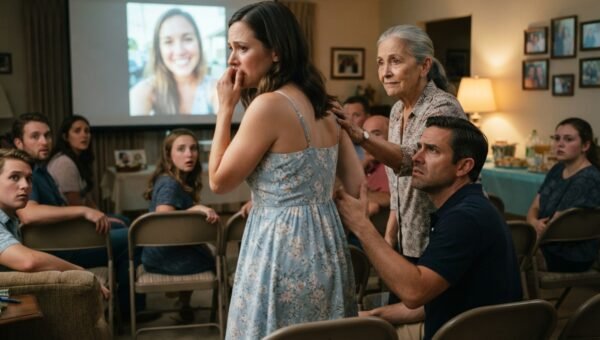
There, in twenty-foot-tall letters, was the official architectural rendering of the new facility: The Vance Logistics Pediatric Center. Below it, the slide displayed the corporate seal, my name, and the formal acknowledgment of the three-hundred-thousand-dollar endowment gift.
The spotlight swung away from the stage. It cut across the dark ballroom, sweeping across the rows of tables, and landed directly on me at Table four.
The applause started at the doctors’ table, then the board of directors stood up, and within five seconds, the entire room of three hundred people was on its feet, giving a standing ovation.
I stood up slowly, smoothing the front of my black dress.
Across the room, Evelyn’s table had not stood up. Evelyn was frozen in her chair. Her face had gone completely white, the color draining so fast she looked like a ghost. Her mouth was open, her hands trembling so badly against the tablecloth that her water goblet was rattling. Beside her, my father looked as if he had been struck by lightning. His hands were gripping the edge of the table, his knuckles white, his eyes darting frantically between my face in the spotlight and the giant rendering on the screen. Chloe sat slumped back, looking down at her lap, utterly humiliated.
Marcus waved me up toward the stage. I walked down the center aisle through the thunder of applause. Local business owners I had known since childhood reached out to shake my hand. The mayor gave me a nod of deep respect.
When I reached the podium, Marcus handed me the microphone.
I looked out over the sea of faces. I saw Evelyn staring up at me, trapped in the front row, forced to look at the granddaughter she had called a worthless liar forty-eight hours earlier.
“Thank you, Marcus,” I said, my voice carrying clearly through the room. “Six years ago, my late mother taught me that a person’s real value isn’t measured by the name on their country club membership, or the approval of people who look down on honest work. It’s measured by what you build with your own two hands, and what you’re willing to give back to those who need it most.”
I paused, looking directly at Evelyn.
“I built Vance Logistics from a single storage unit with twenty-five thousand dollars of my mother’s legacy. Tonight, I am proud to give this gift in her memory, fully paid, without needing anyone’s permission, anyone’s approval, or anyone’s name.”
The ballroom erupted into another roar of applause. Several hospital board members wiped away tears. I handed the microphone back to Marcus, stepped off the platform, and walked back to my table with my head high.
ENDING
The moment the formal program concluded and the orchestra began to play, the crowd surged toward my table. Doctors, bank executives, and county commissioners queued up to introduce themselves, handing me business cards and praising our logistics company’s expansion. For nearly an hour, I was surrounded by the exact high-society figures Evelyn had spent forty years trying to impress.
Evelyn and my father couldn’t escape. Because of their prominent seating at the VIP table, they were forced to stand by and watch as the most influential people in the county came to pay their respects to me.
Around ten o’clock, the crowd around me thinned out as people moved toward the valet. I picked up my clutch purse and turned toward the exit.
My father intercepted me near the marble corridor. His tuxedo looked rumpled, and his face was strained with a desperate, nervous energy I had never seen in him before.
“Claire,” he said, his voice dropping to an urgent whisper. “Claire, wait. We need to talk.”
“I have an early morning at the warehouse, Dad,” I said, not breaking my stride.
He walked beside me, his hands fluttering nervously. “Look… your grandmother is in shock. You completely blindsided her. You humiliated her in front of the entire town! Do you know how it looks for you to drop three hundred thousand dollars without telling your own family? People are asking me why I didn’t know about it. They think we’re estranged!”
“We are estranged, Dad,” I said, stopping to look at him. “You made that very clear on Sunday when you told me to get out of the house.”
“I was stressed!” he stammered, looking around to make sure nobody was listening. “You know how Evelyn gets. But Claire… three hundred thousand dollars? If your company has that kind of liquidity, we need to sit down with the family accountant. Chloe’s design firm is struggling to make payroll, and the estate taxes on the family house this year are through the roof. We could form a family trust. We could partner up. You have an obligation to help your family.”
I looked at him, and for the first time in my life, I felt nothing. No anger. No hurt. No desire for his approval. Just complete, freeing indifference.
“I don’t have an obligation to anyone who laughs at my work and calls me a liar,” I said. “Not one dollar of my company’s money will ever go toward Chloe’s bills or your estate taxes. You made your choice when you backed Evelyn.”
Before he could answer, Evelyn walked up. She was leaning heavily on Chloe’s arm. Her posture was broken, her pride shattered. Her social currency had been built on being the wealthy matriarch who controlled the purse strings, but tonight everyone in that room saw that the only real wealth in our family belonged to the daughter she tried to crush.
“Claire,” Evelyn said, her voice shaking with a mixture of rage and desperation. “You think you’re clever. You think you bought this town tonight. But you are still my granddaughter, and family respects hierarchy. You will not shut us out.”
“Evelyn,” I said quietly, stepping close enough so only she could hear, “you threw a fork at me two nights ago and told me I didn’t know what a million dollars looked like. Now your name isn’t on the wing. Mine is. And every time you walk into that hospital for the rest of your life, you will have to look at what I built without you.”
She flinched as if I had slapped her.
I turned on my heel, handed my valet ticket to the attendant, and waited by the entrance. As my car was brought around, Chloe tried to approach me with tears in her eyes, saying something about how she didn’t mean what she said at dinner. I didn’t engage. I tipped the valet, got behind the wheel of my car, and drove home into the quiet night.
In the months that followed, things changed permanently. My father tried calling every Sunday, leaving voicemails about family unity and business opportunities; I blocked his number. Evelyn resigned from the hospital gala committee by the end of the year, claiming poor health, but everyone in our circle knew the truth: she couldn’t bear walking past the lobby where my company’s plaque hung in bronze. Chloe ended up losing her junior design position and had to take an administrative job two towns over.
As for me, Vance Logistics continued to expand. We opened a second distribution center six months later, creating forty new jobs in the county. The pediatric wing officially opened its doors the following spring, and on opening day, I stood in the bright, sunlit therapy garden watching children learn to walk again.
I spent decades believing that family was something you had to suffer for, that blood gave people the right to treat you like dirt and demand your loyalty in return. Walking through those hospital doors, I finally understood the truth. You don’t prove people wrong by begging for their respect. You prove them wrong by outworking them, outlasting them, and building a life so solid that their cruelty can’t even cast a shadow on it.