PART 1
The envelope arrived on a Tuesday morning, tucked right between a coupon circular and a water bill that was three dollars higher than usual. It was heavy, cream-colored stationery with my maiden name written across the front in my father’s cramped, upright handwriting. I recognized the stroke of his favorite ballpoint pen immediately, the way he pressed down hard enough to leave deep indentations on the back of the paper.
My hands went a little cold before I even pulled the flap open. We hadn’t spoken in eighteen months, not since the day I told him I was moving across the state line to live with Arthur. He didn’t scream or slam doors when I left. He just looked at me like I was a ledger that didn’t balance anymore and told me I was making a permanent mistake for a temporary feeling.
Inside the envelope wasn’t a card or an apology. It was a single sheet of lined legal paper folded in half, accompanied by a pink merchant receipt with the thermal ink already starting to fade around the edges. At the top of the note, he had written my full legal name in block letters, followed by a formal heading like I was an overdue tenant renting space in his life.
“Family still costs money whether you invite us properly or not,” the note began.
The tone was clipped and devoid of warmth, dripping with the self-righteous grievance he wore like an old cardigan. “Since you insisted on running off to have your little courthouse ceremony without giving your family proper time to arrange travel or respect traditions, I was left holding the expenses of preparation. You cannot expect me to absorb the cost of a custom garment purchased expressly for an event I was intentionally excluded from. Kindly remit payment at your earliest convenience.”
I unfolded the merchant receipt. It was from a menswear shop in downtown Nashville called Hallowell & Sons. The total printed at the bottom was $812.47. It listed a charcoal wool-blend jacket, matching trousers, a white poplin dress shirt, and a silk tie in a pattern he called statesman blue.
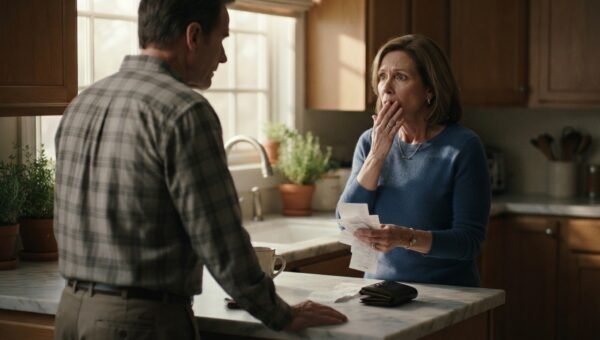
I stood in my quiet kitchen with the morning light pooling across the linoleum, staring at that number. Eight hundred and twelve dollars and forty-seven cents.
For eighteen months, I had carried a dull, heavy ache in my chest because of how my wedding day had ended. I had saved him a front-row seat on the aisle, dead center, right where my mother would have sat if she had lived to see me walk. When the registrar asked if there were any objections or if anyone was waiting, I looked out at the empty chair and felt like a fool. My father had called me the night before the ceremony to tell me his blood pressure was through the roof and his doctor had strictly forbidden him from making the three-hour drive. He sounded weak, raspy, and genuinely distressed. I had spent half my wedding morning crying into my bouquet, wondering if my father was going to stroke out alone in that big, drafty house while I was cutting cake with Arthur.
I laid the receipt flat on the kitchen counter and smoothed out the curled edge with my thumb.
That was when the detail hit me. The purchase date stamped at the top of the Hallowell & Sons receipt was a Saturday. Specifically, it was Saturday, October fourteenth, exactly two days before my wedding.
I remembered that weekend vividly because it was the exact same weekend my father told everyone in our extended family that he was confined to his bed with a violent stomach flu and a dangerous spike in his systolic pressure. He had texted my cousin Linda to say he couldn’t even keep water down, let alone travel. Yet here was proof, cold and printed in thermal ink, showing that at two-fifteen in the afternoon on that exact Saturday, he was standing at a register fifty miles away in Nashville, buying a brand-new suit.
PART 2
I didn’t pay the bill. I didn’t text him back either, though my thumb hovered over the keypad for an hour that afternoon, itching to type out a furious list of every lie he had told. Instead, I folded the letter and the receipt back up, slid them into my desk drawer beneath a stack of old tax returns, and tried to focus on my job at the community clinic. But the paper sat there like a hot coal.
By Friday evening, curiosity had hardened into a stubborn, sharp-edged determination. I needed to know why. If he wasn’t sick, and if he had gone to the trouble of buying an expensive suit just two days before my wedding, why didn’t he show up? Why stay home, pretend to be dying on the phone, and then stick me with an itemized invoice a year and a half later?
I called my cousin Linda after dinner. Linda has lived in our hometown her entire life and knows every whisper that passes through the local diner and the First Methodist congregation. I didn’t mention the bill right away. I just asked casually if she remembered my wedding weekend and whether anyone had seen my father lately.
There was a long pause on the other end of the line before Linda sighed. “Oh, honey. I thought you knew. I didn’t want to bring it up back then because you were just starting your new life with Arthur and I didn’t want to stir up old mud.”
“Knew what, Linda?” I asked, my grip tightening around the phone.
“Well, your dad wasn’t sick that weekend,” she said softly. “At least, not with the flu. Everyone in town knew he went to Nashville that Saturday. But he didn’t go alone, and he certainly wasn’t buying that suit for your wedding.”
My breath caught in my throat. “What are you talking about?”
“He went down there with Brenda Vance,” Linda said, dropping her voice to a conspiratorial whisper. “You remember Brenda, the woman who runs the antique cooperative down by the square? Her daughter lives in Nashville, and they had some big fancy anniversary gala or charity ball at the country club that weekend. Your dad bought that custom suit so he could walk arm-in-arm with her in front of all her high-society friends. He told everyone at the club that his daughter had eloped out of spite and he refused to validate her foolishness by attending a backyard sham.”
The room seemed to tilt slightly. My wedding wasn’t just avoided; it was actively traded away. He had skipped my life’s biggest milestone not because his heart was failing or his blood pressure was spiking, but because he preferred to play dress-up at a charity gala with a woman he had been secretly courting, all while letting me weep at the altar over his supposed medical emergency. And now, eighteen months later, he had the staggering audacity to send me the bill for the costume he wore to abandon me.
PART 3
The following Tuesday, I drove back to my hometown for the first time in over a year. I didn’t call ahead. I didn’t warn him. I wanted to catch him in the exact environment where he felt untouchable behind his polished mahogany desk and his spotless reputation.
When I pulled up to the house, his Buick was parked in the driveway. The lawn was manicured down to the millimeter, every shrub trimmed into sharp, humorless geometric shapes. It looked like a museum exhibit of a life I used to belong to.
I walked up the concrete steps and pushed the doorbell. I heard his heavy, deliberate footsteps approaching from the hallway, slow and measured. When he pulled the door open, his face didn’t register shock. It registered mild, bureaucratic annoyance, the kind of look he reserved for postal workers delivering junk mail.
“Clara,” he said, straightening the cuffs of his button-down shirt. “You should have called before driving out here. I’m in the middle of sorting my quarterly statements.”
“Aren’t you going to invite me in, Dad?” I asked, keeping my voice entirely level, devoid of the tremor I had felt all morning.
He hesitated, his eyes narrowing as he scanned my posture, looking for the emotional vulnerability he was used to exploiting. Then he stepped aside, motioning for me to enter the foyer. The house smelled exactly the same—pledge furniture polish, old paper, and stale decaf coffee.
We went into the study. He didn’t offer me a seat, so I sat down in the leather wingback chair anyway, crossing my ankles. He remained standing behind his desk, resting his fingertips on the blotter.
“I received your letter,” I said, reaching into my canvas tote bag. I pulled out the original Hallowell & Sons receipt and laid it squarely in the center of his spotless desk. “And the invoice.”
He glanced down at the paper, then back up at me, his chin lifting just a fraction. “Good. I expected promptness. That expense was incurred directly as a result of your poor planning and refusal to respect family protocol. I am simply holding you accountable for the costs you forced upon me.”
“Accountability,” I repeated, letting the word hang in the air between us. “That’s a very interesting word coming from a man who spent Saturday, October fourteenth, fitting himself for a charcoal wool-blend jacket to wear to a country club gala in Nashville with Brenda Vance.”
The color drained from his face so fast it looked like someone had snapped off a light switch. The self-righteous stiffness in his spine dissolved, replaced by a sudden, rigid stillness. He opened his mouth, but no sound came out.
“You told me your blood pressure was through the roof,” I continued, my voice steady, cutting through the heavy silence of the room. “You told cousin Linda you couldn’t keep water down. You let me stand at the altar crying my eyes out because I thought my father was dying alone. But you were actually fifty miles away, playing dress-up so you could show off for a woman who didn’t even care enough to send a card.”
“Where did you—” he started, his voice cracking slightly before he managed to force it back into his stern register. “That’s none of your business. Private matters between adults—”
“Private?” I laughed, a short, dry sound. “You mailed me a public invoice itemizing your lies, Dad. You put a price tag on your absence. You charged me eight hundred and twelve dollars and forty-seven cents for the privilege of being abandoned so you could eat hors d’oeuvres in Nashville.”
ENDING
He gripped the edge of his desk, his knuckles turning white as porcelain. For a second, I thought he might yell, might try to pull rank or threaten to cut me out of a will that probably only contained old tax forms and regrets. But he didn’t have any moves left. The ledger was exposed, and every column was filled with red ink.
I reached into my bag again, pulled out a twenty-dollar bill and a stack of coins totaling twelve dollars and forty-seven cents, and dropped the little pile of cash right on top of his receipt.
“Here is thirty-two dollars and forty-seven cents,” I said, standing up and smoothing down my jacket. “That covers the tie and the poplin shirt. You can wear them the next time you need to lie your way out of showing up for someone who loves you.”
He stared at the small pile of money on his desk, his lips pressed into a thin, white line. He didn’t touch it. He didn’t look up as I turned around and walked out of the study.
I didn’t look back as I walked down the hallway, pulled the heavy front door shut behind me, and listened to the satisfying click of the latch falling securely into place. When I got back into my car, the afternoon sun was breaking through the clouds, bright and warm across the windshield. I started the engine, backed out of the driveway, and drove away without looking in the rearview mirror once. For the first time in my life, the road ahead of me was entirely my own, and it didn’t cost a single cent.