PART 1
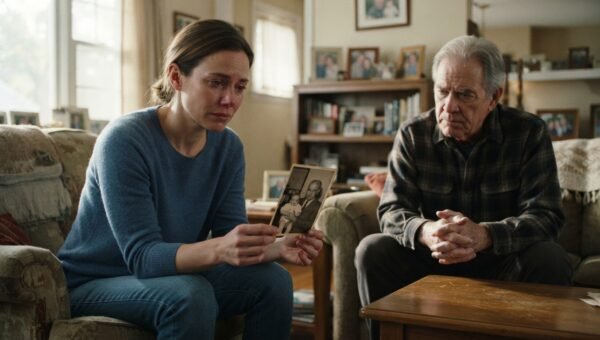
My grandson asked me to keep an envelope hidden until his eighteenth birthday. He was fourteen years old that summer, standing in my hallway with his shoulders pulled up around his ears. He looked scared enough that I did not push him for details.
“Promise Dad won’t find it,” he told me.
Those were his exact words. He handed me a plain white envelope, thick and stiff, sealed with three strips of brown packing tape.
Tucked under one of the tape edges was a school counselor’s business card from Lincoln Middle School. The counselor’s name was Mrs. Warren, and across the bottom of the card was a handwritten office phone number with an extension circled twice.
I told myself not to make too much of it. That was my first mistake, and I made it because of something I had never been able to forget.
Five years earlier, when Toby was nine, his mother died in an interstate crash on her way home from her nursing shift. My son, Mark, took it hard. He was my only child, and when grief hit him, he did not cry or ask for help. He got tight, quiet, and controlling. He checked Toby’s backpack every afternoon. He went through the boy’s desk drawers. He treated ordinary teenage privacy like a personal insult. I told myself Mark was just broken and terrified of losing the only piece of his wife he had left.
So when Toby handed me that envelope and begged me to keep it away from his father, I put it at the bottom of an old cedar chest under two patchwork quilts I had made back in the nineties.
I promised him his father would not find it. And for four years, Mark never did.
During those four years, things between Toby and his father did not get better. Toby stopped bringing friends over. He worked two summers at a local tire shop, saving every dollar he could, and he spent most Friday nights at my house eating pot roast and watching old ballgames without saying much. Every time I looked at him, I wanted to ask about Mrs. Warren’s card. I wanted one clear answer. But Toby had his mother’s stubborn jaw, and every time I brought up school or his father’s house, he changed the subject.
Then, two weeks ago, on a Tuesday morning, Toby turned eighteen.
He walked into my kitchen at seven in the morning. He did not ask for pancakes or coffee.
He stood by the counter with his hands deep in his coat pockets.
“Grandma,” he said. “It’s time.”
I went into the spare bedroom, lifted the quilts, and brought out the sealed envelope. The paper had yellowed slightly around the edges, and the cedar smell clung to it. But when I turned it over in my hands under the kitchen light, my stomach dropped.
Right across the back, in faint red marker that had bled into the paper grain over four years, was my son’s handwriting. It was Mark’s signature, plain as day, written above three words: *Do not open.*
PART 2
I looked from that red ink straight into Toby’s face.
“Your dad wrote this,” I said. “Toby, why does your father’s name belong on something you told me to hide from him?”
Toby did not blink. His jaw set hard. “He didn’t give it to me, Grandma. I took it out of his metal lockbox after Mrs. Warren told me I had to protect myself. If he knew I had it, he would have burned it.”
My hands shook a little as I handed it over. Toby did not tear the paper. He took a paring knife from the wooden block on my counter and sliced cleanly through the top fold.
Inside was a single official document from a life insurance company, dated six months after Toby’s mother passed away, and three years of bank statements stapled to the back.
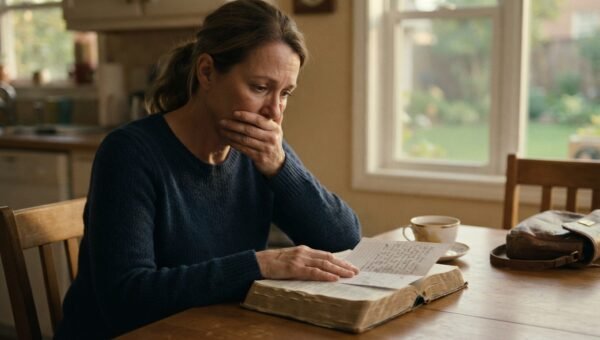
I sat down at the table and pulled my reading glasses out of my cardigan pocket. Toby did not say a word. He just laid the top paper in front of me.
It was a survivor benefit payout notice. When my daughter-in-law died, she had a private policy through the hospital where she worked. It named Toby as the sole beneficiary, with eighty-two thousand dollars set aside in a restricted custodial account meant for his college education or his living expenses after he turned eighteen. Mark was named custodian, but the terms were clear. The funds were locked for the boy’s welfare, requiring an annual accounting filed with the probate clerk until Toby reached legal adulthood.
Under that paper was the first bank statement. The initial balance read $82,400.
By the time Toby turned fourteen, the balance on that account was $1,140.
There were twelve separate withdrawals across three years, each one just under the ten-thousand-dollar reporting threshold. Every withdrawal slip had Mark’s signature on it.
“When I was fourteen,” Toby said, his voice barely louder than the hum of the refrigerator, “I told Dad I wanted to take the summer camp prep class for engineering. He told me we were broke. He told me Mom didn’t leave us a single dime and that I was selfish for even asking. He told me I was going to have to work full shifts as soon as I was old enough just so we didn’t lose the house.”
“Mark wouldn’t do that,” I whispered, but the words felt hollow the second they left my mouth.
I knew Mark’s habits. Four years ago, he suddenly bought a new bass boat and paid cash for a commercial-grade riding mower he did not need. He had told me he got a bonus at the freight depot. I had believed him because believing my own son was easier than asking to see a pay stub.
“Mrs. Warren helped me pull the county probate records after I broke down in her office,” Toby said. “She told me I couldn’t touch the account until I was eighteen anyway, but if Dad realized I knew the money was gone, he would find a way to make me sign a release before I understood what it meant. So I took the statements from his desk safe. And I brought them to you.”
The kitchen went completely quiet.
“He’s coming here today,” Toby added, looking at the clock on the stove. “He thinks we’re all having lunch for my birthday.”
PART 3
Mark knocked on my back door at noon, carrying a plastic grocery bag with two bakery cupcakes and a card. He had on his work jacket, smiling like nothing in the world was wrong.
“There’s the birthday boy,” Mark said, walking into the kitchen. He set the cupcakes on the table, right next to the white envelope.
Then he saw the papers.
Mark stopped moving. The smile stayed on his face for two seconds too long before it completely faded. He looked at Toby, then he looked at me.
“What is this?” Mark asked.
“You tell me,” I said. My voice did not shake. The trembling had stopped an hour ago, replaced by a cold, steady ache. “Eighty-two thousand dollars, Mark. That was Sarah’s policy for her son.”
Mark’s neck flushed dark red. He pulled his hands out of his pockets and stepped toward the table. “You went through my things. Toby, you stole from my desk.”
“He was fourteen years old,” I said, cutting him off before he could raise his voice. “He was fourteen, and he was terrified of you. You told him his mother left him nothing. You told him he had to work to pay for your roof while you spent his college money on yourself.”
“I kept the roof over his head!” Mark shouted, his face twisting up. “You think raising a kid alone is cheap? You think food and clothes and insurance don’t cost money? That money was for this family. I had to use it to keep us afloat after the plant cut our hours.”
“You bought a boat, Mark,” I said. “You bought a boat and parked it in my pole barn for two years. You told me it came from a depot bonus.”
Mark looked at me, his eyes wide and angry, but he had nowhere to run. He did not have an excuse. The bank statements laid it all out in plain black ink: nine thousand here, eight thousand there, transfers straight into his personal checking account.
“I’m his father,” Mark said, sounding smaller now. “Whatever’s done is done. He lives under my roof. We can handle this at home.”
“No,” Toby said.
It was the first time Toby had spoken since Mark walked in. He reached out, gathered the papers together, and slipped them back into the envelope.
“I moved my clothes into Grandma’s basement yesterday while you were at the depot,” Toby said. “I have my own job. And Mrs. Warren’s husband is an attorney. He’s filing the petition with the probate court on Monday morning.”
Mark stepped forward, his fists clenched at his sides. “You sue your own father? Over money that’s already spent? You won’t see a dime, Toby. It’s gone. What are you going to do, put me in jail?”
“I don’t care about the jail,” Toby said. “I want the court to know you took it. And I’m never asking you for a single dollar again.”
ENDING
Mark left ten minutes later. He did not touch the cupcakes. He slammed the storm door hard enough that the glass rattled in the frame, and I watched his truck back down my gravel driveway too fast, spitting stones against the fence.
I sat with Toby at the kitchen table until the afternoon light started to fade.
The legal battle took six months. It did not send Mark to prison, and it did not bring back eighty-two thousand dollars. The judge entered a formal civil judgment against Mark, requiring him to repay thirty-five thousand dollars over seven years through wage garnishment, which was all the state could reasonably enforce based on his depot wages. Mark stopped speaking to me the day the court papers were served. He changed his phone number, and when I ran into him at the grocery store in town two months ago, he turned his cart around and walked straight down another aisle without looking me in the eye.
That part hurts. He is my son, and I carried him before I ever knew what kind of man he would become. I spent years making excuses for his temper because I thought a mother’s job was to protect her child from the world. I was wrong. Sometimes your job is to protect an innocent boy from the child you raised.
Toby is enrolled at the community college ten miles up the road now, studying civil drafting. He works twenty hours a week at the tire shop, and he sleeps in the spare bedroom where the cedar chest sits under the window.
Every morning before he heads out to his eight o’clock class, he leaves his car keys on the small tray by the front door and says the same thing on his way out: “See you at five, Grandma.”
I answer him every single time.
The white envelope is gone, filed away in a steel drawer in a lawyer’s office downtown. But the empty paring knife mark is still visible on my wooden kitchen table, right next to where I pour my morning coffee. Every time I see that small scar in the wood, I remember that the truth does not wait for people to be ready. It just waits for someone brave enough to ask for it.