PART 1
When Daddy’s will was read in Mr. Henderson’s wood-paneled office in town, my brothers split the farmhouse, the eighty acres of bottomland, and $96,000 in CDs.
I got his accordion.
It was the black Hohner he wheezed through “Silent Night” on every Christmas Eve, the red pearloid finish worn down to dull wood right where his right thumb had rested for forty years.
My brother Lester laughed from across the conference table. “Figures. You were always the sentimental one, Clara.”
My younger brother, Wayne, didn’t laugh, but he didn’t look at me either. He just gathered his copy of the inventory, tapped the corner on the mahogany desk to square the papers, and slipped them into his leather folder. They had already hired an appraiser two weeks before Daddy’s memorial service. They were planning to divide the timber acreage and put the bottomland in corn.
I took the leather handle of the accordion case, which was cracked down the center and held together with black friction tape. It weighed heavy in my hand as I walked past them down the courthouse steps. I didn’t cry. I was fifty-eight years old, and I had spent the last four years driving sixty miles every Friday night to wash Daddy’s sheets, fill his pill planner, and sweep the dried mud off his porch while Lester and Wayne were too busy running their feed store.
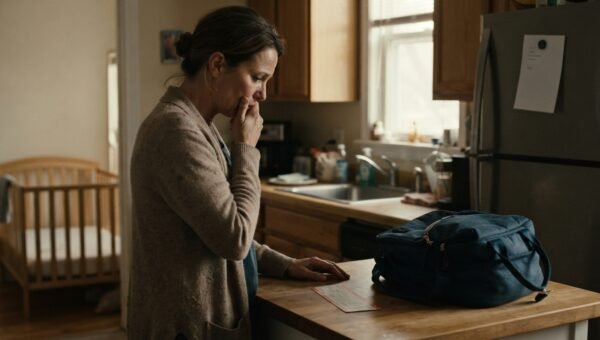
I carried the instrument straight to my kitchen and set it on the oilcloth tablecloth.
I wanted to put it away in the back closet, out of sight, but something bothered me about the way it sat. When I had lifted it into the back of my station wagon, it had rattled with a dull, hollow thud instead of the sharp metallic clatter of the reeds.
I stood by the kitchen sink, wiped my hands on a dish towel, and tipped the instrument on its side.
It rattled wrong again. The bellows were stiff, jammed tight as if something thick was wedged into the folds behind the bass buttons.
I went to the silverware drawer, pulled out a flat butter knife, and worked the rusted brass clasp at the back of the casing. The small brass pin popped free and rolled across the linoleum floor.
I pried back the heavy leather corner.
Folded tight into the accordion bellows was a thick stack of yellowed papers wrapped in an oiled canvas cloth, tied with rough binder twine, and a small brass key with an ink-stained paper tag.
My hands shook as I worked the twine loose.
The top document was an official county deed with a raised blue seal pressed into the lower corner.
The address printed across the second line wasn’t the farm on Ridge Road, and it wasn’t the acreage Lester and Wayne had just signed for.
It was the three-acre point on Blue Creek Lake.
It was the exact piece of water frontage my brothers had been fighting over for six years, ever since the county paved the boat launch and lakefront lots started selling for three hundred thousand dollars an acre. Lester had claimed Daddy promised it to him for his retirement cabin. Wayne insisted Daddy had pledged it to him to offset his divorce debt.
I smoothed the stiff paper flat against the table.
The owner listed on the deed wasn’t Daddy, and it wasn’t Lester or Wayne.
The recorded owner was me.
PART 2
The deed had been filed in the county registry nine years ago, two full summers before Daddy had his first stroke.
Under the deed lay a handwritten note on lined yellow legal paper.
Daddy’s handwriting was still firm and tall then, not the shaky scratch he used toward the end.
“Clara,” it read. “Your brothers have been circling this lake lot like hawks since your mother died. They think it’s still held under the old family partnership. They don’t know I bought out your Uncle Ray’s half back in ninety-four with my own cash and deeded the whole point to you before they could badger me into dividing it. The tax notices have been going to my post office box in Oak Grove, and I paid them every year out of my farm savings. The key goes to the green lockbox under the workbench in the back shed. That’s where you’ll find the paid tax receipts and the title insurance. Don’t let them bully you into selling. You earned this ground ten times over.”
I sat down at the table and read the page twice.
The lake property wasn’t just three acres of scrub oak. It was the only deep-water access left on that cove, with two hundred feet of limestone shore that didn’t flood when the dam opened in the spring. Lester had already told the appraiser that Daddy had died without a title on the lake parcel, claiming the estate lawyer would have to quiet the title through probate so he and Wayne could split it.
He didn’t know Daddy had transferred it clean when his mind was clear as water.
My phone rang while I was holding the key. It was Lester.
“Clara,” he said, not even asking how I was doing. “Wayne and I are meeting the surveyor out on the Ridge Road property tomorrow morning around eight. We need to go through the back shed on the home place to see if Daddy left the original boundary markers in his toolbox. Bring that old accordion with you if you don’t want it. Lester Jr. said he might put it on eBay and get you fifty bucks.”
“I’m keeping the accordion, Lester,” I said.
“Suit yourself,” he grunted. “Just bring the shed keys. Wayne says you took Daddy’s ring off his dresser after the funeral.”
“Daddy gave me his ring while he was still sitting up in his chair,” I said.
“Well, we’ll talk about that tomorrow,” Lester said, and hung up.
Early the next morning, before the mist had burned off the fields, I drove over to the old farm. The county surveyor’s white pickup was already idling near the cattle gate, and Wayne was leaning against the tailgate with a paper cup of coffee. Lester’s truck pulled in right behind mine.
Lester climbed out, hitched his jeans, and walked toward me. “Give Wayne the shed key, Clara. We want to check the tools before the surveyor starts charging us by the hour.”
I didn’t reach into my purse for the big ring of farm keys. I walked past both of them toward the small cedar shed behind the barn, where Daddy used to repair his tractor belts. The air inside smelled of grease, dried dirt, and old cedar shavings. Under the far end of the bench, covered by an empty burlap feed sack, was the heavy green metal box.
I knelt down on the packed-dirt floor, set the brass key into the lock, and turned it. The tumbler clicked open smooth and quiet.
Inside were eight years of stamped county property tax receipts, every single one made out in my name, with Daddy’s post office box listed as the billing address. Alongside them was a sealed letter from the title company in Oak Grove confirming the deed had been recorded in Book 412, Page 88, with no outstanding liens.
When I stepped back into the daylight, Lester and Wayne were standing by the pump house, watching me with their arms crossed.
“What did you drag out of there?” Lester called out. “If that’s Daddy’s socket set, that belongs to the farm.”
“It’s not tools, Lester,” I said, walking right up to the hood of his truck.
PART 3
I laid the county deed and the tax receipts directly onto the warm metal hood of his truck.
Wayne stepped over, glanced down, and his coffee cup stopped halfway to his mouth. Lester squinted, leaned in, and picked up the deed by the top corner as if it might bite him.
“What kind of garbage is this?” Lester’s face went dark red, the color running all the way down his thick neck. “Daddy couldn’t deed the lake ground to you. That parcel belongs to the estate. We’ve got eighty acres and the CDs on the probate inventory, and Henderson said the lake lot was going to be pulled in once we filed the quiet title.”
“Henderson didn’t know about this because Daddy didn’t want him to know,” I said. My voice was steady, clearer than I expected. “Daddy bought Uncle Ray out thirty years ago with his own money. He recorded this transfer at the county seat nine years ago. He paid the taxes for nine years in my name, and the receipts are right there under your thumb.”
“You coerced him,” Wayne said, his voice dropping into that cold, careful tone he uses when a tractor sale goes bad. “He was losing his head toward the end, Clara. Everyone in the county knows you were staying out here on weekends. You took advantage of him while he was sick.”
“Look at the date, Wayne,” I said, pointing my finger at the notary stamp on the bottom right. “That was stamped nine years ago. Daddy was still driving his combine. He was still sitting on the school board. He had his full mind, and he drove down to Oak Grove by himself to file it.”
Lester dropped the paper back onto the hood. “We’ll take this to probate court. We’ll challenge it. You think you’re going to walk away with the best piece of ground in the family while Wayne and I bust our backs paying the upkeep on the home place?”
“You got eighty acres of prime tillable ground, Lester,” I told him. “You got the farmhouse. You got ninety-six thousand dollars in cash CDs that you didn’t spend five minutes helping him save. For four years, I was the one who changed his catheter bags when he couldn’t get out of bed. I was the one who drove him to radiation in Springfield three days a week while you two told him you were too busy with the spring rush. He didn’t leave you the lake lot because he knew you’d sell it to a developer before his grave settled.”
Lester took a step toward me, his hands balled up into fists, but the surveyor cleared his throat from twenty yards away by the fence line.
“Mr. Vance,” the surveyor called out, looking at his clipboard. “Are we running the boundary on the lake point today or just the eighty acres? Because if the lake parcel is deeded separate, I need the owner’s signature on the entry authorization before I touch that line.”
Wayne looked from the surveyor to the deed on the hood. He had always been the one with some sense of business, even if he didn’t have much heart.
“Put it away, Lester,” Wayne said quietly. “It’s recorded. It’s got the county seal.”
“She hid it,” Lester snarled. “She had Daddy hide it in that damn accordion so we wouldn’t see it until the estate was settled.”
“Daddy hid it,” I said. “Because he knew you. He knew if he told you while he was alive, you’d make his last years miserable trying to get him to sign it over. He left you the farm because you worked the ground. But he left me the lake because he wanted me to have a piece of earth that nobody could take from me.”
I reached out, gathered the deed, the receipts, and the title policy, and put them back in the green box.
Neither of them said another word as I walked back to my car, set the box on the passenger seat, and shut the door.
ENDING
The probate on Daddy’s estate closed three months later.
Lester hired a lawyer in town to look into the lake deed, but after the lawyer pulled the microfiche at the county recorder’s office and saw Daddy’s signature witnessed by the county clerk herself, he told Lester he didn’t have a case to stand on. Lester stopped answering my calls, and Wayne only talks to me when we run into each other at the grain elevator or the post office.
They divided the eighty acres between them, but they had to sell fifteen acres of the west timber just to pay the inheritance taxes and their lawyer’s retainer.
Last Saturday, I drove out to the lake point for the first time since Daddy passed.
The old dirt track down to the shoreline was overgrown with blackberry brambles, but the limestone shelf at the water’s edge was just as wide and clean as I remembered from when Mama used to bring us down here with cane poles and cold fried chicken. The water was calm, reflecting the grey fall sky.
A realtor from Springfield called me two weeks ago, offering four hundred and twenty thousand dollars in cash from a builder who wants to put up two vacation homes.
I told him the property wasn’t for sale.
When I got home that evening, the house was quiet. The black accordion was sitting on the corner of the sideboard in the dining room, the bellows closed tight and the old leather strap resting over the buttons.
I picked it up, rested it on my knee, and slid my left hand through the bass strap. I never could play a full tune like Daddy did, but I pulled the bellows open and pressed down on the middle C chord.
The sound filled the empty kitchen, low and rough and completely whole.