PART 1
I have kept the books at Grace Fellowship for eleven years. When you hold the ledger in a small-town church, you do not just count dollars. You count the slow leaks in people’s lives. You know who dropped their pledge from fifty dollars a week to ten after the plant laid off the third shift. You know whose check bounced right after Christmas. You learn to spot trouble long before it ever walks up to the altar for prayer.
So when our benevolence fund dropped down to nine hundred dollars this past winter, my stomach soured. We usually keep four or five thousand in reserve for emergency heating oil, funeral repasts, or groceries when a young family hits a rough patch. But money had been bleeding out in steady, quiet dribbles since November.
Then I started noticing the envelopes.
Every single Wednesday night after the benediction, once the sanctuary emptied out and the lights were cut to half-power, Pastor Maddox would linger by the side hallway near the coat room. And every single Wednesday, Tessa Hardy would be the last one to leave.
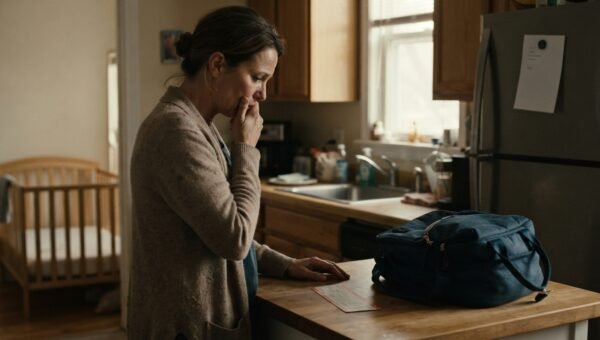
Tessa is twenty-six years old. Her husband, Jimmy, died two years ago, leaving her with a four-year-old boy and a baby girl. She sits in the back pew with her coat on, holding both children in her lap, always looking exhausted down to the marrow of her bones.
She is pretty in that quiet, fragile way that makes older women nervous and makes men look twice, whether they mean to or not.
Three months ago, I saw Pastor Maddox step up to her near the coat rack. He glanced down both ends of the hallway, reached into his suit jacket, and slid a thick white envelope into her diaper bag. He did not say more than two words. Tessa looked at the floor, swallowed hard, nodded, and hurried out into the gravel parking lot.
The next week, it happened again. Exactly the same way.
By the third week, I did what any woman who takes care of a church would do. I looked at the numbers. Then I looked at the man.
Pastor Keith Maddox came to our pulpit five years ago. He is forty-one, married to a sweet woman named Sarah who runs the Sunday school, and he has three boys of his own.
In a town like ours, a young pastor does not slip private cash envelopes to a twenty-six-year-old widow in dark hallways without a reason.
There were only two reasons that made any sense in this world. Either he was having an affair with her, or he was paying her to keep quiet about something he had already done.
I could have gone to the deacon board right then, but I wanted to be certain. I did not want to ruin a family on a hunch. But I could not carry it alone, either. The guilt of keeping quiet felt like a physical weight on my chest. So after choir practice that Friday, I pulled Martha and Evelyn aside by the fellowship kitchen. Both of them have been on the prayer chain with me since our children were in diapers.
“Keep your eyes on the coat room after Wednesday service,” I whispered, keeping my hands busy folding dish towels so I would not shake. “Watch Pastor Keith and Tessa. Just watch. And pray.”
Martha looked at me like I had slapped her across the face. “Norma, what are you saying?”
“I am saying the benevolence ledger is down to nine hundred dollars,” I told her plainly. “And white envelopes are trading hands in the dark.”
By the next Wednesday, the air in the church had changed. You could feel it. Martha and Evelyn were watching from the rear foyer. Other women started glancing sideways. The whispering had already begun, spreading through the pews like smoke through floorboards.
Last Wednesday night, I could not stomach it anymore. The communion table had been packed away, the folding chairs were stacked, and the building smelled like damp wool and cold furnace air. I saw Tessa take the envelope, pull her babies close, and slip out the side exit into the freezing rain.
Pastor Maddox turned back toward the dark coat room to grab his overcoat.
I did not wait. I stepped into the room right behind him, grabbed the brass handle, and pulled the door firmly shut until the latch clicked.
He turned around, surprised to find me in the dim space. “Norma? Everything alright?”
“No, Pastor,” I said, my voice shaking with all the righteous anger I had gathered over three long months. “Nothing is alright. I know about the envelopes.”
PART 2
I expected him to stammer. I expected his face to drain white, or for him to reach out and try to smooth me down the way preachers do when they get cornered by an angry committee member.
Instead, Pastor Maddox just looked tired. Deeply, terribly tired. He set his leather briefcase down on the long folding table where the choir robes were stacked in plastic bins.
“Norma,” he said softly. “Sit down for a minute.”
“I am not sitting,” I told him, crossing my arms over my chest to keep from trembling. “I have balanced the books for this congregation for eleven years. The benevolence account is down to nine hundred dollars, Keith. And every single Wednesday night, you stand back here handing cash to a young widow. People are talking. Martha knows. Evelyn knows. If this church is funding an affair or paying off your sins, the congregation deserves the truth.”
The word affair hit the air like a wet sack of flour.
Pastor Maddox did not yell. He did not flinch. He just reached slowly into the inside pocket of his dark wool coat. For a terrible second, I thought he was pulling out another envelope. But what he pulled out was a folded piece of paper with blue perforated edges.
He unfolded it and laid it flat under the single bare bulb hanging over the table.
It was his own pay stub from the local school district, where he drives a bus on the early morning route from six to eight before his office hours at the church. Down at the bottom, in black ink, was his personal checking account statement showing a recurring weekly withdrawal of three hundred dollars in cash.
“That is my personal money, Norma,” he said, his voice flat and steady. “Every single cent of it comes from driving that yellow bus in the dark five mornings a week. Not one dime has come from the church benevolence fund. If you check your ledger, you will see the last benevolence check written was in November to the Miller family when their heat failed. The reason the fund is at nine hundred dollars is because our winter pledges are down across the entire county.”
My breath caught in my throat. I looked at the stub. The dates matched. Every single Wednesday withdrawal for twelve weeks straight.
“Then why her?” My voice came out cracked and thin. “Why in secret? Why are you giving three hundred dollars a week of your family’s own grocery money to Tessa Hardy?”
Pastor Maddox looked down at his shoes. When he looked back up, his eyes were wet, but not with shame. With an old, abiding sorrow.
“Do you remember twelve years ago, Norma?” he asked quietly. “Before I was called to pastor here? When the old township records hall caught fire off Route 9?”
The room seemed to tilt beneath my feet.
“Of course I remember,” I said. “My whole life was in that building.”
PART 3
Twelve years ago, our small town lost its historical annex to an electrical fire in the dead of January. It held all the county birth ledgers, deeds, and veteran files. But what nobody talked about anymore was the small apartment above the garage, where my disabled brother, Ray, lived as the building caretaker. Ray was fifty-four, trapped in a wheelchair from a childhood stroke.
When the roof collapsed that night, the volunteer sirens screamed across the valley. Ray was stuck upstairs, choking on black smoke, unable to reach the stairs.
A nineteen-year-old volunteer firefighter went in alone through the second-story window. He hauled my brother out through the flame, down the ladder, and laid him on the icy grass just seconds before the second floor pancaked into the furnace room below. Ray lived another four peaceful years because of that boy.
The boy’s lungs were scorched so badly that he spent three weeks in the burn unit in Charleston. He never fully breathed right again.
That nineteen-year-old volunteer was Jimmy Hardy. Tessa’s late husband.
“Jimmy never asked for a medal,” Pastor Maddox said, his voice dropping to a whisper. “He married Tessa six years later. When he took sick two years ago with that aggressive cancer, the treatments stripped them down to nothing. When he died, he left Tessa with twelve thousand dollars in medical debt, two babies, and a trailer with a bad roof.”
I could not speak. The dry wool of the coats around us seemed to press in against my ribs.
“Three months ago,” Pastor Maddox continued, “Tessa came to my office. Not to ask for charity. She came to ask if I would officiate at her brother’s house, because she was about to pack up her kids and move in with him in Ohio. Her electricity was scheduled to be cut off the next day. The bank was threatening to repossess her late husband’s truck, which is the only way she gets those kids to the clinic.”
He tapped the pay stub on the table.
“I tried to get her to accept money from the church benevolence board,” he said. “She refused. She looked me in the eye and said, ‘Pastor, my husband gave this town his lungs, and I will not have his children eating off pity checks that get discussed in church business meetings. If I can’t pay my own way, I will leave.’ She was too proud to be a church project, Norma. She would rather freeze.”
Pastor Maddox leaned in, his eyes burning into mine.
“So I lied to her. I told her our regional synod had an anonymous veteran and emergency worker endowment fund. I told her they had approved a grant specifically for surviving spouses of volunteer first responders, three hundred dollars a week through the winter, completely non-repayable, on the condition of absolute privacy so other families wouldn’t flood the board. I told her the money came by wire from the state capital, and that I was required to hand-deliver it in cash.”
He took a slow breath.
“The state doesn’t have an endowment fund, Norma. It was me. Sarah and I prayed over it, and we agreed that driving the morning bus route was a small price to pay so Jimmy Hardy’s widow could keep her lights on without losing her dignity. The only reason it happened in the coat room was so nobody would see her take it and start asking questions.”
He paused, looking at me with a sadness that made me want to sink into the floor.
“Questions like the ones you asked Martha and Evelyn.”
ENDING
I stood in that dim coat room with the sound of the rain lashing against the high window, feeling smaller than a grain of dust.
All my eleven years of bookkeeping, all my proud vigilance, all my clever deductions about young widows and missing money, crumbled into cheap, ugly gossip. I had taken a man’s quiet sacrifice and turned it into sewer water because my own heart was too suspicious to recognize genuine grace.
“I told them to watch you,” I whispered, tears finally spilling hot down my cheeks. “I told Martha. I told Evelyn.”
“I know,” Pastor Maddox said gently. “I saw them staring from the foyer.”
“I have to fix this,” I choked out. “I will resign from the books tonight. I will stand in front of the congregation on Sunday and tell them what I did.”
Pastor Maddox shook his head. He reached out and placed his hand on my shoulder, not with anger, but with the steady weight of a true shepherd.
“You will not tell the congregation,” he said firmly. “Because if you tell them, Tessa will find out that the money came from me. Her pride will break, she will pack up those babies, and she will leave this town thinking her husband’s sacrifice was nothing more than an object of town gossip. Jimmy gave your brother four years of life, Norma. You owe his widow her dignity.”
“Then what do I do?” I asked, my voice breaking.
“You go to Martha and Evelyn tonight,” he said. “You tell them you audited the books and found that every penny of church money is accounted for, down to the cent. You tell them you made a sinful mistake in your own head, and that you owe them and this church an apology for gossiping. And then, you keep the books.”
I walked out into the freezing rain that night with my umbrella closed in my hand, letting the cold water hit my face until I reached my car.
I drove straight to Martha’s house, and then to Evelyn’s. I sat in their living rooms and swallowed every ounce of pride I possessed. I told them I had let suspicion poison my mind, that our pastor was an honorable man, and that I had committed the sin of bearing false witness. I watched their relief, and I bore their quiet disappointment in me without offering a single excuse to defend myself.
On Thursday morning, I went to the bank on Main Street.
I took out fifteen hundred dollars from my own personal savings, the money I had set aside for a new storm door and repairs on my back porch. I went to the post office, bought a money order made out to Grace Fellowship, and marked the memo line: Anonymous General Ledger Donation.
It will not undo the wickedness of what I thought. It will not pay back what Jimmy Hardy did for my brother Ray. But when the winter heating bill arrives next week, Pastor Maddox will not have to wonder if the furnace will stay lit.
Last night was Wednesday again.
I stayed in my pew until the very end, long after the benediction had been spoken. I did not look toward the coat room. I kept my head bowed, staring at the worn carpet, praying that God would forgive my small, suspicious eyes, and that He would watch over the tired young mother walking out the door with her head held high.