PART 1
For eleven years, nobody touched the ledger for Grace Fellowship Church except me. I keep the three-ring binder on the second shelf behind the choir robes, right next to the communion trays and the spare boxes of offering envelopes. Every Monday morning at nine, I sit at the folding laminate table in the back office, click my ballpoint pen, and log every dime that comes in through the plates and every dime that goes back out.
I know how much we spend on furnace oil in January. I know that the senior youth retreat ran seventy dollars over budget because of van repairs. And I know exactly what is supposed to sit in the benevolence fund. That fund is our safety net. When a family loses a breadwinner or an elderly widow needs her propane tank filled before a freeze, that account covers it. For as long as I have managed the books, we have kept a cushion of roughly three thousand dollars in reserve.
Starting in mid-November, the balance began to slide. It did not drop all at once. It leaked out in small, steady increments. A withdrawal here, an unpaid reimbursement there, until by the second week of February, the ledger showed barely nine hundred dollars left.
Around that same time, I noticed Pastor Maddox staying late on Wednesday nights.
He is forty-eight years old, married to his wife Clara for twenty-four years, and has led our congregation for over a decade.
He has always been a quiet, measured man who shakes hands at the double doors and listens patiently to everyone. But three months ago, his habits changed. After the Wednesday evening Bible study cleared out, he would linger near the back pews while the lights were being turned down.
Then came Tessa Hardy.
Tessa is twenty-six years old. Her husband died two years ago, leaving her alone in an old clapboard rental out on Route 4 with two children under five. She works thirty hours a week stocking shelves at the regional pharmacy, her hair usually pulled back in a hurried clip, dark circles permanently shadowing her eyes. She sits in the back row on Sundays, slips out before the final hymn finishes, and rarely speaks to anyone.
In late November, I saw Pastor Maddox walk over to her by the coat rack in the vestibule. I was stacking hymnals three rows away.
He looked around the empty hallway, reached into his suit jacket, and slid a plain white envelope directly into her winter coat pocket. Tessa did not open it. She just looked down, pressed her fingers against the paper through the wool, and whispered something so low I could not catch it.
I told myself it was an official church kindness. But the next month, it happened again. Same quiet corner. Same plain white envelope with no church seal on it. And by late January, when the benevolence fund dipped below a thousand dollars for the first time in my memory, I watched him pass her an envelope for the third time.
My stomach soured. A young widow, an older pastor, secret envelopes in dim hallways, and missing money from the church reserves. The math added up to only two possible things: an affair, or hush money to cover up something worse.
I did not go to the deacons right away. I made the mistake of talking first. I called Evelyn and Martha from the prayer chain. I told them what I had seen with the envelopes, and I told them the balance of the benevolence account had dropped by two thousand dollars. I told them to keep their eyes open during fellowship hours.
The rumor caught like dry grass. By Sunday, women were steering clear of Tessa in the foyer, glancing at her over the tops of their bulletins. People were watching Pastor Maddox’s hands instead of listening to his sermon.
Last Wednesday night, after the closing prayer on Romans, I watched Tessa wait by the coat room again. Pastor Maddox walked in behind her.
I could not stomach another week of pretending. I set my Bible on the pew, walked down the center aisle, pushed open the heavy wooden door to the coat room, and shut it firmly behind me.
“Pastor,” I said, my voice shaking with all the righteous anger I had gathered over three months. “I know about the envelopes.”
He turned around slowly. He was holding a sealed white envelope in his right hand. He did not flinch, jump, or stammer. He simply set the envelope down on the coat table, reached into his back pocket, took out his worn leather wallet, and laid a folded slip of paper directly next to it.
It was a direct-deposit pay stub from the church payroll account, made out to his personal name.
“Read it, Margaret,” he said softly. “Every cent in that envelope is from my own salary. It does not touch the church accounts. Not one dollar.”
I stared down at the slip. The numbers matched the withdrawals from his personal paycheck. But before my brain could make sense of why he would empty his own pocket for a young widow, he looked directly at me with tired, sunken eyes.
“Tessa’s husband was Brian Hardy,” he said, his voice dropping to a gravelly whisper. “The volunteer fireman who ran into the old district history archives building twelve years ago during the four-alarm fire. He broke through the burning beam on the second floor and carried out the records room file clerk.”
The breath completely left my chest. The room seemed to tilt sideways beneath my sensible shoes.
“Brian carried me out of that fire, Margaret,” Pastor Maddox said. “Before I went to seminary. Before I ever stepped foot behind this pulpit. He spent three weeks in the burn unit for saving my life.”
PART 2
The coat room was dead silent except for the humming of the old fluorescent tube above our heads.
My eyes went from the payroll stub to the white envelope, and then to Pastor Maddox’s hands. For the first time, I noticed how stiffly his fingers rested against his knuckles, the pale line of grafted skin running down his wrist into his cuff. I had known him for ten years as our minister, but I had completely forgotten that before he answered the call to ministry, he worked as a county records clerk in the old municipal basement downtown.
“Brian was twenty-one years old back then,” Pastor Maddox continued, his tone devoid of anger, carrying only a heavy, exhausted sorrow. “He did not know me. I was trapped under a collapsed pine rafter in the rear annex when the roof gave way. He crawled through eight feet of active flame to pull that beam off my legs and drag me into the alleyway. His turnout gear caught. He took third-degree burns across his back and his shoulders.”
I swallowed, the taste of copper rising in my throat. “Brian never talked about that.”
“Brian was nineteen when he joined the department and twenty-eight when his heart gave out on that roofing crew two summers ago,” he replied. “The fire department had an auxiliary policy, but it ran out eighteen months after the funeral. Tessa took a shift job that barely pays for child care. In November, her oil tank went empty, and her landlord threatened an eviction notice over sixty days of back rent.”
“Why didn’t she apply through the church board?” I asked, my voice barely audible. “We have the benevolence committee. We have protocols.”
“Because Tessa would rather freeze in that drafty house than sit before five deacons and have her private financial dignity picked apart in an open business meeting,” Pastor Maddox said firmly. “And because it was not this congregation’s debt to pay. It was mine. Brian gave me forty years of life I was never supposed to have. When his widow cannot afford heating oil and groceries for his babies, that bill belongs on my desk, Margaret. Not the church’s.”
The shame hit me so hard my knees felt unsteady. Every suspicious thought I had nurtured over the past twelve weeks curdled inside my stomach. I had stood in the foyer watching a grieving mother receive quiet mercy, and I had turned it into a sordid scandal in my head.
“The benevolence fund,” I whispered, clutching at the only factual thread I had left. “The ledger. Two thousand dollars is missing since November, Pastor. The balance dropped to nine hundred. If you weren’t pulling cash from the church…”
Pastor Maddox sighed, running a hand over his close-cropped gray hair. He reached over, picked up the white envelope, and slipped it into his jacket.
“Did you cross-reference the line-item expenses for the outreach pantry, Margaret?”
I froze.
“Two months ago, the regional food bank cut their dry-goods distribution by half,” he said. “The deacon board voted unanimously during the November budget meeting to absorb the gap so sixty local families wouldn’t go hungry through the winter holidays. You were absent that Sunday because of your hip replacement, remember? Deacon Miller took the minutes. The money was transferred legally to cover three shipments of bulk staples from the wholesale supplier in town. It is all documented in the committee binder on the middle shelf.”
I had not looked at the committee minutes. I had simply looked at the bottom balance in the ledger, watched the envelope pass in the hallway, and let my own pride fill in the worst possible details.
“Pastor,” I choked out, tears finally burning the corners of my eyes. “I… I spoke to people. I told Evelyn. I told Martha.”
The tired expression on his face hardened slightly, replaced by a profound, piercing disappointment that cut deeper than any shout could have.
“I know you did,” he said quietly. “Evelyn’s husband took me aside before choir rehearsal tonight to ask why I had been seen meeting a young mother in private. And two of our regular givers pulled their pledges yesterday afternoon. Tessa walked into the pharmacy on Monday, and one of our own deaconesses would not even look her in the eye while paying for a prescription.”
PART 3
I spent that night sitting upright in my recliner, the floor lamp casting a harsh glare over the open church ledger on my lap.
I flipped back to the November entries. There it was, plain as daylight in Deacon Miller’s scratchy handwriting on the minutes sheet tucked into the back pocket: a unanimous vote authorizing a two-thousand-dollar emergency draw for wholesale grain, canned meat, and heating vouchers for the community food pantry. The invoices from the supplier were paper-clipped right behind the voucher sheet. Every single cent was accounted for.
I had been keeping the books for eleven years, priding myself on being the moral watchdog of Grace Fellowship. I had confused vigilance with righteousness. I had assumed that because I held the pen, I had the right to judge the hearts of the people around me.
By morning, the knot in my chest had turned into a sick, heavy stone. I knew what gossiping women in a small-town congregation could do to a young widow who was already hanging on by a thread. Tessa had lost her husband, was raising two babies on stocking-shelf wages, and now her late husband’s church was treating her like an outcast because I could not keep my suspicious mouth shut.
At eight in the morning, I got into my Buick and drove out to Route 4.
The rental house was small, with peeling white paint and an old plastic tricycle overturned in the frost-bitten grass. A battered wood stove pipe poked through the side wall, sending up a thin ribbon of gray smoke into the cold air.
I knocked on the front door. It took nearly two minutes before the latch turned.
Tessa opened the door three inches, holding her youngest boy against her hip. She wore an oversized gray sweatshirt with frayed cuffs, and her hair was tied back in the same hurried knot. When she saw my face, her posture stiffened immediately. She looked down at the porch boards, defensive and guarded.
“If this is about the benevolence committee, Mrs. Vance,” Tessa said, her voice flat and cold, “I already told Pastor Maddox I don’t want to fill out the paperwork. I work my hours. I pay what I can.”
“Tessa,” I said, my voice cracking before I could stop it. “I didn’t come here as a committee member. I came here to ask you to forgive an old, foolish woman.”
She frowned, shifting her little boy higher on her hip.
I stood on that freezing porch and told her the unvarnished truth. I told her that I had watched Pastor Maddox hand her the money. I told her that I had looked at the church books, assumed the worst of her and the pastor, and spread that poison to other women in the church. I did not soften my words. I did not make excuses about being concerned for church funds. I called it what it was: pride, suspicion, and slander.
Tessa stared at me. For a long moment, the only sound was the wind rattling the bare oak branches above the driveway. Then, her eyes welled up with hard, angry tears.
“Do you know what Brian went through for that man?” she asked, her voice shaking with quiet fury. “He had scars from his shoulder blades down to his lower spine that ached every single winter. When Brian died, Pastor Maddox came to my kitchen and told me that as long as he drew a breath, Brian’s boys would never go without a roof. He pays our electric bill directly to the utility, Mrs. Vance. Out of his own pocket. And you made people think I was selling myself in the church vestibule.”
“I know,” I whispered, tears streaming down my own face now. “And there is nothing I can say to take back the hurt I caused. But I will not let you or the pastor bear the weight of my sin.”
I reached into my handbag and pulled out a cashier’s check for two thousand four hundred dollars. It was drawn directly from my personal savings account, representing two months of my own pension.
“This is not charity,” I said, holding it out to her. “This is restitution. And by noon today, every person who heard a lie from my mouth is going to hear the truth.”
Tessa looked at the check, then looked back at my face. She did not take the paper.
“I don’t want your money, Mrs. Vance,” she said firmly. “I want to be able to bring my boys to church on Sunday without people whispering when I walk through the doors.”
She shut the door quietly, leaving me standing alone in the freezing morning wind.
ENDING
I drove straight from Route 4 to the church office.
I walked into Pastor Maddox’s study without knocking. He looked up from his sermon notes, surprised to see me with red eyes and a coat still buttoned to the chin. I laid the cashier’s check on his desk.
“Put it back in the benevolence fund,” I said. “Or put it toward the pantry invoices. I don’t care where it goes, but I want it in the church’s hands.”
He looked at the check, then up at me. “Margaret, the church doesn’t need your money to cover this.”
“I need to give it,” I replied. “And I need three minutes before the congregation this Sunday morning.”
He studied my face for a long time. He saw that I was not looking for an easy out. Finally, he nodded slowly. “Three minutes. Not a second more.”
Between Wednesday afternoon and Sunday morning, I did not use the phone to gossip. I drove to Evelyn’s house. I sat at her kitchen table and told her precisely what a wicked thing we had done. Then I drove to Martha’s house and did the exact same thing. I went to the two deacons who had questioned Pastor Maddox’s character and laid the food bank invoices and the payroll stubs directly in front of them. I took every single ounce of the blame upon myself, where it belonged.
Sunday morning was cold and clear.
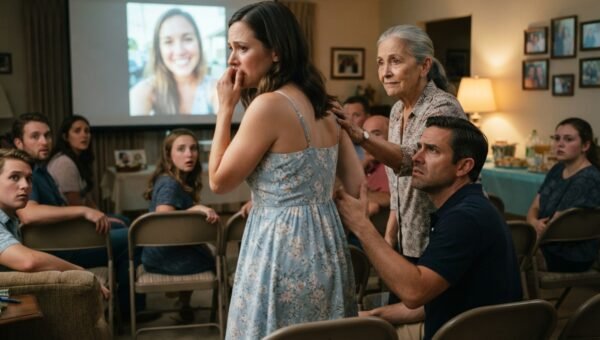
The sanctuary was full. Tessa was not there, which broke my heart, but Clara Maddox was sitting in the third row, her hands folded quietly over her Bible. Pastor Maddox delivered his sermon on the eighth chapter of John, about the woman caught in adultery and the stones that stayed in the dirt. When he finished, he did not give the closing benediction.
Instead, he stepped down from the wooden pulpit and looked at me in the fourth row.
“Our financial secretary, Margaret Vance, has a statement she needs to deliver to the body,” he said quietly.
My legs felt like lead as I walked up the three carpeted steps. My hands were shaking so hard the single sheet of paper in my grip fluttered like a leaf. I looked out at the faces of people I had known for thirty years, neighbors I had baked casseroles for, women I had prayed with.
I did not read from a prepared defense. I confessed.
I told the entire congregation that our pastor had been quietly honoring a blood debt to Brian Hardy, the man who saved his life from a burning building twelve years ago. I told them that every cent given to Tessa came from his own family’s table, not the church’s funds. And then I looked Evelyn, Martha, and the rest of the room in the eyes and confessed that I had manufactured a filthy rumor out of my own arrogant pride because I thought holding the ledger made me the moral judge of Grace Fellowship.
“If you have looked sideways at Tessa Hardy,” I said, my voice echoing through the silent sanctuary, “you looked at the wrong person. The sin in this room belongs entirely to me.”
I stepped down from the platform. The room was so quiet you could hear the radiators clanking against the baseboards.
I handed my church keys and the three-ring ledger binder to the head deacon as I walked down the aisle. I did not wait for the final hymn. I gathered my coat from the rack in the vestibule and walked out to my car, knowing my eleven years of managing the books were finished, and rightly so.
Two weeks later, on a brisk March morning, a knock came at my front door.
I opened it to find Tessa standing on my porch. She was not holding her boy this time. She wore a clean wool scarf, and though her expression was still guarded, the cold anger had faded from her eyes.
“Pastor Maddox told me what you said from the pulpit,” she said quietly.
“It was the least I owed you, Tessa,” I answered.
She looked down at her hands, then reached into her pocket and pulled out a small, foil-wrapped loaf of banana bread. She held it out to me.
“The boys and I sat in the back row this morning,” she said, her voice steady. “Nobody whispered. Clara Maddox sat next to us and held Caleb through the sermon.”
She pressed the loaf into my hands.
“Forgiveness takes a while, Mrs. Vance,” Tessa said softly. “I’m not completely there yet. But you stood up and told the truth when it cost you everything you had in that church. Brian always said that a person who takes their own punishment is worth giving a second chance.”
She turned and walked down my front steps toward her car.
I stood in my doorway holding that warm loaf of bread, watching her drive away. I lost my title at the church, I lost my seat on the committee, and I lost the comfortable illusion that I was better than anyone else in that town. But as I closed the door, I knew that for the first time in eleven years, my books were finally balanced.