PART 1
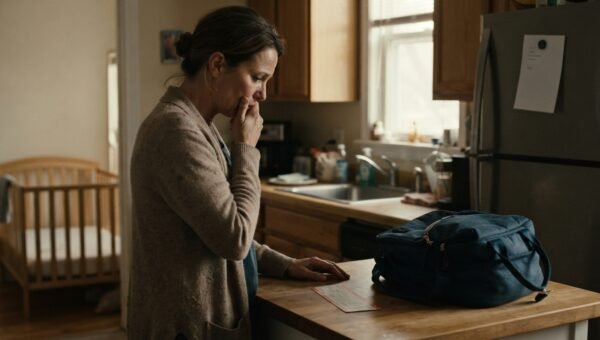
My daughter, Chloe, dropped the green hard-shell suitcase by my coat closet on a Tuesday night and told me not to open it. She said it belonged to a girlfriend from work who was going through a messy divorce and needed a safe place to leave personal papers for a week.
“Don’t go snooping, Mom,” Chloe said, kissing my cheek. “She’s embarrassed enough as it is.”
I respected that. Chloe was twenty-nine, an ultrasound technician with her own quiet apartment across town, and she had never given me a reason to doubt her word.
For six days, the bag sat right where she put it, behind my vacuum cleaner.
Then Monday morning at eight o’clock, my landline rang. A woman named Agent Miller from the regional airport police told me a piece of luggage matching a stolen-bag report from three days prior had been tracked to my home address through an electronic luggage tag registered in the system. The tag listed my street, my house number, and the initials C. V.
Chloe Vance.
I felt a cold knot tighten in my stomach. I told the agent there had to be a mistake, but she asked me to bring the suitcase down to the airline baggage security office immediately so they could clear the flag.
I called Chloe three times before leaving the house. She didn’t pick up.
When I reached the airport terminal, the baggage office smelled of rubber belts and industrial floor wax.
Agent Miller set the green suitcase on a metal examination table under fluorescent lights. Chloe suddenly rushed through the double doors, out of breath, her keys jingling in her hand. She had run from the parking garage.
“Mom, don’t,” Chloe said, her voice shaking as she reached for the handle. “It’s my friend’s. You don’t have the right to hand it over.”
Agent Miller held up a hand. “Ma’am, step back. The serial number on this tag was flagged as stolen out of short-term parking seventy-two hours ago. We need to inspect the contents.”
Chloe swore she had never owned the suitcase, her eyes wide, backing into the doorframe.
Agent Miller popped the dual latches.
Inside, there were no legal papers. There were three expired passports, all bearing different names but all showing the photograph of a woman I recognized as Chloe’s paternal aunt, Martha. Below them lay a stack of faded family photographs from the early nineties, and folded neatly at the bottom was a small red winter coat.
Sewn into the collar on a white fabric label, written in black laundry marker, was Chloe’s full name.
Chloe stared at the coat as if an animal had jumped out of the luggage.
Then Agent Miller ran her fingers along the zipper track of the interior lining. A small strip of gray duct tape came loose. Stuck to the underside was a brass locker key stamped with the number 414.
“Terminal B storage lockers,” Agent Miller said, turning the key over. “Down by the old tram level.”
Chloe tried to grab my arm. “Mom, please. Leave it alone. Just give the bag to the police and let’s go home. You don’t know what you’re doing.”
I pulled away. I walked down the escalator with Agent Miller beside me. Chloe followed ten paces back, silent and pale.
When we reached the row of lockers near the lower service exit, the gray-haired attendant on duty looked at the brass key in Agent Miller’s hand, then glanced up at my face.
“Locker 414?” the man asked, shaking his head. “You’re the second person today.
An older gentleman came down here yesterday afternoon asking for the duplicate key to that exact locker. Said he lost his. Said his name was Vance.”
The room seemed to shrink. I had not seen my father, Arthur Vance, in eleven years. Not since the day he took forty thousand dollars from my late mother’s care fund and walked out of our lives without leaving a forwarding address.
My hands shook so hard I could barely hold my phone. I dialed the old cell number I had saved in my contacts for over a decade, a number that had gone straight to a disconnected recording for years.
To my shock, it rang twice.
A woman’s voice answered, raspy and low.
“Is Arthur there?” I managed to say. “Arthur Vance?”
The woman paused. “He cannot talk right now,” she said quietly. “He is waiting for your daughter.”
PART 2
The woman on the line hung up before I could speak another word.
I turned around in that low-ceilinged airport hallway and looked Chloe in the face. She stood near a row of empty plastic chairs, holding her handbag against her chest with both hands like a shield.
“You’ve been in contact with him,” I said. It was not a question.
Chloe looked down at her shoes. “Mom, let’s go to your car. Please. Not here.”
Agent Miller used the brass key to unlock Locker 414. She pulled out a heavy gray fireproof lockbox and carried it over to the counter. Chloe didn’t try to stop her this time. The attendant stepped back, crossing his arms, while Agent Miller set the box down and tested the clasp. It wasn’t locked.
Inside sat a thick legal envelope and a bank cashier’s check dated four weeks prior for twenty-eight thousand dollars, made payable directly to Chloe.
Alongside the check was a medical folder from a hospice facility two counties north, bearing Arthur Vance’s full legal name and date of birth. Inside the folder was an intake sheet listing Chloe as his emergency contact, signed three months ago.
Agent Miller looked over the documents, checked the police database on her tablet, and sighed. “The stolen report on the suitcase was filed yesterday by an elderly man from an assisted transport van. He claimed a younger relative took his bag without permission.”
She looked at Chloe. Chloe didn’t deny it.
“This isn’t a luggage theft ring,” Agent Miller said, closing the box. “This is a family dispute over property. I can’t release this check or the lockbox until both parties sign a custody release, but neither of you is under arrest. Miss Vance, you need to talk to your mother.”
We walked out to my sedan in the parking garage in absolute silence. The late-morning sun beat down through the concrete pillars, casting hard shadows across the hood.
I unlocked the doors. Chloe got into the passenger seat, pulled her knees up against the glove compartment, and started to cry.
“He called me four months ago, Mom,” she whispered. “He found my clinic number through the hospital directory. He said he had stage four cancer and that he was dying in a county home with no one to help him.”
“He stole forty thousand dollars from your grandmother while she was lying in a hospital bed,” I said, my voice shaking with an anger I had kept buried for eleven years. “He left me to pay the funeral home on a credit card. He let the county put a lien on the house. And you took a suitcase from him?”
“I didn’t take it for myself,” Chloe said, wiping her face. “He told me he had something he owed you. He said he kept everything he had left in that bag. But when I went to see him last week, he wasn’t sorry at all. He tried to use the money to make me promise not to tell you where he was.”
PART 3
Chloe reached into her purse and pulled out a folded piece of yellow lined notebook paper. It was written in my father’s cramped, familiar handwriting.
“He told me that if I kept the bag at my apartment, his sister Martha’s children would come looking for it,” Chloe explained, her voice cracking. “They’ve been managing his small pension checks. He was paranoid they were going to clean him out before he died. So he told me to bring the suitcase to your house because nobody would ever think to look for his belongings with the daughter he abandoned.”
“He used my closet as a hiding spot from his own family,” I said.
“He told me not to look inside,” Chloe said. “He gave me the key to the locker and told me the rest was in there. But when I saw that check for twenty-eight thousand dollars made out to me, I realized what he was doing. He wasn’t paying you back. He was trying to buy my loyalty so I would take care of his arrangements and shut you out entirely.”
Chloe put her face in her hands.
“I took the suitcase from his room because I was furious with him,” she said. “I wanted to look through it, but I got scared. So I brought it to you. I thought if it was in your house, it would somehow make things right, but I was too ashamed to tell you I had been seeing him for three months behind your back.”
We sat in the car for twenty minutes. The anger in my chest didn’t vanish, but the confusion did. My father hadn’t changed. Even at the end of his life, he was still moving money in envelopes, setting family members against each other, and using secrets to keep control.
I drove Chloe straight to the hospice facility listed on the intake form.
The building was a low brick facility thirty miles outside the city, surrounded by dry pine trees. The woman who had answered the phone was a charge nurse named Evelyn. She led us down a quiet, linoleum hallway to room 114.
My father was asleep in a narrow hospital bed, hooked to an oxygen line. His hair was thin and white, his cheeks hollow. On the bedside table sat an empty water pitcher, a plastic cup of ice chips, and an old framed snapshot of me when I was six years old, wearing the red coat that had been packed inside that green suitcase.
When he opened his eyes, he looked at Chloe first. Then his gaze drifted to me.
There was no grand apology. There was no sudden tearful realization. He looked at me with the same stubborn, guarded eyes he had possessed my entire childhood.
“You brought your mother,” he rasped, his voice barely louder than the hum of the oxygen machine.
“I brought the key,” I said, setting the brass locker key on his bedside table beside the water cup. “And Chloe is not taking your check.”
ENDING
My father looked at the key for a long time. His fingers twitched against the rough hospital blanket, but he didn’t reach for it.
“The money was what was left,” he said quietly. “After Martha took her share.”
“I don’t want the twenty-eight thousand dollars,” I told him, standing straight at the foot of his bed. “And neither does Chloe. Agent Miller has the lockbox at airport security. If you want that check deposited, you can instruct your facility administrator to sign the release and use every cent of it to pay for your care here. We will not be your couriers, and we will not keep your secrets.”
He didn’t answer. He turned his face toward the window, looking out at the gravel parking lot, his jaw set tight.
I stayed in the room for five minutes. Chloe sat in the vinyl chair beside him and held his cold hand for a brief moment, whispering something I couldn’t hear. Then she stood up, let go, and walked out to the hallway with me.
We drove back to the city in the late afternoon. Chloe came into my kitchen, sat down at the table, and helped me sort through the week of unopened mail on the counter.
She didn’t try to defend him again, and I didn’t yell. The boundary had been drawn. My father died two weeks later without calling either of us again, and the state probate court applied the remaining funds in the lockbox toward his outstanding medical bills.
The green suitcase remained at the airport impound, unclaimed. The only thing I kept was the small red winter coat with my daughter’s name stitched in the collar, which I folded carefully and placed on the top shelf of my linen closet, a reminder of what had been saved, and what had finally been left behind.