PART 1
My wife, Brenda, started leaving our house every single night at exactly 10:15.
It did not matter if we were watching television, folding laundry, or getting ready for bed. When the microwave clock in our kitchen hit 10:15, she would put on her heavy green wool coat, pull on her sneakers, and step out into the dark.
We had been married twenty-eight years. We had two grown children living two states away and a quiet house on Maple Street.
Our life was predictable, and I liked it that way. But this new routine started three weeks ago, in the middle of November, when the Ohio night air was already biting cold.
The third time she did it, I asked her where she went.
“Just around the block, David,” she said, wrapping her scarf around her throat. “I need fresh air before I sleep. You know how my legs cramp up if I sit too long.”
“At ten fifteen at night?” I asked, looking up from my recliner. “It is twenty-eight degrees out there, Brenda. Walk in the afternoon.”
She frowned at me, her hand resting on the brass deadbolt. “Are you checking up on me? I am fifty-three years old, David. Stop being suspicious. Stop spying on me.”
Her voice was sharp. It was the sharpness that bothered me most. Brenda was normally gentle, the kind of woman who saved old greeting cards and remembered everyone’s birthday.
Hearing her accuse me of spying made me pull back, but it also made a knot form in my stomach.
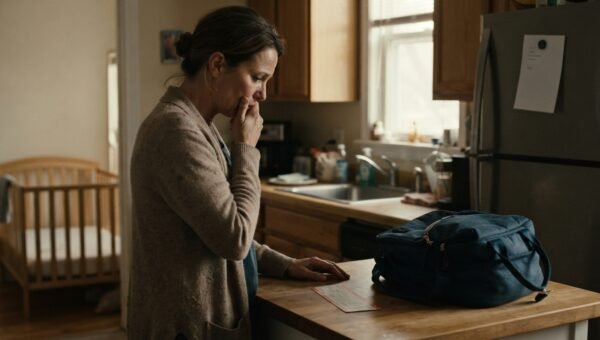
A week later, I noticed the silver thermos missing from our kitchen cabinet. It was the tall stainless-steel one I used to take on fishing trips. Brenda had filled it with hot chicken vegetable soup from the pot she made for dinner. She packed it into a plain canvas grocery bag.
At 10:15 on a Tuesday night, the front door clicked shut behind her.
I waited two minutes. Then I grabbed my dark windbreaker, left the front porch light off, and followed her into the street.
I stayed about fifty yards behind her, keeping close to the shadow of the maple trees. She did not walk around the block. She turned sharp at the corner, crossed Elm Street, and cut down the narrow gravel alley that ran behind the old brick duplexes.
She walked with purpose, holding the canvas tote bag close against her ribs.
At the end of the alley stood a small, tired four-unit apartment building. The exterior light above the back entrance was burned out. I watched from behind a wooden privacy fence, my stomach twisting into a hard ball. I thought about the worst things a husband could imagine after almost three decades together. I thought about another man. I thought about secrets that ruined families.
Brenda stepped up to the ground-floor back door, apartment 1B, and tapped softly three times.
The lock rattled. The door opened slowly.
The light from inside spilled out across the small stoop, and my breath caught in my throat. Standing in the doorway was not a secret lover. It was an elderly man, frail and stooped, wearing two thick flannel shirts over each other and a faded brown knit cap. His hands shook as he held the doorframe.
Brenda smiled softly, reached into her tote bag, and handed him the warm silver thermos.
“Evening, Frank,” she said quietly. “Chicken and rice tonight. Still hot.”
“God bless you, Brenda,” the old man rasped. His breath misted faintly in the doorway.
I stood in the darkness, stunned. I felt a sudden rush of deep shame. Here I was, lurking behind a neighbor’s fence like a jealous fool, suspecting my faithful wife of something ugly, while she was out in the freezing cold feeding a lonely old neighbor. I stepped back, ready to slip away before she caught me, planning to walk home and apologize to her the minute she walked through our door.
Then the old man reached out and touched Brenda’s sleeve.
“You did not tell him, did you?” the old man asked, his voice thin but carrying in the quiet alley. “You promised not to tell your husband about the envelope.”
Brenda hesitated. She pulled her coat tighter around herself. “No, Frank. Not yet. I just want to make sure you are safe first.”
Before Frank could answer, my boot crunched against a patch of gravel.
Brenda turned instantly toward the sound. Her eyes locked directly onto mine in the darkness. She did not scream. She just looked at me with an exhausted, defensive sadness.
Frank looked past her, blinking his watery eyes into the alley. He held a thick white legal envelope in his trembling left hand.
The porch light from the adjacent duplex caught the dark ink across the front. In bold, printed black letters, my own name was written across the center: David Miller.
PART 2
Nobody spoke for several seconds. The only sound was the low drone of an old furnace compressor down the alley.
“David,” Brenda said. Her voice did not have anger in it anymore. It was just tired.
“What is that?” I asked, stepping out from behind the wooden fence. My voice felt rough in my throat. “What is my name doing on that envelope?”
Frank pulled the envelope back against his chest, tucking it inside his oversized flannel shirt like a scared animal protecting food. He looked between Brenda and me, his jaw trembling.
“You should not have followed me,” Brenda said softly, walking over to where I stood on the edge of the gravel path.
“You told me you were getting fresh air,” I replied, keeping my voice low. “You told me I was crazy for asking. And now an old man in an alley has an envelope with my name on it.”
“His name is Frank Kowalski,” Brenda said. “He is seventy-six years old. His wife passed away four years ago, he has no children, and his phone line was shut off last month because he could not pay the bill. Come inside for two minutes, David. Just two minutes. Look at how he is living.”
I hesitated, but the confusion was heavier than my anger. I followed Brenda up the two concrete steps into apartment 1B.
The cold hit me immediately. The apartment was barely warmer than the alley. A small electric space heater sat on the worn linoleum floor, but its red coils were completely dead. The place smelled of stale bread, damp carpet, and old dust. An unopened loaf of white bread and a jar of generic peanut butter sat on a laminate counter. There was a tiny black-and-white television that looked thirty years old, unplugged in the corner.
Frank sat down heavily in a vinyl armchair with torn armrests, keeping both hands pressed over his stomach where the envelope was tucked.
“His building heater broke ten days ago,” Brenda said, pointing to the cast-iron radiator beneath the frosted window. “The landlord told the tenants the part was backordered. The other three apartments on this side are empty right now. Frank was sleeping in his winter coat under four blankets. I found out when I ran into him at the corner pharmacy trying to buy canned soup with loose change. I could not just leave him here to freeze.”
“I understand that, Brenda,” I said, looking at the frail man whose breath was still faintly visible in his own living room. “Helping him with hot soup is decent. But why hide it from me? And why does he have my name in his hands?”
Brenda looked down at the linoleum. “Ask him who his landlord is, David.”
I turned toward the old man. Frank shrank back slightly into the worn vinyl cushions.
“Mr. Miller,” Frank whispered, his voice shaking. “I am sorry about the rent. I really am. I paid on time for seven years. Every single month on the first. You can check the receipts. But after my hip surgery in September, the copays took everything from my pension check. I fell two months behind. Three hundred and eighty dollars total. That is all it is.”
A cold knot tightened in my chest.
“I am not your landlord, Frank,” I said, shaking my head. “I work at the county water treatment plant. I do not own any apartments.”
“He does not own it directly,” Brenda cut in, her voice flat and steady. “His brother does.”
The words hit me like a slap.
My brother, Greg.
Greg was two years younger than me, sharp-tongued, and always talking about his real estate investments. For the past six years, Greg had been buying up cheap multi-family units across the county, renovating what he called the bare minimum, and renting them out. He drove a new truck every two years and constantly bragged at Thanksgiving about how tough you had to be in the property game.
“Greg owns this building?” I asked.
“Greg owns the limited liability company that bought it three years ago,” Brenda said. “And two weeks ago, Frank got a certified letter taped to his door. A three-day notice to vacate, followed by an eviction filing. It was signed by the property manager. But Frank knew the name on the county deed.”
Frank reached inside his flannel shirt. His arthritic fingers shook as he held out the thick white envelope toward me.
“I did not know what else to do,” Frank murmured, looking at the floor. “I remembered reading the property transfer in the local weekly paper back when the building sold. It said Miller Properties LLC. And last week, when Brenda brought the first batch of broth, she told me her last name was Miller. I asked her if she was related to the man on the tax bill. When she told me you were Greg Miller’s brother, I wrote everything down. Every receipt. Every medical bill. Every dollar I owed.”
I took the envelope from his hand.
Across the front, in uneven cursive beneath my printed name, Frank had written: *Please ask him to give me until the first of the year. I have nowhere else to go.*
PART 3
I opened the envelope right there under the bare forty-watt bulb hanging from Frank’s ceiling.
Inside was a lined sheet of yellow legal paper, covered in Frank’s neat, trembling handwriting. Beneath the letter were three carbon copies of money orders from the summer, totaling $1,140, and a copy of an unpaid hospital bill from his hip replacement for $1,820.
At the bottom of the yellow paper was a copy of the eviction notice taped to his door, demanding $380 in back rent plus an extra $150 in late fees, giving him seventy-two hours to get out before the sheriff came to set his belongings on the curb.
The signature at the bottom was not an anonymous property manager. It was my brother Greg’s familiar, aggressive scrawl.
“Why didn’t you give this to me, Brenda?” I asked, turning to my wife. The anger had drained out of me, replaced by a sick, heavy weight. “Why did you make him promise not to tell me?”
Brenda looked at me, her eyes steady. “Because every time Greg does something awful, you make excuses for him. You have done it our entire marriage, David.”
Her words cut deep, but they were true.
Three years ago, Greg borrowed $4,000 from our joint savings to fix a roof on one of his duplexes and never paid back a dime. When Brenda wanted to confront him, I told her to let it go because family was family. Two years ago, Greg insulted our daughter’s fiancé at our kitchen table, and I told Brenda not to make a scene. Whenever Greg pushed people around, I looked the other way because our father had died young and I had promised our mother I would always look out for my little brother.
“I saw what the cold was doing to Frank,” Brenda said, stepping closer to me. “I brought him soup every night because he was starving and freezing in the dark. But I knew if I showed you that envelope, you would call Greg, Greg would tell you it was just business, and you would tell me we couldn’t get involved. I wanted to pay the $380 myself out of our personal account, but Frank refused to take charity. He insisted on giving his letter to a Miller who had a conscience.”
I looked at the yellow paper in my hand. Then I looked at Frank, sitting in the broken chair with his hands curled in his lap, waiting to see if he was going to be thrown into the November frost.
“How long has the heat been out, Frank?” I asked.
“Ten days,” Frank said quietly. “The radiator clanked on a Sunday, spit out black water, and went cold. I called the number on the rent slip three times. The man who answered said the boiler was old and they were waiting on an estimate. He told me to buy extra blankets.”
I pulled my cell phone from my pocket. It was 10:48 PM.
“David, don’t,” Brenda said, stepping forward. “It’s late. He won’t answer.”
“He’ll answer,” I said.
I dialed Greg’s number. It rang four times before he picked up, his voice thick with sleep and irritation.
“David? What the hell is going on? Do you know what time it is?”
“I am standing in apartment 1B at 414 Elm Street,” I said. My voice was completely level, calmer than I had ever felt in my life.
Silence hung on the line for three full seconds.
“What are you doing over there?” Greg asked, suddenly awake.
“I am standing in the living room of a seventy-six-year-old retired machinist named Frank Kowalski,” I said. “The room is thirty degrees. The radiator is dead. And you served him an eviction notice for $380 while he is recovering from hip surgery.”
“David, that is my business,” Greg snapped, his tone instantly defensive. “The guy is two months delinquent. You can’t run rental properties like a church charity. The boiler part is on backorder from Cleveland. It takes time.”
“There is no backordered part, Greg,” I said. “I worked thirty years maintaining municipal water lines and commercial boilers. A standard low-pressure steam valve does not take ten days to get in this county. You turned the gas main off to this side of the building because the other three units are vacant and you didn’t want to pay to heat one apartment.”
The line went completely dead quiet. Greg didn’t deny it. He didn’t even try.
“Here is what is going to happen,” I told him, looking straight at Frank. “Tomorrow morning at eight o’clock, you are going to the county courthouse and withdrawing the eviction filing against Frank Kowalski. Then you are going to call Miller Heating and get a technician here by noon to turn the heat on. If that heat is not running by three o’clock tomorrow afternoon, I am walking into the county housing inspector’s office with Frank’s medical records, the notice you signed, and timestamped photos of the thermometer in this apartment.”
“You would report your own brother to the county?” Greg’s voice rose, cracking with disbelief. “Are you out of your mind? That will trigger an audit on the whole block!”
“Then you better have the heat fixed by noon,” I said. “And the $380 Frank owes you? Consider it paid out of the $4,000 you still owe Brenda and me from three years ago. If you ever contact this man again without going through me, I will file in small claims court for the remaining thirty-six hundred dollars.”
“David, you can’t—”
I hung up the phone.
ENDING
We did not leave Frank alone that night.
I walked back to our house, backed my truck out of the driveway, and loaded two heavy oil-filled electric radiators from my workshop into the truck bed. I brought them into Frank’s apartment, plugged them into separate circuits so the breakers wouldn’t trip, and stayed until the air in his small living room reached sixty-eight degrees. Brenda warmed up another bowl of soup and sat at his small laminate table while he ate.
The next morning at 11:15, a commercial heating van pulled up into the alley behind Elm Street.
By one in the afternoon, the cast-iron radiator beneath Frank’s window was hissing and radiating steady, dry heat. At two o’clock, an envelope arrived by courier at our house. Inside was a stamped dismissal of the eviction proceeding, signed by the clerk of courts, along with a zero-balance receipt for Frank’s apartment through the end of the year.
Greg did not come to Thanksgiving dinner that year. He did not call on Christmas, either. My mother called me once to ask why Greg was so bitter, and I told her the plain truth without raising my voice. She was quiet for a long moment, then said she understood.
Protecting a brother who mistreats vulnerable people is not loyalty. It is just cowardice dressed up as family pride. It took me fifty-three years and an alleyway in the freezing cold to finally understand that.
Frank lived in apartment 1B for another two years before moving into an assisted living facility near the county center. During those two years, his rent was paid on the first of every month, and his heat never failed again.
Brenda still walks at 10:15 at night sometimes. But she doesn’t carry soup in the dark alone anymore, and she doesn’t keep secrets to protect my pride. Now, when the microwave clock turns, I just grab my coat, take her hand at the door, and walk beside her.