PART 1
My parents left our eighty-acre family farm entirely to my sister, Becky, because they claimed she had done more for them.
I did not scream or hire a lawyer to contest the will. I just packed my truck, drove two hours west to a rental in Springfield, and stopped answering their calls. For three years before Mom died, and during the eighteen months Dad declined after her, I had driven out to that farm every single weekend.
I changed furnace filters, cleared fallen limbs off the fences, paid their property taxes twice when their social security fell short, and hauled Dad to his kidney appointments. Becky lived ten minutes down the county highway. She stopped by on Tuesdays to bring groceries Dad had already paid for, and she made sure everyone at church knew she was the dutiful daughter. When Dad passed in November, the will left the house, the barn, and every square foot of dirt to her. Her reasoning, said right across the kitchen table with the lawyer sitting there, was simple: “You always had a steady city paycheck, Mark. I gave up my life to be near them.”
I walked away. The hurt was too deep, and arguing over dirt felt ugly. I rented a quiet brick ranch, kept my head down at my logistics job, and tried to forget the smell of the damp pine grove along the southern boundary where Dad and I used to hunt deer.
Three months after the funeral, on a Tuesday morning in late February, my phone rang from a local number with the county area code.
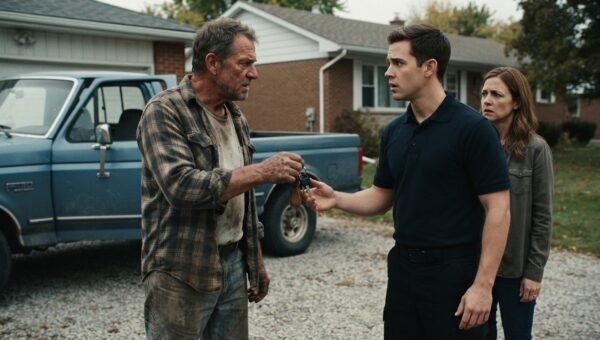
“Mr. Mark Miller?” a man asked. His voice was gravelly and unhurried.
“Speaking,” I said, holding the receiver between my shoulder and ear while typing an inventory spreadsheet.
“My name is Dale Henderson. I’m a licensed surveyor contracted through Miller County. I’m standing out here in your family’s back thirty-two acres, running boundary flags along the old drainage creek. I ran into a serious title flag on the county GIS map, and I need to ask you why your signature and name are registered on an iron-pin boundary survey recorded twenty years ago.”
I stopped typing. “I’ve never signed any survey, Mr. Henderson. The whole property went to my sister. It’s hers.”
“Well, that’s the problem,” Dale said. He kicked at gravel on the other end of the line. “Becky signed a purchase agreement with Oakridge Commercial Holdings to sell off the full eighty acres for a distribution yard.
The title company ordered this survey to clear the deed for closing this Friday. But according to the county clerk’s deed ledger, Book 412, Page 88, the back thirty-two acres haven’t belonged to your father since October 2004. They belong to you. And Oakridge cannot close on eighty acres when the woman selling it only owns forty-eight.”
PART 2
The office around me seemed to go dead silent. I gripped my desk with both hands.
“That’s not possible,” I told Dale. “My father died four months ago. His will was probated, and the entire property went to Becky. I was there. I read the paperwork.”
“I don’t know what will was filed, son,” Dale said, his boots crunching over frozen grass through the phone. “Wills can write down whatever a dying man imagines he owns. But you can’t bequeath what you already conveyed away twenty years prior. In October of 2004, your father executed a warranty deed transferring the southern thirty-two acres to Mark Thomas Miller. That’s you, isn’t it?”
“Yes,” I muttered.
“He filed it with the county recorder himself. He even paid the transfer stamp. Then he filed an exclusion plat on the farm’s official tax parcel, splitting it off. For twenty years, your father paid the county property taxes on the whole tract under an agricultural escrow, so nobody ever noticed the parcel split on the surface. But when a developer buys commercial land, they run an unbroken title search back fifty years. The title company found the conveyance yesterday. Oakridge sent me out here today to verify the corner pins. If you didn’t know about this, Mark, you need to call an attorney before noon, because your sister has a $1.2 million closing scheduled in three days.”
A million and two hundred thousand dollars.
My stomach dropped. Becky had told me she was keeping the farm to preserve our parents’ memory. She had sworn she wanted her kids to raise horses where we used to run.
“Thank you, Dale,” I said, my voice barely above a whisper. “Send me the book and page number.”
I left work at noon, took personal leave, and drove directly to the county courthouse in Greenfield. The clerk in the land records department was a woman in her sixties named Martha who had known my parents for thirty years. When I gave her the reference, she pulled up the digital microfiche on her screen and turned the monitor toward me.
There it was. Dated October 14, 2004.
At the bottom of the deed was my father’s familiar, left-leaning signature in black ink, witnessed by a county notary. Attached to the back was an old carbon copy of a cashier’s check for $14,000, payable to First State Bank.
I looked at the date again. In the fall of 2004, I was twenty-six years old. Dad had gotten into serious trouble with an equipment loan on the John Deere combine. The bank had threatened to put a lien on the homestead. I had taken out a personal loan and emptied my entire four-year company 401(k), paying the bank directly so Dad wouldn’t lose the farm. He had looked at me on the front porch with tears in his eyes, handed me a glass of iced tea, and said, “I’ll make this right by you, Mark. You saved my skin.”
He never brought it up again. I thought he had just tucked the memory away out of stubborn pride.
Instead, he had driven into town the following Monday, carved the back timber and deer creek completely off the farm’s legal boundaries, and signed the deed into my name. He had protected my money the only way he knew how, without ever making a show of it to Mom or Becky.
I sat in the clerk’s office and pulled out my cell phone. I dialed Becky.
She answered on the second ring, her voice clipped and busy. “Mark? I’m running errands. What is it?”
“Becky,” I said calmly. “Who is Oakridge Commercial Holdings?”
The silence on the line was instant.
“I don’t know what you’re talking about,” she said, her voice tightening.
“You’re selling Mom and Dad’s land for a warehouse yard,” I said. “Closing is Friday. And you tried to sell thirty-two acres that you don’t own.”
PART 3
Becky’s breath hitched, but she didn’t apologize. Instead, her voice turned sharp and bitter.
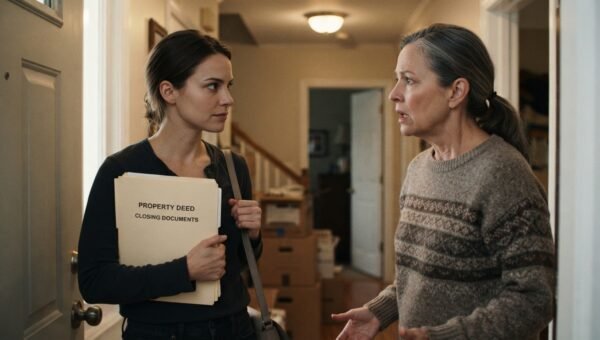
“That farm is mine, Mark! Dad left it to me. I had to wipe down Mom’s counters every week while you were living your fancy life in the city. The lawyer looked at the will. Everything went to me. Whatever outdated junk you found in the basement doesn’t mean a thing.”
“It’s not in the basement, Becky. It’s filed in the county recorder’s office. Dad deeded the back thirty-two acres to me twenty years ago when I bailed him out on the combine. You can’t sell it. Oakridge won’t touch this title with a thirty-two-acre cloud hanging over it.”
“You sign it over,” she said, her voice rising to a near shriek in my ear. “You sign the release form! If Oakridge walks, the entire deal falls through. They won’t buy just the front forty-eight. The access road has to cut straight through that back timber to reach the county highway! You are ruining my life! That money was supposed to be my retirement!”
“You lied to me,” I said. “You told me you were keeping the land for the family.”
“I don’t owe you an explanation!” she screamed. “Dad was confused back then. He didn’t know what he was doing in 2004! If you don’t sign that waiver by tomorrow morning, I’ll take you to court and claim undue influence. You’ll spend every penny you have fighting me!”
She slammed the phone down.
I sat in my truck in the courthouse parking lot for a long time. The anger was there, but beneath it was a strange, heavy clarity. My father hadn’t forgotten me. When he grew frail and Mom’s care took over everything, Becky had moved in close, whispering in their ears about how ungrateful I was, poisoning the well until Dad signed that final will just to keep peace in his house. But twenty years earlier, with a sound mind and steady hands, he had built a wall between Becky’s greed and the piece of earth I loved most.
The next morning, I met with Oakridge’s lead acquisition representative and their corporate attorney at a title office in town. Becky was already sitting at the conference table, her arms crossed tight across her chest, her eyes red, refusing to look at me. Her husband, Greg, was staring at the floor.
The corporate lawyer laid out three survey maps across the mahogany table.
“Mr. Miller,” the lawyer said to me, “our client intended to purchase the entire eighty acres for $1.2 million. However, your sister only has legal right to convey forty-eight acres. Without the back thirty-two acres, our access corridor to the state route is gone, making the front acreage essentially useless for our distribution center. Our offer was for the combined tract. If you do not sign a quitclaim deed joining the sale, the contract with your sister terminates today under the title contingency clause.”
Becky glared at me. “Sign it, Mark. We’ll split the difference on the back field. I’ll give you ten percent.”
“Ten percent?” I asked.
“You haven’t paid taxes on it in twenty years!” she snapped.
The lawyer cleared his throat. “Actually, Mrs. Henderson, your father’s agricultural account covered the tax bundle, but the legal title rests solely with your brother. Under the contract’s per-acre valuation, the back thirty-two acres represent roughly $480,000 of the total purchase price. If your brother refuses to sell, our company walks away completely.”
Becky looked like she had been slapped across the face. She turned to me, her arrogance suddenly dissolving into desperation. “Mark, please. Greg took out loans against this closing. We put deposits on a new house in Naples. You can’t do this to us. We’re your family.”
I looked at the maps on the table. The southern parcel had the stand of blue spruce, the winding creek bed, and the old limestone ridge where Dad taught me how to shoot a target with a .22 rifle. Becky wanted to pave it with four inches of asphalt for semi-truck trailers.
“I’m not signing a quitclaim,” I said.
Becky gasped. “Mark!”
I looked at the developer’s attorney. “I will never sell the back thirty-two acres to a commercial developer. But I know my sister wants out. I will make one offer to clear this table. I will buy the front forty-eight acres, including the house and the barn, from my sister for its agricultural appraised value. Not commercial development value. Farmland value. Two hundred and ten thousand dollars. Cash.”
Becky jumped up from her chair. “That’s an insult! That property was worth over a million yesterday!”
“It was worth a million because Oakridge needed my timber to build an exit ramp,” I said, keeping my voice low and steady. “Without my dirt, it’s just forty-eight acres of rocky pasture and a house that needs a new roof. Take my offer, Becky. Or take down your ‘Sold’ signs and figure out how to pay the back debts Greg ran up.”
ENDING
The developer walked out of the room twenty minutes later. Becky fought, cried, and threatened to sue for three days, but every property attorney she consulted told her the same truth: my deed was unassailable, and no commercial buyer would touch a landlocked parcel with family litigation attached.
By Friday afternoon, the original closing date, she signed the deed of the front farm over to me for $210,000.
I took out a twenty-year mortgage on the farmhouse to cover the payment. Becky and Greg packed their things, took their money, and left for Florida that same weekend. She hasn’t spoken a word to me since, other than to mail a change-of-address card for the utility bills.
Last Sunday, I drove my truck through the main gate of the farm.
The developer’s surveyor flags had already blown away in the late-winter wind. The barn was drafty, and the house smelled like cold floorboards and old tea, but every single acre on both sides of the creek was whole again.
I walked out through the back field, past the frozen mud along the tree line, until I found the rusted iron pin Dale Henderson had driven into the dirt twenty years before. Right next to it was the old cedar fence post Dad had notched with an axe when I was a boy.
I rested my hand against the rough wood, listened to the wind move through the pines, and for the first time in five months, I felt completely at home.