PART 1
My mother stopped celebrating my birthday after I turned thirty.
She did not forget the date. She was not the kind of woman who lost track of a calendar. Every year, on the twenty-sixth of September, the phone stayed quiet. Then, promptly at eight in the morning on September twenty-seventh, she would call to ask if I needed anything from the grocery store, or how the garden was doing, or whether my car was running properly.
Sometimes she called on the twenty-fifth instead. Never on the day itself.
For fifteen years, I took it as a quiet, bitter slight. We had never been especially close, but we were not enemies either. My father had passed away when I was twenty-two, leaving the two of us to carry an awkward, stiff kind of relationship. I always assumed she was holding some private grudge from when I moved out, or that she simply resented watching me get older while she stayed alone in the house on Elm Street.
On my forty-fifth birthday, I decided I was tired of tiptoeing around it.
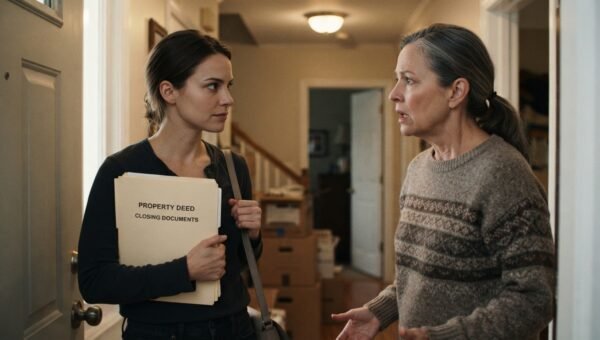
I drove over to her house on my lunch break with a box of cinnamon pastries from the bakery downtown. She opened the door in her quilted housecoat, looking smaller than I remembered.
“What are you doing here, David?” she asked, wiping her hands on an apron. “It’s the middle of a Tuesday.”
“It’s my birthday, Mom,” I said, holding out the box. “I brought lunch.
I thought maybe this year we could just sit down and have coffee together on the actual day.”
Her face went completely rigid. She didn’t reach for the box. Her eyes shifted away from mine, staring down the hallway toward the kitchen where the old brass clock was ticking.
“I can’t talk about that day,” she said. Her voice was flat and dry.
“Mom, I’m forty-five years old,” I said, feeling fifteen years of irritation bubble up in my chest. “You call me the day before. You call me the day after. Every single year you act like the day I was born doesn’t exist. Just tell me what I did. Did I do something wrong?”
“Take the pastries home, David,” she said quietly. “Please.”
“No,” I snapped. “If you can’t even say happy birthday to your own son after four decades, I’m done pretending it doesn’t bother me.”
I turned around, walked down the porch steps, got in my car, and drove away.
Two months later, her neighbor found her collapsed beside the mailbox.
By the time I reached County General, the doctor told me she had suffered an ischemic stroke.
She was stabilized, but she couldn’t speak, and her right side was completely limp. Because I was her only listed family, the hospital staff handed me a clipboard and told me I needed to track down her secondary insurance cards, her power of attorney, and her living will.
The next morning, I stood in her spare bedroom, pulling open the bottom drawer of her metal filing cabinet.
Her life was filed in neat manila folders labeled with a label-maker from the 1980s: *Taxes 1994*, *Roof Warranty*, *Water Bills*. Tucked behind the property deeds was a faded blue file marked *David – Medical*.
Inside was my vaccination card, my pediatric dental charts, and an original yellow carbon-copy document from St. Jude’s Mercy Hospital dated September 26, 1981. It was my mother’s labor and delivery summary.
I scanned down the page, expecting to see a standard discharge report. But halfway down the page, under the section for multiple births, the box marked *Twin* was checked in faded blue ink.
The typewritten line read:
*Infant A: Male, 6 lbs 2 oz. Condition: Stable.*
*Infant B: Male, 5 lbs 8 oz. Condition: Critical.*
My eyes stayed locked on the words *Infant B*.
I had grown up as an only child. There had never been another crib in the house. There were no baby clothes tucked away in trunks, no small headstone next to my grandparents at Oakridge Cemetery, and my father had never once mentioned another baby.
I read further down the faded page. Infant B had survived for six hours in the neonatal unit.
Then came the final section at the bottom of the form. Under the standard disposition box, the word *Deceased* was not stamped. Instead, a manual typewritten correction had been added across the line:
*Released to father.*
PART 2
I stood by the metal cabinet with the paper shaking in my fingers.
My father, Arthur, had been a quiet, practical machinist who worked thirty years at the tool and die plant. He was not a man of mysteries. He went to church on Sundays, fixed the lawnmower on Saturdays, and ate dinner at five-thirty sharp. To look at this yellowing hospital form and see his signature authorizing the release of a living, breathing twin brother made the floor feel uneven beneath my work boots.
I went back to the hospital that afternoon. Mom was still half-asleep, hooked to monitors that beeped in a steady, cold cadence. I sat in the vinyl chair beside her bed with the file folded inside my coat pocket, watching her chest rise and fall.
The hospital would not give me the full archived file over the counter. Because the birth took place over four decades ago and St. Jude’s Mercy had merged into the Valley Health Network in the late nineties, the clerk told me archived records had to go through formal legal retrieval.
I had Mom’s medical power of attorney stamped that very afternoon. It took four days of phone calls, two notarized forms, and an eighty-dollar archive fee, but by Friday afternoon, an official sealed manila envelope arrived at the records desk.
I took the envelope out to my truck in the hospital parking lot and ripped the top open.
Inside were the complete physician notes from September 26, 1981.
According to Dr. Robert Vance, the attending obstetrician, my mother had suffered severe preeclampsia and excessive blood loss during an emergency cesarean section. She had slipped into a coma immediately following delivery and remained in intensive care for nine straight days.
The notes on Infant B were brief, typed on St. Jude’s letterhead:
*Baby presented with respiratory distress and cyanosis. Transferred to warming crib. At 04:15, father Arthur Vance requested voluntary transfer of custody for private transport to pediatric specialty unit. Form 4B signed. Child released into custody of father at 05:00.*
There was no record of a death certificate in the file. There was no burial permit.
My father had taken my twin brother out of the hospital while my mother was unconscious in the ICU. When she finally woke up more than a week later, he must have told her the baby didn’t make it.
I folded the papers back into the envelope and walked back up to the fourth floor.
Mom was awake. Her eyes were open, clear and wet, tracking me as I walked into the room. Her left hand was resting on the white blanket.
I pulled the chair close to the edge of the mattress and sat down. I took her left hand in mine. Her fingers twitched, then pressed weakly against my palm.
“Mom,” I said softly.
Her lips parted, but she could only produce a dry, raspy breath.
I reached into my coat, pulled out the 1981 summary, and laid it gently on the edge of the blanket where she could see the faded blue letterhead of St. Jude’s Mercy.
Her eyes drifted down to the logo. Then her gaze found the line: *Infant B*.
A low, trembling sound came out of her throat. It was not a sound of confusion. It was the sound of an old, buried wound being torn open all over again. Her fingers gripped mine with surprising force.
She looked up at me, tears spilling over the corners of her eyes, running into the wrinkles near her ears.
She struggled against her slurred speech, forcing the words out one by one.
“I thought… he buried… your brother,” she whispered.
I leaned in closer so my ear was inches from her face.
“Mom,” I asked, “what did Dad tell you when you woke up?”
She closed her eyes, her breathing shaking her thin frame.
Then she looked at me and said, “He said… the baby died… while I was asleep. He said he handled the burial… so I wouldn’t have to see… a tiny casket. He never… let me speak… of that day again.”
PART 3
The room was silent except for the hiss of the oxygen line.
For forty-five years, every September twenty-sixth was not just the day I was born. For my mother, it was the day she woke up from a nine-day coma to be told that one of her children had died, that his body was already in the ground, and that she was forbidden from ever mentioning it because it was too painful for my father.
She hadn’t ignored my birthday out of cruelty or resentment. She had avoided the calendar date because surviving that day, while another child supposedly vanished into an unmarked grave, carried a guilt that paralyzed her. She called me the day before and the day after because she loved me, but the twenty-sixth was the day her family broke in half.
“Mom,” I said, keeping my voice steady. “Look at the bottom line. It doesn’t say deceased. It says released to father. He took him.”
Her eyes went wide, filled with an agony so raw it looked like she had just heard the news an hour ago. She tried to lift her head off the pillow, but the weakness pinned her down. She could only shake her head, her hand trembling in mine.
I needed the truth. Not just for myself, but for the broken woman lying in that bed.
The next morning, I drove out to my father’s old hunting cabin in Mercer County. When he died twenty-three years ago, we had cleaned out his clothes and his tools, but his old metal lockbox had been moved to the cabin’s cedar wardrobe. Nobody had opened it since the estate was settled.
I used the spare key from my mother’s kitchen drawer to unlock the brass padlock on the green steel box.
Inside, beneath his military discharge papers and our family life insurance policies, lay an envelope of heavy parchment paper with a return address from an attorney’s office in Madison: *Cunningham & Miller, Attorneys at Law, November 1981.*
Inside was an agreement. A private placement contract.
My father had not buried my brother.
The documents showed that in 1981, my father’s younger sister, Clara—my aunt who had moved away to Oregon when I was five—had suffered three consecutive miscarriages and had been told she could never carry a pregnancy to term. She and her husband, Paul, had spent thousands on private adoptions that had fallen through.
When the doctors told my father that his twins were premature and that my mother might not survive her internal bleeding, my father made a terrifying, cold calculation. He believed Mom was dying. He believed he would be left alone, broke, working sixty-hour shifts at the machine shop with two infants in incubators.
So he called his sister.
Clara and Paul had driven all night from their temporary apartment in Chicago. My father signed Infant B out of the hospital under private transport, met them in the parking lot of a diner off Interstate 90, and handed my twin brother through the window of a station wagon.
Three weeks later, when my mother unexpectedly survived and came home frail and grieving, my father realized what he had done. To admit the truth would have destroyed his marriage, sent his sister to court, and landed him in prison. So he locked the lie down. He told Mom the child had died after six hours, that he had paid for a quiet cremation and scattered the ashes in the river to spare her the pain of a funeral.
And he kept the papers locked in steel, paying Clara’s attorney three hundred dollars a month for two years until the private adoption records were sealed by a judge in another county.
My twin brother was alive.
His name was Thomas. I had seen him twice in my entire life—once at a family reunion when we were seven, and once at my father’s funeral when we were twenty-two. Aunt Clara had kept him three states away, always making excuses about travel expenses and work schedules whenever holidays came around. We had thought he was our quiet cousin from out west.
I sat on the wooden floor of that dusty cabin, holding the signature pages with my father’s neat, slanted handwriting beside my aunt’s name.
He had traded a son to protect a secret, and he had let his wife live forty-five years carrying the weight of a ghost.
ENDING
I drove directly from the cabin to the airport, caught an evening flight to Portland, and rented a car. By noon the following day, I was standing on the gravel driveway of an apple orchard outside of Eugene.
Thomas came out of the pole barn wiping grease from his hands with a red shop rag.
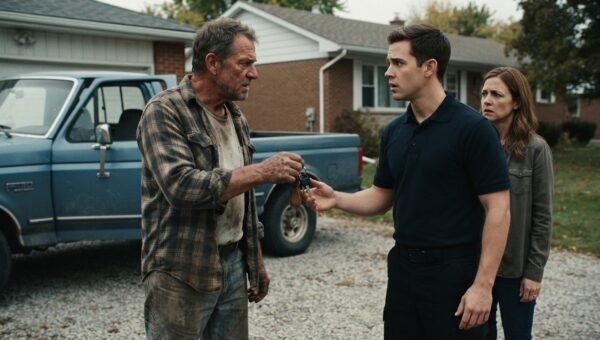
He had the exact same build as me. He had the same broad shoulders, the same cowlick above his right temple, and the same dark eyes that my mother had. When he saw me standing by the rental car, he stopped in his tracks. He didn’t ask what I was doing there. He just stared at my face, looking like he was staring into a mirror that had aged twenty years.
Aunt Clara had passed away in 2018. Before she died, she had left Thomas a letter in her safe deposit box telling him that he was adopted, but she had never told him the full story. She had only told him that his biological parents were too poor to keep both babies.
I handed him the yellow hospital summary and the legal agreement from 1981.
We sat on the tailgate of his pickup truck for two hours without either of us raising our voices. When you find out your whole life was built on a transaction made in the cab of a station wagon behind a diner, anger isn’t the first thing that hits you. It’s a hollow, heavy ache for the people who were lied to.
“She’s in the hospital,” I told him. “She had a stroke. She doesn’t have much time.”
Thomas stood up, walked into the barn to turn off the air compressor, washed his hands at the garden hose, and grabbed his jacket.
“Let’s go,” he said.
Two days later, we walked into Room 412 together.
Mom was sitting up slightly, supported by two white pillows. Her hair was brushed back, and her face was tired, worn down by forty-five years of silent grief that she had never been allowed to speak aloud.
I stepped into her line of sight first, then moved aside.
Thomas stepped forward. He stood at the right side of her bed, the side she couldn’t move, and gently reached down to cover her paralyzed hand with his own.
“Mom,” Thomas said. His voice was deeper than mine, but it carried the same cadence. “I’m here.”
My mother didn’t scream. She didn’t drop her head.
She stared into his face, taking in his chin, his nose, the curve of his forehead, tracing the lines that belonged to the boy my father told her had turned to dust in the river. A soft, rattling breath escaped her chest, followed by a quiet sob that seemed to come from the deepest part of her life.
With the strength she had left in her good left arm, she reached across the sheets, grabbed the sleeve of Thomas’s shirt, and pulled him toward her until his forehead rested against her shoulder.
She didn’t ask how it happened. She didn’t ask about my father, or about Aunt Clara, or about the diner on Interstate 90. In that hospital room, none of the lies mattered anymore. The only thing that mattered was that the dead boy was standing in front of her, breathing, with warm hands and Arthur’s shoulders.
Mom lived another four months.
We moved her into a small assisted care facility ten minutes from my house, and Thomas flew out every other weekend. We didn’t talk about my father much. His photo stayed on her nightstand because after forty years, you can’t simply erase a marriage, but nobody touched it, and nobody mentioned his name.
When September twenty-sixth came around the following year, the three of us were sitting together in the sunroom of the care home.
Outside, the maple trees were turning bright red, just like they had on the morning I was born. There was a small sheet cake on the table with two candles on it, bought from the same bakery downtown.
Mom sat in her wheelchair between us, her left hand holding Thomas’s fingers, her right wrist resting quietly on the armrest.
At noon, the grandfather clock in the corner struck twelve times.
Mom turned her head toward me, then turned toward Thomas. Her voice was weak, the words still slightly broken from the stroke, but her eyes were clearer than I had ever seen them in my forty-six years.
“Happy birthday,” she said.
She said it on the actual day.