PART 1
The hallway smelled like floor wax and stewed carrots, and every Sunday around two in the afternoon, the front parking lot filled with minivans and sedans. I sat in the same vinyl armchair near the tall window in the sunroom, watching daughters carry floral tins and grandsons jog up the concrete ramp.
My son, Greg, came once in two months.
He was thirty-eight years old, wore starched shirts that cost more than my monthly grocery budget, and had spent the last five years telling everyone in our circle how hard it was to manage his aging mother.
The story he told my sister, my former neighbors, and the intake coordinator at Oak Ridge Living was always the exact same version.
He said he drove over to my ranch house on Elm Street in the middle of a November night, opened the back door with his key, and found me wandering around the kitchen in the pitch dark at three in the morning. He told them I was disoriented, staring blankly into empty cabinets, and completely unsafe to live alone in a house my husband and I paid off fifteen years ago.
He never told them the power had been cut off at noon that Tuesday because the utility company shut down the meter.
I had given Greg access to my checking account eight months earlier when my arthritis got too stiff to write out checks by hand. Every month, my Social Security deposit of $1,620 and my late husband Arthur’s modest railroad pension of $850 went directly into that account. Greg swore he had set everything up on automatic bill pay.
He told me I never had to worry about a light bill, a water bill, or the property taxes again.
“Just let me handle the paperwork, Mom,” he had said, kissing the top of my head in my own kitchen. “You worked forty years at the dry cleaner. It is time for you to just relax and let me carry the load.”
The night he claimed I was wandering in a confused haze, the house was forty-eight degrees inside. The baseboard heaters were dead cold. The digital clock on the stove was black. I had gotten out of bed wrapped in two wool blankets because the refrigerator had started to thaw, dripping foul water across the linoleum, and I was trying to find a box of matches in the dark pantry so I could light a candle and see where the leak was coming from.
When Greg let himself in with his key, flashlight beaming across my face, he did not ask why the lights were off.
He did not check the breaker box in the laundry room. He took out his cell phone, took a photo of me standing in my nightgown with a puddle of thawed freezer frost by my bare feet, and said, “Look at you, Mom. You cannot keep living like this. You do not even know what time it is.”
Within forty-eight hours, he packed two suitcases of my clothes, drove me forty miles across the county line to Oak Ridge, and signed the temporary thirty-day residential admission forms. He paid the first month out of my own checking account.
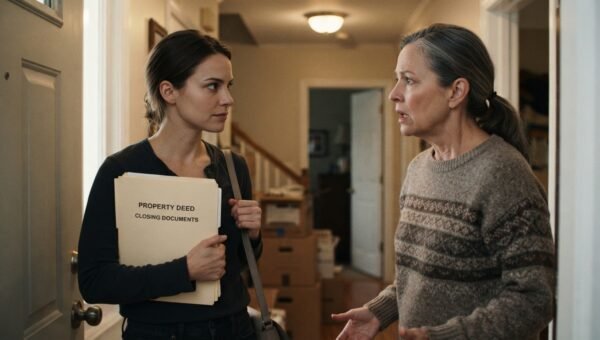
When he finally visited me three weeks into my stay, he did not bring fresh clothes or the photographs of Arthur I asked for. He brought a thick blue manila folder with yellow sticky flags sticking out of the sides.
He set the folder on the small laminate desk in my room and pulled a ballpoint pen from his coat pocket.
“The facility director needs these signed before Friday, Mom,” he said, speaking in that loud, slow voice he started using the day he dropped me off. “It is just standard administrative authorization.
It gives me legal standing to manage your medical files and keep your room here funded without having to drag you to the bank every thirty days.”
I looked at the yellow flags. I looked at the legal font on the cover sheet. Even without my reading glasses, I could see the words *General Durable Power of Attorney* and *Quitclaim Deed*.
“I am not signing anything until I go home and look at my mail, Greg,” I told him quietly.
He stared at me for five long seconds. His face went flat and tight.
“You are not going home, Mom,” he said, tapping the desk with the tip of the pen. “The house is too big for you. It is dangerous. If you do not sign these, the county will step in, appoint an outside guardian, and take everything you and Dad built anyway. You sign these, and I protect you. Think about it.”
He left the packet on the desk and walked out.
As soon as his car pulled out of the driveway, I slid the blue folder under my thin mattress, pressed down flat against the steel spring frame. I told no one it was there.
PART 2
For six weeks, nobody mentioned the house, the papers, or my discharge date. Whenever I asked the floor nurse when my transition review was scheduled, she gave me a sympathetic pat on the shoulder and said Greg was handling all family communications with the social services director.
Then, last Tuesday at ten in the morning, an unfamiliar woman in a navy trench coat walked into the sunroom.
She carried a brown leather briefcase and asked the charge nurse for Martha Vance. When the nurse pointed across the room toward my chair by the window, the woman walked straight over, pulled up a wooden visitor chair, and sat down facing me.
“Mrs. Vance? My name is Clara Ruiz,” she said, opening a badge wallet that showed the seal of the county adult protective services division. “I am a caseworker with the county probate oversight office.”
My stomach turned over. I thought Greg had followed through on his threat to have the state declare me incompetent.
“Did my son call you?” I asked, keeping my hands folded firmly in my lap to hide the tremor in my knuckles.
“No, ma’am. Your son did not call us,” Mrs. Ruiz said. She opened her briefcase and pulled out a manila folder with three official-looking documents clipped to the top. “A title search company in the county recorder’s office flagged a transaction yesterday afternoon. Mrs. Vance, did you know that your house on Elm Street was listed on the open real estate market three weeks ago?”
The room seemed to tilt slightly.
“No,” I whispered. “My husband and I lived in that house for forty-six years. It is paid off. It is not for sale.”
“Did you sign a listing agreement with a broker named Miller Realty?”
“I have not signed a single piece of paper since the day Greg drove me through the front doors of this place,” I told her.
Mrs. Ruiz leaned forward, her expression turning sharp and serious. “The listing agent submitted a purchase agreement yesterday morning for three hundred and ten thousand dollars, cash. The buyer is an LLC registered to a local developer. Attached to the closing file was a signed, notarized special warranty deed dated two weeks ago, bearing your signature.”
My heart hammered against my ribs like a trapped bird. “I never saw a notary. Nobody came here.”
“Mrs. Vance, has your son asked you to sign any legal documents since you were admitted here?”
I stood up, walked her down the corridor to room 114, closed the door behind us, and lifted the corner of my mattress. I pulled out the thick blue folder Greg had left on the desk six weeks earlier and handed it to her.
Mrs. Ruiz sat on the edge of my bed and flipped through the pages. She examined the blank signature lines, the yellow post-it flags, and the notary blocks that were completely empty.
Then she looked up at me, her face pale.
“Who told you to sign these?” she asked quietly.
“Greg did,” I said. “He told me if I did not sign them, the county would take my house and put me in a state ward. He said they were just medical care forms.”
Mrs. Ruiz flipped back to the deed document in her own folder, comparing it to the blank deed in the blue packet.
“Mrs. Vance,” she said, her voice dropping to a harsh whisper. “The deed filed with the county recorder has your name signed in black ink, witnessed by a mobile notary, and dated November twenty-fourth. But the document you just pulled from your mattress is the original copy of that exact same instrument. Which means the signature filed with the county is a forgery.”
PART 3
Mrs. Ruiz took out a small recording device, set it on my bedside stand with my permission, and spent the next hour asking me every detail about my finances, my health, and the night Greg brought me to Oak Ridge.
I told her about the dark kitchen, the thawed meat in the refrigerator, and the baseboard heaters that would not turn on. I told her how Arthur and I had saved every nickel to ensure the mortgage was burned in 2009. I told her that Greg had taken over writing my checks because my hands were stiff, but that every penny of my monthly income went straight into the joint account at First National.
Mrs. Ruiz made three phone calls right from my room.
The first was to the regional utility company. She gave my address, read off my Social Security number with my consent, and requested the billing ledger for the last twelve months. She put the call on speakerphone.
The customer service supervisor read the records directly from the screen.
“Service to 418 Elm Street was disconnected on November twelfth due to non-payment,” the representative said. “The last payment received on that account was in June. Three separate final termination notices were mailed to the primary billing address.”
“Was there any request to transfer service?” Mrs. Ruiz asked.
“Yes. On November thirteenth, a party identifying himself as Gregory Vance requested that the shut-off remain active because the property was being prepared for winterization and market preparation.”
Mrs. Ruiz wrote the date down in heavy ink. November thirteenth was forty-eight hours before Greg showed up at three in the morning with his flashlight, claiming he found me lost in the dark.
He had let the power get cut on purpose. He knew the house would freeze, he knew the refrigerator would spoil, and he waited until the conditions were miserable enough to create an emergency scene he could photograph on his phone.
The second call was to First National Bank. Because Mrs. Ruiz carried an emergency investigatory order from the probate court, the branch manager pulled up my checking account history within ten minutes.
The ledger was devastating.
My monthly deposits had arrived without interruption every single month: $2,470 total. But between August and November, twenty-eight separate cash withdrawals of five hundred dollars each had been pulled from the automated teller machine two blocks from Greg’s downtown condo. In September, a certified cashier’s check for twelve thousand dollars had been drawn from the account and made payable to a high-end European car dealership.
The balance in my checking account on that Tuesday morning was sixty-four dollars and twelve cents.
Greg had drained my life savings, let my utilities go dark to manufacture a dementia crisis, and forged my name on a deed to sell my home to a developer for three hundred thousand dollars before anyone could ask why I was living in a nursing home forty miles away.
Mrs. Ruiz closed her folder, stood up, and looked me in the eye.
“Mrs. Vance, we are filing an emergency petition for an immediate freeze on all transactions concerning your real property,” she said. “The county prosecutor’s elder financial abuse task force is going to take this case today. I am also calling the facility administrator right now. You are not a ward of the state, your admission was based on fraudulent representations, and you are free to leave whenever you are ready.”
“Where am I going to go, Clara?” I asked, tears finally slipping down my cheeks. “My house has no heat, no food, and my bank account is gone.”
“You are going to stay right here for forty-eight hours while we sort this out,” she said gently. “The county will cover the bed cost under emergency victim assistance. And tomorrow morning, we are going to have a visitor.”
ENDING
The next afternoon at one o’clock, Greg walked into the small administrative conference room near the front entrance of Oak Ridge. He had his camel-hair topcoat over his arm and a confident smile on his face, clearly expecting that the administrator had finally called him in to sign the final private-pay contract.
Instead, he found four people sitting around the mahogany table: myself, Mrs. Ruiz, the facility administrator, and Detective Miller from the county sheriff’s financial crimes unit.
Greg stopped dead in the doorway. The smile vanished from his lips.
“Mom?” he said, his voice instantly dropping an octave. “What is going on here? Why are you in this meeting?”
“Take a seat, Mr. Vance,” Detective Miller said, gesturing toward the empty chair on the other side of the table.
Greg did not sit. His eyes darted to the folder in front of the detective, then to Mrs. Ruiz’s county badge lying flat on the wood.
“If this is about her care plan, I am her power of attorney,” Greg said, puffing out his chest. “I make the legal decisions for her welfare.”
“No, Mr. Vance, you do not,” Mrs. Ruiz said calmly. She slid the blue folder across the table. “This is the power of attorney document you brought to your mother six weeks ago. As you can see, it was never executed. You never had legal authority over her person or her property.”
Greg swallowed hard. His face flushed bright red. “There was another copy. She signed it at home before she came here.”
Detective Miller pulled a black-and-white printout from his file. It was the deed submitted to the county recorder, bearing my forged signature, along with a written statement from a twenty-four-year-old mobile notary who had broken down in tears when the sheriff visited her office that morning.
“The notary admitted everything, Gregory,” Detective Miller said plainly. “She told us you gave her five hundred dollars cash to stamp the deed in a coffee shop without the grantor present. She gave us the text messages you sent her from your personal phone.”
Greg’s hands began to shake. He reached out to lean against the back of the empty chair.
“Look, this is a family misunderstanding,” Greg stammered, looking directly at me for the first time. “Mom, you know how hard it was. I was trying to manage your care. The house was deteriorating. I was going to use the proceeds from the sale to pay for your room here so you would have top-tier care for the rest of your life.”
“You bought a sports car in September, Greg,” I said. My voice did not shake. It was the steadiest it had been in ten years. “You took twelve thousand dollars of your father’s railroad pension to make a down payment on a car while you let the power company turn off the heat in my house.”
“Mom, please—”
“You left me in the dark at three in the morning,” I told him, looking straight into his eyes. “You took a picture of my feet in melted ice so you could tell my sister I was losing my mind. Arthur worked thirty years on the track lines so I would never have to beg anyone for a place to sleep. And you tried to throw me away like an old coat.”
He did not have an answer. He looked at the floor, his mouth opening and closing without a sound.
Detective Miller stood up, walked around the table, and touched Greg’s shoulder.
“Gregory Vance, you are under arrest for felony forgery, uttering a forged instrument, and grand theft by financial exploitation of an elder,” the detective said.
Greg did not fight. He offered no resistance as Detective Miller placed his hands behind his back and clicked the steel handcuffs shut around his wrists. As they led him down the tiled hallway past the nurses’ station, two nurses stopped their medication carts and watched in dead silence. He did not look back once.
Three weeks have passed since that meeting.
The county prosecutor filed formal charges against Greg, and the court placed an immediate freeze on his personal assets to secure full restitution for the funds stolen from my bank account. The fraudulent deed was officially voided by a probate judge on Thursday morning.
Yesterday, Clara Ruiz drove me back to Elm Street in her own car.
The power had been reconnected four days earlier, paid for by an emergency fund from the senior community assistance council. The house was quiet, but the air was warm, and the yellow baseboard heaters were humming softly beneath the windows.
I walked into the kitchen, opened the refrigerator, and filled an electric kettle with cold tap water. I sat at my old oak table, watching the pale winter sun stretch across the linoleum floor where Arthur and I used to drink our coffee together every morning before the sun came up.
I am seventy-four years old. My hands are stiff, and some mornings my knees take a few minutes to get going. But my mind is as clear as cold spring water, and nobody is ever going to tell me what room I belong in again.