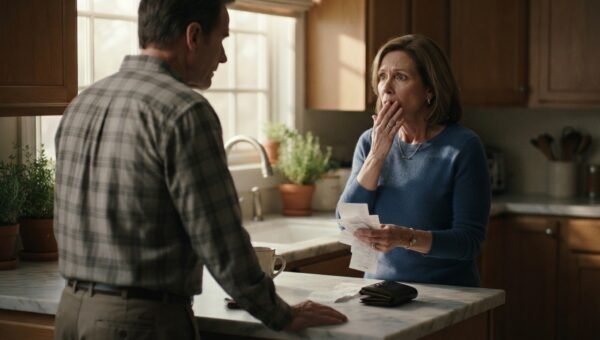
“It’s just the dry cleaners, Clara. You know how they lose those little cardboard tags.”
That was what Greg said six months ago when I found a stray blue ticket wedged between the cushions of the loveseat. I didn’t think much of it then. A man who runs an independent hardware store down on Third Street has grease and receipts on him half the time anyway. You get used to the laundry smelling like WD-40 and galvanized nails.
You stop questioning every little piece of paper that drops out of a hem or a pocket.
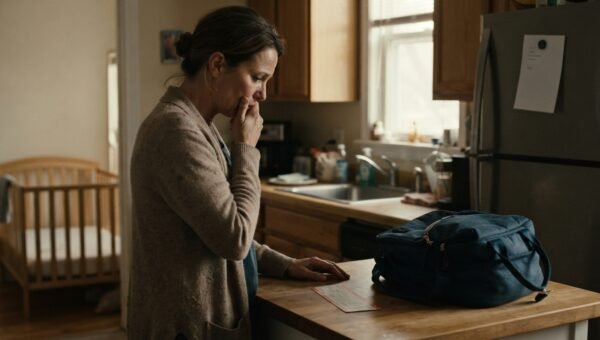
Then came Tuesday afternoon, and the weather had that heavy, damp feel of early spring when the bottomland stays soaked for days. I was putting away his winter wool coat in the hall closet because the frost had finally broken for good. The wool was heavy on my forearms. I slid my hand down into the deep right pocket to check for loose screws or stray receipts the way I always do before things go into storage, and my fingertips caught on something stiff and plastic.
It was a standard white plastic key card. No name on it, just a faded black logo for the Hilton Garden Inn off the bypass, twenty-two miles away in the county seat.
A person doesn’t keep a hotel key card in their winter coat unless they have been staying somewhere that isn’t home.
Our town isn’t big enough for secret overnight stays. Everybody knows everybody’s truck, and everybody knows which cars belong in which driveways. If Greg was sleeping twenty-two miles away, he wasn’t doing it by accident.
I didn’t yell. I didn’t drop to the floor or throw things against the wainscoting. I just walked over to the kitchen desk where we keep the landline and the old ledger books, picked up the receiver, and dialed the front desk of that Hilton with steady fingers.
“Good afternoon, Hilton Garden Inn,” a young woman’s voice answered, bright and entirely too cheerful for what was about to happen.
“I need to ask you about a reservation pattern,” I said, keeping my voice level. “Room 718. It’s booked every Wednesday evening by a man paying cash.”
There was a short pause on the line, the sound of a keyboard clacking away in the background. “I’m sorry, ma’am, I can’t give out guest information over the phone unless, “
“I am the wife,” I said. “And I have the key card in my hand right now.
You can save us both the trouble of me driving out there with the sheriff, or you can tell me how long this has been going on.”
The keyboard stopped clicking. “Room 718 has been reserved every Wednesday for eleven months,” she said quietly. “Always paid in cash at check-in. One hundred forty-nine dollars a night.”
I did the math right there while the dial tone hummed in my ear. Forty-four weeks. $6,512 just for the room. Not counting whatever else was happening inside those four walls while I was home canning green beans or tending to the porch ferns.
By Wednesday evening, the sky over the ridge had turned the color of an old galvanized bucket. The truck engine rattled a little as I pulled out of the gravel drive, keeping my headlights off until I turned onto the blacktop so Greg wouldn’t hear me leave. I drove the twenty-two miles with both hands locked on the steering wheel, watching the odometer tick up through the dark.
The Hilton Garden Inn sits back behind a row of stunted Bradford pears that never quite took to the clay soil. I parked three rows away, near an old Ford Ranger with a rusted tailgate, where I could see the side entrance and the bank of windows facing the interstate.
At exactly 6:15 PM, Greg’s gray sedan pulled into the lot and backed into a space near the side door. He sat there for three minutes with the engine running before he turned the key. At 6:18, a second car pulled in, a dusty blue sedan with a dented fender. A woman stepped out, her head down against the wind, pulling her jacket tight around her shoulders. They didn’t walk in together. Greg went through the side glass doors first, and she followed three minutes behind him.
I waited thirty minutes in the cab of my truck, watching the second-floor windows where the amber lights were just beginning to flicker on against the gathering dusk. My hands felt cold, but my head was clearer than it had been in a year.
The carpet in the second-floor hallway was thick enough to swallow the sound of my boots. I walked past the ice machine and stopped outside 718. The “Do Not Disturb” sign wasn’t hanging from the knob. I raised my hand and knocked twice, sharp and hard against the wood.
It took twelve seconds for the lock to click.
Greg pulled the door open. His flannel shirt was untucked on the left side, the top button undone, and his hair was standing up where he’d been running his fingers through it. He looked at me, and his face didn’t go pale; it just went slack, like a rusted hinge giving out all at once. He didn’t speak. He just stood there blocking the frame for a long second, then slowly stepped aside.
I pushed past him into the room.
A woman was sitting on the edge of the queen-sized mattress with a heavy manila folder open across her knees. She looked up, and the breath caught somewhere behind my ribs.
I knew that face. I had looked across my parents’ kitchen table at her just three months after my younger brother David was buried. It was Claire, David’s widow, sitting right there in a stale hotel room twenty-two miles from our farm.
Greg closed the door behind me with a soft click and leaned back against it, his eyes fixed on the patterned carpet between our feet.
He swallowed hard, his throat working under the collar of his shirt. “She came to me,” he whispered, his voice cracking slightly at the edges. “Said if I didn’t meet her every week we’d tell you what happened between her and your brother.”
“Tell me what?” I said, looking from Greg to Claire.
Claire didn’t flinch. She closed the manila folder with a dry snap that sounded like a dry twig breaking underfoot. She had always been sharp-eyed, even back when David was alive and working three jobs trying to keep his small contracting business afloat before his heart gave out in the cab of his truck.
“Your husband wasn’t just David’s brother-in-law, Clara,” Claire said, her voice steady and flat as pond water. “He was his silent partner in that machine shop venture down in Knoxville. The one that went under six months before David died.”
I looked at Greg. He kept his eyes on the floor, his shoulders hunched inside his jacket.
“He didn’t lose his own money,” Claire went on, standing up from the bed and laying the folder on the small laminate desk. “He used David’s signature as collateral on a commercial loan when the bank wouldn’t touch him. When the shop tanked, Greg walked away clean with our savings tied up in his name, and David took the debt to his grave because he was too proud to break your family apart.”
The room felt smaller than it was. The heater under the window gave a low, mechanical hum, blowing lukewarm air across the carpet.
“Eleven months,” I said, my voice barely louder than the heater. “You’ve been paying her hush money out of the hardware store drawer every Wednesday for eleven months.”
“It wasn’t hush money,” Greg muttered, finally lifting his chin just enough to look at me with that old, pathetic defensiveness that always made me want to scream. “It was… restitution. She found the paperwork in David’s desk after the funeral. She came to the shop with copies. If you had found out that I brought us to the edge of ruin and dragged your brother down with me, you wouldn’t have looked at me twice. I was protecting us.”
“Protecting us?” I laughed, and it sounded like dry leaves scraping across concrete. “You were protecting yourself. You always have.”
I walked over to the desk and picked up the manila folder. Claire didn’t try to stop me. Inside were the bank withdrawal slips, the promissory notes signed in David’s sloping handwriting, and the ledger sheets detailing every single cash payment Greg had handed over across this very table week after week. The math was all there in black and white. Every $149 hotel receipt stapled to a handwritten tally sheet.
“You’re going to pack your truck tonight,” I said, looking straight at Greg. I didn’t yell. There was no room left for yelling. The anger had burned down to something cold and hard, like a coal left in the stove overnight. “You aren’t coming back to the house. You can stay at the motel down by the county road until we get the lawyer to sort out what’s left of the hardware store.”
Greg opened his mouth, probably to start in on one of his long, winding explanations about how things were complicated and how he was just trying to keep the roof over our heads, but I held up my hand.
“Don’t,” I said. “Just don’t say another word.”
I turned and looked at Claire. She was standing by the window, watching me with a tired, hollow sort of grief that looked too much like my own.
“Take whatever is owed to you through the formal estate,” I told her, setting the folder back down on the desk. “Not like this. We’ll do it right through the county court, and my name will be on the papers too.”
Claire gave a small, slow nod. “I’m sorry it had to come to a hotel room, Clara. But he wouldn’t talk to me anywhere else where you might hear.”
I didn’t answer her. I turned around, pushed past Greg without brushing his sleeve, and pulled the door open to the hallway.
The drive back home took twenty-two minutes instead of twenty-two miles because I kept the truck in third gear most of the way, watching the high beams cut through the mist rising off the creek beds. When I pulled into the farm driveway, the house was dark except for the single yellow bulb burning over the side porch.
I didn’t turn on the television when I went inside. I walked straight through the kitchen, hung my coat on the peg by the back door where it belonged, and sat down at the wooden table by the window.
The house was quiet. Too quiet, maybe, but for the first time in eleven months, the air in it felt like my own.