PART 1
My mother passed away on a Tuesday in November after a quiet three-year fight with ovarian cancer.
She and Dad had been married for forty-one years. They built a modest life in a brick split-level on two acres outside of Canton, Ohio. Dad was a retired heavy machine mechanic for the county road department, and Mom worked thirty years as an administrative clerk at the local high school.
When Mom died, the house went cold and still. Dad seemed completely lost in the kitchen, staring into open cupboards like he could not remember how a can opener worked.
Six months later, Dad met a woman named Cheryl at a regional square-dancing group. Cheryl was fifty-nine, divorced twice, and lived in a rented duplex near the mall. Within eight weeks of their first date, Dad announced they were getting married at the courthouse.
It felt like a punch to the stomach. My younger brother and I were still sorting through the grief, still finding Mom’s handwritten grocery lists tucked inside cookbooks. But I loved my father. I saw the hollow fear in his eyes whenever he had to eat alone at that kitchen table. So I swallowed my sorrow and attended the small dinner Cheryl organized at an Italian restaurant. I smiled, shook hands with her adult children, and told myself that an old man had a right not to spend his final years in total isolation.
Then Cheryl moved into the house.
Within thirty days, the changes started. Cheryl bought dozens of plastic storage totes from the home improvement warehouse. She began taking down Mom’s cross-stitch samplers from the hallways, replacing them with mass-produced canvas prints of inspirational quotes from discount home decor stores. She boxed up Mom’s stoneware dishes, her collection of vintage milk glass, and the garden tools Mom had kept neatly hung in the garage.
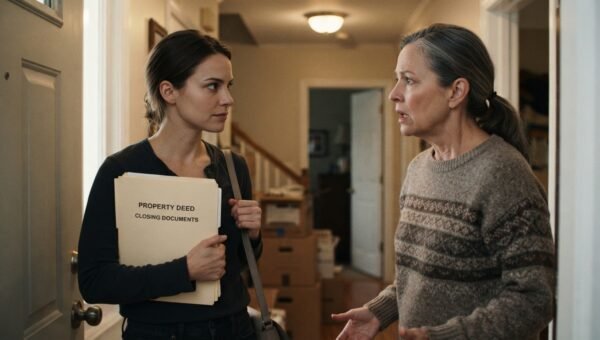
Dad just sat on the back patio with his dog, letting Cheryl sweep through the rooms like a summer storm. He was seventy-one, his knees were failing him, and he hated confrontation more than anything on earth. Whenever I visited on Sunday afternoons, Cheryl would meet me at the front door with a tight, plastic smile, pointing to stacks of labeled boxes waiting for the charity donation truck.
“We need to modernize, Rachel,” Cheryl told me, wiping down the kitchen counter with lemon-scented spray. “A house cannot remain a museum for someone who isn’t here anymore.
Your father needs fresh energy and light, not dusty reminders everywhere he looks.”
I bit my tongue until it bled. I helped carry boxes of Mom’s ordinary kitchen gadgets to my own car so they would not be thrown out. But there was one thing I could not let go.
Up in the walk-in attic space above the garage sat a heavy, dark aromatic cedar chest. Mom’s father had built it by hand out of solid red cedar boards for Mom’s eighteenth birthday in 1968. It had heavy wrought-iron handles, dovetail corner joints, and a solid brass lock.
Inside that chest was the true core of our family history. It held Mom’s vintage satin wedding dress, carefully wrapped in blue acid-free tissue paper. It held three shoeboxes filled with letters Dad had mailed to Mom while he was stationed with the Army in West Germany during the early seventies. And at the bottom, protected in leather binders, were the only existing original photo albums from my childhood and my brother’s infancy, along with Mom’s handwritten baby journals.
I took Cheryl into the attic on a Saturday in August, pointed directly at the chest, and looked her dead in the eye.
“Cheryl, you can redecorate the downstairs however you want,” I said, keeping my voice calm and firm. “You can change the curtains and repaint the cabinets. But do not touch this chest. My brother and I will come with a pickup truck next weekend to move it to my home. It holds my mother’s personal keepsakes.”
Cheryl smiled that narrow, condescending smile of hers. “Of course, Rachel. I am not a monster. Family keepsakes stay in the family.”
Next weekend arrived. My brother and I rented a small utility trailer, drove out to the house on Saturday morning at ten o’clock, and walked up the attic stairs with two pairs of heavy work gloves.
The attic floor was swept clean.
The space between the two exposed roof rafters where the cedar chest had sat for thirty-five years was completely bare.
I felt the blood drain from my face. I hurried down the stairs to the kitchen, where Cheryl was sitting at the breakfast nook with a cup of herbal tea, reading a magazine. Dad was out back in the garden shed tinkering with his lawn mower.
“Cheryl, where is the cedar chest?” I demanded, my hands shaking at my sides. “We brought the trailer to pick it up, exactly like I told you last week.”
Cheryl did not even look up from her magazine for five seconds. She slowly turned a glossy page, took a quiet sip of her tea, and looked at me with an expression of faint annoyance.
“Oh, that old wooden trunk?” Cheryl said, waving a hand dismissively toward the window. “I called the local veteran’s thrift center donation truck on Wednesday. They hauled it away along with some old lamps and curtains. Nobody needs that old clutter gathering dust up there, Rachel. Your father agreed it was just taking up floor space.”
“You donated it?” I choked out, tears of sheer fury stinging my eyes. “I specifically told you Mom’s wedding dress, Dad’s service letters, and our only baby pictures were inside that trunk!”
“Well, you should have moved it faster,” Cheryl snapped, her voice turning sharp and venomous. “This is my house now. I don’t run a free storage facility for forty-year-old junk. If it meant that much to you, you wouldn’t have left it sitting in an attic.”
I did not scream at her. I did not waste another breath in that kitchen. I ran out the back door, got into my car, and left my brother to confront Dad.
I spent the next four hours driving in frantic circles across the county. I visited every single secondhand store, charity depot, and thrift shop within a twenty-five-mile radius. Most of the donation processing centers told me they had not received a furniture intake from our area all week.
At three in the afternoon, I pulled into the gravel lot of a community thrift outlet on the old industrial road near the rail tracks. It was a cavernous warehouse filled with used sofas, dented refrigerators, and rows of clothing racks.
I walked straight to the customer service counter where an older woman with silver hair and reading glasses was pricing costume jewelry.
I described the heavy cedar chest down to the dovetail corners, the black iron side handles, and the distinctive brass latch shaped like a diamond.
The clerk paused, lifted her glasses, and nodded immediately.
“Yes, honey, I remember that piece,” she said. “Heavy solid red cedar. Came in on a private drop-off Wednesday afternoon around three o’clock. We don’t see craftsmanship like that very often.”
My heart leaped with a frantic hope. “Is it in the back? Can I buy it back right now? It has my late mother’s wedding dress inside!”
The woman shook her head with genuine regret. “Oh, honey, I am so sorry. It didn’t even make it onto the showroom floor. A man was standing right by the loading bay when the drop-off happened. He paid cash on the spot, loaded the whole chest into the back of his truck, and drove off within twenty minutes.”
My knees felt weak. “Did you take a name? Or a receipt? Do you know who he was?”
“Store policy requires a name and phone number on all loading-dock buyout receipts over fifty dollars,” the clerk said, opening a green metal receipt register beneath the counter. She flipped through the carbon slips, pulled out a yellow copy, and handed it across the counter.
I looked down at the scribbled handwriting on the buyer’s line.
It was not a stranger. It was not an antique dealer or a flea market picker.
The name on the receipt was Todd Bradley.
Todd Bradley was Cheryl’s thirty-two-year-old son from her second marriage.
I stared at that name until the ink burned into my mind. Cheryl had not donated Mom’s memories to a charity. She had arranged a private handoff behind Dad’s back.
PART 2
I stood by the counter of that thrift warehouse with the yellow receipt copy clutched in my fingers.
The store clerk looked at my face and reached across the glass to touch my arm. “Honey, are you alright? You look like you’ve seen a ghost.”
“This man is my stepmother’s son,” I said, my voice barely louder than a whisper.
The clerk frowned, adjusting her glasses to examine the receipt again. “Wait a minute. The woman who brought the chest in on Wednesday was driving a gray pickup. She told our dock manager it was an abandoned estate piece, but she insisted we write up a quick yard-sale transfer slip so this fellow could buy it out of our bay for seventy-five dollars. We thought they were together. She didn’t donate anything. She used our loading dock to transfer the property.”
A cold, methodical calm settled over me. All the panic and frantic rushing of the last five hours disappeared, replaced by iron resolve.
Cheryl had not merely been careless or impatient. She had calculated the whole thing. She knew the solid red cedar chest alone was worth several hundred dollars to antique collectors, and she knew the sentimental contents were leverage she could use to hurt me and erase my mother completely.
I looked down at the receipt. Todd Bradley had written down his real cell phone number and his street address on the customer line. He lived twenty minutes away, in a rental townhouse on the north side of town near the community college.
I walked out to my car, took a clear photograph of the receipt with my phone, and called my brother, Mark.
Mark was still at Dad’s house, sitting on the back patio.
“Rachel, where are you?” Mark asked, his voice strained. “Dad is in tears inside. He had no idea Cheryl gave the chest away. He thought it was still in the attic. Cheryl is in the living room screaming that we are treating her like an outsider and threatening to pack her bags.”
“Don’t let Dad apologize to her,” I told him. “And don’t let Cheryl leave the house. Cheryl didn’t donate the chest to charity, Mark. Her son Todd took it from the loading dock on Wednesday afternoon for seventy-five dollars.”
Mark went completely silent on the line. I could hear his heavy, ragged breathing.
“Her son?” Mark said, his voice dropping into a dangerous, icy growl. “She gave Mom’s wedding dress and Dad’s service letters to her deadbeat son?”
“She sold it to him through the thrift bay so there would be a paper trail showing it left the family,” I said. “I have the receipt right in front of me with Todd’s signature and his address. I am driving to his townhouse right now. Meet me there, or stay with Dad so he doesn’t let her destroy anything else.”
“Stay in your car until I get there,” Mark ordered. “I am leaving Dad’s driveway right now. It will take me fifteen minutes.”
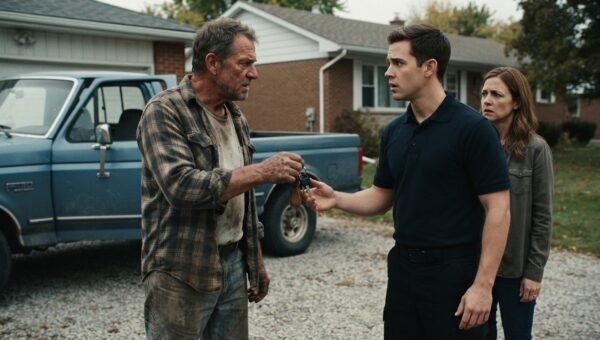
I drove across town to the north side. Todd’s rental was part of a brick four-plex off the main avenue. Parked in the open carport behind his unit was a beat-up blue pickup truck with peeling clear coat. Sitting in the open bed of that truck, wrapped haphazardly in a dirty blue plastic tarp tied down with frayed bungee cords, was the rectangular outline of Mom’s cedar chest.
It had rained on Thursday night.
The sight of Mom’s handmade cedar chest sitting in the open bed of a rusty truck under a damp tarp made my stomach knot with pure fury.
I pulled up to the curb, killed the engine, and stepped out. Before I could walk up the concrete path to Todd’s door, a silver sedan pulled in behind my car. Mark jumped out of the driver’s side, his work boots hitting the asphalt with heavy, purposeful strides.
“Is that it?” Mark asked, pointing toward the truck bed.
“That’s it,” I said.
We walked up to the front door of unit B. Mark did not knock gently. He pounded his fist against the hollow metal door three times with enough force to shake the frame.
A minute passed. The deadbolt clicked open, and the door pulled back about six inches.
Todd stood in the doorway wearing gym shorts and a stained gray t-shirt. He had dark circles under his eyes, his hair was uncombed, and he was holding a bottle of cheap beer in his left hand.
When he saw Mark and me standing side by side on his small concrete porch, his eyes widened in surprise, then quickly narrowed into a defensive scowl.
“What are you two doing here?” Todd asked, trying to block the doorway with his shoulder. “My mom told me you guys were causing trouble out at your dad’s place.”
“Open the door, Todd,” Mark said quietly.
“Get off my porch,” Todd sneered, reaching to push the door shut. “I don’t know what your problem is, but you can take it up with my mother.”
Mark stepped forward, placed the flat of his heavy work boot against the bottom corner of the door, and shoved it wide open.
PART 3
Todd stumbled backward onto his living room carpet, dropping his beer bottle onto a low coffee table with a loud clatter.
“Are you crazy?” Todd yelled, his voice cracking with fear. “That’s breaking and entering! I will call the police on you right now!”
“Call them,” I said, stepping past Mark into the entryway.
I reached into my purse, pulled out the yellow carbon receipt from the thrift warehouse, and held it six inches from his face.
“Call the police, Todd,” I told him, keeping my voice completely steady. “Let’s have the sheriff come out here and review this receipt. Let’s explain to the deputies how your mother removed property belonging to my deceased mother’s estate without authorization, staged a fake donation at a local charity, and had you purchase stolen goods off the loading bay for seventy-five dollars.”
Todd’s face drained of color. He looked from the yellow paper to my eyes, his mouth falling slightly open.
“I didn’t steal anything,” he stammered, backing toward the kitchen counter. “Mom told me she had an old trunk from an estate cleanup that she needed cleared out of the garage. She said if I picked it up from the charity bay and paid the processing fee, I could flip the wood on an online marketplace and keep the profit to help with my truck insurance.”
“Did you open it?” Mark demanded, stepping toward him. Mark stood six-foot-two, and right then he looked ready to take down a brick wall.
Todd raised both hands defensively. “No! I swear to God, I didn’t open it! The lock was jammed, and Mom said not to pry it open because it would ruin the resale value of the antique brass latch! It’s been sitting in the back of my truck since Wednesday!”
“Where is the key, Todd?” I asked.
“Mom has it,” Todd whispered, his hands trembling. “She kept the key on her key ring. She said she was going to come over this weekend with a crowbar if I couldn’t find a buyer who wanted the original lock intact.”
A wave of cold revulsion washed over me. Cheryl had kept the key. She had sent the chest to her son’s truck like disposable cargo, planning to strip whatever valuables or family documents were inside once she was certain Mark and I had given up the search.
“Go get your shoes, Todd,” Mark ordered.
Todd blinked. “What?”
“Put on your shoes, go out to that truck, and help us untie the tarp,” Mark said, his voice hard as iron. “We are loading that chest into my trailer right now. And then you are going to get into your car and follow us back to your mother’s house.”
“I am not going out there,” Todd protested, whining now. “This is between you and my mom.”
“You are coming with us,” I said, looking directly into his frightened face. “Because if you don’t, I will walk straight into the county prosecutor’s office on Monday morning with this receipt, the surveillance footage from the thrift warehouse loading dock, and a formal complaint for grand theft and possession of stolen property against both you and your mother. How do you think that will look on your background checks for that county road job you’ve been applying for?”
Todd swallowed hard. His adam’s apple bobbed twice. Without another word, he slipped into a pair of dirty running shoes, grabbed his keys off the counter, and followed us out to the carport.
It took ten minutes to undo the wet cords and lift the heavy cedar chest into the back of Mark’s enclosed trailer. The wood on the outside was damp, but the solid tongue-and-groove cedar construction had kept the moisture from penetrating the interior seals.
We drove back to Dad’s house in a quiet caravan. Mark led the way with the trailer, I followed in my car, and Todd trailed behind us in his blue pickup, looking like a prisoner being escorted to a sentencing.
When we pulled into Dad’s driveway, Cheryl was standing on the front porch. She had an overnight duffel bag sitting by her feet, and she was pacing back and forth with her arms crossed over her chest, clearly preparing to stage a dramatic departure to force Dad into an apology.
Dad was sitting on the wooden bench under the big maple tree, his head resting in his calloused hands.
When Cheryl saw Todd’s beat-up blue truck pull in behind Mark’s trailer, she froze.
The smug, self-righteous expression she had worn all morning vanished instantly. Her arms dropped to her sides, and her mouth fell open in absolute shock.
Mark killed his engine, stepped out of the truck, and lowered the back ramp of the trailer with a heavy metal clang that echoed across the quiet front yard.
Dad lifted his head. When he saw the dark cedar corners of Mom’s chest resting inside the trailer, he stood up from the bench, his old knees trembling, and walked toward us with wide, disbelieving eyes.
“Rachel?” Dad whispered, looking from the trailer to me. “Mark? Where did you find that?”
I didn’t answer Dad right away. I walked up the front porch steps until I was standing two feet from Cheryl.
“Give me the brass key, Cheryl,” I said.
ENDING
Cheryl took a step back, pressing her spine against the front siding of the house.
“I don’t know what you are talking about,” she stammered, looking past me toward her son, who was leaning against the fender of his truck, staring down at the gravel. “Todd, what did you do? Why did you bring these people here?”
“Todd didn’t do this, Cheryl,” I said, pulling the yellow thrift-store receipt from my coat and holding it up where Dad could see it. “You did. You didn’t donate Mom’s things to a charity truck. You took this chest to the loading dock on Wednesday, had your son buy it for seventy-five dollars behind our backs, and planned to sell the antique wood while Mom’s wedding dress and our childhood pictures were locked inside.”
Dad reached the porch steps. He looked down at the receipt in my hand. He looked at Todd standing silently in the driveway, and then he looked up at the woman he had married four months ago.
For forty-one years, my father had been a gentle, quiet man who never raised his voice in anger. But when he looked at Cheryl right then, the weakness left his posture completely.
“Cheryl,” Dad said. His voice was not loud, but it had a deep, terrible weight that made her flinch. “Is that true?”
“Arthur, listen to me,” Cheryl pleaded, her eyes filling with instant, calculated tears as she reached for his arm. “Your children have been hostile to me since the day we met! They never accepted me in this house! I was only trying to help Todd with a little extra money, and I wanted this place to feel like our home, not a graveyard for your past! You told me you wanted a fresh start!”
“I never told you to throw my wife’s memory into the dirt,” Dad said, pulling his arm away from her touch like she was hot iron.
He climbed the three steps, walked past her, and pulled her set of house keys from the small hook beside the front door. He slid the small brass barrel key off the ring, handed it down to me, and set the rest of her keys on the porch railing.
“Dad,” Cheryl gasped. “What are you doing?”
“Todd,” Dad called out down the driveway.
Todd looked up nervously. “Yes, Mr. Miller?”
“Take your mother’s bags and put them in your truck,” Dad said evenly. “And take her with you.”
Cheryl let out a sharp, hysterical sob. “Arthur, you cannot throw me out of my own home! We are legally married! I have rights to this property!”
“The deed to this land and this house is held in a family trust created by my late wife and me twenty years ago,” Dad told her, his eyes cold and steady. “You are not on the title, Cheryl. You never were. Pack whatever clothes you brought into this house, get into your son’s truck, and leave. My attorney will contact yours on Monday morning with the annulment paperwork.”
Cheryl looked at Dad, realizing there was no crack in his resolve, no soft spot left to exploit. She grabbed her duffel bag off the porch floor, stormed down the steps without looking at any of us, and climbed into the passenger seat of Todd’s truck, slamming the door so hard the glass rattled.
Todd didn’t say a word. He backed his truck down the long gravel driveway and turned onto the county road, disappearing behind the tree line.
The front yard was completely still. The only sound was the wind rustling through the late-summer leaves of the maple tree.
Mark and I lowered Mom’s cedar chest from the trailer and carried it carefully into the cool living room, setting it down on the braided rug where Mom used to sit with her knitting basket.
I took the small brass key Dad had handed me, knelt on the floor, and slid it into the lock. The tumblers turned with a smooth, heavy click.
I lifted the lid.
The rich, clean scent of pure red cedar filled the entire living room, washing away the smell of the lemon spray Cheryl had used on the furniture.
Everything was untouched.
There was the ivory satin of Mom’s wedding dress, folded neatly beneath the blue tissue paper. Beneath it were the three shoeboxes tied with green kitchen twine, holding every letter Dad had written across the ocean fifty years ago. And at the bottom lay the heavy leather-bound photo albums, their corners protected by thick cloth covers Mom had stitched herself.
Dad walked slowly into the room. He didn’t say a word. He sank onto the sofa beside the chest, reached down with his calloused, oil-stained hands, and picked up the top bundle of letters.
He held the yellowed envelopes against his chest, closed his eyes, and let out a long, ragged breath that sounded like four months of suffocating silence finally breaking free.
“I’m sorry, Rachel,” Dad whispered, tears finally rolling down into the deep lines of his cheeks. “I was just so lonely after she left. I thought having someone in the kitchen would make the house feel alive again. I almost let her erase everything that mattered.”
I sat on the edge of the sofa beside him, wrapped my arm around his trembling shoulders, and laid my head against his arm.
“You don’t have to apologize, Dad,” I told him gently. “Mom is still here. She never left.”
The legal annulment took less than ninety days to clear the county court. Cheryl tried to demand a financial settlement, but when our family lawyer presented the thrift warehouse receipt, the dock manager’s statement, and the terms of the irrevocable family trust, Cheryl’s attorney advised her to sign the quitclaim documents and walk away without a single dollar of Dad’s pension.
Over the next month, Mark and I spent every weekend at the house.
We took down Cheryl’s generic discount-store prints and put Mom’s cross-stitch samplers back on the walls. We unpacked the boxes of stoneware dishes from the garage and put Mom’s milk glass vases back on the sunny kitchen windowsill.
The house smelled like fresh coffee, cedar wood, and Sunday pot roast again.
Last Saturday afternoon, I drove out to visit Dad.
He was sitting in his green rocking chair in the living room, wearing his favorite wool cardigan, reading through an old photo album from the summer we camped at Lake Erie when Mark and I were children.
Beside his chair, resting against the brick fireplace where it belonged, sat Mom’s cedar chest. The brass diamond latch caught the afternoon sun pouring through the front window, glowing warm and bright against the polished wood.
Dad looked up from the album, smiled that easy, gentle smile I had missed for so long, and patted the arm of the empty rocking chair next to him.
“Sit with me a while, Rachel,” he said softly.
I sat down, looked at the pictures of my mother smiling back at us from thirty years ago, and felt the quiet peace of a home that was finally whole again.