PART 1
After twenty-two years of marriage, you know the sound of your own home down to the floorboards.
You know how your wife takes her coffee, which side of the bed she turns to when the furnace clicks on, and where she sets her reading glasses. For more than two decades, my wife Sarah treated her cell phone like a coaster. She would drop it on the kitchen island, leave it between the couch cushions, or let it slide under the mail pile by the front door.
Half the time, the battery was dead because she forgot to plug it in.
Then, about three months ago, that changed.
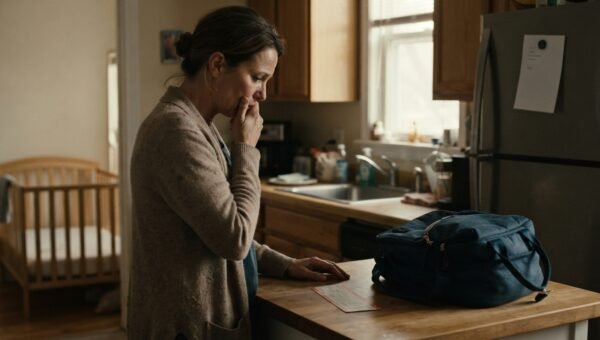
It was not dramatic at first. It was just small, deliberate shifts. When she walked into the kitchen, the phone went face down on the granite counter. If we sat at the dinner table, she kept it in the pocket of her cardigan instead of setting it next to her water glass. If it buzzed while we were watching television, she did not glance down casually. She placed her palm over the screen, picked it up with the glass turned inward against her thigh, and left the room to answer or text back.
I noticed, of course. Any man married for twenty-two years would notice. But I did not snoop. I have always believed that the minute you start demanding passwords and digging through personal drawers, you are admitting that your foundation is already cracked.
Sarah had been a devoted partner, an honest woman, and the anchor of our quiet life in Indiana. I told myself she was coordinating a surprise for my upcoming fifty-fifth birthday, or maybe dealing with health troubles involving her estranged sister in Missouri.
Then the bank called on a Tuesday morning.
I was at my desk at the regional building supply warehouse where I have worked as an inventory estimator for twenty-four years. My desk phone rang, and the caller ID showed the fraud protection department of First Valley Federal, where Sarah and I keep our joint primary savings and checking accounts.
“Mr. Callahan, this is David from member security,” the representative said. “We are flagging an automated clearinghouse transfer initiated this morning from your primary money market fund in the amount of nine thousand eight hundred dollars. The destination is an external credit union account under the name Blue River Trust.
Because this exceeds your standard online daily threshold, we require verbal authorization from both primary account holders.”
Nine thousand eight hundred dollars was not pocket change for us. That was nearly a third of the emergency reserve we had spent seven years rebuilding after paying off our mortgage.
“I didn’t initiate that transfer, David,” I said, my chest tightening. “Hold it until I speak with my wife.”
I hung up and called Sarah’s cell phone immediately. It rang once and went to voicemail. I called our landline at the house. On the fourth ring, she picked up, breathless.
“Dan?” she asked, her voice tight.
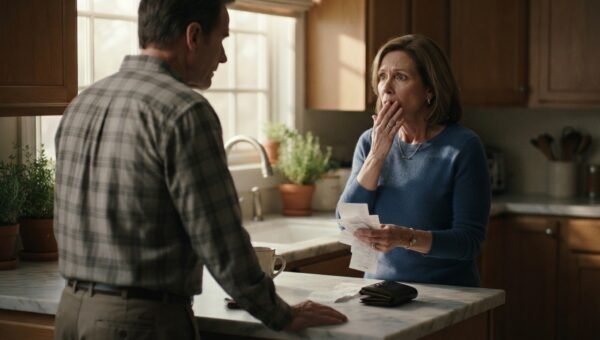
“Sarah, First Valley just called me,” I said, trying to keep the anger out of my voice. “Someone initiated a wire for ninety-eight hundred dollars out of our money market account. Did our account get hacked?”
The line went completely dead for five seconds. All I could hear was the faint sound of her shallow breathing through the receiver.
“No, Dan,” she said quietly. “It wasn’t a hacker. I set up the transfer.”
I leaned back in my office chair, staring at the pegboard on my wall. “Ninety-eight hundred dollars? Sarah, what is going on? What is Blue River Trust?”
“Please don’t be angry,” she whispered, and for the first time in twenty-two years, I heard a tremor in her voice that sounded like pure, raw panic. “It is a family emergency. A severe one. I cannot explain the details right now, but nobody is stealing from us. I had to send it. Dan, I am asking you to trust me. Just this once, please sign off on the wire and trust me.”
“A family emergency with who?” I asked, my voice rising. “Your sister? Your cousins? Why wouldn’t you tell your own husband before moving ten thousand dollars out of our savings?”
“I will explain everything when it is safe,” she said. Her voice broke completely, turning into a muffled sob. “I swear to God on my life, Dan, this is not an affair, and it is not what you think. If you have ever loved me, please let the bank release the funds. If I don’t send this today, someone is going to get hurt.”
A man hears his wife of twenty-two years say that, and the world tilts sideways. I wanted to scream at her. I wanted to drive home and demand the passwords to her accounts. But the sheer terror in her voice was not the sound of a liar covering her tracks. It was the sound of a woman standing at the edge of a cliff.
I called the bank back. I gave the verbal verification. The money cleared.
For the next week, our house felt like a funeral home. Sarah barely slept. She picked at her food, jumped every time a car turned into our cul-de-sac, and kept her phone clutched in her hand like a lifeline. When I tried to ask her about the transfer, she would shake her head, stare at the floor, and repeat that she was waiting for confirmation that things were settled.
Then, on a rainy following Tuesday afternoon, I left work early at two o’clock to pick up a replacement alternator for my truck. As I drove down the commercial bypass on the south end of town, past the cheap strip malls and extended-stay motels, I saw our silver Honda crossover parked in the rear lot of the Pine Crest Motel.
The Pine Crest was a run-down, two-story brick motor inn with rusted railings and an hourly rate sign near the ditch. It was the kind of place people stayed when they had nowhere else left to go.
I pulled my truck into the gravel lot, parked two rows back, and stepped out into the steady drizzle.
I walked up to the driver’s side of the Honda.
Sarah was sitting in the front seat, staring straight ahead through the rain-streaked windshield. Her head was tilted back against the headrest, and tears were streaming down her face in thick, silent tracks. Her knuckles were white where her hands gripped the steering wheel.
I tapped my knuckles against the glass.
She jumped so violently she struck her shoulder against the door frame. She looked up at me, and what I saw in her eyes was not the guilt of a woman caught doing something dirty. It was absolute, paralyzing terror.
She unlocked the door with a shaking hand.
Before I could open my mouth to ask a single question, the heavy metal door of room 114 swung open behind my back.
Footsteps sloshed through the wet gravel.
I turned around. A tall, skinny teenage boy with dark, unkempt hair was walking toward the car. He could not have been older than sixteen or seventeen. He had a heavy black canvas duffel bag slung over his shoulder, and a purple, fading bruise covered the right side of his jaw.
He didn’t look at me. He walked straight to the open window of the driver’s side, his chest heaving, his eyes wild and bloodshot.
“Mom,” the boy choked out, his voice cracking with exhaustion. “He found me again. He was waiting at the bus depot in Fort Wayne.”
Sarah buried her face in both hands, letting out a ragged, muffled scream into her palms.
Then she lowered her hands, turned her tear-streaked face toward me, and looked into my eyes.
“Dan,” she whispered, her voice barely audible over the drumming rain. “I should have told you before we got married.”
PART 2
The rain hit my bare neck, but I didn’t feel the cold.
I stood in that gravel parking lot, looking between my wife of twenty-two years and a teenage boy who had just called her Mom.
My mind refused to process it. We didn’t have children. When we were thirty, we spent three painful years trying to conceive. We went to fertility specialists, endured temperature charts, hormone shots, and two failed intrauterine inseminations before a specialist in Indianapolis gently told us that Sarah had extensive pelvic scarring from an old, untreated infection in her youth that made carrying a pregnancy impossible. We grieved together. We bought a smaller house, built our life around each other, and accepted that it was just going to be the two of us.
Now, a boy with Sarah’s high cheekbones and hazel eyes was standing three feet from me, holding a duffel bag with trembling hands.
“Get in the car,” I said.
My voice was flat. It didn’t sound like my voice at all. It sounded like an automated recording.
“Dan, please,” Sarah cried out, reaching through the open window to grab my sleeve.
“Get him in the car, Sarah,” I repeated, stepping back from the door. “And you drive. Follow my truck. We are going to our house right now.”
The drive back across town took twenty minutes. I watched the silver Honda in my rearview mirror the entire way. The boy sat in the front passenger seat, his head down, while Sarah kept both hands locked at the top of the wheel. My chest felt hollow, like somebody had scooped out every vital organ and left an empty wooden box behind my ribs.
When we pulled into our driveway, I hit the garage door opener, pulled my truck inside, and waited until they pulled in beside me. I lowered the heavy bay door, sealing us in from the street and the rain.
Nobody moved for almost a full minute.
Then Sarah stepped out of the car. The boy followed her, clutching his duffel bag against his stomach like armor. He looked terrified, darting his eyes from the tool racks on the wall to the kitchen entry door. Up close, I could see that his jacket was frayed at the cuffs, his sneakers were soaked through, and the dark purple swelling along his jawline was fresh, no more than two or three days old.
“Go inside,” I said, holding open the door to the mudroom.
We walked into the kitchen. The warmth of the house and the smell of the morning’s coffee felt absurd, like walking onto a stage set after a bomb went off.
I pulled out three chairs at the wooden dining table.
“Sit down,” I told them.
The boy looked at Sarah for permission. She gave him a small, tearful nod, and he sank into the wooden chair closest to the hallway, keeping his duffel bag between his feet. Sarah sat across from him. She folded her hands on the table, her knuckles red and raw, and stared at the grain of the oak wood.
“Who is he, Sarah?” I asked.
I remained standing by the counter, my arms crossed over my chest.
Sarah took a deep, shuddering breath. “His name is Toby. He is sixteen.”
“And you are his mother?”
“Yes,” she whispered.
“We met when you were twenty-six years old,” I said, keeping my tone deadly level. “We got married when you were twenty-eight. You told me you had never been married. You told me you lived with your aunt in southern Illinois after your parents died, working at a dry cleaner until you moved up here to work for the school district. You told me you had no children.”
“I didn’t have him then, Dan,” Sarah said, lifting her face. Her eyes were red-rimmed and hollow. “Toby was born six years after we were married.”
I grabbed the edge of the kitchen counter so hard the laminate dug into my palms. The room spun slightly.
“You had a child while we were married?” The words felt like acid in my throat. “You had an affair six years into our marriage, had a baby, and hid him from me for sixteen years?”
“No!” Sarah cried out, standing up so fast her chair screeched against the hardwood. “No, Dan! I swear to God, I never touched another man! I never cheated on you! Not once! Not ever!”
“Then how does a married woman have a sixteen-year-old child without her husband knowing?” I yelled, my control finally snapping. “Look at him! He is sixteen years old! Where was he? Who is his father?”
The boy, Toby, flinched at my shouting and shrank back into his chair, pulling his shoulders in toward his ears.
Sarah looked at the boy, then looked back at me, tears streaming down her throat.
“His father is Marcus Vance,” Sarah whispered.
The name meant nothing to me, but the terror in her eyes when she spoke it made the hairs on my arms stand up.
“Before I moved to Indiana, when I was nineteen years old, I lived in Carbondale,” Sarah said, her voice dropping into a rapid, desperate rhythm. “Marcus was thirty-two. He was charming, he had money, and he was dangerous. By the time I realized what he was, I was trapped in a rural house outside town. For four years, he controlled every dollar I made, who I spoke to, and where I went. When I tried to leave the first time, he broke three of my ribs and ruptured my spleen. That was what caused the pelvic scarring, Dan. Not an infection. It was Marcus.”
She swallowed hard, wiping her cheeks with the back of her sleeve.
“The local sheriff was his first cousin,” she continued. “Nobody would help me. In the summer of 2000, while Marcus was serving ninety days in the county jail for an aggravated assault on a truck driver, an advocate from a women’s underground network in St. Louis got me out. They gave me a bus ticket, helped me change my legal name from Sarah Jane Miller to Sarah Lynn Miller, and helped me relocate three hundred miles away to this county.”
“You changed your name?” I asked, my voice cracking.
“Only my middle name and social security prefix through a state protective assistance program,” she said. “I thought I was safe. I met you two years later. You were kind, you were gentle, and for the first time in my life, I felt like a human being. I wanted so desperately to leave that horror behind that I buried it. I told myself Marcus would never find me, and that telling you would only bring danger to your doorstep.”
“That explains twenty-five years ago, Sarah,” I said, pointing a finger at Toby. “That does not explain him.”
PART 3
Sarah sat back down, reaching across the table to place her hand over Toby’s trembling wrist.
“Eleven years after I left, in 2009, Marcus found me,” Sarah said, her voice turning into a cold, flat monotone.
My stomach plummeted. “Here? In this town?”
“He followed me home from the grocery store while you were on a four-day fishing trip in Michigan,” she said. “He didn’t come to the door with a gun. He waited until I was loading groceries into the trunk, slid into the passenger seat, and showed me a photograph of this house, a photograph of your workplace, and your daily commute schedule. He told me that if I went to the police, if I told you, or if I tried to run again, you would have a fatal accident on the highway.”
I stared at her, unable to breathe.
“What did he want?” I asked.
“He wanted an heir,” Toby spoke up for the first time.
His voice was deeper than I expected, but it was frayed with a lifetime of fear. He looked up at me with dark, hollow eyes.
“My father is a monster,” Toby said. “He runs an illegal chop-shop and narcotics ring out of Jackson County. He had two other sons who both died in prison. He found my mother because he wanted a child from the only woman who ever got away from him. He forced her into an arrangement. A private surrogacy contract through an unlicensed clinic in Chicago, using her harvested eggs and his genetic material, carried by a surrogate mother he paid cash for.”
I looked at Sarah, horror rising in my chest like bile. “Is this true?”
“Yes,” Sarah wept. “Marcus told me that if I submitted to the medical extraction in Chicago, he would take the baby, raise him, and leave you and me alone forever. He promised on his mother’s grave that I would never hear from him again. I was terrified, Dan. I was so terrified he was going to kill you in that warehouse parking lot. I went to Chicago for three days while you thought I was at a weekend scrapbooking retreat with the church ladies. They took my eggs. Marcus paid the clinic off. Ten months later, Toby was born to a surrogate in Missouri.”
“She didn’t abandon me,” Toby said, his voice tightening as he defended Sarah. “My father kept me locked on a compound outside Murphysboro for sixteen years. He raised me to work in his shop. He beat me whenever I questioned him. But when I was twelve, my father got drunk and bragged about how he broke my real mother, and he showed me the paperwork from the Chicago clinic with her photo and her name.”
Toby pulled a battered, creased piece of paper from his jacket pocket and laid it on the table. It was a clinic intake form from 2009, showing Sarah’s maiden name, her signature, and a stamped medical clearance.
“Six months ago, my father told me I had to start moving product across the state line for him,” Toby continued, his hands shaking violently. “I refused. He beat me with an iron tire iron, broke my collarbone, and locked me in the barn. That night, I jimmied the window latch, stole four hundred dollars from his desk safe, and ran. I spent four months living in homeless shelters in St. Louis and Indianapolis, trying to find her.”
“He found my phone number two weeks ago through an online public records search,” Sarah said, fresh tears spilling onto her sweater. “He called me from a payphone outside a shelter in Terre Haute. He was starving, sick, and running for his life. That was why I started hiding my phone, Dan. Marcus had men looking for Toby at every bus depot and train station between Illinois and Ohio.”
“And the ninety-eight hundred dollars?” I asked.
“An underground legal advocacy network in Fort Wayne called the Blue River Trust,” Sarah explained. “They specialize in getting emergency emancipated minor status and complete identity protection for children escaping domestic trafficking and abuse compounds. The ninety-eight hundred was the retainer for the private investigator and the emergency petition attorney to file sealed federal protection papers. It was the only way to legally sever Marcus’s parental rights before he dragged Toby back to that compound.”
“Then why were you at that motel today?” I asked.
Toby looked at the floorboard. “Because my father’s cousin, the former deputy, spotted me at the Fort Wayne bus station this morning. He called my father. They chased me through the terminal. I lost them in the crowd, jumped on a regional commuter van heading south, and called Mom to meet me at that motel. They know I am in this county, Mr. Callahan. My father has two trucks in this area right now looking for me. If they find me, he will kill me, and he will kill my mother for helping me.”
As if on cue, the heavy silence of the kitchen was shattered by a low rumble from the street outside.
Through the front living room window, I saw the glare of headlights sweeping across our front lawn. A dark, lifted four-wheel-drive pickup with out-of-state plates slowed to a crawl at the edge of our driveway, its engine idling like a growling animal in the dark.
ENDING
I didn’t panic.
When you spend twenty-four years managing heavy logistics, you learn that panic is a luxury that gets people killed. The shock that had frozen my chest for the last hour vanished, replaced by an ice-cold, protective clarity.
Sarah was my wife. She had carried an unimaginable nightmare alone for over two decades because she loved me enough to trade her own body and peace of mind to keep a bullet away from my head. And this boy sitting at my kitchen table, with his bruised jaw and terrified eyes, was her blood.
“Sarah,” I said quietly, stepping away from the counter. “Take Toby into the back master bedroom. Close the blinds, lock the door, and do not make a sound.”
Toby stood up, his face white as paper. “Mr. Callahan, they have guns. My father never travels without a weapon.”
“Go with your mother, son,” I told him, looking him dead in the eye. “I have lived in this county for fifty-four years. This is my house.”
Sarah took Toby’s arm and pulled him down the hallway.
I didn’t turn on any lights. I walked into the dark living room, stepped to the side of the bay window, and lifted a single slat of the wood blinds.
The black pickup truck had parked directly across the street, blocking our driveway entrance. The driver’s side door clicked open. A heavy-set man in a canvas work coat and a ball cap stepped down into the rain. He walked halfway across our front grass, squinting at the garage door, pulling a heavy steel flashlight from his coat pocket.
I did not reach for a hunting rifle. If you pull a gun on men like that, you give them an excuse to turn your home into a war zone.
Instead, I picked up my phone from the entryway table and dialed a direct personal number I had kept in my contacts for fifteen years.
“Jim,” I said when the call connected on the second ring. “I have a situation at my residence. I need you and two patrol units here right now. Code three, no sirens.”
Jim Miller was the chief deputy of our county sheriff’s department. We had played high school football together, our families shared Sunday barbecues, and his son worked in my warehouse.
“What’s going on, Dan?” Jim asked, his voice instantly sharp and alert.
“There is an out-of-state pickup parked across my driveway,” I said, watching the man on my lawn through the window blinds. “The vehicle belongs to Marcus Vance out of Jackson County, Illinois. He is a felon operating an armed pursuit of an abused runaway minor who is currently secured inside my home under an active federal protection petition. The driver is trespassing on my front lawn with a weapon visible in his right coat pocket.”
“Stay away from the glass, Dan,” Jim ordered. “Two units are three blocks out on the bypass. I am forty seconds behind them.”
I lowered the phone.
Outside, the man in the canvas coat walked up the three front concrete steps of my porch. He raised his heavy fist to pound on my front door.
Before his knuckles could touch the wood, the quiet neighborhood exploded in red and blue strobes.
Two county patrol cruisers rounded the corner at high speed, cutting their engines and sliding their tires across the wet asphalt to box the black pickup in against the curb. Chief Deputy Miller’s unmarked SUV pulled up right onto my front lawn, its high-beam takedown lights blinding the man on my porch in an instant.
“County Sheriff!” Jim’s voice boomed through an external loudspeaker. “Step down off the porch with your hands on your head! Do it now!”
The man on my porch froze. He reached toward his jacket hem, but within four seconds, three deputies had their sidearms drawn and leveled across the hood of their cruisers.
The man slowly raised his thick, scarred hands into the blinding white light, swearing violently as the deputies forced him down onto the wet grass and snapped steel cuffs around his wrists.
It was not Marcus Vance. It was his older brother, Wayne Vance, who had an active felony warrant out of Illinois for interstate parole violation and aggravated stalking.
Twenty minutes later, Chief Deputy Miller was sitting in my kitchen, sipping a cup of hot black coffee while Sarah and Toby sat across from him with the paperwork from the Blue River Trust.
Jim reviewed the medical documents, the Chicago clinic records, and the emergency federal protective order that the advocacy attorney had filed electronically earlier that afternoon.
“You did the right thing calling us immediately, Dan,” Jim said, setting the papers down and looking at Toby with genuine sympathy. “Wayne Vance is going back to Illinois in chains tonight. And based on these clinic records and the interstate trafficking elements, I just contacted the FBI field office in Indianapolis. Marcus Vance isn’t going to be hunting anyone anymore. A federal task force is serving a multi-agency search warrant on his compound outside Murphysboro before sunrise.”
The room fell into a heavy, exhausted quiet.
Jim finished his coffee, patted Toby’s shoulder, and promised that a patrol car would remain stationed at the end of our cul-de-sac for the next forty-eight hours until the federal warrants were executed.
When the door clicked shut behind Jim, the house was silent except for the refrigerator humming in the corner.
Sarah sat with her head down, her hands trembling in her lap, waiting for the axe to fall. She thought the danger was over, but that her marriage was finished.
I walked over to the dining table. I pulled my chair out, sat down beside her, and reached out to cover her cold, shaking hands with both of mine.
“Dan,” she whispered, her voice cracking into pieces. “If you want me to pack my things and leave with him… I will understand. I lied to you for twenty-two years. I brought this horror to your door.”
I looked at the boy across the table. He was watching me with wide, terrified eyes, bracing himself to be thrown out into the rain again.
“You didn’t bring horror to my door, Sarah,” I said gently, wiping a tear from her cheek with my thumb. “You carried a cross for twenty-two years to keep me alive. You gave up everything to protect me from a monster. I am not angry at you, Sarah. I am angry that you had to bleed in the dark for so long without me holding your hand.”
Sarah broke down, burying her face into my chest, sobbing with a depth of relief that shook her entire frame.
I looked over her shoulder at the boy.
“Toby,” I said.
The boy sat up straight, wiping his nose with the back of his hand.
“The guest bedroom upstairs has a queen bed, clean sheets, and a hot shower down the hall,” I told him. “Your mother bought some roast beef and potatoes this morning. Go wash up, get into dry clothes, and come back down here. We are going to have dinner as a family.”
A small, trembling breath escaped Toby’s chest. For the first time all night, the terrible, haunted look in his eyes softened, and he nodded slowly.
That was six months ago.
The federal raid on Marcus Vance’s compound uncovered five illegal firearms, three stolen vehicles, and enough financial fraud evidence to put him away in a federal penitentiary for the rest of his natural life. He was convicted on four felony counts in August, with no possibility of parole.
The legal proceedings took time, but the ninety-eight hundred dollars we spent with the Blue River Trust was the best investment we ever made. In July, a federal family court judge signed a sealed decree granting full legal emancipation and a permanent protective name change for Toby.
He didn’t want to run anymore. He chose the legal name Toby Callahan.
He is finishing his junior year at our local high school now. He made the varsity track team as a sprinter, his collarbone has completely healed, and every afternoon at three-thirty, I hear his heavy sneakers hit the mudroom floor when he comes home from practice.
Yesterday evening, I walked into the kitchen after work.
Sarah was standing at the stove, stirring a pot of chicken noodle soup while Toby sat at the island doing his algebra homework. On the granite counter, right next to the cutting board, Sarah’s cell phone was sitting face up in the warm afternoon light, glowing with a text message from a friend about a weekend book club.
She didn’t jump. She didn’t turn it over.
She just looked up at me, smiled with the calm, steady warmth I had fallen in love with twenty-four years ago, and said, “Dinner will be ready in ten minutes, Dan.”
I hung my coat on the peg, kissed my wife on the temple, and walked over to help my son with his math.