PART 1
I was five days out from a twenty-six-hour labor when my husband, David, walked into our bedroom, shut the door, and set an opened white cardboard envelope on the nightstand.
He did not look at me. He looked down at the bassinet where our baby girl, Clara, was asleep in a yellow cotton sleeper.
“I bought this at the pharmacy on my way home from work,” David said.
His voice was dead flat, without any of the tenderness he had used during our three years of marriage. “It is a cheek swab kit. I want us to send it off today.”
I looked from the box to his face. My body was still swollen, every muscle ached, and I had only slept in forty-minute stretches for nearly a week. “A cheek swab for what, David?”
“A paternity test,” he said.
The room went completely quiet, except for the tiny, steady breathing coming from the bassinet. I felt the blood rush to my ears. I had never looked at another man since the day David and I met at our church potluck four years ago. I had spent nine months sick to my stomach, throwing up every morning, praying over every ultrasound, while he painted the nursery pale yellow and hung floating shelves for her little storybooks.
“Why would you even ask for that?” I whispered. My throat was so tight I could barely push the words out.
David looked away, his jaw working. “Look at her, Sarah. Just look at her head.”
Clara had been born with a thick crown of bright, copper-red hair. Both David and I have nearly black hair and dark brown eyes. My parents have dark brown hair. David’s father, who passed away ten years ago, had thick black hair in every photograph on our mantel. And David’s mother, Evelyn, had dark hair before it turned steel gray.
“Babies have odd hair colors when they are born,” I said, my voice shaking with disbelief. “It changes. Sometimes genes skip three generations. You know that.”
“I did not think anything of it at first,” David muttered, crossing his arms over his chest. “I thought it was just newborn fuzz. But my mother came over yesterday while you were upstairs taking a shower. She sat right in that rocking chair, looked down at Clara, and asked me straight out how two people with dark hair could make an auburn-haired baby.
She told me blood does not lie, and babies do not lie.”
Hearing Evelyn’s name made the puzzle pieces snap together, and an ugly knot formed in my stomach. Evelyn had never liked me. When David and I got engaged, she told him privately that I was too independent and came from a family that did not have deep roots in this town. When we bought our small brick ranch, she complained about the neighborhood. And when I had Clara, Evelyn walked into the hospital room, took one look at the bassinet, and did not pick her up once.
“So your mother whispers in your ear, and you decide your wife is unfaithful?” I asked. Tears were burning behind my eyelids, but I refused to let them drop.
“I just need peace of mind, Sarah,” David said. “If you have nothing to hide, it is just two swabs and a week of waiting.
If she is mine, I will apologize on my knees. But until the paperwork comes back, I cannot sleep in this bed.”
He did not wait for me to argue. He picked up his pillow, grabbed a spare quilt from the top shelf of the closet, and walked across the hall into the guest bedroom.
I sat there in the silence, staring at the unopened swab kit on my nightstand. The insult went down to the bone. To accuse a new mother, bleeding and healing from delivery, of cheating on her vows just because an old woman dropped poison into his ear was something I did not know how to forgive. But I knew one thing: I had nothing to hide. I was not going to give Evelyn the satisfaction of watching me refuse. Refusing would give her permission to whisper to the whole town that David’s wife had something to cover up.
I walked into the guest room ten minutes later. David was sitting on the edge of the mattress, staring at his phone.
“Get the kit,” I said quietly. “Let us do it right now.”
We stood over Clara’s crib while she slept. I held her tiny head still with one hand while David rubbed the soft cotton tip against the inside of her cheek. Then he swabbed his own mouth, sealed the vials in the prepaid mailer, and drove it directly to the post office down on Elm Street.
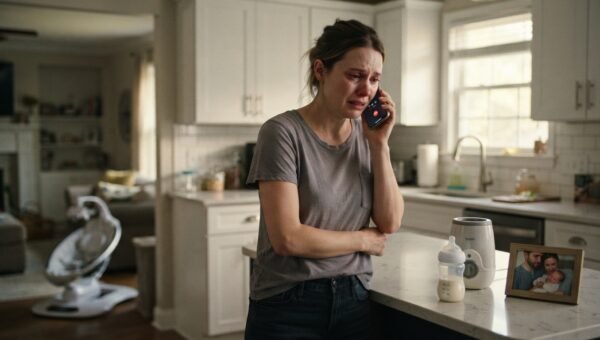
For five days, our house felt like a tomb. David slept in the guest room. He ate dinner at the kitchen counter with his back turned to me. When Clara cried in the middle of the night, he did not get up to help. He treated our daughter like a stranger’s child he had been forced to babysit.
Every afternoon, Evelyn found an excuse to drop by. She would bring a plastic container of store-bought cookies or a bag of apples, set it on the kitchen counter, and cast sidelong glances at me while I fed Clara.
“You look tired, Sarah,” Evelyn said on the fourth afternoon, standing in the doorway with her handbag tucked under her arm. “Guilt takes a heavy toll on a woman’s body. I always say the truth has a funny way of coming out in the daylight.”
“Clara is David’s daughter, Evelyn,” I told her, looking her dead in the eye. “And when the papers come back, I expect you to remember what you said in this kitchen.”
Evelyn just gave a thin, pitying smile. “We will see what the science says, dear. Science does not take sides.”
On the fifth morning, an alert chimed on David’s phone while we were sitting in the living room. Evelyn was already there, sitting on our sofa with her coat still on, as if she had sensed the delivery was coming.
David opened his email, and his hands began to tremble. “The certified lab report is ready. It has a PDF attached.”
“Print it out, David,” Evelyn commanded from the couch, her voice sharp with sudden authority. “Read it right here in front of both of us. Do not let her spin it.”
David walked over to the home office desk in the corner of the living room, clicked print, and waited by the machine. The printer groaned, spitting out the single sheet of white paper.
David pulled the sheet from the tray. I watched his eyes scan the lines. His shoulders suddenly dropped, and the color drained completely from his face.
“What does it say?” Evelyn demanded, standing up and marching across the rug. “Read it out loud, David!”
David did not speak. His mouth opened, but nothing came out.
Evelyn reached out and snatched the page right out of his fingers. She shoved her reading glasses onto the bridge of her nose, ready to pounce on the verdict she had spent a week waiting for.
I sat in the armchair with Clara in my arms, watching them both. I already knew what the result was.
“Probability of Paternity: 99.999 percent,” Evelyn read. Her voice faltered on the numbers, shrinking down to an embarrassed whisper. “The tested male cannot be excluded as the biological father.”
The living room went dead quiet. Evelyn stared at the bottom of the paper, her face turning a mottled red. David stood there with his arms hanging at his sides, looking at me like a man who had realized he just burned his own house down over a lie.
“Sarah,” David began, his voice breaking. “Sarah, I am so sorry. I should have never—”
Before he could finish the sentence, the house phone on the kitchen wall let out a shrill ring.
David jumped. Evelyn did not move; she stood frozen with the paper trembling in her hand. The phone rang a second time, then a third.
I did not move from the chair. “Answer the phone, David,” I said softly.
He swallowed hard, turned around, and walked into the kitchen. He picked up the receiver from the wall cradle. “Hello?”
I could hear a woman’s voice coming through the receiver, speaking in a measured, professional clip.
“Yes, this is David,” he said. He paused, listening. His eyebrows knitted together. “Yes, we just printed the PDF about ten minutes ago.”
Another long silence fell over the kitchen. David looked back toward the living room, his eyes darting between Evelyn and me.
“Wait,” David said into the receiver, his voice rising in confusion. “What do you mean, you need to verify something? What report?”
He listened for another thirty seconds, his grip on the white plastic receiver turning white at the knuckles. Then he turned the phone slightly toward the room and spoke in a bewildered tone.
“Sarah,” he said, holding the receiver against his chest. “It is the direct supervisor from the testing lab in Richmond. She says she needs to speak with both adults who submitted the swabs.”
I shifted Clara into the crook of my left arm, stood up, and walked over to the kitchen island. Evelyn followed right behind me, her heels clicking on the hardwood floor, determined not to miss a syllable.
David pressed the speakerphone button and set the receiver on the granite counter.
“This is Sarah,” I said clearly. “I am on the line with my husband, David, and his mother is in the room as well. What is the issue with our daughter’s test?”
The woman on the line cleared her throat. “Hello, Mrs. Miller. My name is Dr. Karen Reynolds. I am the laboratory director here. I am calling because our senior geneticist flagged this profile for a mandatory manual review before filing the state-certified record.”
“Why?” David asked, his voice cracked with anxiety. “The paper says 99.9 percent. It says I am her father.”
“You are her biological father, Mr. Miller. That result is entirely accurate,” Dr. Reynolds said calmly. “However, when we run a standard twenty-four-marker STR panel, we also analyze the chromosomal inheritance patterns to confirm sample integrity. That is where we ran into an unexpected finding. Have either of you ever had a medical DNA screening done before?”
“No,” David said. “Never.”
“I see,” the doctor replied. She paused, and for a second the only sound was the soft hum of the kitchen refrigerator. “There is an additional finding on this report that your husband may not fully understand without clinical context. Mr. Miller, the genetic markers we matched between you and your newborn daughter are legally conclusive. But the specific markers your daughter inherited from you are impossible under the family profile you provided on your intake form.”
Evelyn stepped forward, leaning her hands on the counter. “What does that mean, doctor? Speak plain English.”
“It means,” Dr. Reynolds said slowly, “that Mr. Miller carries a very distinct, rare genetic deletion on his Y-chromosome. A deletion that can only be passed down directly from father to son. But when we checked the marker references, that specific deletion is completely incompatible with the regional ancestry you checked on your form. In fact, Mr. Miller, genetically speaking, it is impossible for the man listed as your biological father to have passed you that chromosome.”
PART 2
The silence in the kitchen was so heavy I could hear the kitchen clock ticking on the wall above the pantry.
Evelyn was the first to react. Her voice shot up an octave, shrill and trembling with rage. “This is an outrage! How dare you call our home and make wild accusations about my late husband? Arthur Miller was a deacon in the First Baptist Church for thirty years! He died ten years ago, God rest his soul, and he was the only man I ever loved. You people made a clerical error. You mixed up the cotton swabs with someone else’s mail!”
“Ma’am, we do not make clerical errors with certified legal chain-of-custody markers,” Dr. Reynolds replied evenly, her professional tone never wavering. “The baby’s swab and Mr. Miller’s swab were processed in duplicate in separate bays. The genetic match between Mr. Miller and his daughter is ironclad. He is her father. But the specific deletion on Mr. Miller’s twenty-third chromosome is an extremely rare hereditary marker. It is found almost exclusively in a specific lineage of Mediterranean descent, coupled with a benign micro-inversion.”
“Arthur was pure Scottish and English,” Evelyn snapped, her knuckles pressing white against the edge of the granite island. “His family came over to Virginia in 1840. We have the family Bible right in the cedar chest to prove it!”
“Then whoever gave Mr. Miller his Y-chromosome was not of that descent,” Dr. Reynolds stated calmly. “The genetic material does not lie, Mrs. Miller. A child cannot inherit a chromosome that their father does not carry, and a man cannot carry a chromosome his father never had to give him. I am calling to ask if Mr. Miller wishes to have an expanded family panel run to update his medical chart, because this particular deletion carries minor cardiovascular screening recommendations later in life.”
David stood completely motionless. His face was entirely gray, the look of a man who had pulled a loose thread on a sweater only to watch his entire body unravel.
“David, hang that phone up right now,” Evelyn commanded, her eyes wide and manic. “Hang it up! Do not entertain this nonsense. They are trying to scam us into paying for more tests. You tell them you are not interested!”
“Doctor,” David said, his voice barely a rasp. “Could this… could this just be a random mutation?”
“A single point mutation is possible, Mr. Miller,” Dr. Reynolds answered gently. “A complete, twelve-marker lineage deletion that mirrors an established ancestral haplogroup is not. It represents direct biological descent. If you want official documentation for your physician, you can log into your portal. The full medical addendum has been attached to the certificate. Good day, Mr. Miller.”
The call disconnected with a soft click, followed by the low, droning hum of the dial tone.
David slowly reached over and hung the phone back on its cradle. He did not look at me. He turned his eyes slowly toward his mother.
Evelyn was already gathering her purse, her fingers fumbling with the leather strap. Her breath was coming fast and shallow. “That woman did not know what she was talking about. A lab technician sitting in an office three states away thinks she knows our family better than I do? It is an insult. I am going home. I will not stand here in this kitchen and be slandered.”
“Mom,” David said. His voice was not loud, but it had a frightening, hollow edge to it. “Sit down.”
“I will not sit down!” she declared, her chin jutting out defensively. “Your wife should be on her knees thanking you for clearing her name, and instead you are listening to some computerized gibberish about chromosomes. Arthur was your father. He raised you, he taught you how to throw a baseball, he bought you your first car. That is the end of the matter.”
“No, it is not the end of the matter,” David said, taking a step toward her. “Arthur had heart problems, Mom. He had a triple bypass when he was fifty-two. Clara just inherited a genetic marker from me that carries a cardiovascular risk. The doctor just said that marker comes from my biological father. So I need you to look at me right now and tell me the truth.”
“I just told you the truth!” Evelyn said, her voice rising into an angry screech. “Arthur is your father! Don’t you dare look at me like that, David Thomas Miller! After everything I did for you, working overtime at the county clerk’s office after your father’s pension was cut, sacrificing my whole life so you could go to college—”
“Mom,” David cut in, his eyes narrowing as a sudden, awful memory seemed to hit him. “Why did Uncle Marco move to Florida the summer I turned twelve?”
Evelyn stopped talking instantly. Her mouth stayed slightly open, the color draining from her cheeks until she looked ten years older under the kitchen lights.
“Uncle Marco was Arthur’s best friend,” Evelyn stammered, looking at the floor. “He moved because… because he got a job transfer with the highway department. You know that.”
“Uncle Marco’s full name was Marco Bellini,” David whispered, his hands beginning to shake. “His parents came from Sicily. He was at our house every single weekend when I was little. He used to take me fishing when Dad was working late at the rail yard. And then one day, Mom, you and Dad had a screaming match in the basement that lasted until three in the morning, and the next day all of Marco’s things were gone, and Dad told me I was never allowed to say his name in the house again.”
“Stop it, David,” Evelyn pleaded, backing toward the hallway. “You are making up stories. You were just a boy. You did not understand grown-up things.”
“You made me take this test,” David said, the realization hitting him like a physical blow. Tears finally welled up in his eyes, thick and heavy. “You came into my home, looked at my newborn daughter, and told me that babies do not lie. You told me red hair meant Sarah cheated on me. You convinced me to sleep in the guest room and treat my own wife like a liar!”
“I was protecting you!” Evelyn cried out, cornered against the hallway doorframe. “You have dark hair, Sarah has dark hair! What was I supposed to think?”
“You weren’t protecting me,” David said, his voice dropping into pure, raw heartbreak. “You saw Clara’s hair, and you panicked. Uncle Marco had auburn hair. I remember it now. He had that thick, wavy reddish-brown hair in every old picture in the attic. You were terrified that if Clara grew up looking like him, someone in this town would finally figure out what you did thirty years ago. You wanted to pin it on Sarah before anyone could look at you!”
Evelyn’s face crumpled. She did not yell. She did not argue. She pressed her hand over her mouth, turned on her heel, and practically ran down the hall toward the front door. The heavy oak door slammed shut behind her, rattling the glass panes in the sidelights.
PART 3
The sound of the front door closing left an unbearable silence in the house.
David stood in the middle of the kitchen, staring at the empty hallway. He looked completely shattered. The man who had walked into our bedroom five days ago with an envelope and a cold accusation on his tongue was gone. In his place was a grown man who had just discovered that the man whose grave he visited every Memorial Day, the man whose watch was ticking on his wrist, was not his biological father.
I walked over to the dining table, pulled out a chair, and sat down. Clara stirred in my arms, letting out a soft sigh before settling back against my chest.
David slowly turned around. He looked at me, then down at the baby, and then he collapsed into the chair opposite me. He put his elbows on the table, buried his face in his hands, and began to sob. It was not a quiet, polite cry; it was deep, ragged weeping that shook his entire back.
“Sarah,” he choked out between breaths, not looking up. “I don’t even know what to say. I am so sorry. I am so disgusting. I don’t know how I let her get into my head like that. I let her poison me against you. I made you do that test when you were barely healed… I slept in the other room… I didn’t hold my own daughter for five days…”
I sat there, listening to him. A part of me felt a deep, instinctive ache for him. He had just had the bedrock of his identity ripped away in a ten-minute phone call. But a stronger, fiercer part of me remembered the five days of cold silence. I remembered the feeling of sitting in our bed alone, bleeding and nursing, while my husband treated me like a criminal because his mother told him to.
“You don’t get to put all of this on Evelyn, David,” I said. My voice was calm, but it was like iron.
David lifted his head. His eyes were bloodshot and his cheeks were soaked. “What?”
“Your mother dropped the match, but you poured the gasoline,” I told him plainly. “You have known me for four years. You promised before God and our families to love me and trust me. But the very first time an old woman whispered a doubt into your ear, your loyalty didn’t belong to me. It didn’t belong to your newborn daughter. It belonged to your mother.”
David swallowed hard, looking down at the wooden table. “I was terrified, Sarah. I was weak.”
“You were,” I agreed. “And you need to understand that the lab test fixed your doubts about Clara, but it broke something between you and me. You thought the worst of me without a single shred of evidence. That does not get erased just because you found out your mother had a secret thirty years ago.”
David wiped his face with the back of his sleeve. “What do you want me to do? Tell me what to do, Sarah. I will do anything. I will cut her off. I will never speak to her again.”
“I don’t want you to make dramatic promises right now while you are in shock,” I said. “Right now, you are going to take your things, move them back into the guest room, and you are going to stay in there. You are going to help with the laundry, you are going to cook our meals, and you are going to take care of this house while I recover. But you are not sleeping in my bed, and we are not pretending everything is fine.”
David nodded quickly, looking down at his hands. “Okay. Yes. Whatever you need.”
“And as for your mother,” I added, looking toward the front door, “she is not permitted in this house. She does not cross that threshold, she does not touch Clara, and she does not speak to me until she offers an honest, public apology for what she tried to do to my marriage.”
Over the next two weeks, our house operated under an uneasy truce. David lived in the guest room. To his credit, he did not complain once. He woke up at five in the morning to wash bottles, he sanitized the pump parts, he went to the grocery store, and he took over the evening shifts so I could get four solid hours of uninterrupted sleep. Whenever he held Clara, his hands were steady and gentle, but there was an overwhelming sorrow in his eyes.
Evelyn called David’s phone twenty times a day during the first week. When he refused to pick up, she drove over and parked in our driveway. David walked out onto the porch, shut the front door behind him, and stood on the steps. I watched from the living room window through the blinds.
I couldn’t hear what was said, but I saw Evelyn waving her arms, crying, pointing toward the car, and then pointing back toward the house. David never moved. His arms stayed crossed, his head shook back and forth, and after ten minutes, he turned his back on her and walked back inside, locking the deadbolt behind him. Evelyn sat in her sedan for twenty minutes, crying into a handkerchief, before she finally backed out of the drive and sped away.
That evening, David knocked softly on the open bedroom door. He was holding a manila folder.
“I talked to my cousin in Atlanta,” David said quietly, standing by the dresser. “The one who does genealogy. I told him about the lab results. He confirmed what Marco Bellini’s family background was. And he told me that back in the nineties, it was an open rumor among the extended family that Arthur and my mother had separated for six months in 1993, right before I was conceived. Arthur took her back, but they moved three towns over and never spoke to that side of the family again.”
David dropped the folder onto the desk. “She built an entire lifetime out of hiding it. She made Arthur carry that secret to his grave. And then, when she saw Clara’s hair, she was so consumed by her own guilt and paranoia that she tried to destroy my marriage just to throw the scent off herself.”
ENDING
It took nearly eight months for David and me to rebuild our marriage from the foundation up.
We spent six of those months in marriage counseling with a licensed therapist in town. David had to learn what it truly meant to leave his mother and cleave to his wife. He had to unpack thirty years of emotional manipulation from a woman who had used him as her emotional anchor while keeping the truth of his own blood hidden from him. He had to face the reality that he had failed me in the most vulnerable week of my entire life.
He did the work. He didn’t just apologize with words; he showed up every single day with humility. He learned how to put our little family first, setting boundaries that should have been built years before Clara was even thought of. When Clara cut her first tooth, when she rolled over, when she spoke her first word—which was “Dada”—David was right there on the carpet, tears of quiet gratitude in his eyes.
By the time Clara turned one, her hair had settled into a stunning, fiery shade of copper that caught the sunlight whenever we walked in the park. She had David’s wide, expressive eyes and my dimpled chin, but that hair was entirely her own legacy.
As for Evelyn, the isolation she created for herself was absolute. When she realized David would not sweep her confession under the rug, she tried to tell her church circle that David and I were keeping the baby from her out of spite. But small towns have long memories, and once the story of David’s paternity test got out, the older folks began whispering about the year Arthur Miller had walked out of his house in 1993. The very shame Evelyn had tried to bury beneath my reputation ended up surfacing in the broad daylight she had claimed to love so much.
She eventually wrote a five-page letter and left it in our mailbox on Clara’s first birthday. It was filled with excuses, justifications, and complaints about her failing health, but tucked into the fourth page was a single, handwritten sentence: *I should never have questioned Sarah’s honor, and I let my own fear make a monster out of me.*
It was not a complete redemption, and it was certainly not enough to earn her a seat at our dinner table. David called her that evening, spoke to her for fifteen minutes from the back patio, and told her that forgiveness was a long road that had to be earned with changed behavior, not letters left in mailboxes. He told her she could see Clara for one hour, once a month, at a public park, with both of us present, and that the moment she made a single passive-aggressive remark, the visit was over.
She accepted those terms because she had no other choice.
Last Saturday, Clara celebrated her second birthday in our backyard. The grass was green, the picnic tables were covered in yellow cloths, and my parents were sitting by the grill laughing with David as he flipped burgers.
Clara was running through the sprinkler, her bright copper curls plastered against her forehead, squealing with pure, untamed delight. David walked over to where I was slicing watermelon at the patio table. He set his tongs down, reached out, and wrapped his arms around my waist, resting his chin on my shoulder just like he used to before the world tilted on its axis.
“Look at her, Sarah,” he whispered into my hair.
“I see her,” I smiled, watching our daughter chase a butterfly across the lawn.
“She looks just like the truth,” David said softly, his voice full of peace. “Strong, bright, and impossible to hide.”
I leaned back into his chest and let out a breath I felt like I had been holding for two years. We had walked through the fire of another woman’s shame and come out on the other side, whole and clean, with our little girl leading the way.