PART 1
My daughter, Brenda, called me two days before the fifth-grade play to say I could not come. Her voice was flat, the way it always got when she was repeating words her husband, Greg, had given her. She told me Greg felt uncomfortable around me, that my presence brought unnecessary tension, and that it would be better for our ten-year-old granddaughter, Maya, if I stayed home. Maya was playing Wendy in Peter Pan.
For three months, every Tuesday afternoon when I watched her after school, she had rehearsed her lines at my kitchen table while I hemmed her blue nightgown.
I did not argue with Brenda. When an adult child decides her marriage requires your absence, arguing only makes you look desperate. But on Thursday evening, forty minutes before curtain, I drove my old sedan to the elementary school anyway. I parked in the back corner of the gravel lot, right beneath the high casement windows of the gymnasium where they had set up the stage. The evening was warm, and the custodians had propped the upper glass panels open to catch the breeze.
I turned off my engine, rolled my windows down halfway, and sat with my hands resting on the steering wheel.
I could hear the chatter of families filing into the metal folding chairs, the scrape of sneakers on varnish, and the recorded piano music humming through the speakers.
When Maya took the stage, her voice carried clearly across the lot. It was small, sweet, and careful. I could picture her standing there, fingers clutching the hem of that blue flannel gown I had ironed with lavender water.
Then, halfway through the nursery scene, she stopped speaking.
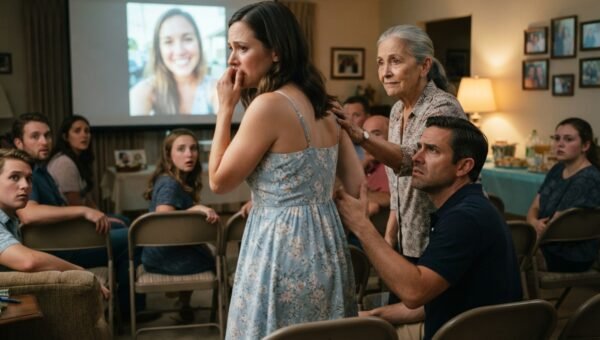
The silence lasted too long. A few parents laughed nervously. Through the screen of the nearest open window, I saw the top half of the audience stand up to look. A murmur passed through the room. I leaned closer to my car window, my stomach tightening. Maya’s clear voice cut through the stillness: “Who is that back there?”
She was pointing. I could see her small arm through the gap in the glass, aimed toward the back row of the bleachers.
The music sputtered out. Footsteps echoed over the wood floor, followed by the muffled voice of Mrs. Gable, the fifth-grade science teacher.
She was asking someone to step into the hall. From my angle near the side double doors, the metal push-bar clattered open. Mrs. Gable stepped onto the concrete landing outside, followed by a tall, lean man in a faded gray field jacket.
My heart did not pound; it went completely hollow.
I had never met this man in person, but I knew his face instantly. Three years ago, while helping Brenda pack boxes to move into Greg’s house, I had dropped an old cedar jewelry chest. Behind the bottom velvet tray, tucked flat against the wood, was a yellowed newspaper clipping from sixteen years ago. It showed a younger version of this exact man, standing beside a wrecked pickup truck near the county line, with a headline about an unsolved hit-and-run that had shut down Route 9. Below the picture, Brenda had written a single word in blue ink: “Dad.”
Brenda’s father had supposedly died when she was two months old. That was the story my own mother had told the family, the story I had repeated to Brenda her whole life because it was the only lie my mother had ever asked me to keep.
Mrs. Gable looked around the gravel lot, noticed my car idling with the parking lights on, and walked over to my driver-side window. Her face was flushed with embarrassment.
“Ruth?” she whispered, looking past me into the empty back seat. “Do you know this gentleman? He was sitting by the fire exit without a visitor badge. He said he was family, but Greg told the principal no one else was coming.”
The man stood ten feet back on the gravel, his hands jammed deep into his jacket pockets. His eyes were pale gray, the identical color of Brenda’s eyes, watching me without blinking.
“No,” I said, my voice barely above a whisper. “I don’t know him.”
Mrs. Gable sighed, turned around, and told him he had to leave the property before the police were called. But the man did not run. Instead, as Mrs. Gable hurried back inside to check on Maya, he took four slow, deliberate steps toward my open car window.
He reached inside his coat, pulled out a folded paper school floor plan, and dropped it into my lap.
Across the top of the map, Classroom 14 was circled in dark red felt-tip marker. Next to the circle, in shaky, faded ballpoint ink that had been written years ago, was a single word: “Bee.”
Bee was what only two people in the world had ever called my daughter.
PART 2
The man turned his back before I could speak. He walked across the dark gravel toward the tree line behind the athletic field, melting into the shadows without looking back once.
Inside the gym, the piano started again. Maya had resumed her lines, her voice slightly shaky but pushing through to the end of the scene. I sat in the front seat of my car, staring down at the folded paper in my lap.
It was an architectural floor plan of the old high school wing that had been converted into the middle school administrative annex five years ago. In the late nineties, Classroom 14 had been the secondary art room. Next to the red circle, the word “Bee” was written in careful, childish cursive. It was Brenda’s handwriting from when she was twelve or thirteen years old.
I had called her Bee because of a yellow-and-black striped sweater she wore until the elbows gave out. But after my mother died, Brenda had stopped letting anyone use the nickname.
Greg’s silver truck was parked near the front entrance of the main auditorium. I saw the silhouette of his head through the glass doors as he stepped out to grab a bottle of water from the lobby vending machine. Greg was a man who managed everyone around him through small, quiet exclusions. When he married Brenda four years ago, he insisted they consolidate her savings into his commercial rental accounts. When I offered to help pay for Maya’s dental work, he told Brenda it was an insult to his ability to provide. Bit by bit, he had shaved me out of their weekday routines, until tonight, when he finally convinced my daughter that her own mother was a nuisance.
I folded the map, put it into my purse, and started the engine.
Instead of driving home to my empty duplex, I drove three miles down the county road to the old annex. The district used the building for record storage and maintenance supplies now. Because of the play, the exterior floodlights were on, illuminating the cracked asphalt where school buses used to park.
The side door to the old art wing had a modern digital lock, but beside it was the old dual-cylinder deadbolt from thirty years ago. Sitting on the concrete sill of the small basement window right below the handle was a brass key attached to an aluminum safety pin. It was the exact trick the district maintenance crew had used when my late husband worked facilities there in the eighties.
My hands were steady, but cold. I picked up the key, slipped it into the bottom lock, and turned it. The heavy metal door popped open with a hollow click.
The hallway smelled of wax, dust, and old construction paper. I used the flashlight on my phone, keeping the beam pointed low against the linoleum. Room 14 was at the very end of the corridor, past the old locker bays.
The door had a brass plaque that read: “Storage C – Archives.”
It was unlocked. Inside, metal industrial shelving lined the walls, stacked high with grey plastic storage totes labeled by school year. On the center work table, cleared of dust, sat a single legal-sized brown accordion folder. On the front of the folder, written on masking tape, was the name: “Arthur Vance.”
Arthur Vance was the name in that newspaper clipping.
I opened the folder. The first item was not a threat or an old love letter. It was a certified cashier’s check stub dated October 14, 2011, for $48,000, payable directly to Gregory Thomas.
Greg.
Beside the stub was a carbon copy of a signed private agreement. My eyes scanned the lines twice to make sure I was reading the dates correctly. Arthur Vance had not abandoned Brenda as an infant. He had been sent to state prison for six years following that hit-and-run on Route 9, a crash that had occurred when Brenda was sixteen. When he was released, he had attempted to reach out to her. But by then, my mother had passed, Brenda was twenty-seven, and Greg had stepped in as her fiancé.
The agreement stated that Arthur Vance would surrender all parental claims, relinquish his share of an inherited ten-acre parcel bordering the state park, and agree never to contact Brenda or Maya directly. In exchange, Greg was supposed to place the $48,000 into an educational trust fund for Maya’s future college tuition.
Tucked behind the agreement was a bank notice dated three weeks ago. The trust account had never been opened. The check had been deposited into Greg’s private LLC, the same LLC he had used to buy his speed boat two summers ago.
Arthur Vance had not come to the play to cause a scene. He had come because the ten-year statute on their private contract had expired, and he had finally checked the county registry to see if the trust existed. It did not.
PART 3
I took the folder, put it under my arm, and locked the annex door behind me, returning the brass key to the window sill just as I had found it.
By the time I drove back to the elementary school, the play was over. Parents were streaming out of the gymnasium into the cool night air, carrying bouquets of grocery-store carnations and plastic programs. I parked near the exit lane where Greg would have to pull his truck through.
Within ten minutes, Brenda walked out of the double doors. She was holding Maya’s hand. Maya looked tired, her stage makeup smudged around her temples, holding a folded paper crown. Greg walked two paces ahead of them, checking his phone, not carrying Maya’s coat or her stage basket.
I stepped out of my car and stood under the lot light.
When Brenda saw me, her face tightened with that practiced, defensive irritation she had developed over the last two years. “Mom,” she said, raising her voice so other parents turned to look. “I told you not to come. Greg told you. Why do you always have to make things difficult?”
Greg stopped, sliding his phone into his pocket. His jaw was set. “Ruth, we talked about boundaries. You’re embarrassing Brenda, and you’re embarrassing Maya.”
I didn’t raise my voice. I looked past Greg, directly at my daughter.
“Maya did a wonderful job,” I said gently. “Her Wendy was clear enough to hear all the way from the gravel lot.”
Maya smiled, a small, shy expression, and tried to step toward me, but Greg put a hand firmly on her shoulder to keep her back. “We’re going to ice cream, Ruth. Get in your car.”
“Did you take the $48,000 to buy the boat, Greg, or did you use it for the truck payments?” I asked.
The sentence hung in the cool air between us. Greg’s hand dropped from Maya’s shoulder. His mouth opened slightly, but no sound came out.
Brenda frowned, looking between us. “What are you talking about? What money?”
“Ask him about Arthur,” I said.
Greg’s face lost every trace of its usual smug composure. “Shut up, Ruth. Don’t do this here.”
“I am doing it right here,” I said, holding out the brown accordion folder. “Because you told my daughter I was the poison in her life, while you took forty-eight thousand dollars from her father to keep him away from her, and then you stole it from your own stepdaughter’s college fund.”
Brenda grabbed the folder from my hands. Her fingers were trembling. She opened it under the glare of the parking lot floodlight. She didn’t need to read every page; she saw the cashier’s check stub, she saw Greg’s signature on the private release, and she saw the date: three months before their wedding.
“Greg?” Brenda’s voice was different now. It wasn’t the tired, compliant tone she used to placate him. It was sharp, cold, and stripped of illusions. “What is this?”
“He was an ex-con, Brenda,” Greg hissed, stepping close to her, trying to reach for the paper. “He was trying to buy his way into your life after leaving you with nothing. I protected you. I handled it.”
“You handled it by putting it in your commercial account?” she asked, pointing at the deposit stamp on the back of the copy. “The account you told me was locked for business taxes when I asked for Maya’s braces money?”
Parents nearby were slowing down, pretending to look for their car keys while listening to every word. Greg looked around, his neck turning red. He realized, for the first time in four years, that he had run out of leverage.
“We are going home to talk about this,” Greg said, his voice dropping to a harsh whisper.
“No,” Brenda said. She reached down, picked up Maya’s duffel bag from the ground, and took her daughter’s hand. “Maya and I are going with my mother.”
ENDING
Greg did not follow us. He stood by the driver’s door of his truck, watching as Brenda buckled Maya into the back seat of my sedan.
We drove back to my house in complete silence. Maya fell asleep before we reached the bypass, her head resting against the car window, worn out from the stage lights and the sudden tension of grown adults.
When we got inside, I made a pot of chamomile tea while Brenda sat at my small kitchen table, the contents of the accordion folder spread out across the floral tablecloth. She read every line of Arthur’s letters, the ones Greg had hidden in the annex archives where district records were routinely forgotten.
“He wrote to me four times,” Brenda said, her voice cracking as she touched a sheet of lined yellow legal paper. “Greg answered him using a lawyer’s letterhead. He told Arthur I wanted nothing to do with him, that if he ever showed up near the house, he’d have his parole revoked.”
She looked up at me, her eyes wet. “Why didn’t you tell me the truth about him when I was little?”
“My mother made me swear,” I said honestly, sitting down across from her. “Arthur was young, he was reckless, and after the accident, my mother believed cutting him out entirely was the only way to keep you safe. I let her make that choice for you. That was my mistake, Brenda. I was too afraid of the conflict to tell you the truth, just like you were too afraid of Greg to tell him no.”
Brenda didn’t argue. She leaned forward, resting her forehead against my hand, and cried quietly so she wouldn’t wake her daughter in the guest room.
The next morning, Brenda didn’t go back to Greg’s house. She went to the county courthouse with an attorney we hired using my emergency savings. Within forty-eight hours, the attorney filed an injunction freezing Greg’s business accounts pending an audit of the converted funds. Two weeks later, Brenda served him with divorce papers.
It took another month before Arthur reached out again. He didn’t come to the house, and he didn’t push. He sent a single postcard to my address, addressed simply to “Bee,” with a phone number and a return address at an auto repair shop two towns over.
Yesterday afternoon, I sat on the porch swing with a glass of iced tea while Brenda stood by the garden gate, holding her phone to her ear. I couldn’t hear what she was saying, but I could see her shoulders drop, losing that defensive hunch she had carried for four long years. Through the kitchen window behind me, I could hear Maya humming the Peter Pan melody, practicing her lines for no one in particular, safe in a house where the doors were finally unlocked.