PART 1
My father stood by the heavy oak doors at the back of the chapel, his hands shoved deep into the pockets of his dark wool overcoat. He did not sit in the front pew with Mom and me. He did not cry, he did not hug a single neighbor who offered condolences, and when Pastor Douglas motioned for him to come forward and speak, Dad gave a slow, rigid shake of his head and stared straight at the floor.
I was furious with him. My brother, Mark, was only thirty-four years old. The state troopers had told us his car skidded off the river bluff during a torrential rainstorm, dropping eighty feet into the swollen current. Three days of searching had produced only his wallet, a ruined phone, and a severely battered vehicle lodged against a sandbar miles downstream. When the recovery team finally retrieved a body wedged beneath a tangled log jam two weeks later, water damage and time had taken a terrible toll. Dental records were supposedly matched through an old clinic file, but the casket stayed firmly closed.
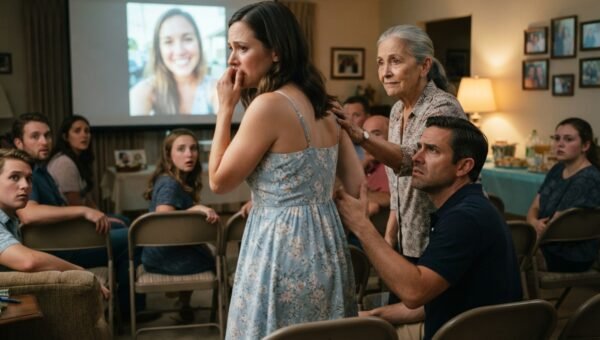
Mom barely survived that service. She sat slumped against my shoulder, sobbing until her voice broke into hoarse gasps. All our relatives took turns speaking. Mark’s friends told stories about his quick laugh, his habit of fixing old cars for free, and how he never walked past anyone who needed a jump start in winter.
Dad just stood by the exit like a stranger who had walked into the wrong church by mistake. When it was time to leave for the cemetery, he walked straight out to his pickup truck, started the engine, and drove away. He didn’t even watch the casket lower into the ground.
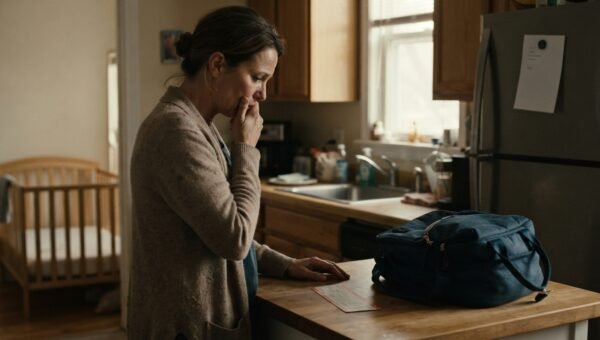
I drove Mom back to our family home outside of town. The silence in the house was suffocating. Every photograph of Mark on the mantle felt like an accusation. Dad came home late, parked by the barn, and slipped into the back bedroom without saying a word to either of us. For two days, I avoided looking at him. Whenever our paths crossed in the kitchen, I glared at his stoic, expressionless face. I thought he was cold, detached, and utterly heartless.
On the morning of the third day, Mom was still asleep upstairs after taking the mild sedative Dr. Miller had prescribed for her nerves.
The house was quiet, except for the hum of the refrigerator and the ticking of the wall clock in the entryway. I walked down the hall toward the kitchen to brew coffee, and that was when I saw Dad.
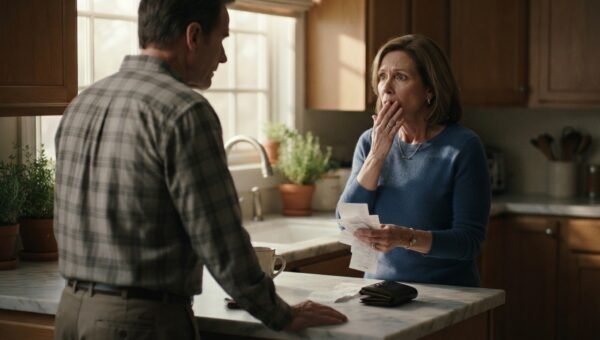
He was sitting at the kitchen table, his forehead resting on his folded left forearm. A mug of black coffee sat beside him, cold and untouched. Sprawled open beneath his right hand was a thick, black spiral notebook with dog-eared cardboard covers. The pages were covered in Dad’s familiar, cramped handwriting, done in blue ballpoint ink.
I stepped quietly, intending to pull the blanket off the rocking chair and drape it over his shoulders. But as I reached the edge of the table, my eyes caught the date scrawled across the top of the open page: November 12. That was barely five days before the crash.
Below the date, a single paragraph jumped out at me.
“Mark, I know you’re alive, and I know why you asked them to bury an empty casket.
Every week I write these pages so you know what is happening back here, but God forgive me, watching your mother weep today nearly broke my resolve. If they believe you are dead, they stop hunting. If you show yourself, they finish what they started.”
The room seemed to drop ten degrees in an instant. The hair on my arms stood up. I stared at the words, reading them three times over. My mind spun in complete circles. The immediate, rational thought that hit me was terrifying: Dad had lost his mind. The shock of Mark’s sudden death had snapped his grip on reality, and he had retreated into a desperate, delusional fantasy where his dead boy was still out there somewhere.
My hand shook as I reached down and touched the edge of the page. The paper rustled softly.
Dad stirred instantly. He lifted his head, blinking heavily against the morning light coming through the blinds. He looked haggard, his eyes bloodshot and deeply lined with exhaustion. When he saw me standing over the table, his eyes dropped to my hand on the notebook.
I waited for him to snap, to yank the notebook away, or to shout at me for invading his privacy. He didn’t. Instead, he let out a long, ragged breath that sounded like air escaping a deflated tire.
He didn’t pull the book back. He just stood up slowly, walked across the linoleum to the antique sideboard against the dining room wall, and unlocked the small drawer beneath the silverware chest with a key he kept on his ring. He reached in, pulled out a glossy four-by-six photograph, walked back, and placed it face-up on the table right in front of me.
My breath caught in my throat.
It was Mark. He had a short, dark beard and his hair was cut much closer to the scalp than usual, but it was unmistakably him. He was wearing a plain faded jacket, leaning against a wooden guardrail by a wide, muddy river. Behind him were street signs with words written in Spanish, and in the corner of a small building behind his shoulder was a calendar poster showing the current month of this very year.
“Your brother isn’t dead,” Dad said, his voice flat, quiet, and steady. “The man in that casket wasn’t him.”
My knees felt weak. I grabbed the back of the chair to steady myself. “Dad, who is in that grave? What are you saying?”
Dad looked me right in the eye, without a trace of confusion or madness. “The man in that grave is the person Mark was running from.”
PART 2
The room stayed dead silent for several seconds while my brain tried to process what he had just said. I looked from the photograph back to my father. He looked exhausted, but his eyes were clear and completely lucid. There was no mania, no confusion.
“Sit down, Sarah,” Dad said quietly, pulling out a wooden chair for me.
I sat down, keeping my fingers pressed against the photograph on the table. “You let Mom sit in that church and weep until she couldn’t breathe. You let the whole county come out and mourn him. How could you do that if he’s alive?”
“Because if they didn’t see a grieving mother and a family burying him, two men would have walked into this house with handguns and killed all three of us,” Dad said. His voice was barely above a whisper, but every word fell like lead.
He sat back down and opened the notebook from the very first page. It was dated five years ago.
“Mark never told you what happened with the logistics company he started down near the border,” Dad said. “He told everyone he went bankrupt because of bad supply chain contracts. That was a lie. He found out three of the shipping brokers he partnered with were using his freight trucks to move illegal, untraceable cash and stolen military-grade hardware across state lines. The moment he tried to go to the authorities, he found out the ringleader was a man named Victor Vane. Vane had bought off local dispatchers and half the precinct. Mark had to run.”
Dad turned several pages. “Mark fled north, but Vane didn’t stop looking. About a month ago, Vane tracked Mark to the county line. Mark called me from a burner phone. He said a black SUV had followed him out of town toward the river bridge. Vane was in the passenger seat with one of his enforcers. They forced Mark off the road, but on that narrow bluff curve, Vane’s driver misjudged the shoulder. The rain was torrential. Mark’s truck spun, but Vane’s vehicle took the brunt of the impact, hit the guardrail, and plummeted straight into the water.”
My jaw tightened. “And the car they pulled out? The one they said was Mark’s?”
“Mark’s car was battered, but it didn’t go in,” Dad explained. “Vane’s car went down. The driver managed to scramble out and fled into the woods, but Vane was trapped inside. When Mark saw what happened, he realized Vane’s network wouldn’t stop coming. If Vane simply vanished, his associates would assume Mark killed him and come after our family to wipe out the witness. But if Mark was the one officially confirmed dead, the investigation would close, Vane’s crew would scatter or fight over the territory, and the heat would die down completely.”
“Who helped him do this?” I asked, trembling. “The coroner? The state police?”
“Sheriff Miller’s older brother, Frank,” Dad said grimly. “Frank was a federal marshal who had been building a RICO case against Vane’s group for eighteen months. When Mark called Frank that night from the bluff, Frank made the call. The body pulled from the river was crushed and unrecognizable from the rocks and water. Frank took Mark’s dental records from an old army enlistment file, switched the records in the county archive with Vane’s private dental charts, and logged the body as Mark. The casket was ordered sealed by state protocol.”
“And Mark?” I asked, my voice cracking.
“Mark was escorted across the border that same night under federal protection,” Dad said. “He had to leave everything behind. His name, his identity, his home. Frank told us that absolute silence was the only thing keeping Mom and you safe. If anyone showed suspicion, if anyone smiled at the funeral, if anyone didn’t behave like a shattered family, Vane’s remaining associates would smell a setup.”
“Why didn’t you tell Mom?” I demanded, tears finally welling in my eyes. “Look at what this is doing to her!”
“Because your mother has a pure heart, Sarah,” Dad said, his own voice finally breaking with grief. “She can’t lie. If an insurance investigator, or a cousin, or one of Vane’s spotters came to the door to offer condolences, Mom would give it away in a second. Her grief had to be genuine. That was the price of Mark’s life. And mine had to look like shock and denial so no one would ask me questions.”
Dad closed his eyes and rubbed his temples. “I stayed by the doors so I wouldn’t have to look people in the face. I knew if I stood up at that podium, I would either vomit from the guilt or tell the whole church the truth.”
Just as he finished the sentence, the floorboards in the hallway creaked.
PART 3
We both froze. The kitchen door swung open, and Mom stood in the doorway, wearing her faded blue bathrobe.
She was pale, her hair unbrushed, and her face puffy from days of weeping. But her eyes were fixed directly on the table, where the photograph of Mark sat right next to the open notebook.
“What are you two whispering about?” she asked, her voice raspy.
Dad moved instinctively to cover the photograph with his arm, but it was too late. Mom walked slowly into the room, her slippers dragging against the floor. She looked down at Dad’s arm, then reached out with a trembling hand and pushed his sleeve aside.
She picked up the photograph.
She didn’t scream. She didn’t drop it. She held the small glossy print close to her face, staring at the recent date in the background, the unfamiliar beard, and the Spanish street signs.
“Where did this come from, Arthur?” she whispered, staring at my father.
Dad looked down. “Helen, you need to sit down.”
“Don’t tell me to sit down!” she yelled suddenly, the sudden burst of energy startling both of us. “Whose body did we bury on Tuesday? Whose grave did I just put fresh flowers on yesterday afternoon? Tell me right now, Arthur, or so help me God, I am calling the sheriff!”
Dad stood up, gently took her hands, and led her to the table. For the next hour, he laid out every single detail, exactly as he had told me. He explained the criminal network, the ambush on the bluff road, Marshal Frank Miller’s intervention, the swapped dental records, and the grave sitting in Oakwood Cemetery.
Mom listened without moving a muscle. The tears streamed down her cheeks, but this time they were not tears of bereavement. They were tears of pure shock, anger, and overwhelming relief all crashing into each other.
“He’s alive,” she repeated over and over, clutching the photo against her chest. “My boy is alive.”
“He is alive, Helen,” Dad said softly. “But he can never come back here. He is living under a completely different name two thousand miles away. If anyone finds out, the federal case falls apart, and the people Vane worked with will retaliate against this house.”
Mom wiped her face with the sleeve of her robe. Her posture suddenly changed. The fragile, broken woman from the church service disappeared, replaced by the stubborn, protective mother who had raised two kids through hard winters on a dry-land farm.
“If he is in danger,” Mom said firmly, “then why are you keeping this photograph in an unlocked drawer? Why are you writing letters with his real name in a notebook sitting on the kitchen table?”
Her question hit Dad like a cold bucket of water. He stared at the notebook, his face draining of color.
“Frank told me to document everything in case the federal trial fell through and Mark needed proof of our communications,” Dad said defensively.
“Frank isn’t sitting in this kitchen,” Mom replied, her voice razor-sharp. “If someone from that gang comes poking around, looking through these windows while we’re at the store, what happens if they see this book? What happens if an appraiser or an insurance claims adjuster walks in?”
Before Dad could answer, the gravel in the driveway crunched.
A dark sedan had just pulled past our mailbox and was rolling slowly toward the front porch.
ENDING
Dad instantly grabbed the notebook and shoved the photograph inside it, tucking the entire book beneath the seat cushion of the rocking chair in the corner. I hurried to the living room window, pulling back the lace curtain just an inch.
A tall man in a plain charcoal suit stepped out of the vehicle. He adjusted his jacket and walked deliberately up the front steps, carrying a thin leather folder.
“Is it the police?” Mom whispered from behind me.
“No,” I whispered back. “It’s not a uniform.”
A firm knock echoed through the front hallway. Dad placed a reassuring hand on Mom’s shoulder, motioned for us to stay back, and walked to the front door. He pulled it open, leaving the screen door latched between them.
“Can I help you?” Dad asked, his voice returning to the flat, guarded tone he had used at the church.
“Mr. Arthur Vance?” the man asked. He reached into his coat and produced a brass badge enclosed in black leather. “I’m Deputy Marshal Henderson. I work with Frank Miller.”
Dad let out a breath and unlatched the screen door. “Come in.”
The agent stepped inside, removing his hat. He glanced toward Mom and me, giving a respectful nod. “Mrs. Vance. Miss Vance. I apologize for intruding so soon after the service, but we received final confirmation from our field office forty minutes ago. The sweep is complete. Victor Vane’s four primary regional lieutenants were taken into custody in three different states at dawn. The network has been dismantled.”
Mom clasped her hands over her mouth. “Is Mark safe?”
Henderson looked at Mom with a gentle, serious expression. “Your son is safe, ma’am. He has already been relocated to a permanent, secure facility. But Frank asked me to come out here in person to deliver two things.”
He opened the folder he was carrying. He pulled out a small, sealed white envelope with no address or postage, handed it directly to Mom, and then pulled out an official document with a state seal.
“The federal court has officially closed the investigation regarding Mark’s disappearance,” Henderson said. “Under federal witness protection protocols, Mark Vance is legally deceased. That public record will remain permanent to ensure no lingering associates ever track him down. The man buried in Oakwood will remain listed as John Doe under a restricted federal seal until the trials conclude next year.”
“Will we ever see him again?” Mom asked, clutching the envelope to her chest.
“Not in this town,” Henderson answered honestly. “Not under his old name, and not for a very long time. In two years, after the trials are finished and the convictions are secured, an intermediary will contact you with arrangements for a supervised visit in a neutral location. Until then, you must live your lives exactly as you have for the past three days. As far as the world is concerned, your son is resting in Oakwood Cemetery.”
The marshal tipped his hat, gave Dad a firm handshake, and walked back to his vehicle. We stood on the porch together and watched the dark car disappear down the long gravel driveway until the dust settled back onto the road.
We went back inside and sat down at the kitchen table. Mom carefully broke the seal on the white envelope. Inside was a single piece of lined paper with three short lines written in Mark’s handwriting:
“I am safe. I am whole. Please forgive me for the pain this caused you, and please take care of each other until I can see you again.”
Mom folded the note, kissed the paper, and then handed it to Dad.
Dad walked over to the woodstove in the corner of the kitchen. He opened the iron door, dropped the thick spiral notebook filled with five years of letters onto the glowing embers, and watched the blue ink turn to ash. Then he laid Mark’s note on top of it, letting the fire consume the last physical trace of his secret.
I looked at my father, remembering how much I had hated him three days earlier as he stood alone at the back of that church. I realized then that while the rest of us were allowed to break down and let the world comfort us, Dad had taken the hardest burden of all: he had chosen to look like a coward and a cold father to the entire town, just so his son could live.
He shut the iron stove door, turned back to Mom, and for the first time in two weeks, my father sat down at the kitchen table and finally wept.