PART 1
I never wanted to be the sister who interfered. For thirty-eight years, I let Karen make her own mistakes, clean up her own messes, and carry the consequences. But the fourth of July changed that completely.
Karen had been seeing a man named Greg Miller for about four months. She met him at a regional supply chain conference in Columbus, and within three weeks, he had practically moved into her split-level home in Oak Creek.
Karen has a fourteen-year-old daughter, Maya. I have a sixteen-year-old daughter, Chloe.
We were having a cookout in Karen’s backyard. It was hot, the humidity sticking to your skin, and Greg was standing near the patio table where Chloe had set down her phone. I was by the sliding screen door holding a bowl of potato salad when I saw him. He was standing too close to Chloe, leaning down under the guise of asking about her high school volleyball schedule, but his eyes were roaming in a way that made every instinct in my body lock up. When Chloe shifted uncomfortably and took two steps back toward the house, Greg stepped right with her, reaching out to touch the strap of her sundress under the excuse of brushing off a stray gnat.
Chloe froze. Her whole back went rigid.
I set the bowl on the counter, walked outside, and pulled Chloe inside immediately.
Later that evening, after the girls went to the basement to watch a movie, I pulled Karen into her laundry room. I kept my voice low and steady. I told her plainly that Greg’s behavior made Chloe uncomfortable, that he was crossing boundaries, and that I did not trust him around teenage girls.
Karen did not pause to consider what I said. She exploded. Her face flushed red, and she accused me of being a bitter, judgmental cynic who could never stand to see her happy. She told me I was projecting my own failed marriage onto a decent man who was only trying to be friendly.
“Don’t you ever come back into my home,” Karen hissed at me, her finger inches from my chest. “And keep your twisted imagination away from my family.”
I took Chloe and left that night. For six months, total silence followed. Karen blocked my phone number.
She blocked Chloe on social media. She forbade Maya from calling or texting us. Maya was only fourteen, gentle and quiet, an avid reader who spent half her life curled up in a corner with a paperback. I worried about her every single day, but my hands were tied. I had no legal right to Karen’s home, and pushing harder would only make Karen dig her heels deeper.
Then came the second Tuesday of January.
The mail carrier dropped a small, padded yellow envelope into my mailbox. It had my name and address written in neat, cramped pencil. There was no return address, but the postmark showed it had been mailed from the downtown branch of our county library system.
Inside was a weathered library copy of *To Kill a Mockingbird*.
At first, I thought someone had returned a misplaced book to my address by mistake. I was about to drop it in the library book bin near the grocery store when a white slip of paper fluttered out from between the pages.
It was a standard county library checkout receipt, dated four days prior. Across the back of the receipt, in faint blue ballpoint pen, Maya had written five page numbers next to specific calendar dates:
Page 42 (Nov 14)
Page 89 (Dec 02)
Page 134 (Dec 19)
Page 201 (Jan 04)
Page 268 (Jan 08)
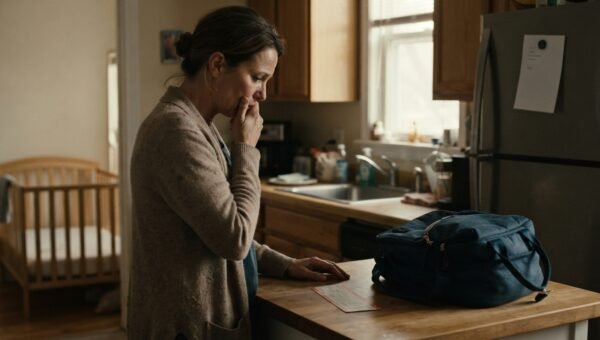
My hands began to shake at the kitchen island. I flipped open the book to page 42. In the third paragraph, the word “He” was lightly circled in pencil.
I flipped to page 89. Three words were circled: “has Mom’s bank.”
Page 134 had two words circled: “card and.”
Page 201 had four words circled: “sleeps in my room.”
Page 268 had four words circled: “when she works nights.”
Put together, the circled words formed a chilling sentence: “He has Mom’s bank card and sleeps in my room when she works nights.”
The air left my chest completely. Karen worked the graveyard shift three nights a week as a charge nurse at Saint Jude Memorial Hospital. She was gone from seven in the evening until seven-thirty the following morning. During those hours, Maya was entirely alone in that house with Greg Miller.
I did not stop to pack a bag. I grabbed my car keys, dialed the local police dispatch on my car’s Bluetooth system, and drove straight toward Karen’s neighborhood, my heart pounding so hard against my ribs that my vision blurred.
PART 2
I met two patrol officers, Officer Vance and Officer Diaz, at the entrance of Karen’s subdivision. I showed them the mailed library book, the checkout slip, and the exact sequence of circled words. Officer Vance examined the pencil marks under the beam of his heavy flashlight. Because Karen’s shift ended at seven in the morning and it was barely ten o’clock, she was home.
When we pulled up into the driveway, Karen’s gray sedan and Greg’s black pickup were both parked outside. Karen opened the front door in her flannel bathrobe, her hair unbrushed, looking exhausted from her hospital shift. The moment she saw me standing behind two uniformed officers, her face hardened into pure fury.
“What is this?” Karen yelled, ignoring the officers and glaring directly at me. “I told you six months ago to stay away from us! Did you really bring the police to my doorstep to harass my household?”
Officer Vance stepped between us, keeping his voice calm and professional. “Ma’am, we received a report regarding a potential safety concern involving a juvenile in this residence. We need to check on your daughter, Maya.”
“Maya is fine!” Karen shouted. “She’s upstairs in her room studying for finals! Greg, come out here!”
Greg stepped into the front foyer from the kitchen, wearing sweatpants and a gray t-shirt. He looked completely relaxed, giving the officers a polite, baffled smile. “Everything all right, officers? Karen, calm down, let them speak.”
Maya appeared at the top of the stairs. She was wearing an oversized hoodie, clutching a soft, gray stuffed elephant against her chest. When her eyes found mine, she did not look surprised. She looked terrified, but resolved.
“Maya,” Officer Vance said gently from the base of the staircase. “Can you come down here and talk to us for a moment?”
Karen tried to step in front of the stairs. “She doesn’t need to talk to anyone without me present. My sister is delusional, officer. She’s been trying to break up my relationship since the day she met Greg.”
Maya walked down the stairs anyway, stepping around her mother. She didn’t look at Greg. She kept her eyes locked on Officer Diaz.
“I sent the book to Aunt Sarah,” Maya whispered, her voice trembling but clear. “Because nobody would listen to me.”
Greg let out a soft, sad sigh, shaking his head. “Maya, honey, what are you talking about? We talked about your sleepwalking phases. You know I only check your room to make sure your window is latched.”
“You don’t just check the window,” Maya said. Her hands were shaking so hard the stuffed animal trembled. She reached her fingers into the back seam of the elephant’s neck, where the thread had been carefully snipped open, and pulled out a small black cube no larger than a postage stamp. It was an inexpensive nanny cam with a micro-SD card slot on the side.
“I bought this at the electronics store by school with my birthday cash,” Maya told the officers. “I hid it on my bookshelf behind my trophy. It records when it senses motion.”
Karen crossed her arms, her jaw tight. “This is ridiculous. You bought a spy camera? To spy on your own stepfather figure?”
“Show them, Maya,” Greg said smoothly, holding his hands up in a gesture of total surrender. “Show the officers the video, sweetheart. I have nothing to hide. I’ve done nothing but protect this house while your mother works twelve-hour shifts saving lives.”
He was so confident that for a split second, a cold doubt gripped my stomach. Had Maya misinterpreted something? Was Greg truly just checking doors?
Officer Diaz asked for the device. Maya handed the tiny camera to him. Officer Diaz took a portable tablet from his duty bag, inserted the micro-SD card via an adapter, and turned the screen toward Officer Vance, Karen, and me.
We all expected the camera to show Greg creeping down the hall in the dark. We expected footage of the doorway, confirming the chilling words Maya had pieced together in the book.
Instead, the first recorded video file was stamped at three in the afternoon, inside Karen’s master bedroom.
On the screen, Karen was sitting on the edge of her unmade mattress. Greg was standing by the closet door. In the video, Karen reached into her nightstand drawer, pulled out a small black camera identical to the one in Officer Diaz’s hand, and pressed it directly into Greg’s palm.
“Take it,” Karen’s recorded voice came through the tablet’s small speaker, sharp and clear. “Put it in her room where she won’t see it. Make sure my daughter believes it’s an intruder or that you’re just sleep-checking her. If she thinks you’re watching her, she won’t dare look through my purse or check the bank statements.”
The hallway went dead silent.
PART 3
The sound of Karen’s voice coming out of that speaker froze everyone in the foyer.
Officer Vance immediately turned his body, positioning himself between Karen, Greg, and Maya. Greg’s easy, charming posture vanished instantly. The relaxed smile fell off his face like wet paint, replaced by a cold, calculating stillness.
“Officer, that is taken entirely out of context,” Karen stammered, her voice suddenly high and frantic. Her face turned an ashen, sickly white. “That’s—we were talking about Maya’s behavioral issues! Maya has been stealing from my account, she’s been sneaking out at night—”
“Mom, stop lying!” Maya screamed, breaking down in heavy, ragged sobs. “You gave him my college fund! You gave him Grandma’s money!”
The truth did not unravel like a neat puzzle; it burst open like a broken dam.
When Officer Diaz continued scrubbing through the video files, the pieces locked into place with brutal clarity. Maya had discovered the miniature camera Karen had bought weeks earlier when she found the receipt crumpled in the laundry room trash. Knowing something was terribly wrong, Maya had taken her own saved birthday money, bought an identical miniature camera from the local store, and placed hers in the master bedroom first to find out why her mother was acting so secretive. Later, she moved it to her own room when Greg began entering her space.
What Maya had captured was not just a violation of privacy; it was the mechanics of a financial and psychological trap.
Greg Miller was not a logistics manager. His real legal name was Gregory Vance Miller, an individual who had served two prior state prison terms for grand larceny and wire fraud targeting middle-aged divorcees. When Karen met him in Columbus, she fell completely under his sway. Over five months, Greg had convinced Karen to invest seventy-two thousand dollars—the entirety of Maya’s custodial college savings account left by our mother, along with thirty thousand dollars Karen had drawn against her own home equity line of credit—into a nonexistent commercial property flip in Indiana.
When Maya accidentally saw an overdue mortgage notice on the kitchen counter in November, she asked Karen about it. Instead of confessing her catastrophic mistake, Karen panicked. Greg convinced Karen that if Maya started poking around or telling relatives, the state or her ex-husband’s family would intervene and declare Karen unfit, ruining her nursing career and freezing all her assets before the “investment” could pay out.
Greg’s strategy had been simple and cruel: gaslight Maya into believing she was mentally unstable, monitor her movements, and keep her terrified and isolated in her own room so she would never go through Karen’s purse or look closely at the bank statements Greg was actively draining. Greg had been using Karen’s debit card to pull daily ATM maximums at casinos across the state line while Karen was at the hospital. Whenever Maya questioned why Greg was in her bedroom late at night, Greg told her she was sleepwalking and imagining things, warning her that her mother was under too much stress to deal with a troubled teenager.
Maya had been living in a psychological prison for three months. She couldn’t tell her mother because her mother was complicit in the cover-up. She couldn’t call me because Karen had blocked my number and monitored the home router. Her only lifeline had been the school bus trip to the public library, where she checked out the one book she knew I loved, painstakingly coding the message across five different pages because she was terrified Greg would intercept a plain letter in the mail.
“Step outside, sir,” Officer Vance commanded Greg, his hand resting firmly on his duty belt. “Hands where I can see them. Right now.”
Greg didn’t argue. He raised his hands and walked backward out the door onto the porch, where Officer Diaz ordered him against the railing and began running his identification through state dispatch. Within six minutes, dispatch confirmed an active bench warrant for parole violations and felony fraud out of Marion County.
Karen sank down onto the bottom step of the staircase, burying her face in her hands, weeping hysterically. “Sarah, you don’t understand… he said he was going to buy us a house in Naples. He said we were going to be a family. He said Maya would have everything she ever wanted.”
I looked at my sister sitting there in her bathrobe, crying not for her terrified fourteen-year-old child, but for the fairy tale an obvious con artist had sold her at the expense of her daughter’s safety and sanity. Any trace of pity I had carried for her evaporated into thin air.
I walked over to Maya, pulled her into my arms, and held her while she shook.
“Pack a bag, sweetheart,” I told her softly. “You’re coming home with me.”
ENDING
The legal aftermath was swift and devastating.
Gregory Miller pleaded guilty to grand larceny, wire fraud, and identity theft six months later. Because of his prior felony convictions, the judge sentenced him to nine years in state prison without the possibility of early parole. The money, however, was almost entirely gone. Out of the one hundred and two thousand dollars he had taken from Karen and Maya’s accounts, investigators recovered less than eleven thousand dollars from an offshore sports betting account.
Karen lost almost everything. The hospital placed her on administrative leave after local news outlets covered the arrest, though she was eventually allowed to transfer to an outpatient clinic in another county at a significant pay cut. To avoid foreclosure on the Oak Creek house, she had to sell it in a rushed short sale, walking away with nothing.
Child Protective Services opened an immediate investigation into the household. Because the video evidence proved Karen had knowingly placed a surveillance device and allowed an active felon to manipulate and terrorize her daughter to hide her own financial negligence, the county court granted me temporary emergency custody of Maya. Two months later, with the support of a court-appointed guardian ad litem, that arrangement was made permanent through a formal guardianship order.
Maya moved into our spare bedroom down the hall from Chloe. For the first two months, she barely spoke above a whisper. She kept her bedroom door locked from the inside, even though she knew Greg was locked behind bars. We put her into weekly counseling with an adolescent trauma therapist who specialized in family gaslighting.
Slowly, the color came back into her life.
Chloe gave Maya her old desk, and together they covered the walls with drawings, postcards, and photos from school track meets. Maya joined the school’s academic decathlon team. She began sleeping through the night without waking up in a panic.
Karen reached out to me once, roughly eight months after that January morning. She sent a long, rambling letter filled with excuses, blaming Greg’s manipulative charm, blaming her exhausting work hours, and asking if she could visit Maya for her fifteenth birthday.
I showed the letter to Maya. I didn’t tell her what to do; I let her decide for herself.
Maya read the letter twice sitting at the kitchen table. Then she folded it up, placed it back into its envelope, and handed it to me.
“She still doesn’t mention the book, does she?” Maya asked quietly.
“No,” I replied. “She doesn’t.”
“Then she still thinks the only problem was getting caught,” Maya said.
She stood up from the table, grabbed her backpack, and walked out the front door to catch the school bus with Chloe.
On the kitchen shelf above our dining table sits that worn library copy of *To Kill a Mockingbird*. I went to the downtown branch that spring, paid the thirty-dollar replacement fee to the library so they could buy a fresh edition for their shelves, and kept the original.
Whenever I look at that faded blue cloth spine, I don’t see Karen’s betrayal or the man who tried to break my family apart. I see the brave, brilliant little girl who refused to let herself be silenced, and the few circled words that brought her home.