PART 1
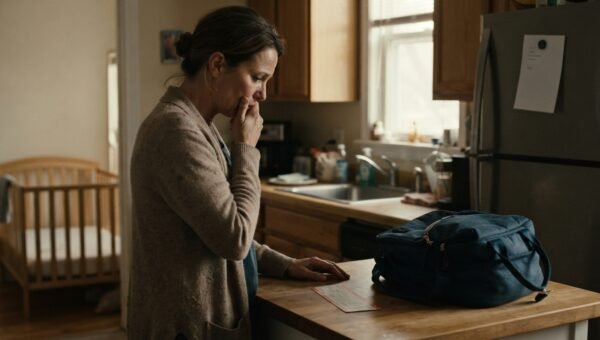
The smell of cold pine and damp wool stayed in the hall for three days after we brought Mom back from the hospital. She had gone fast at seventy-four, a sudden stroke that left her teacup half-full on the side table. By Thursday evening, the house felt hollow. By Saturday morning, my older sister Brenda had moved with the efficiency of a liquidator. She brought contractor grade trash bags into the front room and started sorting winter coats by size, throwing away the heavy wool ones Mom had worn since the nineties because they were “outdated junk.”
I stood by the doorway with a box of photographs in my arms, watching Brenda drop a pewter salt shaker into a carton marked for Goodwill. We were supposed to be sorting together, but Brenda had a way of treating grief like an audit.
“You don’t need these slides,” Brenda said, not looking up as she tossed a plastic sleeve of Kodachrome into the trash can. “Nobody has a projector anymore. I am taking the credenza for the guest room in the city, and Scott is coming with his truck tomorrow for the upright freezer.”
“Wait, Brenda, let’s talk about the freezer,” I said, my voice sounding thin in the high-ceilinged room. “We haven’t even looked through Mom’s papers. We don’t even know what bills are auto-drafting from her credit union.”
Brenda turned around, wiping her palms on her jeans with a sharp little huff of air. “There is nothing to look through.
Mom told me last Thanksgiving that everything was settled. She wanted me to have the cabin because my kids actually use it for their friends, and frankly, you have been living out of a suitcase for six years traveling for that supply chain job. You do not even have a lawn mower.”
“I have paid the county property taxes on that cabin for eight straight years,” I said, keeping my voice level though my chest felt tight. “Every spring when the bill came to my apartment, I wrote the check. Mom paid the insurance, but I kept the lien off the land.”
“Well, you were renting it from her emotionally, then,” Brenda snapped, lifting a heavy stack of mail-order catalogs and dumping them into a bin. “You can drive up to the mountains whenever you want if you ask me first, but I am the one with the bigger family, and Mom knew that logic mattered.
Let us not make a federal case out of a cedar shack with a leaking roof.”
She locked the front door of the city house that afternoon while I was still loading my car with boxes of old tax forms. Two days later, I drove up to the cabin in the foothills to clear out my winter boots and check the propane lines.
The heavy iron padlock on the front porch was entirely new. A thick brass shackle gleamed in the gray mountain light, and a bright red sign from a local locksmith in Placerville was screwed directly into the weathered wood of the doorframe. My old brass key slid into the side door and jammed instantly against a plugged cylinder. When I rattled the handle, the entire frame shuddered with a dry, heavy deadness that told me the interior deadbolt had been thrown from the inside or replaced with a commercial grade bolt.
My phone buzzed in my pocket. It was Brenda.
“Don’t bother trying the doors,” she said without a greeting. “I had the locksmith out this morning. I am putting my security cameras up on Friday, and I do not want your landlord-tenant mindset messing with my family’s weekends. If you left anything inside that you actually care about, tell me and I will look for it when I go up next month.”
I did not scream at her. I stood on the porch with the wind smelling of pine resin and wet cedar, looking down at the gravel driveway where my tires had left twin ruts in the dirt. I had spent eight summers painting those cedar boards by hand, scraper in one palm and linseed oil in the other, while Brenda stayed in Oakland complaining about the altitude.
I got back into my sedan and drove straight down the mountain to the county assessor’s office in town. The clerk behind the counter was an older man with graying temples named Arthur who remembered my grandfather.
“The cabin parcel is fifty-one acres, split back in seventy-two,” Arthur told me, sliding a yellowed ledger sheet across the laminate counter. “Your mother owned the main structure and the south ridge. But there is a quirk on that northern boundary line. The old logging road used to cut right through the middle before the state rerouted Highway 49 back when Eisenhower was in office.”
“Brenda thinks she owns the whole thing because Mom made a comment over turkey,” I said.
“Family talk doesn’t clear a title,” Arthur said, tapping a ballpoint pen against the margin. “If you want to know where your foot actually lands when you step off that porch, you need a certified plat map and a chain survey. The fence lines up there have been moving since the timber companies left in the fifties.”
I did not call Brenda back. I called a private surveyor named Miller whose office was out of a converted dairy barn near the river. He charged four hundred dollars a day and could start on Thursday.
PART 2
Miller met me at the rusted cattle gate at eight o’clock in the morning, his Dodge truck loaded down with tripods, yellow lath stakes, and a heavy yellow case containing his Trimble GPS rover. He wore a faded flannel shirt with the sleeves cut off at the shoulders and smelled of instant coffee and cedar smoke.
“Your sister was up here yesterday,” Miller said, nodding toward the cabin where Brenda’s Subaru was parked by the water tank. “She pulled down my first set of lath stakes by the well house and threw them in the brush. Told me if I drove another iron pin into her gravel, she would call the sheriff for trespassing.”
“Did you stop?” I asked.
Miller grinned, showing a gold molar in the back. “Missy, I have been surveying mountain ridges since before your sister learned how to write checks. Property lines don’t care about family arguments. Let us walk the northern ridge first.”
We spent four hours walking the perimeter through heavy manzanita and scrub oak, dragging the orange chain and checking the angles against the original 1974 subdivision plat. Miller was methodical, checking his handheld data collector against satellite telemetry while I cleared brush with a pair of loppers.
By noon, we reached the ravine behind the old tool shed where the rusted remains of an International Harvester tractor sat half-buried in fern roots. Miller stopped, his eyes fixed on the small digital screen of his receiver. He looked up at me, then back down at the device, whistling low through his teeth.
“Something wrong with the GPS?” I asked, wiping sweat from my forehead with the back of my wrist.
“The GPS is fine,” Miller said. He reached into his vest pocket and pulled out a rolled-up blue line print from the county records room. He unrolled it across the hood of my sedan, weighting the corners with two heavy river stones. “Look at this corner here, right where the old spring box feeds the drainage ditch.”
I leaned over the blue paper. The lines looked like a spiderweb of red pencil marks and black ink.
“That cabin isn’t on your mother’s parcel,” Miller said quietly.
I stared at him. “What do you mean it isn’t on the parcel? My grandfather built it with his own hands in nineteen sixty-five. I spent every July of my childhood sleeping in the loft under that cedar shingle roof.”
“He built it,” Miller agreed, tapping the map with his thumbnail. “But when they subdivided the timber holdings in seventy-two, the county clerk transposed two digits on the metes and bounds description for the east forty. Your grandfather’s deed description puts the main living structure twenty-eight feet north of the actual property line. It sits entirely within the boundaries of the old Miller-Garrison timber patent next door.”
“Who owns the timber patent?” I asked, my voice dropping an octave.
“Nobody has paid taxes on that adjacent section since nineteen ninety-one,” Miller said. “The holding company dissolved during the savings and loan crisis. The county has been listing it as tax-defaulted backland for thirty years, but because the description was botched in the transfer, it never went to public auction. It is essentially a legal ghost tract.”
“And the cabin sits on it?”
“Every square inch of the living room, the kitchen, and the front porch,” Miller said. “Your sister changed the locks on a building that technically belongs to the state’s surplus inventory—and she doesn’t even own the land she thinks she is guarding.”
PART 3
I drove back down the mountain with Miller’s preliminary drawing on the passenger seat, the heavy paper smelling faintly of ammonia and damp paper. Instead of going home to my apartment, I drove to the county tax collector’s office downtown.
The woman behind the glass was named Sarah, a woman who had worked the county intake windows since the typewriter days. She took Miller’s survey map, adjusted her glasses down her nose, and typed a string of parcel numbers into her green-screen terminal that had been obsolete since the nineties.
“Well, this is a mess,” she muttered, her fingers clacking against the mechanical keys. “The main house parcel is in your mother’s estate name. But this northern strip—parcel four-zero-two—has been flagged in our suspense file since the Clinton administration. The tax bills were mailed to a post office box in Sacramento that has been closed since nineteen ninety-two.”
“How much is back-owed on it?” I asked.
Sarah peered at the small monochrome monitor, her lips moving silently as she added up columns of figures in her head. “With thirty-four years of penalties, interest, and weed abatement assessments? It is about fourteen thousand two hundred dollars. But it cannot be paid by just anyone. To redeem a tax-defaulted parcel of that class, you have to prove an active possessory interest or continuous maintenance under color of title.”
“I have paid the insurance and the perimeter taxes on the adjacent section for eight years,” I said, my heart hammering against my ribs. “And my family has maintained the fence lines and the well house since nineteen sixty-five.”
“Under color of title,” Sarah repeated, looking up at me with sharp, assessing eyes. “If you file an application for adverse possession and tax redemption under section thirty-eight of the state revenue code, and if the estate doesn’t contest within ninety days… you can clear the title in your own name.”
“What about my sister?” I asked.
Sarah gave a dry, humorless little laugh. “If the cabin sits on parcel four-zero-two, and your mother’s will only deeded parcel four-zero-one to the estate… then your mother’s will gave away a building she didn’t legally own. Your sister inherited a parcel with a woodshed and a gravel driveway. You are the one standing on the land with the tax receipts.”
I walked out of the county building into the late afternoon glare. The heat off the asphalt was shimmering, rising in waves against the brick storefronts of Main Street.
I called Brenda from the parking lot. She answered on the fourth ring, her voice tight with the irritation of someone interrupted while packing more boxes.
“If this is about the freezer, Scott is already loading it,” she said before I could speak. “And I called the sheriff’s non-emergency line to log your visit today as harassment. You have no business being on that property.”
“Brenda,” I said, my voice completely steady. “Did you know the cabin isn’t on Mom’s deed?”
There was a long silence on the other end of the line, broken only by the faint sound of a car horn honking in downtown Oakland.
“What are you talking about?” she asked, her voice dropping its high, defensive edge. “Mom showed me the blue folder in the metal filing cabinet. It says Lot Four. The cabin is on Lot Four.”
“The cabin is twenty-eight feet north of Lot Four,” I said. “It sits on the old timber patent that went default in ninety-one. I just left the tax assessor’s office. The county has thirty-four years of back taxes on it, and I am filing the redemption papers tomorrow morning.”
“That’s impossible,” she hissed. “Mom said—”
“Mom didn’t check the survey from seventy-two,” I said quietly. “Neither did you. You locked me out of a building that doesn’t even belong to the estate you’re liquidating.”
ENDING
Two weeks later, the orange stakes Miller had driven into the dirt were still standing, though someone had kicked the one by the well house sideways into the mud. I didn’t fix it.
I sat on the front porch of the cabin with a cup of black coffee in my hand, listening to the blue jays screaming in the Douglas firs above the roofline. The new brass padlock Brenda had installed was still hanging on the door, but the hasp had been unscrewed from the jamb with a cordless drill and laid neatly on the Welcome mat like an offering.
Brenda hadn’t come back up the mountain. Her lawyer sent a three-page letter on heavy cream stationery claiming that the family trust retained equitable rights to any improvements made on the land, but Arthur in the assessor’s office had laughed when I showed it to him. An equitable right doesn’t cover thirty-four years of municipal default, and it certainly doesn’t override a certified tax redemption filed by the person who has the cancelled checks to prove she kept the county from seizing the slope.
My name was on the new tax receipt in my backpack, stamped in bright purple ink by the county treasurer’s office. The amount was fourteen thousand two hundred dollars, paid with the savings I had set aside for a new car—money I had originally planned to use on a down payment for a condo in the city.
Instead, I had a cedar cabin with a leaking roof, a gravel driveway that needed grading before the winter rains, and twenty-eight acres of mountain ridge where the property lines finally matched the map. Brenda was still trying to sell the city house and split the porcelain figurines, but she hadn’t called me about the keys since September.
I reached down, picked up the heavy brass padlock from the porch floor, and tossed it into the tall dry grass at the edge of the clearing. It didn’t make a sound when it landed, just a dull thud against the pine needles, swallowed completely by the woods.