PART 1
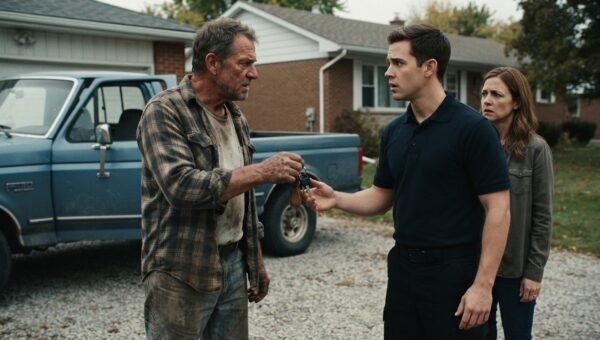
My brother Kevin borrowed my blue Ford F-150 the Tuesday our father died, and he returned it with the glove box completely cleaned out.
Dad had passed early that morning in hospice after six months of lung cancer. Kevin called me around noon saying his sedan had a bad alternator and he needed my truck to haul some boxes from Dad’s garage before the landlord started asking questions.
I didn’t think twice. He had the keys for four days. When he parked it back in my driveway the evening after the funeral, he dropped the key on my kitchen counter, hugged me stiffly, and muttered that he had vacuumed the cab to do me a favor.
I didn’t notice the glove box until the following weekend when I reached inside for the tire gauge. My registration was there, but everything else was gone. The stack of old service receipts, Dad’s spare reading glasses he kept in the console, and an old spiral notebook where Dad used to jot down lumber measurements were all missing. When I texted Kevin about it, he replied that the box had been overflowing with old junk, so he tossed the trash into a dumpster behind Dad’s apartment. I was grieving and exhausted, so I let it go.
Four months passed. It was late October when an envelope arrived from the city of Mercer, a small town two hours north of where any of us lived.
It was an overdue municipal parking citation. The violation had occurred three days after Dad’s funeral, on a Friday morning at 9:42 AM. Attached was a grainy automated street photo. There was my blue pickup, unmistakable with its dented tailgate and faded yellow toolbox, parked directly in front of a red brick storefront that read: *Vance & Holloway, Attorneys at Law*.
Kevin had told me he spent that entire Friday in bed with a migraine.
I called the number on the parking notice first, paid the $45 fine so it wouldn’t hit my credit, and then looked up Vance & Holloway. The receptionist answered on the third ring.
I introduced myself and explained that my truck had been parked outside their building four months earlier. I asked if they had any record of my father, Arthur Bradley, or my brother, Kevin Bradley.
The receptionist went quiet. I heard paper shuffling on the other end of the line, followed by the clicking of computer keys.
“Arthur Bradley?” she asked, her voice dropping into a careful, deliberate tone. “We wondered when you would call, Mr. Bradley.”
I gripped the steering wheel. “Why would you wonder that? My father passed away in June.”
“Yes, we are aware,” she said. “Your father left a sealed document in our vault last winter with explicit instructions for both of his children. It was to be opened only upon proof of his passing, in the presence of both of you, or picked up individually if copies were requested. Only one child came to collect a copy.”
A sour knot formed in my stomach. “Kevin came up there in my truck three days after the service.”
“Before I tell you what the document is,” she said softly, “you need to know your brother wasn’t the person who signed for it.”
PART 2
The line stayed quiet long enough that I could hear a clock ticking in her office.
“What do you mean he wasn’t the person?” I asked. “My truck was parked right at your curb.”
“The individual who entered our office presented identification and signed the release log as Arthur Bradley’s designated family representative,” the receptionist said. “The signature in our register belongs to Evelyn Marsh.”
Evelyn was Dad’s younger sister. She lived in Mercer, out on four acres of overgrown scrub oak where she kept six horses and barely spoke to anyone.
Dad and Aunt Evelyn had stopped talking seven years ago over a timber sale on my grandfather’s old property. At Dad’s funeral, she had sat in the very back pew, wearing a dark wool coat in eighty-degree heat, and slipped out the side door before the casket was even wheeled into the hearse.
Kevin hadn’t spoken to her in a decade. Or at least, that was what he had always told me.
“Miss,” I said, my mouth dry, “Evelyn Marsh hasn’t been a part of my dad’s life in years. My brother took my truck that morning. Did he come in with her?”
“I cannot give you personal descriptions over the phone,” she replied firmly. “However, your father left clear instructions that you, Thomas Bradley, are named as a co-recipient of the sealed packet. If you wish to see the file, review the release log, and collect your copy, you must appear in person with two forms of state identification.”
I took off work early the next morning. The drive up Route 9 took two hours and twenty minutes through damp gray pine woods.
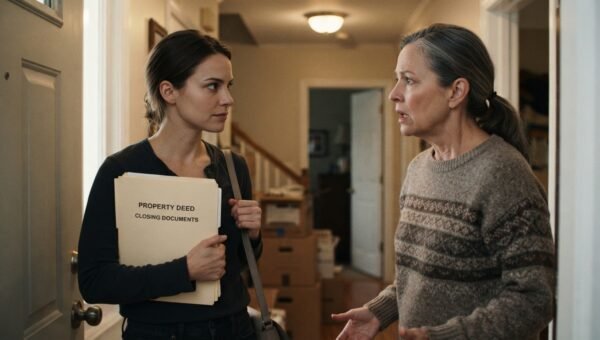
The office of Vance & Holloway was cramped and smelled of old heating oil and carpet cleaner. The receptionist, an older woman named Brenda, examined my driver’s license and my passport. She then walked me down a short hallway into the office of Mr. Vance, an attorney who looked to be in his late seventies, wearing a tweed jacket with frayed cuffs.
On his desk lay a thick buff folder and a black leather visitor log.
“Your father came to me eighteen months ago,” Mr. Vance said without ceremony, gesturing for me to sit. “He knew his diagnosis before he told either of you. Arthur was a stubborn man, but he was meticulous about debt. He wanted to make sure that whatever remained of his affairs was settled cleanly.”
Mr. Vance spun the ledger around to face me.
There it was, dated June 19th at 9:55 AM. Three days after Dad’s funeral.
The signature was written in thin, shaky cursive: *Evelyn Bradley Marsh*. But right beside her signature, under the column marked *Accompanying Party / Vehicle Info*, someone had scribbled the license plate of my truck and the name of the driver who had waited in the lobby.
It didn’t say Kevin.
It said: *Sarah Bradley*.
Sarah was Kevin’s wife.
I stared at her neat, round handwriting. Sarah hadn’t even attended Dad’s funeral; Kevin had claimed she had to stay home with their daughter because of a stomach virus.
“Sarah was here?” I asked.
“Mrs. Sarah Bradley waited in the lobby while Mrs. Marsh signed for the release,” Mr. Vance said. “They requested the duplicate file, took the sealed packet, and departed together. Your brother did not enter this building.”
“And what was in the packet?”
Mr. Vance slid the buff folder across the desk. Inside was a single certified copy of a promissory note and an accompanying private mortgage deed dated three years earlier.
The document showed that Aunt Evelyn had loaned my father $65,000 in cash to pay off the remaining balance on his small machine shop so the bank wouldn’t seize it during his first round of chemo. The loan had been secured by a quiet lien on Dad’s fifty-acre parcel of hunting land in Mercer County, land that Kevin and I had spent every autumn camping on since we were boys.
According to the terms, if Dad passed before the debt was paid, the two surviving children had ninety days from the date of death to pay Evelyn the balance, or the deed to the hunting land would transfer entirely to Evelyn to satisfy the debt.
The note showed a remaining balance of exactly $41,200.
Attached to the back was a handwritten addendum from Dad: *To Thomas and Kevin. You share the land equally if you settle with Evelyn together. She gave me the money when no bank would touch me. Treat her square.*
The ninety-day deadline had expired four weeks ago.
PART 3
I sat in Mr. Vance’s office looking at Dad’s signature.
“The land already transferred, didn’t it?” I said.
Mr. Vance adjusted his glasses. “Mrs. Marsh filed the deed transfer with the county clerk on September 22nd. The ninety days lapsed without any settlement payment from the estate. Legally, the property now belongs entirely to your aunt.”
The pieces hit hard and clean. Kevin hadn’t just borrowed my truck to haul junk. He had found Dad’s personal copy of that promissory note in Dad’s apartment or in the glove box of my pickup, where Dad had kept his important truck papers. Kevin didn’t have the $20,600 for his half of the debt. Instead of coming to me, he had sent his wife to drive Aunt Evelyn to the lawyer’s office to speed up the process.
Or so I thought.
“I need to go see Evelyn,” I told Mr. Vance.
“You can try,” Mr. Vance said quietly. “She lives off Mill Creek Road. But Mr. Bradley, before you go accusing your brother of stealing the family land, you might want to look at the county recording sheet attached to the very last page.”
I turned the page over.
There was the Mercer County Clerk’s filing stamp from September 22nd. The property had transferred from the Estate of Arthur Bradley to Evelyn Marsh.
And then, filed twenty minutes later on the exact same morning, was a Quitclaim Deed.
Evelyn Marsh had deeded the entire fifty acres to a private buyer for the sum of $41,200, the exact payoff of the debt.
The buyer listed on the deed wasn’t Kevin. It wasn’t Kevin and Sarah.
The deed was recorded under the name: *Sarah J. Miller*.
Miller was Sarah’s maiden name. She had used her separate banking account and her maiden name on the county records to buy out Aunt Evelyn’s lien the second the ninety days ended, cutting out Dad’s estate entirely.
I left the office, got into my truck, and drove straight down Mill Creek Road until the pavement turned to washboard gravel.
Aunt Evelyn’s house was an unpainted wood cottage behind a rusted iron gate. Her dogs barked from the porch as my truck pulled into the yard. When she came out onto the porch, wiping her flour-dusted hands on an apron, she didn’t look surprised to see my truck again.
“You’re Thomas,” she said from the top step.
“Aunt Evelyn,” I said, holding the yellow folder in my hand. “Why did you sign that land over to Sarah?”
Evelyn looked at me for a long moment, then nodded toward two metal chairs on the porch. “Sit down, Thomas. Your feet look tired.”
I didn’t sit. “Kevin cleaned out Dad’s glove box the week he died. He took Dad’s paperwork so I wouldn’t see the note. Then he had Sarah buy the land from you behind my back for pennies on the dollar.”
Evelyn let out a dry, rattling breath that sounded like dry leaves.
“Your brother didn’t do this, Thomas,” she said plainly. “Kevin doesn’t know a damn thing about that land.”
I stared at her. “What are you talking about? It was my truck. Sarah drove her here.”
“Sarah showed up at my gate the morning after Arthur died,” Evelyn said, leaning against the porch railing. “She told me that Kevin was drowning in credit card debt and gambling on football games, and that if Arthur’s estate went through normal probate, the creditors would swallow the hunting land whole. She told me you had already moved on, that you had your own house and didn’t care about Arthur’s woods.”
Evelyn looked straight at me, her eyes clouded with age but sharp as glass.
“She brought $41,200 in a cashier’s check from her own mother’s inheritance. She said she was doing it to keep the land safe for Arthur’s grandchildren, so Kevin couldn’t sell it off for cash. She told me you knew all about it and had agreed to let her handle the debt so you wouldn’t have to spend your savings.”
The air went still around us.
“I didn’t know anything about it,” I said. “Not a single word.”
“I see that now,” Evelyn said softly. “When you pulled up in that blue truck, I thought Arthur was rolling in his grave. Arthur told me before he died that you were the steady one. He said, ‘If Kevin gets his hands on that timber, it’s gone in six months, but Thomas will keep it.’ Sarah told me you signed off on it.”
“I never signed anything.”
“I know,” Evelyn said. “Because after Vance gave them the papers, Sarah asked me not to talk to you. That was the mistake she made. Arthur and I didn’t speak for seven years because we were both too proud, but we never lied to each other’s faces. The minute she told me not to answer your phone calls, I went down to the bank and kept a copy of her cashier’s check.”
Evelyn walked into her house and returned two minutes later with a bank carbon slip and a handwritten letter on lined notepad paper.
The letter was written in Sarah’s neat handwriting, instructing Evelyn to transfer the deed only to ‘Sarah J. Miller’ to protect it from Kevin’s debts.
Sarah hadn’t been protecting the family. She had been quietly moving Dad’s most valuable asset into her own private name before filing for divorce.
ENDING
I drove home that night with the papers resting on the passenger seat of my truck.
I didn’t call Kevin. I drove directly to their house in Oakridge. It was past eight o’clock, and the television was flickering blue against their living room blinds.
When Kevin answered the door in his socks, holding a coffee mug, he looked worn down. He had dark circles under his eyes, the same look Dad used to get when the machine shop books didn’t balance.
“Thomas?” he asked, surprised. “What’s wrong?”
“Come out to the driveway,” I said.
He followed me out into the cool evening air. I leaned against the bed of my truck and dropped the buff folder onto the tailgate.
“Where’s Sarah?” I asked.
“Inside putting the girl to bed. Why?”
“Look at the last page,” I said.
Kevin opened the folder under the glow of the truck’s bed light. He looked at Dad’s signature first, then at the date, then at the county recording stamp with Sarah’s maiden name. His brow furrowed. He read it twice, turning the pages back and forth, trying to make the words fit together.
“What is this?” he whispered. “Dad didn’t have a mortgage in Mercer. He owned that woods outright.”
“He borrowed $65,000 from Aunt Evelyn three years ago to pay off the shop,” I said. “He kept the note in the truck. You took it out of my glove box when you hauled Dad’s boxes.”
“I didn’t take any note, Thomas!” Kevin’s voice cracked. “Sarah cleaned the truck out. She told me she was helping me out while I was at the funeral home making the arrangements. She told me the glove box was full of old junk and she threw it away.”
The screen door squeaked open. Sarah stepped out onto the porch, pulling a knitted cardigan around her shoulders. She saw the folder on the tailgate and stopped on the top step.
She didn’t run, and she didn’t yell. She just stood there, watching the two of us under the yellow security light.
“Kevin,” she called out, her voice tight and level. “Come inside.”
Kevin didn’t move. He looked from the deed in his hands to his wife on the porch. “Sarah, what did you do with Aunt Evelyn?”
She didn’t answer him. She looked at me. “Your father was going to lose it anyway, Thomas. We needed an asset that wasn’t tied up in your brother’s mess.”
“You used my truck to go steal our father’s land,” I told her quietly. “And you lied to an old woman who gave Dad money when nobody else would.”
The following Monday, I retained my own attorney in Mercer. Because Sarah had obtained the deed under fraudulent representation of authority from Arthur’s heirs, and because Aunt Evelyn provided a sworn affidavit stating she had been misled about my consent, the county transfer was frozen before Sarah could list the property with a broker.
It took seven months of painful legal filings and nearly $8,000 in legal fees, which Kevin and I split down the middle.
The quitclaim deed to Sarah was formally rescinded by court order. Kevin and I took out a joint bank loan, paid Aunt Evelyn the $41,200 Dad owed her down to the last cent, and put the fifty acres into a family trust with both of our names on the title. Neither of us can sell or borrow against an acre without the other’s written consent.
Sarah moved out three months after that night in the driveway. Kevin is living in an apartment two miles from my house, working overtime at the freight depot to pay off his share of the legal fees and his own debts. He comes over on Sundays to help me work on the pickup.
Last Saturday, we drove the old Ford up to Mercer together. We stopped by Aunt Evelyn’s house first to drop off a bushel of apples from Dad’s favorite orchard, and then we drove out to the fifty acres.
The woods were quiet, the oak leaves turning copper in the autumn sun. We walked the boundary line Dad had marked twenty years ago with faded red paint on the birch trees.
For the first time since June, the glove box in my truck had Dad’s tire gauge and his old reading glasses back inside where they belonged.