PART 1
The ham was still warm on the platter when Amanda tapped her champagne glass with the handle of a butter knife. It was Easter Sunday, just past one in the afternoon. My twelve-year-old granddaughter, Chloe, was outside in the backyard searching for plastic eggs, and my son, Mark, was sitting directly across from me, cutting his roll into tiny, neat quarters.
“Everyone, listen up for just a second,” Amanda said, smiling the bright, sharp smile she uses whenever she wants something to sound like a gift instead of a takeover. “Mark and I have an announcement that makes total sense for the whole family.
We are officially taking over the Pine Lake cabin starting this May. We know Carol hardly uses it anymore, and with the kids getting older, it just breaks our hearts to see an asset like that sitting empty nine months out of the year.”
My fork stopped an inch above my plate. I am seventy-two years old, not dead.
That cabin on Pine Lake had belonged to my parents. My father had cleared the brush with his own hands back in 1964, hauling cedar logs on the back of an old flatbed truck. Every board, every squeak in the porch floor, and every coat of honey-colored varnish held forty years of our family. My late husband, Arthur, had spent our last good summer together rebuilding the boat dock with Mark when Mark was barely sixteen.
I looked straight at my son. Mark would not meet my eyes. He stared fixedly down at his plate, buttering a piece of roll that had already been buttered twice.
“Taking it over?” I asked, keeping my voice very quiet. “What does that mean, Amanda?”
“Oh, Carol, don’t make a face,” Amanda said smoothly, waving a manicured hand. “You won’t have to worry about the property taxes or the winterizing anymore. We are taking the burden off your shoulders. In fact, I’ve already met with a design contractor out in Mercer. We have bids to open up the kitchen, knock out that dark knotty pine in the front room, and tear down the old woodshed to make room for a paved two-car pad.”
She had priced it. She had walked someone through my home while I was in town at physical therapy.
“Did you read the deed, Amanda?” I asked.
Amanda let out a short, dismissive laugh that made the crystal water glasses ring. “We don’t need a legal lecture, Carol. Be reasonable. You haven’t stayed there for more than two weekends since Arthur passed. The family needs to move forward.”
I laid my napkin down beside my plate, stood up, and picked up my purse. I did not raise my voice, and I did not wait for the lemon meringue pie cooling on the sideboard. I kissed Chloe on the forehead on my way through the screen door and drove the eight miles back to my house with my hands gripping the steering wheel so tightly my knuckles ached.
That was Sunday.
On Monday morning at eight-fifteen, my landline rang. It was a man named Dale from Northwood Contracting.
“Mrs. Dawson?” he asked, shouting slightly over the sound of diesel engines in the background. “We’re staging the crew for the Pine Lake demo, and the road into the lot is pretty tight. My driver needs to know where you want us to drop the twenty-yard dumpster. Left side by the birch tree, or down along the gravel turnaround?”
“Mr. Dale,” I said, my chest going tight. “You have the wrong property. No work has been authorized on that house.”
There was a long pause on the other end of the line, followed by the rustle of stiff paper. “Ma’am, I have a signed work order and authorization right here in front of me. Project approval, fifty percent mobilization deposit, and property owner signature. It says Carol Dawson and Mark Dawson.”
My hand began to shake. “Email that to me right now.”
He sent it five minutes later. The signature at the bottom was a scrawl of black ink. My son’s handwriting was unmistakable, looped and hurried. Right beside it, on the line marked Primary Titleholder, was my name. It was written in a shaky, rounded script that someone had tried very hard to make look like an elderly woman’s handwriting.
I had never seen that piece of paper in my life.
I grabbed my keys, got into my Buick, and drove straight down to the county recorder’s office in town. I knew Brenda behind the desk; her mother and I used to organize the church bake sales thirty years ago.
“Brenda,” I said, leaning on the counter, “I need you to pull the parcel history for the Pine Lake property. Parcel 44-A.”
Brenda smiled, typed the numbers into her system, and waited. But after about thirty seconds, her smile completely vanished. She leaned closer to the monitor, her brow furrowing. She clicked her mouse two or three times, then typed something else.
The silence stretched so long that the hum of the overhead fluorescent lights sounded like a swarm of bees.
Brenda looked up at me, her eyes wide, her face unusually pale.
“Carol,” she said in a hushed whisper, “you need to come back into the supervisor’s office. There’s been another filing on your land, and you need to see this immediately.”
PART 2
Brenda led me into an inner office and shut the door behind us. The supervisor, a quiet man named Greg whom I had known since he was a boy, turned his computer monitor so I could see the scan.
On the screen was a recorded quitclaim deed. It had been stamped and filed just three weeks earlier. The document purported to transfer full ownership of the Pine Lake cabin from Carol Dawson, surviving widow, to Mark Dawson and Amanda Dawson, as joint tenants with right of survivorship.
Below the parcel description was my signature, notarized by a mobile notary service based out of an office suite near the regional airport.
“Carol,” Greg said gently, watching my face. “Did you sign this?”
“I did not,” I said. My voice was completely flat, drained of any heat. “I have lived in this county for fifty-one years. I have never used a mobile notary in my life. My lawyer is Tom Bennett on Third Street.”
“Then you need to get Tom on the phone right now,” Greg said. “Because whoever did this paid the expedited recording fee, and according to our county records system as of this morning, you don’t own that cabin.”
I didn’t call Tom from the hallway. I walked two blocks in the cold April wind directly to his office. Tom had handled my husband Arthur’s estate, and before that, he had handled my father’s affairs. He was sixty-eight, slow-moving, and had the memory of an elephant.
When I placed the printouts of the contractor’s contract and the recorded quitclaim deed on his desk, Tom put on his reading glasses. He read through both pages twice without saying a single word. Then he took off his glasses, set them down on his blotter, and looked at me over his folded hands.
“Carol,” he said, “do you remember twenty-two years ago, when your father was in failing health, and we set up the family estate plan?”
“Of course I do,” I replied. “Arthur and I sat right in these chairs.”
“And do you remember what your father insisted on regarding Pine Lake?”
The memory hit me like a splash of well water. “He said the land had to stay in the family line, no matter what happened to any of us.”
“Exactly,” Tom said, opening a drawer and pulling out a heavy blue file folder that smelled of aged paper and cedar. “Your father didn’t just give you that property. He placed the real estate into the Miller Family Heritage Trust. You are the sole lifetime beneficiary and the sole trustee. The trust document specifies that upon your death, the property passes to your biological issue, under strict protective terms. But here is the critical part: under Article Four, the property cannot be transferred, gifted, encumbered, or sold by any individual deed. Any conveyance must be executed by the Trustee of the Miller Family Heritage Trust, in that exact capacity, and must include the recorded Certificate of Trust Authority.”
Tom tapped the fake quitclaim deed on his desk.
“Amanda and Mark thought they were being clever,” Tom continued quietly. “They pulled a standard quitclaim deed from an online legal forms site. They forged your personal signature, ‘Carol Dawson, single person.’ But Carol Dawson as an individual hasn’t held title to Pine Lake since 2004. The trust owns the land. This forged deed they recorded is a legal nullity. It transfers nothing, because Carol Dawson the individual had no title to give.”
He looked at me with deep sympathy. “Carol, forged instruments in real estate filings are a Class C felony in this state. The mobile notary will have to produce their logbook and the identification presented. And if Mark signed that contract and paid a deposit using a fraudulent title, he is exposed to both criminal fraud charges and contractor liabilities.”
My stomach turned over. Mark was my only child. I had carried him, bandaged his knees, helped him with college tuition, and supported him through every promotion. I had watched him slowly surrender his spine to Amanda over fifteen years of marriage, watching her chip away at his connections to his childhood until he barely called except on holidays. But I never imagined he would put his name to a forged document to strip his own mother of her heritage.
“What do we do, Tom?” I asked.
“First,” Tom said, picking up his pen, “we file a formal Notice of Fraudulent Instrument and an Affidavit of Invalid Conveyance with the recorder’s office to cloud their filing and protect the title. Second, I call the sheriff’s department. Third, we send an immediate Cease and Desist to the contractor and to Mark and Amanda.”
“Wait on the sheriff for twenty-four hours,” I told him. “Give me until tomorrow afternoon.”
Tom looked at me closely. “Carol, you cannot protect him from this.”
“I am not protecting him,” I said. “I want him to look me in the eye when he finds out what he did.”
PART 3
I drove to Mark and Amanda’s house on Tuesday morning. Their suburban home was pristine, with immaculate landscaping and two new German SUVs parked in the concrete drive.
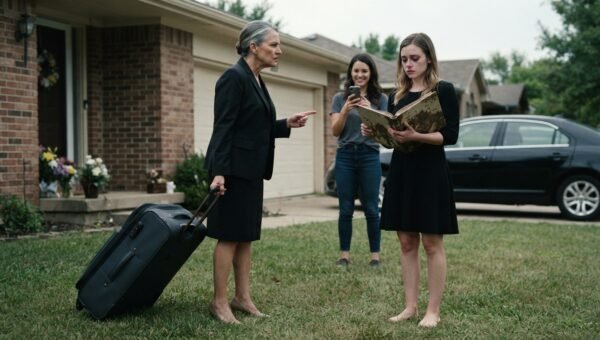
I didn’t ring the doorbell. I used the key Arthur and I had been given years ago for emergencies, unlocked the front door, and walked straight into their white-and-gray kitchen.
Amanda was sitting at the marble island with a laptop open, surrounded by granite swatches and printed kitchen cabinet brochures. Mark was at the coffee maker, dressed in his work clothes, pouring a mug.
When the back door clicked shut, they both turned. Mark froze, coffee pot suspended in mid-air.
“Carol?” Amanda said, her tone instantly defensive. “What are you doing here? You could have texted first.”
“Sit down, Mark,” I said.
My voice wasn’t loud, but it had an edge to it that he hadn’t heard since he was twelve years old. He set the pot down slowly and took a stool beside his wife.
I reached into my bag and pulled out three things.
First, I laid down the contractor’s work authorization for twenty-eight thousand dollars, bearing my forged signature.
Second, I laid down the recorded quitclaim deed from the county recorder’s office.
Third, I laid down the certified copy of the Miller Family Heritage Trust agreement that Tom Bennett had stamped that morning.
Amanda glanced at the papers, and her face tightened. “Carol, if this is about the renovations, I told you on Sunday that we are handling the costs. You don’t have to look at the bills.”
“Shut your mouth, Amanda,” I said, without blinking.
Amanda gasped. She looked at Mark, expecting him to defend her, but Mark was staring at the second document, the quitclaim deed. His hands started to tremble against the edge of the counter.
“Mark,” I said, “look at me.”
He slowly lifted his head. His eyes were red-rimmed, full of guilt and panic.
“Did you sign my name to that contractor’s form?” I asked.
Mark swallowed hard. He couldn’t speak. He just gave a tiny, miserable nod.
“And who signed my name in front of the mobile notary on March twenty-eighth?”
Amanda jumped to her feet. “Now wait just a minute! That cabin was sitting there rotting! You’re seventy-two years old, Carol! You can’t even rake the yard yourself anymore! We needed equity for our children’s future, and you were just hoarding that property out of sheer stubbornness! We were going to tell you once the refinancing went through!”
“Refinancing,” I repeated slowly. “You weren’t just renovating. You were taking out a home equity loan against the cabin.”
The silence in the kitchen was absolute.
“We needed two hundred thousand for the business expansion,” Mark whispered, his voice cracking. He put his head in his hands. “Amanda’s boutique was going under, and the bank wouldn’t approve a second mortgage on this house. Amanda said you’d never sell, but that if we held the deed, the bank would give us a line of credit. She said we’d make the payments and you’d never even know.”
“She said,” I repeated. “And you went along with it. You forged your mother’s signature on a legal deed to steal the home your grandfather built with his bare hands.”
“It doesn’t matter now anyway,” Amanda snapped, though her voice had lost its confident edge and had turned shrill. “The deed is recorded with the county. Mark is the legal owner now. If you want to fight it, you’ll have to hire a lawyer and spend tens of thousands of dollars in court, Carol. Is that really what you want to do to your own son?”
I pointed one finger down at the third document on the counter.
“Read Article Four, Amanda,” I said.
Amanda scowled, reached out, and pulled the trust document toward her. She read the first few lines, then skimmed down the page. Her face began to lose all its color, the pink draining from her cheeks until she looked grayish-green under the kitchen pendant lights.
“The cabin is held in an irrevocable family trust,” I said, speaking every word with cold precision. “I don’t own it as an individual. Mark does not own it. You do not own it. Carol Dawson had no legal authority to sign that quitclaim deed, even if the signature had been real. Your forged deed isn’t worth the paper it’s printed on. It conveys zero legal title. Which means your bank loan is void, your contractor has no legal access to the lot, and what you both committed is felony fraud under state law.”
Mark dropped his forehead all the way down onto the marble counter, his shoulders shaking. “Mom… please. Mom, please don’t.”
ENDING
I did not let the sheriff arrest my son, but I did not protect him from the consequences of his choices.
Tom Bennett filed the invalidation documents that afternoon. By Wednesday morning, the cloud on the title was cleared, and the county recorder officially struck the fraudulent deed from the registry.
Tom then called the contractor, Dale. The dumpster was turned around before it ever left the highway. But Dale did not just walk away quietly; he kept their five-thousand-dollar deposit for breach of contract and cancellation fees, and threatened to sue Mark for the remaining mobilization costs until Mark took out a high-interest personal loan to settle the debt.
The bank that Amanda had applied to for the home equity line of credit was notified of the fraudulent filing. Not only did they immediately cancel the application, but they also flagged Mark and Amanda’s credit profiles for attempted mortgage fraud. Within a month, the credit line on their suburban home was frozen, and Amanda was forced to shutter her boutique, liquidating the inventory at a fraction of what she owed.
Mark came by my house two weeks later. He stood on my front porch in the rain, looking thin, exhausted, and ten years older. He brought a box of old fishing lures Arthur had given him when he was twelve, which he had kept in his garage.
“Mom,” he said, tears running down his face. “I am so sorry. I let her convince me it was harmless. I let her tell me you wouldn’t care as long as you still got to visit. I was weak, and I was terrified of losing our house, but that’s no excuse. I betrayed you.”
I stood behind the screen door, looking at the boy I had raised, and the man he had allowed himself to become.
“You didn’t just betray me, Mark,” I said quietly. “You betrayed your father, your grandfather, and yourself. You let your wife turn you into a thief.”
“Are you going to cut me out of the trust?” he asked, his voice barely a whisper.
“The trust protects the property for your children, Chloe and Ben,” I told him. “I changed the successor trustee provisions yesterday morning. When I pass, the cabin will not go to you or Amanda. It will be held in trust by Tom Bennett’s firm until Chloe and Ben turn twenty-five, for their use and their inheritance. You will never hold the deed to Pine Lake. Not today, not tomorrow, and not when I’m gone.”
He stood there for a long time, nodding slowly, accepting the sentence he had earned.
“Can I… can I still come up and help with the dock this summer?” he asked.
“No,” I said. “You can’t. That dock was built by honest men.”
I closed the door.
Memorial Day weekend, I drove up to Pine Lake alone. The water was clear and cold, lapping gently against the cedar pilings Arthur and Mark had set into the lakebed so many years ago. The old knotty pine inside smelled of smoke, resin, and memory. I sat on the porch with a cup of black coffee, listening to the call of a loon across the water, watching the sun dip behind the tall white pines.
The house was quiet, but it was mine. And as long as I have breath in my body, no one will ever steal the ground my family stood on.