Why do we keep spending years trying to fix things that were broken on purpose from the very first day? That is the question I keep asking myself while sitting at my kitchen table, watching the afternoon light hit the single intact square of blue and yellow cotton I managed to save.
For months, my hands were stiff every evening from pulling the thick quilting needle through layers of batting.
My grandson Leo loved blue, so I used forty different shades of it, scraps from old shirts, bits of flannel, things I had gathered over a lifetime of sewing.
When Julian bought that big new house across town with Elena, I thought we were turning a corner. Julian is my only boy, and ever since he married her, he has lived with his shoulders hunched up near his ears, always watching her face to see if he is allowed to breathe.
I baked three peach pies and packed the quilt into a clean cedar-scented box, planning to walk up the brick pathway and hand it to them myself. Instead, Julian intercepted me right at the curb before I even killed the engine of my old sedan. He wouldn’t even look me in the eye, shifting his weight from one shiny Italian loafer to the other while the sprinkler ticked in the neighbor’s yard.
“Mom, you really shouldn’t come in today,” Julian said, his voice tight and thin like a stretched rubber band. “Elena’s parents are here. They are just more appropriate guests for this kind of gathering.”
I sat there with my hands on the steering wheel, feeling the heat rise right up into my ears. I didn’t yell or make a scene because I was trying to be the bigger person for my son’s sake. I just set the box on the edge of the grass, told him to enjoy the pies, and drove away without another word.
For seven days, I waited for an apology that I knew deep down would never come. Then the delivery truck pulled into my gravel drive on a Tuesday morning, kicking up a cloud of grey dust that settled over my hydrangeas.
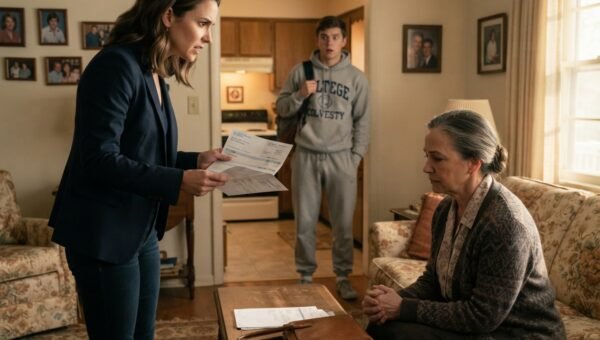
The delivery driver looked uncomfortable as he handed me a taped-up cardboard box.
The shipping label had my name crossed out with heavy black marker, and right across the top in jagged, furious handwriting someone had written unwanted.
I took the box inside, set it on the laminate counter, and cut the packing tape with an old kitchen knife. Inside wasn’t the folded quilt I had packed with such care. It had been sheared right down the middle with heavy fabric shears, sliced methodically into four distinct, ragged squares.
I stood there by the sink, my brain refusing to connect the pieces of what I was looking at. I didn’t cry right away. I just stared at the raw edges where the blue cotton was starting to fray.
My fingers were shaking so badly I dropped the kitchen phone twice before I finally punched in Julian’s number. It rang three times before a cold, clipped voice answered on the other end.
“If you’re calling about the package, save your breath,” Elena said, her tone dripping with the kind of polished venom only someone from money could pull off. “We needed rags.”
“You cut it up?” I managed to get out, my voice sounding like dry paper scraping together.
“We have a certain aesthetic to maintain in this house,” Elena said, laughing a short, ugly sound. “A homemade patchwork quilt looks like a charity case dropped it off on the porch. We don’t do charity here.”
Before I could answer her, the line made a muffled clattering sound, like someone had snatched the receiver away in a hurry. Then came a small, breathless sob that made my chest tighten into a hard knot.
“Grandma?” Leo whispered, his voice trembling so hard I could barely catch the words over the sound of him trying not to hyperventilate. “Grandma, please don’t be mad. He didn’t mean to let them do it.”
“Leo, honey, talk to me,” I said, leaning over the counter. “Where are you?”
“There’s a reason,” the boy cried, his little voice cracking right down the middle. “She said it was ugly, but I kept it. I kept the photo album you gave me. It’s hanging behind the locked door, Grandma. She’s going to throw it out too.”
The line went dead with a sharp click. I stood in my quiet kitchen for three long seconds, listening to the hum of the refrigerator, feeling every ounce of my seventy-one years settle into my bones.
I didn’t call them back. I walked over to the hook by the back door, grabbed my heavy canvas jacket, and shoved my car keys into my pocket.
The drive across town took twenty-two minutes, and every single mile felt like a lifetime of second-guessing myself. When I pulled into Julian’s paved driveway, their fancy white SUV was parked right in the middle, blocking the garage.
I got out of my car and walked straight up to the front double doors without stopping to catch my breath. I didn’t bother ringing the bell; I just pounded my fist against the heavy mahogany wood until the brass knocker rattled.
The door swung open a moment later, and Julian stood there looking like he had just seen a ghost. His hair was messy, and the collar of his shirt was unbuttoned.
“Mom? What are you doing here?” Julian asked, his voice pitching up into a nervous stutter as he tried to block the doorway with his shoulder. “I told you, it’s not a good time.”
“Move, Julian,” I said, my voice dropping down to a register that made him flinch back automatically.
“You can’t just barge in,” Elena said, stepping out from the hallway behind him with her arms crossed tightly over her designer sweater. “This is private property. Julian, tell your mother to leave before I call the police.”
I looked right past my son at her, letting her see every bit of the fury I had kept bottled up for years. “You cut up a child’s quilt and told him it was rags. And now I’m going upstairs to see my grandson.”
Elena’s face went rigid, her pale skin flushing a mottled red beneath her foundation. “He’s our son, and he needs to learn proper standards. We don’t need your country-trash heirlooms cluttering up our clean floors.”
Julian looked between the two of us, his mouth opening and closing like a fish out of water. “Elena, wait a minute…”
“Shut up, Julian,” she snapped at him, not even bothering to keep the contempt out of her voice. “Tell her to get off our lawn right now or I’m walking out.”
I didn’t wait for Julian to find his backbone. I took two steps forward, brushed right past his shoulder with enough force to send him stumbling against the wall, and headed straight for the grand staircase.
“Mom! You can’t go up there!” Julian called out, scrambling after me on his loafers.
“Watch me,” I said over my shoulder as my boots hit the hardwood steps.
Upstairs, the hallway was painted a pale, lifeless grey that made the whole place feel like a hotel lobby. I could hear muffled crying coming from the end of the hall, right behind a white door with a small brass keyhole.
I walked straight to that door and knocked twice. “Leo? It’s Grandma. Open the door.”
“It’s locked!” the boy sobbed from inside. “She took the key!”
Elena and Julian reached the top of the stairs just then, both of them breathing hard. Elena lunged forward, her hand clawing at my sleeve to pull me away from the door.
“Get your hands off me,” I hissed, turning on her with such sudden venom that she actually stepped back, her eyes wide with shock.
“Julian, do something!” Elena shrieked, pointing a manicured finger at me. “Your mother is trespassing in our home!”
Julian looked at his wife, then down at the floor, and finally at me. For the first time in ten years, I saw something shift behind his eyes, a tiny crack in the armor of his cowardice. He looked at the white door, then back at Elena, whose chest was heaving with pure fury.
“Where is the key, Elena?” Julian asked, his voice dangerously quiet.
“What did you say to me?” she gasped, her jaw dropping.
“I asked where the key is,” Julian repeated, stepping between his wife and me for the very first time since their wedding day. “Give it to me.”
“I threw it in the trash where it belongs!” Elena screamed, her composure finally shattering completely as she realized she was losing control. “That boy has been sneaking around hiding junk in there, old pictures of her family, cheap trinkets, things that don’t belong in this house! I cleaned it out!”
Julian didn’t argue with her anymore. He walked past her, grabbed a heavy brass candlestick off the console table in the hallway, and jammed the base into the gap of the doorframe right by the latch. With one sharp heave, the old wood splintered with a loud crack, and the door swung open.
The room inside was stark and bare, lacking any personal warmth, save for a small cardboard shoebox sitting on the floor by the bed. Leo was huddled in the corner by the window, his face stained with tears, clutching a small leather-bound photo album to his chest like a shield.
I walked right past Julian, knelt down on the carpet in front of my grandson, and gently pulled him into my arms.
“I’ve got you, Leo,” I whispered into his hair, feeling him shake as he buried his face in my jacket. “You’re safe now. Grandma’s right here.”
Leo looked up at me, his eyes bloodshot and wide with terror. “She said you didn’t love me anymore because we threw away your gift. She said poor people don’t get to keep memories.”
“That’s a lie,” I said loudly enough for the adults standing in the doorway to hear every single word. “Nobody takes your memories away.”
Julian stood frozen in the doorway, staring down at the splintered lock and then at the trembling boy in my arms. The color had completely drained from his face as the full weight of what he had allowed his wife to do finally crashed down on him.
“Get out,” Julian said, his voice flat and cold as he turned to look at Elena.
“Excuse me?” she scoffed, though her voice shook.
“I said get out of the house,” Julian repeated, turning around to face her fully for the first time in years. “Pack your bags and go stay with your parents. We are done.”
Elena stared at him as if he had lost his mind, realizing too late that her cruelty had finally broken the one man weak enough to tolerate it. She spun around on her high heels and stormed down the stairs, the front door slamming hard enough to rattle the windowpanes.
Julian didn’t chase after her. He slowly walked into the room, knelt down beside us on the carpet, and reached out a trembling hand to touch the corner of the photo album Leo was holding.
“I’m sorry, Leo,” Julian whispered, a tear finally cutting a clean track down his dusty cheek. “I’m so sorry.”
“It’s okay, Dad,” the boy mumbled, leaning into his father’s shoulder.
We stayed like that on the floor for a long time, listening to the afternoon silence settle back over the house. When we finally went downstairs, Julian helped me gather the remaining pieces of the ruined quilt from the kitchen counter, placing them carefully into a clean paper bag.
I didn’t say anything to him about what comes next. Some things don’t need to be explained with speeches.
Today, back in my own kitchen, that single saved square of blue and yellow cotton sits right beside the sugar bowl on my wooden table. Leo is upstairs in my spare bedroom doing his homework with the door wide open, his laughter carrying down the stairs just like it used to when he was little. Julian is staying across town in a small apartment, trying to figure out how to be a man again after years of hiding behind a closed door.