PART 1
For thirty-five years, I have lived in the exact same modest three-bedroom ranch house on Maple Street. It is not fancy. The kitchen cabinets still have their original nineteen-seventies laminate, the back porch has a slight lean that requires a brick under the wooden step, and the carpet in the hallway bears a faint, permanent shadow from where my children dropped grape juice back when they were toddlers.
But it is paid for. I bought it with my late husband, Arthur, after working five grueling years double-shifting at the local textile mill, and after he passed, every creak and groan of those old floorboards felt like an echo of our shared life.
My younger brother, Richard, never understood that kind of permanence. While I planted roots, Richard chased every shiny economic horizon that caught his eye. He made a fortune in commercial real estate during the boom years, lost half of it in some complicated overseas scheme, and then reinvented himself as a self-styled venture capitalist who wore tailored Italian suits to backyard barbecues.
At every single family holiday, Richard found a quiet, humiliating way to remind me of the disparity between our lives. As he carved the turkey or poured a glass of expensive Napa Cabernet, he would survey my modest living room with a patronizing smirk.
“Still clinging to the time capsule, are we, Clara?” he asked last Thanksgiving, gesturing broadly at my floral print sofa. “Thirty-five years in the same zip code. Don’t you ever feel the urge to upgrade? Life starts when you leverage your equity, sis. Sitting on a pile of dirt and drywall doing nothing is just a slow way to lose money.”
I usually just laughed it off, spooning cranberry sauce onto my plate and changing the subject. My children were grown, my property taxes were manageable on my modest pension, and I liked knowing my neighbors. I liked walking to the corner bakery where the owner still remembered Arthur liked rye bread. To me, peace of mind was worth more than square footage or granite countertops.
That peace shattered into a million sharp pieces on a rainy Tuesday evening in August, exactly three weeks after Richard’s latest corporate venture collapsed under a mountain of unpaid vendor debts and federal inquiries.
My doorbell rang at around eight o’clock. When I pulled open the door, I found Richard standing on my porch looking thoroughly hollowed out.
His expensive suit was wrinkled, his hair was graying at the temples without its usual styling gel, and he was dragging a heavy leather-trimmed suitcase behind him.
“Clara,” he said, his voice cracking with a forced, pathetic vulnerability I had never heard from him before. “I am in an absolute nightmare. The partners froze all corporate accounts, the bank is circling my primary residence, and I have nowhere else in the world to turn. Can I please just stay in your spare room for a few weeks until I sort out the bankruptcy proceedings?”
Every protective instinct and sisterly obligation I possessed warred inside my chest. I remembered our mother making us promise on her deathbed that we would always look out for one another. I looked at his defeated posture and felt a heavy tug of pity.
“Just a few weeks, Richard,” I sighed, stepping aside and holding the front door open wide. “You can use the back bedroom.
But you need to understand right now, this house runs on my rules. No late-night business calls, no strange visitors, and you start looking for a permanent solution tomorrow morning.”
He nodded gratefully, dragging his expensive luggage down my carpeted hallway, completely unaware that the hospitality I was offering him was about to be weaponized against everything I owned.
PART 2
For the first forty-eight hours under my roof, Richard played the part of the humbled, grateful dependent to absolute perfection. He ate my homemade pot roast, helped me carry groceries from the trunk of my Buick, and spent hours sitting at my kitchen table staring quietly at his laptop screen while nursing cup after cup of instant coffee.
I actually began to feel a softening in my heart, wondering if perhaps this sudden catastrophe might finally humble my arrogant brother and teach him the value of genuine, honest stability.
That illusion evaporated on the fourth night.
It was past midnight. I had woken up parched and crept quietly down the dark hallway toward the kitchen to get a glass of tap water. As I neared the doorway, I noticed a pale, flickering blue light spilling out from the kitchen counter where Richard had set up his portable monitor.
He was speaking in a hushed, sharp whisper into his smartphone, his tone completely devoid of the defeated exhaustion he put on display during daylight hours.
I froze halfway across the linoleum, my bare feet silent against the floor.
“I’m telling you, the old layout is entirely unencumbered,” Richard hissed into the receiver, pacing back and forth near my refrigerator. “There’s no mortgage, no liens, nothing. The title has been in her sole name since her husband passed away back in ninety-eight. Once she signs the authorization paperwork, we push the refinance through an expedited commercial channel, clear six figures in immediate liquidity to settle my legal fees, and she won’t even realize what hit her until the foreclosure notice drops three months later.”
A cold sweat broke out across the back of my neck. My breath caught sharply in my throat, and I had to grip the doorframe to keep my knees from buckling.
“She trusts me,” Richard continued, a cruel, cold chuckle escaping his lips. “She thinks I’m just a broken brother looking for a safe harbor. All I need is her signature on the power of attorney form under the guise of helping her update her estate planning. By the time she figures out the deed was used as collateral for my bridge loan, I’ll have the cash transferred offshore.”
I backed away into the shadows of the hallway without making a sound, clutching my empty glass so tightly my knuckles turned white. My mind raced through decades of memories, family ties, and shared blood, all instantly incinerated by the raw, predatory greed echoing from my own kitchen. He wasn’t just hiding out from his creditors; he was actively hunting his own sister to feed his financial survival.
When I returned to the house an hour later, Richard was waiting by the front door holding a thick folder of printed legal documents and a pen.
“Clara, thank goodness you’re back,” he said smoothly, flashing his most disarming, charismatic smile. “I was looking over your home insurance and property taxes, and I found a terrible loophole where you’re overpaying. I drafted a simple administrative authorization form. If you just sign right here on page two, I can handle all the bureaucratic headache with the county auditor and save you thousands.”
He held out the pen, his eyes gleaming with the predatory anticipation of a man who thought he had already won.
I did not take the pen. Instead, I slowly unzipped my handbag, pulled out the certified copies I had just printed from the county courthouse, and tossed them squarely onto the kitchen table in front of him. The papers slid across the laminate and stopped right against his coffee mug.
Richard’s smile froze instantly, his color draining away until he looked like a ghost. He glanced down at the preliminary title report, then up at me, his mouth opening and closing without producing a single coherent sound.
“Pack your bags, Richard,” I said, my voice steady, cold, and quiet enough that it echoed off the walls. “You have exactly one hour to get every single piece of your luggage out of my house. If you are still standing on my property when the clock strikes noon, I am walking down to the police precinct with these title fraud documents and handing them directly to the detective division.”
He stammered something about family, about being desperate, about how he was just trying to temporarily stabilize his business until things turned around.
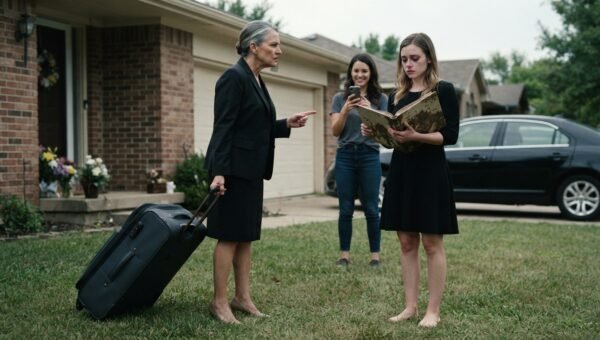
I pointed a firm finger toward the hallway. “Fifty-five minutes, Richard.”
He didn’t argue anymore. He grabbed his designer suitcase, rushed down the hall, and slammed the front door behind him less than twenty minutes later.
As the latch clicked shut, I walked over to the front window and watched his town car pull away down Maple Street for the very last time. I felt no sorrow, only a profound, grounding wave of relief. The house was quiet again. The floorboards still groaned when I walked across them, but they were mine, every single creak, and nobody was ever going to take them away from me.