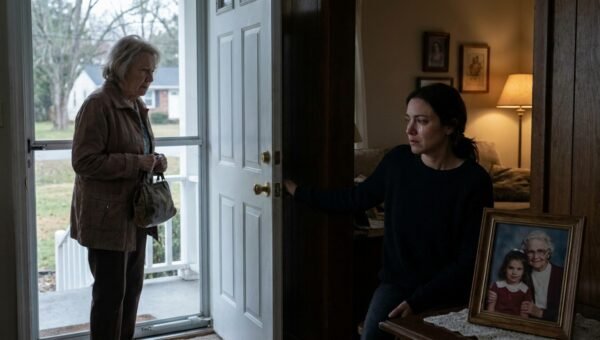
The divorce papers were dated the day before Uncle Warren died.
I noticed that first. Not the signature line, not the blue pen Rhett had left beside my place at the kitchen table. The date. He told me he’d only just heard about the inheritance, but the papers were already filled out, with my name spelled right and our address printed under it.
I asked him about that later. First I went back to the phone call.
I was at work in the county billing office, trying to match a stack of insurance notices to the right accounts. I remember one had a coffee ring on it from the morning. Rhett called at 10:13.
“Uncle Warren died,” he said. “I inherited $800 million.”
I thought I’d heard him wrong. Warren owned a large seed company and a lot of land, but $800 million was a number people said on TV, not one I expected my husband to say between my calls about unpaid invoices.
“Are you sure?” I asked.
“His lawyer called. It’s real.”
Then he told me to pack my things and be out before he got home.
I’m not proud of this, but I said, “Okay.” I didn’t ask why. I didn’t cry. I sat at my desk with the phone in my hand and looked at that coffee ring until one of the other women asked if I was sick.
Rhett and I had been married for 19 years. We lived in a two-bedroom apartment in central Iowa, nothing fancy. We’d bought the same brand of grocery-store coffee for most of those years because we both liked it, and because neither of us ever cared enough to try another kind.
That’s a silly thing to remember now. I remember it anyway.
I got home at 5:40. Rhett wasn’t there yet. The divorce papers were on the kitchen table, squared up beside a pen. There was a yellow sticky note on top that said, Sign where marked.
That was when I saw the date.
The night before, Rhett had come to bed late. He said he’d been on the phone with his uncle’s lawyer. I was half asleep and asked if Warren was getting worse. Rhett said, “No, it’s business stuff.” I didn’t press him. I was tired of asking about Warren and being told it wasn’t my concern.
We’d met Warren at Christmas and at the occasional family dinner. He was quiet, not unfriendly, and he always asked me about my work. Rhett liked to say his uncle didn’t understand regular people. I never thought that was true. Warren just didn’t waste words.
The phone rang while I was still standing over the papers.
Rhett said, “You saw them?”
“I saw the date.”
“What about it?”
“You told me you found out today.”
“I did.”
“These are dated yesterday.”
He didn’t answer for a second. Then he said, “I knew he was dying. I’d been looking at my options.”
I leaned one hand on the counter. There was a small sticky patch from where I’d spilled maple syrup at breakfast and wiped it badly.
“Your options?”
“Don’t make this harder than it needs to be, Dana.”
He said it like I was the one doing something to him.
I asked if he’d been planning to divorce me before the inheritance.
He said he’d been thinking about it for months, which was the closest thing to an answer I got.
I hung up. I set my bag down. I read the papers from the first page to the last, even the parts I didn’t understand. I signed where he’d marked. I wasn’t calm because I was brave. I was calm because I didn’t know what else to do.
At the bottom of the last page, I wrote the date. I put the pen beside his chair.
I didn’t know if the divorce was final or if it would take months. I didn’t know if there was a way to stop it. I didn’t want to ask Rhett for anything. That may have been pride. I’ve had a hard time telling pride from self-respect some days.
He got home around 6:20. He picked up the papers and checked every signature.
“You signed them.”
“I did.”
He gave a short laugh. “You’re taking this better than I expected.”
I asked him if he wanted me to say something.
“No. I just thought you’d ask for money.”
I looked at him. “You haven’t even got it yet.”
“I’ll have it.”
I can still see the way he said that. Not shouting, not even angry. Just certain.
I packed two bags and took them to my sister Janice’s house. I left the coffee maker and the blue mixing bowl I’d had since before I met him. It felt ridiculous to decide what objects I could live without while my marriage was ending, but I did it anyway. I took my work shoes, my winter coat and the little tin where I kept spare buttons.
Janice didn’t ask me to explain right away. She put a plate of toast in front of me and sat down.
“Do you want me to call him?” she asked.
“No.”
“Do you want me to call a lawyer?”
“Not yet.”
I know that was a bad call. I should’ve called one that night. Instead, I sat at Janice’s counter and watched her butter the toast all the way to the edges, because that’s how she does it. I was trying not to fall apart in front of her, and for a while that gave me something to do.
Rhett called twice before I went to bed. I didn’t pick up. At 9:06 he texted, Your things are still here. I’ll have someone pack the rest.
I wrote, I’ll get them Saturday.
Then I deleted it and didn’t send anything.
The next morning, a woman from Warren’s lawyer’s office called my work number. She said her name was Mavis and asked if I knew Rhett had been named in Uncle Warren’s will.
“I heard he inherited,” I said.
There was a small pause.
“I’d like to go over the papers with you,” she said. “You’re named as a beneficiary.”
I thought she had the wrong Dana. Then she gave me my full name and asked if I could come to the law office at 2:30.
I told her I had to check with my supervisor. When I hung up, I sat very still. I wasn’t sure I believed her, and I didn’t want to tell anyone in the office what the call was about.
At 2:30, I went.
Mavis met me in a small conference room. There was a bottle of water on the table and a stack of papers in a folder. She asked whether Rhett had spoken to me about the will. I said he’d told me he was getting the money.
“He’s been told the estate is valued at about $800 million,” she said. “That doesn’t mean it was left to him.”
She opened the folder.
Warren had left the controlling shares in his company, along with the land and other assets, in a trust for me. It was set up so I’d receive income and control of the trust, with the company managed by its current board. The total value was about $800 million.
My hands were on the table. I noticed a rough spot in the wood near my thumb. I ran my finger over it while Mavis explained the rest.
Rhett wasn’t a beneficiary.
He had been named executor, which meant he was supposed to help carry out the will and make sure the estate was handled properly. He had heard the number and decided it meant the money was his.
Mavis said she couldn’t tell me what Rhett had heard from the lawyer. She could only tell me what the documents said.
I asked, “Why me?”
She pulled out a letter Warren had left with the will. It was addressed to me in blocky writing.
I didn’t open it right away. That’s the part I’m embarrassed about. I wanted the answer, but I was scared the answer would be that Warren felt sorry for me. I didn’t want to be pitied by a dead man.
Mavis waited. Then I unfolded it.
Warren wrote that I had come to see his wife, Louise, every week for almost a year after she moved into a care home. Rhett had stopped visiting. I’d driven out after work, taken Louise a crossword book, and called him when she had a bad week. I’d thought of it as something you do when a person has no one else showing up.
I hadn’t told Rhett I was going. It was easier not to hear him complain that I was spending my Saturday on his uncle’s family.
Warren wrote that he’d watched me do it. He said he was leaving me the company and the money because I’d treated his wife like a person when everyone else treated her like a problem to manage.
Then there was one last line.
“Rhett thinks I left him the money because he’s my nephew. I left it to you because I saw what he was like when nobody was watching.”
I read it twice.
I didn’t cry in Mavis’s office. I folded the letter and put it back in the envelope. Then I asked if Rhett knew what the will said.
“He’ll be informed,” she said. “The estate meeting is tomorrow.”
I thanked her. I don’t know why I thanked her. I walked to my car and sat there with my hands on the steering wheel for a while.
The next day, I went to the estate meeting. I could have stayed away, but I wanted to hear the words from the lawyer myself. I also didn’t want Rhett telling the family I’d misunderstood.
Rhett was there. So were his mother, his sister, and two cousins. His mother had a tissue in her hand. Rhett was sitting at the end of the table with the same confident look he’d had in the kitchen.
The lawyer read the will. He explained the trust, the company shares, the land, and Rhett’s role as executor. He said my name more than once.
Rhett cut in.
“Warren told me I was inheriting.”
The lawyer said, “You were named executor, not beneficiary.”
“That’s not what I heard.”
“I can only read what’s in the signed will.”
Rhett looked at me like I’d done something behind his back. I had not even known about the will until two days before. I kept my hands folded in my lap.
His mother reached across and touched his sleeve.
“I thought you said it was yours,” she said.
“I thought it was.”
His sister asked, “Then what did you tell Dana?”
Rhett’s jaw moved. He looked at the table.
I didn’t answer for him. I could’ve. I could’ve said he told me to get out, and that he had the divorce papers dated before he knew what Warren left. I was tired of being the person who kept the story neat so he didn’t look bad.
The lawyer asked whether I understood that I was the main beneficiary. I said yes.
Rhett pushed his chair back. The legs scraped the floor.
“Can we talk outside?”
“No,” I said.
He looked at the other people in the room, then back at me.
“Dana, come on.”
I said, “You had your chance to talk to me before you put papers on the table.”
He didn’t have anything to say to that. Not then.
After the meeting, his mother came to me in the hallway. She was crying, but quietly. She said Rhett had called her the day before and told her he’d finally be able to help the whole family.
“I’m sorry,” she said.
I said, “I know.”
She didn’t ask me to give them money. I was grateful for that. She said Warren had been a hard man, and she thought Rhett had wanted his approval for years.
I’m not saying that makes what he did okay. It doesn’t. But I could see how he’d built his whole idea of the future around getting picked by Warren. He was sure the fortune meant he’d won something. He never stopped to ask what Warren had actually written.
The calls started before I got home. Rhett’s sister called first. Then one of his cousins. His mother called again, and then stopped. Most of them wanted to know if the estate could be challenged.
I said they’d need to speak with the lawyer.
One cousin told me Warren had been old and confused near the end. Mavis had already told me the will had been signed in front of two witnesses, after Warren met with his attorney alone. I passed that along.
“Rhett’s going to be furious,” the cousin said.
“I know.”
“You should think about what this’ll do to him.”
I almost laughed. I didn’t. “I have been thinking about what he did to me.”
That night, Rhett came to Janice’s house. Janice opened the door but didn’t move aside.
“I need to talk to Dana,” he said.
I came to the front hall. I didn’t want Janice standing between us like a guard, though I appreciated that she was there.
Rhett looked tired. The confident look was gone. He had the divorce papers in one hand.
“Can we talk in private?” he asked.
“No.”
He looked at the papers. “I didn’t know you were in the will.”
“You didn’t ask.”
“I thought I was getting everything.”
“You thought that was enough reason to throw me out.”
He rubbed his forehead. “I was trying to get ahead of it.”
“Of what?”
He said nothing.
I asked if he’d been planning to leave me before Warren got sick. He said he’d felt like our marriage had been over for a while. Maybe it had. It’s hard to tell what’s true when someone changes the story to fit the day.
“Why put the papers out before you even knew?” I asked.
“I wanted it settled.”
I looked at the top page. The date was still there, plain as ever.
“You wanted me gone before you thought you’d be rich.”
He didn’t deny it. He kept looking at the papers instead of my face.
Then he said, “I thought the money would make things easier.”
I said, “For you.”
He gave a small nod.
There it was. Not an apology. Not quite.
He asked if I’d consider waiting on the divorce. He said the lawyer had told him the paperwork still needed to be filed. He said we could talk after things settled down.
I thought of that sticky note, Sign where marked. I thought of the coffee ring at work, and the way I’d spent years smoothing over small things because I didn’t want an argument. I had called that keeping the peace. Maybe some of it was just me avoiding a hard talk.
“I already signed,” I said. “I’m not taking it back.”
He put the papers down on Janice’s little entry table. One corner stuck up. Janice reached over and pressed it flat with her palm.
“I’m sorry,” he said.
I believed he was sorry he’d lost the inheritance. I’m not sure what else he was sorry about.
I told him to leave.
He did.
I hired a lawyer the next morning. I filed the divorce papers myself. The divorce took months, which is how these things work, and the estate took longer. I didn’t suddenly wake up with $800 million in my checking account. The company stayed under the trust. Lawyers handled the land. Accountants explained what I could spend and what needed to stay put.
I kept working at the billing office for a while. People there knew something had happened, but I didn’t tell them about the money. I didn’t want to be treated like I’d won a contest. Mostly I wanted to finish my day and go home to Janice’s spare room, where I could shut the door.
The family kept calling, less often after a few months. Rhett’s mother sent a card at Christmas. She wrote that she hoped I was well. I put it in a drawer with the spare buttons.
Rhett and I signed the final divorce papers at a lawyer’s office. He didn’t ask for a share of the trust. He couldn’t. The money had never been his. Still, he looked at me like I was holding something he’d been promised.
I did not tell him Warren’s last line. Maybe that was petty. Maybe it was the one thing I wanted to keep for myself.
I still have the letter. I’ve read it enough that I know where the fold runs through the word “watching.” Sometimes I think Warren gave me the money because he trusted me. Sometimes I think he wanted to make Rhett feel exactly what he’d made me feel, which isn’t the same thing as kindness.
The company is real. The workers are real. The trust is real. So is the divorce.
I moved into a small place of my own, and I bought a different coffee maker because the old one was still at the apartment. I don’t know if I’ll ever get used to having this much money attached to my name. I do know I don’t want Rhett back.
The papers were dated the day before Warren died. I kept one copy. Not because I need to remember what I signed, but because the date still bothers me.