PART 1
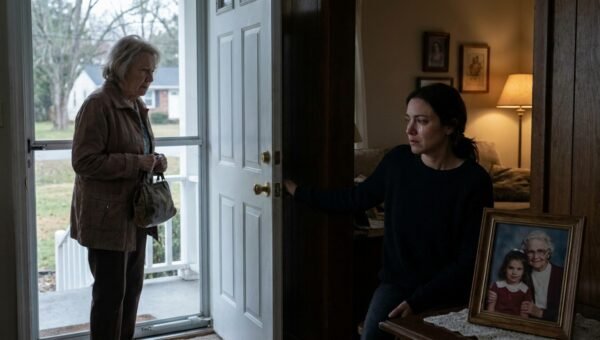
“Take the candy dish and quit whining,” my cousin Maxine said after Aunt Inez’s funeral. She kept the house, the Buick, and $96,000 in savings. I got a chipped glass dish that sat by Inez’s phone for 28 years. Maxine laughed. “She knew what you were worth.”
I carried it home wrapped in a Dollar General bag. The glass cut my thumb. I pressed a towel to it and noticed the felt bottom peeling loose.
There was a safe-deposit receipt, $11 every January, and a flat key taped inside.
During the July heatwave, I took it to the bank. The teller brought out a box marked with my birth date. Inside was a heavy manila envelope tied with faded blue ribbon, three county deed copies, and a notarized letter dated four years before Inez died.
Before I even opened that envelope, I need to be honest about how things stood between me and Maxine, and why I almost threw that candy dish in the dumpster behind my apartment.
I am 62 years old. I worked thirty-one years as a cafeteria supervisor for the county school district, and my retirement check covers my rent, my medicine, and not much else. Aunt Inez was my mother’s younger sister. She never married, never had kids, and lived in the same brick ranch house on Sycamore Street since 1978.
When my mom passed away ten years ago, I started going over to Inez’s house every Tuesday and Thursday after work. I washed her hair in the kitchen sink, sorted her pills into the plastic Sunday-through-Saturday box, drove her to the eye doctor in Macon, and sat with her when the thunderstorms scared her.
Maxine lived forty minutes away in a gated subdivision with two-car garages and manicured hedges. She showed up maybe four times a year, usually around Thanksgiving or when she wanted to borrow Inez’s silver serving trays for her bridge club.
Then, about two years before Inez died, Inez had a mild stroke. Nothing that took her mind, just enough to make her unsteady on her feet and slow with her words. That was when Maxine suddenly found time to visit every weekend. She brought casseroles, hired a lawn service, and started taking Inez to a new lawyer in town instead of old Mr. Hendry, who had handled Inez’s paperwork since the eighties.
I did not fight Maxine on it. I was tired from working on my feet all day, and I told myself family shouldn’t bicker over a sick woman. Looking back, I was naive. I thought showing up for twenty-eight years spoke for itself.
When Inez passed in May, Maxine handled the funeral arrangements and read the will at the dining room table before the flowers had even wilted. According to that will, signed eighteen months before Inez’s death, Maxine was the sole executor and sole beneficiary. The brick house on Sycamore Street, the 2014 Buick LeSabre in the garage, and the $96,000 in Inez’s credit union savings account all went to Maxine.
My name was mentioned in one single sentence near the bottom: “To my niece, Ruth, I leave the green pressed-glass candy dish from my telephone table, that she may remember our afternoon visits.”
Maxine had grinned when she read that line out loud in front of my brother-in-law and two church ladies.
That was when she shoved the dish across the table toward me and told me to quit whining, even though I hadn’t said a word. I just picked up the dish, dropped it into the plastic Dollar General bag I’d brought my spare flats in, and walked out to my Honda.
That cut on my thumb bled all over my kitchen dish towel that night. I sat at my dinette table with a Band-Aid on my finger, staring at the chipped rim of that ugly green glass dish. When I turned it over to rinse the blood off the bottom, my fingernail caught the edge of the dark green felt pad glued to the base. Half of it was already dry and curling up from decades of sitting near the sunny kitchen window.
I peeled the rest of the felt back, expecting to see a manufacturer’s stamp. Instead, folded into a tight square and held down with yellowed Scotch tape, was a small carbon-copy receipt from Farmers and Merchants Bank downtown, dated January 14 of that same year, showing an $11 annual rental fee paid in cash for Box 114. Taped right beside the receipt was a flat brass key with the number 114 stamped into the metal.
I sat there for an hour looking at that key. My first thought was that it was probably empty, or maybe held my grandmother’s old wedding band, which wasn’t worth much more than sentimental value. Besides, Maxine was the executor. I figured if I marched into the bank waving a key, they would tell me I had no legal right to touch anything belonging to Inez’s estate. So I put the key, the receipt, and the candy dish inside my hall linen closet behind the extra blankets, and I went back to my regular life.
Then July hit. It was one of those brutal Georgia heatwaves where the air feels like a wet wool blanket by nine in the morning. My central air unit in the apartment went out on a Tuesday, and the landlord told me the replacement part wouldn’t come in until the following week. On Thursday afternoon, sitting in my living room with two box fans blowing hot air around, I got a text from Maxine.
It was a photo of a “Sold” sign going up in front of Aunt Inez’s brick house on Sycamore Street. Below the picture, Maxine wrote: “Closing next Friday! Getting $215,000 cash from an investor. Hope you’re enjoying that candy dish, Ruthie.”
Something inside me finally snapped. It wasn’t even about the money anymore. It was the cruelty of rubbing my nose in it after I had spent decades wiping Inez’s forehead and holding her hand while Maxine couldn’t be bothered to send a birthday card.
That very afternoon, I walked into the air-conditioned lobby of Farmers and Merchants Bank with my driver’s license, the January receipt, and the flat key in my purse. I didn’t know what would happen, and I half expected to be turned away at the counter.
The teller, an older woman named Mrs. Gable who had worked there since I was in high school, looked at the receipt and punched the box number into her computer. She didn’t ask for death certificates or executor papers. Instead, she looked up at me with a quiet, careful expression and said, “Ruth, your aunt added you as a joint lessee on Box 114 back in 2019. You have full access.”
She led me into the vault room, used her guard key alongside my flat key, and slid out a long metal drawer. Taped to the inside lid of the drawer with a piece of white medical tape was a strip of paper written in Aunt Inez’s unmistakable shaky cursive: “For Ruthie, born October 14, 1963.”
Inside the metal box sat the heavy manila envelope tied with blue ribbon, the three folded county deed copies, and a notarized letter.
PART 2
My hands were shaking so badly in that little private viewing booth at the bank that I tore the corner of the manila envelope trying to untie the ribbon.
I pulled out the notarized letter first. It was typed on plain white paper, signed by Aunt Inez, and stamped by a notary public named Walter Finch, who used to run the insurance agency down on Main Street before he retired. The date at the top was November 8, 2021, two full years before Inez’s stroke and more than two years before the will Maxine had read at the dining room table.
I read the letter three times before the words fully sank in.
“To my niece, Ruth,” the letter began. “If you are reading this, you found the key I taped under the green dish by my phone. I put it there because you are the only person in this family who ever dusted underneath it. Maxine has been pressuring me lately to let her handle my affairs, and I am tired of arguing with her. I want you to know the truth about what I own and what I did before she started meddling.”
My throat went dry. I set the letter down and unfolded the three county deed copies underneath it.
They were certified copies from the Bibb County Superior Court Clerk’s office, all recorded in October 2021. The first two were transfers of title for two parcels of farmland out near the county line, thirty-four acres total that Inez’s father had left her back in the seventies. Inez had deeded both parcels directly to me via a Lady Bird deed, which meant she kept full control of the land while she was alive, and ownership passed automatically to me the moment she died, completely outside of probate and completely outside of any will.
The third deed made me sit back against the vinyl chair in the bank booth and stare at the wall.
It was the deed to the brick ranch house on Sycamore Street.
In October 2021, Aunt Inez had executed and recorded a transfer-on-death deed leaving the Sycamore Street house to me, Ruth Ellen Vance. Not to Maxine. Not to her estate. Directly to me.
I picked up the notarized letter again and read the second page, which I hadn’t even turned over yet.
“I left the $96,000 in my credit union account and the Buick in my regular will so Maxine would have something to boast about and leave you in peace,” Inez had written. “She thinks the house is part of the estate because I never told her I recorded the transfer deed at the courthouse. Mr. Hendry helped me file it before he retired, and I paid him in cash so it wouldn’t show up in my checkbook. Keep the land, Ruthie, or sell it and buy yourself a place with good air conditioning and a porch. Don’t let Maxine bully you out of what I worked my whole life to leave you.”
I sat in that booth for twenty minutes, listening to the hum of the bank’s fluorescent lights. Everything suddenly lined up in a way that made my stomach twist.
Maxine had taken Inez to a new lawyer after the stroke and had a new will drawn up leaving everything in Inez’s “estate” to Maxine. Because Maxine never bothered to run a title search at the county courthouse, she just assumed the Sycamore Street house was still titled solely in Inez’s name and passed under the new will. She had already signed a sales contract with a cash investor for $215,000, and closing was scheduled for the following Friday, eight days away.
If Maxine closed on that house using fraudulent or invalid probate paperwork, or if the title company caught the recorded transfer-on-death deed at the last minute, it was going to turn into a legal mess. Worse, I knew Maxine. If she found out quietly before I took steps to protect the property, she might try to strip the house of Inez’s furniture, appliances, or anything else inside before handing over a key.
I didn’t call Maxine from the bank parking lot. I drove straight across town to the county courthouse, paid six dollars for fresh certified copies of all three recorded deeds plus a certified copy of Inez’s death certificate from the vital records office down the hall, and then walked two blocks over to the office of a real estate attorney named David Calloway, whom Mrs. Gable at the bank had quietly recommended when I stepped out of the vault.
Mr. Calloway spent twenty minutes reviewing the deeds, the death certificate, and Inez’s notarized letter. When he finished, he took off his reading glasses and looked across the desk at me.
“Miss Vance, under Georgia law, a properly executed and recorded transfer-on-death deed supersedes a will,” he said plainly. “Your cousin cannot sell that house next Friday because she does not own it. You have been the legal owner of 412 Sycamore Street since the moment your aunt passed away.”
“What about the buyer?” I asked. “She texted me saying she’s closing next week.”
“Then the buyer’s title company is about to discover a cloud on the title,” Mr. Calloway said. “We can file your Affidavit of Survivorship today, record it this afternoon, and send a formal notice to the closing attorney and your cousin’s probate lawyer tomorrow morning. Once that hits the record, the sale is dead in the water.”
I thought about the $350 consultation and filing fee he quoted me. I had $1,400 in my checking account until my next pension deposit on the first of the month. Paying him meant eating canned soup and skipping my hair appointment for the rest of the summer.
I opened my purse, pulled out my checkbook, and wrote him a check on the spot.
PART 3
The Affidavit of Survivorship was recorded at 3:45 that afternoon. Mr. Calloway’s paralegal faxed and emailed copies to the closing attorney listed on the county’s pending tax inquiry for Sycamore Street first thing Friday morning.
My phone started ringing at 10:12 a.m.
I was sitting at my kitchen table with a glass of iced tea, the green glass candy dish sitting right in front of me on a folded paper towel. I let the first two calls from Maxine go to voicemail. When she called a third time, followed immediately by a text in all capital letters that read, “WHAT DID YOU DO AT THE COURTHOUSE,” I answered and put her on speakerphone.
“Hello, Maxine,” I said.
“What kind of stunt are you pulling?” Maxine’s voice was shrill, the syrupy Southern charm she used at church completely gone. “My closing attorney just called me saying there’s a title block on Sycamore Street! He said you filed some paper claiming Aunt Inez deeded the house to you!”
“I didn’t claim anything,” I said evenly. “I filed my Affidavit of Survivorship on the transfer-on-death deed Aunt Inez recorded back in October 2021. Along with the two deeds for the thirty-four acres out by the county line.”
There was a sharp intake of breath on the other end of the line. For three full seconds, the only sound was the hum of my box fan.
“That’s impossible,” Maxine said, though her voice dropped an octave. “I have her will. Signed in front of two witnesses and a lawyer! Everything goes to me. The house, the car, the bank account, everything!”
“Everything in her probate estate goes to you,” I corrected her. “You got the Buick. You got the $96,000 in the credit union. You even got all the furniture and silver inside the house, because the deeds only cover the real estate. Aunt Inez made sure you got plenty, Maxine.”
“She was out of her mind in 2021!” Maxine snapped. “She didn’t know what she was signing! You must have dragged her down to the courthouse and tricked her!”
“I wasn’t even with her when she signed them,” I said. “Mr. Hendry prepared them, Walter Finch notarized them, and she kept the copies in Box 114 at Farmers and Merchants Bank. Right under my name and birth date. Oh, and by the way, she left a notarized letter explaining exactly why she did it.”
Maxine went quiet again. I could picture her standing in her granite-countertop kitchen, mentally calculating the $215,000 cash payout she had probably already spent in her head.
“You’re going to sign a quitclaim deed,” Maxine said, trying to force authority back into her voice. “I already took a $5,000 earnest money deposit from this investor. If I back out of the contract, I could get sued for breach, and I’m not paying legal fees because you decided to get greedy.”
“You can return the buyer’s earnest money today and explain that you mistakenly listed property you didn’t own,” I told her. “The closing attorney already has the certified deeds, Maxine. Nobody is suing anybody if you cancel the contract before closing.”
“After everything I did for her?” Maxine yelled into the phone. “I paid for her lawn service! I brought her food! You’re a cafeteria worker, Ruth, you can’t even afford the property taxes on a brick house and thirty-four acres of land!”
That stung, just like she meant it to. For thirty years, Maxine had looked down her nose at my uniform, my used cars, and my modest apartment.
“I’ve managed my bills just fine my whole life without taking a dime from anybody,” I said quietly. “And as for the house and the land, I’ll decide what to do with them. What I do need from you, as executor, is a date this weekend when I can come collect the few personal photos of my mother that were hanging in the hallway. You can keep the furniture, the dishes, and the silver.”
“Don’t bother coming over while I’m there,” Maxine spat. “I’ll leave your mother’s pictures on the front porch tomorrow at noon. And don’t ever call me again.”
“I won’t,” I said, and pressed the red button to end the call.
The next afternoon, I drove over to Sycamore Street at twelve-thirty, giving Maxine plenty of time to clear out. Sure enough, a cardboard grocery box containing my mother’s framed photographs and a few old photo albums was sitting beside the front door. Maxine’s SUV was nowhere in sight.
I used my own key, the one Inez had given me twenty years ago for emergencies, to unlock the front door and walk through the quiet rooms. Maxine had already cleared out the silverware chest and Inez’s jewelry box, just as I suspected she would, though she had left the heavy oak dining set and living room sofa behind because she didn’t want to pay movers.
The house smelled faintly of Inez’s lavender talcum powder and old cedar closets. Standing in the empty kitchen beside the small built-in desk where the wall phone still hung, I realized I didn’t feel angry anymore. I just felt relieved that Aunt Inez had seen clearly all along, even when I thought nobody noticed.
ENDING
That fall, I didn’t sell the house on Sycamore Street to an investor.
Instead, I sold ten of the thirty-four acres out by the county line to a neighboring cattle farmer who had been leasing the pasture from Inez for years. After paying capital gains taxes and Mr. Calloway’s final bill, I cleared $48,500.
I used $14,000 of that money to put a brand-new central air and heating system into the brick ranch house on Sycamore Street, replace the aging water heater, and fix the leaky gutter over the back porch. The remaining $34,500 went straight into a high-yield certificate of deposit at Farmers and Merchants Bank, right downstairs from Box 114, where I still pay the $11 rental fee every January.
I moved out of my cramped apartment in October and settled into Aunt Inez’s house before the first frost. I still rent the remaining twenty-four acres of farmland to the same neighbor for $1,800 a year, which covers my homeowners insurance and county property taxes with a little left over for groceries.
I haven’t spoken to Maxine since that phone call in July. My brother-in-law mentioned at Christmas that Maxine used part of the $96,000 to pay off her husband’s truck loan and took a cruise to Alaska, though she tells everyone at church that she “generously let Ruth have the old house out of pity.” I don’t bother correcting anyone. People who knew Aunt Inez know the truth.
Every evening after supper, I sit in the screened-in back porch with a cup of decaf coffee and listen to the crickets in the yard. Inside on the kitchen counter, right beside my landline phone, sits the green pressed-glass candy dish. I glued the felt pad back onto the bottom myself, and I keep it filled with peppermint starlights, just the way Inez did. Every time I reach for one, I feel the tiny smooth chip along the rim with my thumb, and I smile.