PART 1
Eighteen years ago, on a Tuesday afternoon in July, I drove home early from my shift at the medical billing office because my stomach hurt. I still remember the sound of the front screen door rattling in its frame as it shut. I dropped my keys into the blue ceramic bowl on the entryway table. In the hallway, my husband’s boots were resting against the wall, right beside a pair of red low-heeled sandals that belonged to my younger sister, Lauren.
I didn’t call out. I walked down the short hallway toward the master bedroom. The door was cracked about two inches. Through the gap, I saw them. Greg was leaning over my bed, and Lauren was looking up at him, her hand resting against his shoulder. There was no confusion about what they were doing.
I didn’t scream or throw anything. I took two steps back, walked into the kitchen, picked up my purse, and walked out to my car.
By Friday of that same week, I had retained a divorce attorney, rented a furnished one-bedroom apartment across town, and shut off my cell phone. When my mother tracked down my office line to tell me that Greg was confused, that Lauren was sobbing, and that family needed to sit down and talk, I told her, “She’s dead to me. Both of them are.” Then I hung up, notified human resources to block the number, and changed my direct line.
For eighteen years, I kept that wall solid. I never attended a family Thanksgiving. I didn’t go to Christmas gatherings. I moved two towns over, bought a small brick ranch house with a postage-stamp lawn, and built a routine out of quiet evenings, bookkeeping clients, and garden beds. When Lauren married Greg three years after the divorce, my mother mailed me an announcement. I threw it directly into the trash without opening it.
Then, three weeks ago, my cousin Martha sent a letter to my post office box. She wrote that Lauren had died during an emergency delivery at thirty-eight years old, leaving behind a newborn baby girl. Martha begged me to attend the memorial service. She said our mother was too frail to bear it alone and that the family needed to heal.
I threw that letter away too. Lauren had been dead to me since that July afternoon in my twenties.
A funeral didn’t change what she took, and it didn’t change the eighteen years of cold air between us.
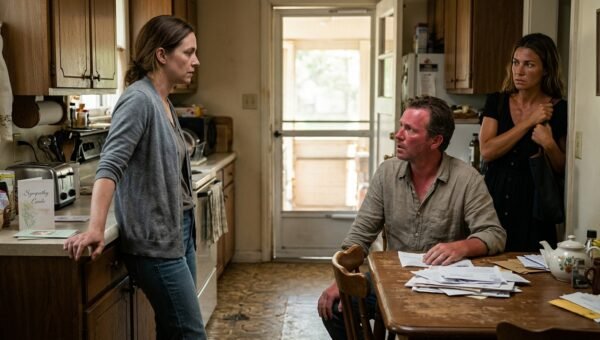
The morning after her service, I was standing at my kitchen sink rinsing my coffee cup when someone knocked hard on my front door.
I dried my hands on a dish towel and opened it. A man in a dark grey suit and wire-rimmed glasses stood on my porch, holding a worn black leather briefcase.
“Katherine Miller?” he asked.
“Yes,” I said. “Can I help you?”
“My name is Arthur Vance. I was your sister Lauren’s attorney,” he said, reaching into his coat pocket to pull out a business card. “I was instructed to deliver something directly into your hands the day following her interment. I need you to sign an acknowledgment of receipt.”
I stared at him. “I didn’t attend the service. I have nothing to do with her estate. Greg is her husband. Give whatever it is to him.”
“Mr. Miller does not know about this,” Mr. Vance said quietly. “In fact, Lauren’s specific instruction was that this be handed to you alone, with no other family members present.”
He reached into his briefcase and produced a thick, legal-sized manila envelope. Across the front, my name was written in Lauren’s familiar, left-leaning script. Below my name, she had pressed a strip of clear packing tape across the sealed flap, signing her name over the edge in black ink.
I told him I didn’t want it. He stood on the porch, his eyes tired, and said, “Mrs. Miller, I don’t know your history, but I drew up these documents under her direct supervision two months before her delivery. She paid me out of her personal savings account to ensure they reached you. If you throw them away, that is your choice. But my obligation ends once you sign.”
I signed the slip of paper on his clipboard just to get him off my porch.
I took the envelope to my dining table and sat down. For nearly an hour, I didn’t touch it. It sat between the salt shaker and a bowl of fresh fruit, looking unnatural in my tidy house. Eventually, curiosity won over pride. I took a kitchen paring knife, slit the top seam, and turned it upside down.
A handwritten letter folded twice fell onto the wood, along with a certified bank check for thirty-six thousand dollars made out to Katherine Miller, and a flat brass safe deposit key tagged with a five-digit number.
PART 2
The certified check sat on the table between the key and the letter. Thirty-six thousand dollars was not an accidental number. Eighteen years ago, when the divorce finalized, Greg had fought me tooth and nail over the equity in our starter home. The court had awarded me fifty percent of the appraised value, but Greg claimed he had sunk his own inheritance into the foundation and forced a settlement that left me with exactly thirty-six thousand dollars less than my rightful half. I had walked away from that money because staying in that courtroom felt like drinking poison every morning.
Lauren had known that number. She had sat in the back row of the family court during the preliminary hearing.
I picked up the handwritten letter. Her handwriting was shaky, the ink slightly bled in places as if her hand had been trembling against the paper.
“Katherine,” it began.
“If you are reading this, I didn’t make it through the birth. Dr. Chen told me three months ago that my heart condition made a full-term delivery high-risk, but Greg insisted we try for a biological child after two failed adoptions. He wanted an heir. He always wanted to control the line of everything.
“I know you hate me. You have every right to hate me. You think I stole your life that afternoon. But you need to know why I was in that bedroom, and you need to know what Greg did before you even walked in the front door.
“The brass key belongs to Box 412 at First State Bank on Elm Street. The box is registered under my maiden name, Lauren Davis, with you listed as the secondary authorized signer. I updated the bank records six months ago. Inside, you will find Greg’s personal business journals from the year you were married, along with the real estate transfer deeds from his late uncle’s company.
“You thought Greg loved me. He never loved me, Katherine. He used me to keep you from digging into his uncle’s estate. Please, go to the bank before Greg realizes the box exists. He has already filed for an emergency audit of my personal accounts.”
My fingers were stiff as I folded the paper back along its creases. The air in my dining room felt thin. For eighteen years, my hatred had been simple: my husband had chosen my sister, and my sister had betrayed me for my husband. It was an ugly, standard domestic disaster. It was painful, but it was clear.
Now, her letter was muddying the water.
I drove down to First State Bank on Elm Street that afternoon. The bank was an old stone branch with heavy brass fixtures that hadn’t changed since I was a teenager. I asked for the safe deposit department and handed the clerk my driver’s license and the brass key.
The woman checked the computer system, nodded, and led me into the vault. She slipped her master key into the upper slot, turned my key in the lower slot, and pulled out a long metal drawer. She carried it to a private viewing booth, placed it on the desk, and shut the door behind her.
Inside the metal box were three bound black ledgers, a manila folder filled with county land filings, and an audio cassette tape with the date October 14 written across the label in black marker.
I opened the top ledger. It was written in Greg’s neat, aggressive hand. On page after page, he had logged payments, property transfers, and dates from the six months leading up to our divorce.
I skimmed the dates until I reached July 8, five days before I caught them in my bedroom.
There was an entry in Greg’s handwriting: “Katherine asked about Uncle Raymond’s land holdings in Fayette County. Told her Raymond is broke and the land is tangled in tax liens. If she gets suspicious and files for discovery during a standard split, the commercial zoning rezoning goes public before probate closes. Must force an immediate, no-fault exit where she walks away without looking at the books.”
I read the line twice.
Eighteen years ago, Greg’s wealthy, eccentric uncle Raymond had been in hospice. Greg had told me repeatedly that the old man had lost everything in bad speculative oil ventures, leaving behind only debts. I had believed him completely. I hadn’t asked questions because I was working fifty hours a week to cover our grocery bill while Greg managed his family’s affairs.
I opened the manila folder. The land filings showed that Uncle Raymond hadn’t been broke. He had owned four hundred acres of prime commercial-grade highway frontage in Fayette County. In June of that year, Raymond had signed a power of attorney naming Greg as his representative. Two weeks later, Greg had transferred the parcels into a shell LLC registered under his own name, hiding the transfer before Raymond died.
If I had divorced Greg normally, my attorney would have demanded a full forensic accounting of his holdings. But if I caught him in my own bed with my own sister, I would run. I would sign whatever separation agreement got me away from him fastest.
I stared at the black ledger on the metal desk. The betrayal hadn’t been passion. It had been an exit strategy.
PART 3
I sat in that small bank booth for nearly two hours, going line by line through the county deeds and the second ledger.
The second ledger belonged to Lauren. Her entries started five years after my divorce, right after she married Greg. She had documented his phone calls, his bank transfers, and his threats. In an entry dated four years ago, Lauren wrote:
“He told me last night that if I ever reached out to Katherine, he would produce the signed promissory notes from our father’s business debt and foreclose on Mom’s house. He owns the debt. He bought the note from the county bank through his LLC ten years ago. He keeps Mom’s roof over her head as a leash on me. He made me go to that bedroom eighteen years ago. He told me he was helping Katherine pay off a secret medical loan, told me to come help him move the paperwork out of her dresser. Then he grabbed me as she opened the front door. He timed it. He heard her car pull into the driveway.”
My stomach turned over completely. I leaned against the cold metal edge of the desk, my breathing loud in the confined space.
All those years, my mother had told me to forgive. She had told me Lauren was weak, that family was complicated, that we needed to make peace. My mother hadn’t known Greg held the deed of trust on her home. Greg had used our father’s old business failures to keep my sister terrified and silent, dangling their marriage and our mother’s shelter over Lauren’s head while he developed the Fayette County commercial parcels into millions.
I packed the ledgers, the deeds, and the audio tape back into my purse, locked the empty metal box, and left the bank.
I didn’t call my mother. I didn’t go home.
I drove straight to the address Lauren had listed in her letter: a brick colonial on two acres in the northern suburbs. Greg’s house.
His silver sedan was parked in the circular driveway. Through the large front bay window, I could see two moving boxes stacked near the door.
I got out of my car, walked up the brick steps, and pressed the doorbell.
The door opened after a few moments. Greg stood there. He was sixty-one now, his hairline receded, his frame thicker around the middle, wearing a dark polo shirt and reading glasses. When his eyes focused on my face, he took a half-step back, his hand freezing on the doorknob.
“Katherine?” he said. His voice was rough. “What are you doing here?”
“We need to talk about Lauren,” I said.
He rubbed his forehead, his face shifting into a rehearsed expression of weary grief. “Katherine, look, I know you didn’t come to the funeral. I understand why. You were bitter for a long time. But right now isn’t a good time. Lauren’s gone, and I have a newborn daughter inside with a private nurse. I’m trying to pack Lauren’s things.”
“The thirty-six thousand dollars,” I said, looking him dead in the eye. “Did you think she wouldn’t pay it back?”
The tired look vanished from his face. His jaw set. “What are you talking about?”
“Box 412 at First State Bank,” I said. “I have the Fayette County property records from July eighteen years ago. I have your personal ledger where you wrote that you needed to force an immediate exit so my lawyer wouldn’t see Raymond’s commercial rezoning.”
Greg’s hand dropped from the door frame. His eyes darted past me, checking the quiet suburban street, before narrowing at my face.
“Those are private papers,” he said, his voice dropping an octave, completely stripped of any grief. “Lauren had no legal right to touch my safe deposit box. That box is part of her marital estate, and as her surviving spouse, everything in it belongs to me. Give them to me right now, Katherine, or I will call the sheriff.”
“Call him,” I said. “The safe deposit box was registered under Lauren Davis before she married you, and I am the primary co-signer on the account. Arthur Vance filed the transfer documents with the county probate office at nine o’clock this morning. It’s already in the state court registry.”
Greg took a step forward onto the porch, his face reddening. “You think you can come here and threaten me? That divorce was settled eighteen years ago. The statute of limitations on property division in this state is three years. You have zero claim to Fayette County. Not one dime.”
“I don’t care about Fayette County,” I said. “I don’t want your commercial strip malls, Greg. But Lauren left a will. Arthur Vance has the original, executed two months before she delivered.”
Greg went completely still. “Lauren didn’t have an attorney.”
“She did,” I said. “And because you had her sign a post-nuptial agreement five years ago to protect your assets from any divorce, she retained sole testamentary power over her independent bank accounts and her personal property. In that will, she named me as the sole legal guardian of her daughter, Clara.”
A faint cry drifted from an open upstairs window.
Greg stared at me, his chest rising and falling heavily. “You’re lying. No judge will hand a newborn infant to an estranged sister who hasn’t spoken to her in nearly two decades.”
“A judge will hand an infant to an aunt when the deceased mother’s sworn affidavit includes twenty pages of documented financial extortion, physical intimidation, and a certified copy of the deed of trust you used to threaten our mother’s home,” I said. “Mr. Vance is filing the emergency guardianship petition at the county courthouse tomorrow morning. If you contest it, every single page of your uncle’s probate fraud and your property ledgers goes into the public record.”
Greg’s mouth opened, but nothing came out. The arrogance that had carried him through eighteen years of quiet control seemed to leak out of him. He knew the Fayette County deals were built on fraudulent transfers. He could survive losing custody of a child he had viewed only as an asset, but he could not survive a forensic audit from the state attorney general’s office.
“She planned this,” Greg whispered.
“She knew you,” I replied. “That was your mistake. You thought she was just quiet.”
ENDING
I walked down his front steps, got back into my car, and drove away. He didn’t follow me. He stood on the porch until I turned the corner, watching my taillights.
The next forty-eight hours were a blur of legal filings, notarized forms, and quiet conference rooms. When Arthur Vance presented the documentation to the family court judge, Greg’s attorney did not file an objection. By Friday afternoon, a temporary custody order was signed, granting me full physical and legal care of baby Clara, with Greg relinquishing parental rights in exchange for a sealed settlement regarding the historical estate documents.
He kept his commercial money. He kept his brick house. But the deed of trust on my mother’s home was formally canceled and recorded as fully satisfied at the county clerk’s office.
I drove to my mother’s house on Sunday morning.
The house was small, with peeling paint around the porch railings and overgrown hydrangeas near the driveway. My mother opened the door leaning on her metal walker. She had aged twenty years in the time I had been away; her hair was entirely silver, and her shoulders were curved inward.
When she saw me standing there, her eyes filled with water. She reached out a shaking hand, her fingers catching my sleeve.
“Katherine,” she breathed. “You came back.”
“I’m here, Mom,” I said.
I didn’t bring up the years of silence. I didn’t blame her for begging me to make peace when she had been living under the terror of losing her home. I walked inside, sat on the faded sofa where my father used to read the evening paper, and placed the certified deed release on the coffee table in front of her.
“Greg doesn’t own this house anymore,” I told her. “It’s yours. Completely free and clear.”
She stared at the legal stamp on the paper, her hands trembling as she touched the raised county seal. She didn’t ask how it happened. She just buried her face in her hands and let out a long, shuddering breath that sounded like eighteen years of held air.
Two days later, the social worker brought Clara to my house.
She was seven pounds, with a shock of dark brown hair and wide, slate-grey eyes that looked around my quiet living room without blinking. I had spent the weekend setting up a white wooden crib in the spare bedroom that used to hold my filing cabinets and tax records.
I sat in the rocking chair by the window, holding the baby against my chest. Her head was warm, resting right over my collarbone, her tiny hand curled into a fist against my sweater.
On the dresser across the room, Lauren’s handwritten letter was folded neatly beside the brass safe deposit key.
For eighteen years, I had believed that walking away was the strongest thing I had ever done. I had built an entire identity around my pride, wearing my coldness like a suit of armor, convinced that refusing to forgive made me untouchable.
I looked down at Clara’s sleeping face. She looked so much like Lauren did when we were girls, sharing a bedroom under the eaves of our parents’ old house.
I hadn’t saved my sister. I had been too angry to see through the trap Greg had laid for both of us. But Lauren had saved her daughter, and she had trusted me to finish what she couldn’t.
I adjusted the edge of Clara’s blanket and began to rock.B