PART 1
Fourteen years of marriage ended on a Tuesday evening over two boxes of kitchen glasses and a half-empty bottle of bourbon.
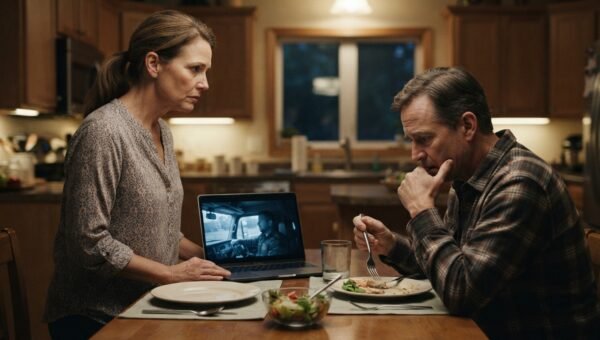
Mark sat across our oak dining table, his coat already zipped, his phone vibrating against the wood every forty seconds. He was forty-nine then, five years younger than me, and had just landed a senior regional vice president title at an logistics firm after eight years of being passed over.
I had spent those eight years packing his lunches, proofreading his presentations until two in the morning, and covering our mortgage out of my salary as an assistant high school principal whenever his commissions hit a slump.
“I don’t hate you, Sarah,” he said, staring at the salt shaker between us. “You just don’t fit the room anymore. When I walk into dinner with the partners, I need someone who matches my status now.”
His exact words. Not shouted. Not delivered in anger. Just said with the quiet, flat cruelty of a man reviewing an outdated balance sheet.
Three days later, I found out who was supposed to match that status. Her name was Amber. She was twenty-seven, worked as a marketing coordinator at an affiliated vendor, and wore pristine cream-colored linen blazers. Mark rented a high-rise loft downtown, leased a German sports sedan he could barely afford the payments on, and told our mutual friends that he had finally stopped settling.
I did what any prideful woman in her fifties does. I didn’t beg. I hired a decent attorney, split the equity on our colonial house down the middle, took my name off his car loan, and moved into a small brick townhouse twenty minutes away. I cried in the shower where the pipes were loud enough to drown it out, and I showed up to work every morning at seven sharp with my hair neat and my posture straight.
For five months, I heard nothing from him directly. Friends told me snippets I didn’t ask for. Mark was hosting cocktail parties. Mark was traveling to conferences in Miami. Mark was buying expensive watches on company expense accounts.
Then, five months almost to the day after he walked out, my cell phone rang while I was grading substitute teacher lesson plans at my kitchen island.
It was an intake social worker from St. Jude Memorial Hospital.
“Mrs. Vance?” she asked.
“I’m his ex-wife,” I said automatically. “We’ve been divorced two months.”
“I understand,” the woman said, her voice dropping into that careful, rehearsed tone hospital staff use when they have bad news. “His emergency contact paperwork still had your cell listed.
Mr. Vance was admitted forty-eight hours ago with severe jaundice and abdominal swelling. His condition deteriorated rapidly. He has acute hepatic failure secondary to aggressive neuroendocrine carcinoma. He’s confused, and there is no one else here.”
“What about Amber?” I asked. The name felt sour on my tongue.
There was a brief pause on the line. “A young woman came in with the ambulance on Sunday night. She left his wallet and insurance card at the desk, took his car keys, and signed out of the visitor log about an hour later. She hasn’t returned, and the number she left is disconnected.”
I stood by my kitchen sink for a full five minutes, staring out at the small square of grass in my new yard. He had tossed fourteen years in the trash for an accessory. He had told me to my face that I wasn’t good enough for his shiny new life.
Every instinct of modern self-help told me to hang up the phone, block the number, and let the state take over his care. He made his bed; let him lie in it.
Instead, I picked up my purse, grabbed my keys, and drove forty-five minutes across town in the pouring rain.
When I walked into room 412, the man lying under the thin hospital blanket didn’t look like an executive. His skin had the yellow tint of old paper. His cheeks were hollow, his eyes glassy and terrified. When he saw me step through the doorway, his mouth trembled. He didn’t say anything about status. He reached out one shaky, bruised hand, hooked his fingers into the sleeve of my cardigan, and began to weep.
She hadn’t just walked out. Amber had emptied the downtown apartment of her clothes, taken the jewelry he bought her, and left him on the floor of their bathroom when he collapsed from internal bleeding. He had no siblings. His parents had been gone for ten years.
He had no one in the world except the woman he threw away.
PART 2
The oncology team was blunt. The cancer had already spread to his liver and bones before he ever had his first symptom. There were no miracle trials, no surgical options. The only path forward was palliative comfort care.
The hospital needed to discharge him within ten days. The lease on his downtown loft had defaulted two weeks prior because he had stopped paying rent, and his corporate health insurance was set to lapse under an unpaid cobra grace period.
I didn’t move him into my home. I wasn’t a saint, and I had boundaries that kept me from losing my own sanity. But I used my savings to secure a private room in a clean, quiet hospice facility four miles from my school. I spent my lunch breaks sitting in the armchair beside his bed, making sure his morphine pump was calibrated, making sure the nurses turned him every two hours, and answering his confused questions when the hepatic toxins made his mind drift back to our early years together.
“Did we pay the gas bill, Sarah?” he would mumble at three in the afternoon, his eyes fixed on the ceiling tile.
“It’s paid, Mark. Go to sleep,” I would tell him.
In his clearer moments, the shame ate him alive. He tried twice to apologize, his voice weak and raspy. Both times, I held up my hand and stopped him. I didn’t want a deathbed speech. A dying man’s regret is easy because he doesn’t have to live with the daily work of fixing what he broke. I wasn’t there because I loved him like a husband anymore. I was there because fourteen years of sharing a life means you don’t let a human being die alone like an abandoned animal in an alley.
Three months after his diagnosis, Mark slipped into a coma. Two days later, on a chilly Thursday morning, he took his last breath while I sat in the corner chair reading the local school board minutes.
The funeral was small. Four people from his old office attended out of polite obligation, stayed for ten minutes during the visitation, and left before the service started. I paid the funeral director $4,200 from a small joint savings account we had never officially closed out during the divorce settlement.
I stood by the casket at the graveside, holding a single white carnation, listening to the minister read Psalm 23 over the sound of highway traffic in the distance. The cemetery workers were standing forty yards away under an awning, waiting for us to leave so they could lower the vault.
That was when gravel crunched behind me.
I turned around. Amber was walking across the grass.
She wasn’t wearing her linen blazers or office heels. She wore an oversized dark trench coat, flat shoes, and large sunglasses, though the sky was gray and overcast. Her hands were clutching a dark green cardboard storage box, roughly the size of a shoebox, taped securely along the seams with yellow packing tape.
I stiffened. My first thought was that she had come to cause a scene or ask about his life insurance.
She stopped about four feet away from me. Her face was pale, devoid of makeup, and her hands were shaking so hard that the cardboard box rattled.
“I know I have no right to be here,” she whispered, her voice barely carrying over the wind. “I’m not staying. I just… he told me to hold onto this when he first got sick, before he went to the hospital. He made me swear I would never give it to you while he was breathing.”
She held the box out toward me like it was burning her fingers.
“Why didn’t you stay with him?” I asked, keeping my voice as flat as stone. “You wanted his status.”
Amber looked down at her shoes. “He didn’t have any status, Mrs. Vance. He didn’t have anything. He was drowning. He told me he left you because he couldn’t stand you watching him fail.”
She thrust the box into my hands, turned around without looking at Mark’s casket, and practically ran back toward a battered sedan idling near the cemetery gates.
PART 3
I carried the box to my car, set it on the passenger seat, and drove straight home.
I didn’t open it immediately. I hung up my coat, boiled water for tea, and sat at my kitchen table for an hour, just watching the dull green cardboard sit in the late afternoon light. The tape across the lid was thick industrial adhesive.
Finally, I retrieved a utility knife from the junk drawer, slit the tape on three sides, and lifted the lid.
Inside were four thick, organized folders, two small plastic flash drives, and a handwritten ledger book bound in black imitation leather. Tucked right on top was a sealed white envelope with my name written in Mark’s precise, slanted handwriting.
My hands remained steady as I pulled out the top folder.
It was labeled in red ink: *Personal Debt and Guaranty Audits.*
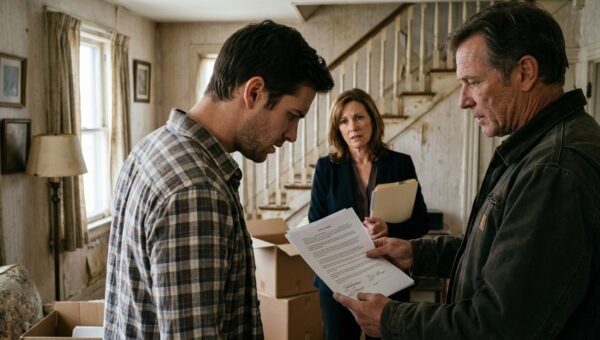
I opened it and began reading the dates and figures. The first document was a formal notification of audit from his employer’s corporate compliance board, dated seven months prior to our divorce. Mark had not received a triumphant promotion; he had been placed on administrative probation for unauthorized expense padding and questionable contract commissions totaling $164,000.
The second document was an unsecured personal promissory note from an aggressive private lender for $85,000, bearing Mark’s sole signature, with an interest rate of nineteen percent.
The third document was a demand letter from a collection agency threatening to place a lien against any real property registered in his name. The date on that letter was exactly three weeks before he sat across our dining table and told me I didn’t fit his new life.
I pulled out Mark’s letter and opened it.
“Sarah,” the letter began. “If you are reading this, I am gone, and Amber finally did the one thing I begged her to do when the hospital called.
You always thought I was smarter than I was. When the corporate office started the internal review last fall, I knew the house was coming down. The debts weren’t from gambling or bad investments; they were from six years of me borrowing from tomorrow just to look like the provider you deserved. Every bonus I bragged about was half-spent before it cleared.
When the audit turned into an investigation, I knew what was coming. If we stayed married, our house, your teacher retirement pension, and the equity you worked thirty years to build would have been dragged into the civil recovery actions. The lenders were already circling our joint titles.
I couldn’t tell you the truth. If I told you, you would have emptied your retirement account to save me, just like you always did. You would have sold your mother’s jewelry. You would have gone down with the ship to be loyal.
So I made myself a villain you could hate.
I hired Amber to play a role at first. She was twenty-seven, broke, and drowning in student loans. I paid her two thousand dollars out of my remaining cash to show up at the firm dinner, act like my girlfriend, and give you a clean, unforgivable reason to file for an immediate contested divorce. It got out of hand when the rumors spread, and God help me, a sick part of my ego liked that people thought I was on top of the world. But the legal goal never changed: get your name off every title, force the split of the house equity so you took your cash out clean before the liens hit, and make sure you despised me enough that you wouldn’t sign a single paper guaranteeing my debts.
The flash drives contain the full accounting of my private accounts and the formal releases. The firm agreed to settle out of court for the return of my remaining stock options. The lenders cannot touch a single dollar of your divorce settlement or your home. It is all documented. You are safe.
I never deserved you sitting by that bed. Amber told me you were there. Every time I looked at your face in that room, I wanted to tell you. But I knew if you knew before I died, you would try to carry the financial mess I left behind.
Forgive me for the words I used at the table. I needed them to stick.”
ENDING
I sat at the table until the sunlight faded completely from the kitchen, the papers spread around my teacup like legal exhibits.
The anger did not disappear. It simply changed shape.
Mark had spent his entire life terrified of looking small. In the end, he had chosen to be remembered as a shallow, selfish adulterer rather than admit to his wife that he was a failure who had ruined himself. He thought he was being a martyr, but it was just the final, desperate act of a man whose vanity was so massive he couldn’t bear to be pitied while he was alive.
He had protected my money. That was true. The binders contained official lien dismissals, signed indemnifications, and certified copies showing the house equity transfer had cleared three months before the creditors filed their joint claims. He had built a fortress around my financial security using his own destruction as the shield.
Yet he had also stolen six months of truth from me. He had made me grieve a betrayal that was partly a staged play, forcing me to swallow the humiliation of being discarded for someone younger, all to manage his own shame.
Two weeks later, I drove down to the county records office. I handed the clerk the notarized release forms and watched her stamp the final discharge on our former property title. I walked out into the cool morning air, holding the stamped receipt.
On my way back, I stopped at the cemetery.
The grass had not yet grown over the fresh dirt above his vault. There was no headstone yet; the bronze marker I had ordered wouldn’t be ready until spring.
I stood there for a few minutes, listening to the wind rustling the bare branches of the oak trees along the fence line. I didn’t cry, and I didn’t offer a grand speech to the ground.
“You were an idiot, Mark,” I said softly to the quiet air.
Then I turned around, got back into my car, drove home to my quiet townhouse, and began fixing my dinner.