PART 1
The call came in at twenty past three on a Thursday afternoon while I was folding laundry in our utility room. It was my husband, Mark. His seven-year-old Ford pickup had sputtered out on the shoulder of Route 62 just outside the commercial park where he worked as an installation supervisor for an industrial air filtration company. He told me the transmission was grinding, smoke was coming off the radiator, and he needed a ride home before the evening traffic backed up across the river bridge.
My own car was up on jack stands in our driveway. Our neighbor Jim had offered to replace my rear brake pads that evening to save us the two hundred dollars in labor that the dealership wanted. With both our vehicles out of commission, I called the only person I knew who lived three streets over and worked at the same facility: his longtime coworker, Greg Miller.
Greg was already stuck on an emergency service call down in Canton, but his wife, Kelly, answered their home phone. Kelly and I had known each other for eight years through annual company picnics and Christmas bowling parties. She was a warm, chatty woman of fifty-two who never met a stranger. She told me she had the afternoon off from the public library and would gladly lend me her blue Buick Enclave to run down to the commercial park. In fact, she insisted on riding along so we could catch up while the roads were quiet.
I climbed into Kelly’s passenger seat around quarter to four. The cabin smelled like fresh vanilla air freshener, and the heated seats warmed the chill out of my lower back. We chatted easily about the rising cost of groceries, our adult children who had moved out of state, and how fast the summer had slipped away.
We were waiting at the red light by the bypass when Kelly turned down the radio, glanced over at me with a wide grin, and nudged my arm.
“Enjoy Hawaii! Forty-two hundred dollars for a week is an amazing deal,” she said, shaking her head in admiration. “Especially with hotel rates through the roof in Maui right now.”
I sat completely still. My hands stayed resting on my purse in my lap. I looked at her profile, waiting for the punchline of a joke I did not understand.
“Hawaii?” I asked. My voice sounded flat and unfamiliar in my own ears.
Kelly laughed, thinking I was just being modest. “Oh, don’t be coy with me, Diane. Greg came home yesterday evening and told me all about it. He said Mark was showing the guys on the loading dock the confirmation screen on his phone during the afternoon break. Greg said Mark booked the tickets yesterday. He told the guys you two were finally getting away after all these years.”
The red light turned green. Kelly pressed the accelerator, and the Buick moved forward into the intersection.
I could hear the tires humming against the asphalt, but my head felt entirely hollow. Mark and I had not traveled in twelve years. The last time we had left Ohio for more than a weekend was back in 2014, when we drove four hours south to visit my sister in Kentucky for our twentieth anniversary. For the last five years, every single conversation about money had been an exercise in belt-tightening.
Whenever I mentioned fixing the drafty basement window, Mark would sigh, rub his temples, and remind me that his company was cutting back on overtime. Whenever the refrigerator started groaning or my winter coat wore thin at the elbows, he would pull out our worn leather checkbook and tell me we had to protect our emergency savings. I had clipped coupons, bought store-brand canned vegetables, and stretched three chicken breasts into four nights of soup because I believed we were building a secure retirement together.
“He told Greg he booked it yesterday?” I managed to say, keeping my eyes fixed straight out the windshield.
“Yes, yesterday around lunch,” Kelly said, still smiling. “Greg said Mark was practically beaming. He told everyone you had been working so hard and that it was high time you had some sunshine.”
We pulled into the gravel lot of the air filtration plant five minutes later. Mark was standing on the curb beside his dead truck, holding his lunch cooler and his hard hat. He opened the rear door of the Buick, tossed his gear on the floorboards, and climbed into the back seat, complaining loudly about the repair estimate the tow driver had quoted him over the phone.
I watched him in the rearview mirror. His face looked completely normal. He complained about the truck alternator, kissed the top of my head from behind the headrest, and thanked Kelly for saving him a three-mile walk. He did not say one word about flights. He did not say one word about beaches, tickets, or four thousand dollars.
I stayed silent during the entire eight-minute drive back to our subdivision. When we pulled into our driveway, I thanked Kelly, walked inside, and immediately unlocked my laptop at the kitchen table.
I logged into our joint checking account at Farmers and Merchants Bank. I scrolled back through three weeks of transactions. There was no charge for forty-two hundred dollars. There was no charge from any airline, travel agency, or booking portal. The account balance sat at $3,142.18, right where it had hovered all month.
Then I heard the aluminum flap of our roadside mailbox snap shut out front. The mail carrier had just dropped the afternoon delivery.
I walked down the concrete walk, pulled the small stack of envelopes from the box, and sorted through them as I walked back toward the porch. There was an electric bill, a grocery circular, an insurance notice, and a thick, heavy envelope from a national credit card company I had never seen before.
It was addressed solely to Mark Vance.
Through the clear plastic address window, a bold statement summary was visible. It showed a new account opened eight days prior, an available credit limit of ten thousand dollars, and an initial transaction posted the previous morning: a charge of exactly $4,200.00 from Hawaiian Airlines.
My knees felt like water. I stepped inside the front door, walked straight into the guest bedroom, and closed the door. I pulled my cell phone from my pocket and dialed the customer service number printed directly on the front of the paper billing summary.
I navigated the automated phone tree until a live reservation agent came on the line. I kept my tone crisp, professional, and hurried.
“Good afternoon,” I said, pitching my voice into a brisk office tone. “This is Karen, executive assistant to Mark Vance. I am confirming his departure details and seat selections for his upcoming corporate schedule, but his calendar invite seems corrupted. Could you please pull up his booking under confirmation code 8-F-4-K-2-9 and read me the passenger manifest on file?”
The agent tapped on her keyboard for fifteen seconds.
“Yes, of course, Karen,” the agent said. “I have the record right here. Two first-class round-trip tickets from Cleveland to Kahului Airport in Maui, departing next Tuesday morning on flight 408. Primary passenger is Mark Vance, seat 2A.”
I gripped the wooden edge of the dresser until my knuckles turned white.
“And the second passenger?” I asked, keeping my voice perfectly level. “Just to verify my records.”
The agent read the name without hesitation. “Seat 2B is assigned to Chloe Adams.”
PART 2
The name Chloe Adams echoed in my head like an electric shock.
Chloe was twenty-eight years old. She had been hired eighteen months earlier as the administrative scheduling clerk for Mark’s commercial installation department. Two years ago, when her mother had been hospitalized with pneumonia around the holidays, I had personally baked three casseroles and sent them to work with Mark so Chloe would not have to worry about cooking after long shifts. Last November, when she had no family in town for Thanksgiving, I had set an extra place at our dining table, served her roast turkey on our best china, and listened to her talk about how difficult it was to start over in a new town.
I stood in that quiet guest bedroom with the phone pressed to my ear, listening to the faint hum of the air conditioner. The agent was still on the line, asking if my employer required special meal requests or airport wheelchair assistance.
“No, thank you,” I told her, keeping my voice as steady as concrete. “Everything is perfectly clear now.”
I hung up, folded the credit card statement, and slipped it deep into the zippered pocket of my purse.
For thirty years of marriage, I had been the woman who avoided scenes. When Mark lost his temper over a burnt roast or a late water bill, I lowered my voice. When he insisted that we could not afford a new mattress even though my lower back ached every morning, I bought a foam topper from the clearance bin and told myself he was just being prudent. But sitting on that guest bed, looking at the dust motes floating in the afternoon sun, the sadness inside me did not turn into tears. It turned into cold, deliberate arithmetic.
I did not march into the living room and scream. A woman who screams gives her opponent time to make excuses, delete text messages, and hide bank accounts.
I waited until Mark took a shower to wash off the road grime from his truck breakdown. The second I heard the bathroom pipes rattle and the water start running, I walked down the hall, out through the kitchen, and into his garage workshop.
Mark kept a heavy steel Craftsman tool chest in the corner beside his workbench. The top three drawers were filled with wrenches and sockets, but the bottom drawer was locked with a small brass padlock. Mark always told me that drawer held sensitive company blueprints and specialty calibration tools that belonged to his employer.
I did not need to search for the key. I had watched him put it away for twenty years. I reached up to the high wooden shelf above his radial arm saw, moved an empty glass jar of drywall screws, and felt the small steel key resting in the dust.
I knelt on the cold concrete floor, slipped the key into the lock, and pulled the bottom drawer open.
There were no company blueprints inside.
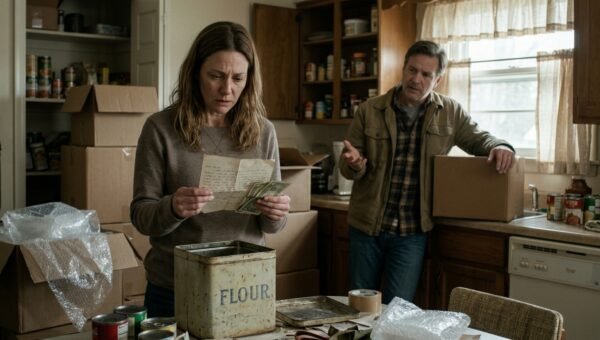
Sitting inside the metal compartment was a green plastic accordion folder. Inside that folder was an entire second life.
There was an active passbook for a private savings account at a commercial bank in downtown Akron, opened ten months ago in Mark’s name only, showing a balance of $18,400. There was a signed document from his human resources department dated six months back, showing he had taken a $35,000 hardship loan against his 401(k) retirement balance, claiming the funds were needed for urgent residential foundation stabilization.
Right beneath the bank statements lay a glossy blue receipt from a high-end jewelry store at the regional mall. The receipt was dated three weeks ago: one fourteen-karat white gold diamond pendant, total cost $1,850, signed by Mark Vance.
Beside the receipt was a printed reservation confirmation for seven nights at an oceanfront villa in Wailea, Maui. Total package price: $5,600, with a fifty-percent deposit already cleared. The arrival date was next Tuesday, the exact day of the first-class flight.
My husband had not just bought two plane tickets. He had spent months systematically draining our future, taking loans against our retirement, and building a luxury romance with a woman twenty-four years his junior, all while telling me that replacing the rusted exhaust pipe on my sedan would ruin our monthly budget.
I pulled out my phone and took clear, well-lit photographs of every single document: the 401(k) loan, the private bank balance, the jewelry receipt, the Maui villa booking, and the credit card contract. I took pictures of the account numbers, the dates, and the signatures. Then I carefully replaced every sheet of paper, shut the green folder, locked the drawer, and put the small steel key right back behind the jar of screws.
When Mark came out of the bathroom with a towel around his neck, smelling of pine soap, he found me at the kitchen stove stirring a pot of tomato soup.
“Truck is officially shot,” he grumbled, leaning against the counter and rubbing his forehead. “Mechanic says the transmission needs a total rebuild. Looking at three thousand dollars, easy. We are going to have to cut our spending down to the bone for the next six months, Diane. I mean it. No extras.”
I looked him dead in the eye, gave him a small, placid smile, and handed him a bowl of soup.
“Of course, Mark,” I said. “We will do whatever it takes to protect the household.”
PART 3
At eight o’clock on Friday morning, while Mark was getting a ride to work with another crew member, I sat in the downtown office of Victoria Vance, no relation to us, a senior family law and divorce attorney who had handled asset division cases in our county for twenty-six years.
Victoria was a no-nonsense woman with sharp silver-rimmed glasses and a reputation for tearing hidden marital accounts to shreds. I laid my phone on her polished desk and showed her the photographs of the 401(k) loan, the secret Akron bank account, the jewelry invoice, the Maui villa, and the Hawaiian Airlines billing statement.
Victoria reviewed the images, her red pen making quick, precise notes on a legal pad.
“This is classic dissipation of marital assets,” Victoria said, looking up with a cool, clinical expression. “Under Ohio law, marital funds spent on a non-marital partner during the breakdown of a marriage must be fully credited back to the innocent spouse during property distribution. He took a thirty-five-thousand-dollar loan from a marital retirement asset without your consent and concealed eighteen thousand dollars in cash.”
She leaned forward, tapping her desk with the end of her pen.
“Do you want to confront him tonight?” Victoria asked.
“No,” I replied, my voice completely steady. “He thinks he is flying to Maui on Tuesday morning. He told me this morning that his company is sending him to an air quality convention in Chicago for four days next week, and that he will be out of cell service during the daytime meetings. I want him to pack his bags. I want him to believe he got away with it right up until the minute he tries to board that plane.”
Victoria smiled, a thin, razor-sharp smile. “Then we follow the rules of precision.”
Over the next seventy-two hours, Victoria and I worked with quiet efficiency.
On Monday morning, Victoria filed an emergency petition for legal separation and divorce in the county domestic relations court, accompanied by a motion for temporary restraining orders freezing all joint financial accounts and prohibiting the transfer or encumbrance of any marital property. The court signed the orders at two o’clock on Monday afternoon.
At the same time, I went to our joint bank branch, withdrew exactly fifty percent of our remaining liquid checking funds into a cashier’s check, and opened an independent account in my name at a completely different credit union across town.
I called Jim, our neighbor, and paid him three hundred dollars in cash to finish replacing my brake pads and install four new tires on my sedan.
On Monday evening, Mark came home whistling. He packed his expensive leather weekender duffel bag, making sure to tuck in his finest linen shirts, two pairs of swimming trunks, and his sunglasses. He told me he was taking an early morning airport shuttle directly from the plant parking lot so I would not have to wake up at four in the morning to drive him.
“You’re a good wife, Diane,” he said, kissing my cheek as he zipped the bag shut. “I will bring you back some Chicago chocolates if I get a free hour near the airport.”
“Have a wonderful trip, Mark,” I said.
At five-thirty on Tuesday morning, Mark loaded his duffel into an airport taxi and pulled away from our curb.
I did not follow him. I did not need to. Victoria had already coordinated with a licensed private process server named Marcus, an off-duty deputy sheriff who knew airport terminal jurisdiction inside and out.
At six-forty-five in the morning, Mark and Chloe Adams were standing at the priority boarding lane for Hawaiian Airlines Flight 408 at Cleveland Hopkins International Airport. Chloe was wearing an ivory sundress and carrying a straw beach bag. Mark had his arm around her shoulder, holding two boarding passes and two large paper cups of premium coffee.
Marcus stepped up beside them in the terminal corridor, held up his identification, and handed Mark a thick, blue-backed legal packet.
“Mark Vance,” Marcus said, loud enough for twenty passengers in the first-class line to turn their heads. “You are hereby served with a summons, a complaint for divorce, and a temporary restraining order issued by the Court of Common Pleas. All credit accounts associated with your name have been placed under formal judicial review for asset diversion.”
Before Mark could even open his mouth, the gate agent at the boarding counter scanned his electronic boarding pass.
The machine let out a loud, harsh double beep. A red warning light flashed on the gate console.
Because Victoria had filed the restraining orders with the bank’s fraud unit on Monday afternoon, reporting an unauthorized secondary credit line opened using joint marital home equity representations, the card issuer had locked the account at midnight. The airline system had flagged the transaction for payment re-verification at the gate.
The gate agent looked at the screen, then looked up at Mark.
“Sir, this booking has been suspended due to a payment dispute from the card issuer,” the agent announced clearly. “These tickets are void. You will need to step out of the boarding line and clear this with customer service.”
Chloe stepped back, her face turning crimson as the surrounding passengers stared.
“Mark, what is going on?” she hissed, looking at the legal papers clutched in his shaking hand. “What did he just hand you? You told me your divorce was finalized last winter!”
Mark dropped his coffee cup onto the terminal floor. The hot liquid splashed across his leather deck shoes as he frantically pulled out his phone and dialed my number.
I was sitting at our kitchen table, drinking a cup of hot black tea and looking out the window at our quiet morning lawn, when his name lit up my screen.
I answered on the first ring.
“Diane!” Mark screamed into the receiver, his voice cracking with hysteria. “What the hell did you do?! The police just served me papers at the gate! They canceled the tickets! Chloe is standing right here! Are you completely insane?!”
“Good morning, Mark,” I said calmly. “Kelly Miller says hello. She was so kind to let me borrow her car on Thursday when your truck broke down. It is amazing how small this town really is.”
The line went dead silent. For five seconds, the only sound was the hollow echo of the airport terminal announcements in the background.
“Diane, listen to me,” he stammered, his arrogance collapsing into pure terror. “It isn’t what it looks like. Let me come home. We can sit down and talk about this.”
“You don’t have a home to come back to today, Mark,” I said. “The locks on the front door, the back door, and the garage were changed an hour ago. Jim did a wonderful job on the deadbolts. Your clothes from the closet have been packed into four plastic storage bins and left neatly under the lean-to shed behind the garage.”
“You can’t lock me out of my own house!” he yelled.
“Victoria Vance says I can, pursuant to page four of the emergency temporary orders,” I told him. “You have sixty days to find your own housing while the forensic accountants review that thirty-five-thousand-dollar retirement loan. Have a safe flight back from Chicago, Mark.”
I ended the call and blocked his number.
ENDING
The divorce proceedings took nine grueling months, but with the digital evidence trail I had captured from his tool chest, there was nowhere for Mark to hide.
The domestic relations judge was ruthless. In the final decree, the court ruled that the thirty-five-thousand-dollar 401(k) loan, the forty-two hundred dollars in airline tickets, the eighteen-hundred-dollar jewelry charge, and the resort deposits constituted intentional dissipation of marital assets. The entire debt was assigned solely to Mark’s liability ledger.
To compensate for the funds he had stolen, the judge awarded me seventy percent of the remaining balance in his employer pension fund, full legal title to our four-bedroom home on Sycamore Ridge with zero equity buyout required, and permanent possession of my sedan with the new brakes.
Mark’s employer was not blind to what happened.
When the company discovered that Mark had falsified a hardship loan application claiming urgent structural repairs to our primary residence, their compliance department conducted an internal audit. They found that Mark had been authorizing unearned overtime pay for Chloe Adams on his department timesheets for eight months.
Two weeks after the airport confrontation, both Mark and Chloe were terminated from the industrial air filtration plant for gross professional misconduct and falsification of company records.
Chloe left town before the leaves finished falling. The romance that seemed so glamorous when paid for with stolen retirement money evaporated the moment Mark became an unemployed, fifty-four-year-old man facing two years of legal bills and credit card collection agencies. She packed her car, moved to an apartment in Columbus, and cut off all contact with him.
Mark was forced to rent a tiny, dark basement efficiency apartment behind an auto parts store in North Canton. With his professional reputation in the industrial filtration business ruined, he had to take an hourly job driving a forklift for an independent lumber yard, earning less than half of his former salary. His broken-down pickup was sold to a salvage yard for twelve hundred dollars to help cover his attorney’s retainer.
Greg and Kelly Miller came over to my house the following spring for a backyard barbecue on my newly repaired patio. Kelly brought a homemade blackberry pie, and Greg helped me trim the overgrown branches along the fence line. The men at the commercial plant had completely frozen Mark out of their circle once the truth about his double life and the phony business trips became public knowledge. Nobody on that crew had any patience for a man who stole from his wife’s future while bragging to the guys on the loading dock.
As for me, I sold our large, four-bedroom house fourteen months after the divorce was finalized. The real estate market was strong, and I walked away from the closing table with two hundred and ten thousand dollars in clean, unencumbered equity.
I bought a charming, two-bedroom brick cottage with a sunporch and a manageable flower garden in a quiet, tree-lined neighborhood near the public library. I paid off my car, set aside a generous emergency reserve in a high-yield account, and took a part-time job coordinating volunteer programs at the local community center.
Last month, on a crisp Tuesday morning in October, I packed a small rolling suitcase, drove myself to the airport, and boarded an airplane.
I did not go to Maui. I flew to Seattle to spend ten days with my daughter, walking along the rocky coastline, drinking coffee in the damp morning air, and watching the ferry boats cross the sound.
I paid for the ticket out of my own checking account, earned from my own peace of mind, and I did not owe a single soul an explanation for the seat beside me.