PART 1
A high school instructor was marking assignments late one evening when she spotted a note from her most attractive yet least hardworking student on his failing physics test.
It was my third cup of black coffee that night, and the kitchen clock had already passed eleven. The red pen felt heavy between my fingers. The paper belonged to Julian Vance, a senior who had drifted through two marking periods on charm, a varsity smile, and barely forty percent attendance.
Across the bottom margin of his kinematics test, right beneath a score of thirty-two, he had scrawled eight words in blue ballpoint: “I’d do absolutely anything to earn a passing mark.” Right beside it, he had drawn a cheeky wink with two quick strokes of the pen.
I stared at that little ink face until my eyes burned. A lot of teachers would have marched straight down to the principal’s office by eight in the morning, waving the paper like a flag. Some would have written a formal referral for inappropriate conduct and washed their hands of him. But I was fifty-four years old, my husband had died three years earlier after a long illness that drained our savings, and I spent my evenings trying to keep an old house from falling down around me. I knew the look of a young person who thought the world was a game of easy smiles and zero consequences.
The following morning, she summoned him to her desk after class, leaned forward, lowered her glasses, and murmured the exact assignment.
“Three o’clock today,” I told him, keeping my voice low so the two girls packing their backpacks near the door wouldn’t hear. “My address is on the slip inside your folder. You bring work gloves and an old shirt. You do not ask questions, and you do not bring your phone into the yard.”
Julian blinked at me. The smirk slipped off his mouth, replaced by a sudden, nervous flicker. “Mrs. Miller, wait. What kind of…”
“You wrote that you would do absolutely anything to pass,” I said, looking him dead in the eye over the wire rims of my glasses. “I am holding you to your word. Three o’clock sharp, Julian. Or that thirty-two goes into the district portal by five.”
He swallowed hard, took the slip, and walked out without a word.
When the final bell rang that afternoon, I drove home to my small bungalow on Elm Street.
My front porch was half-rotted, the gutters were choked with damp pine needles from two seasons of neglect, and the grass had grown knee-high because my shoulder had been giving out every time I yanked the pull cord on the old Briggs & Stratton. I didn’t want a flirt or a slacker. I needed labor, and Julian Vance needed to learn that words have a price.
At ten past three, an old rusted sedan pulled into my gravel driveway. Julian stepped out wearing gym shorts and sneakers that had clearly never seen mud. I didn’t offer him lemonade. I handed him a rake, pointing toward the towering weeds along the side fence.
“Every blade,” I said. “Then the gutters. If you stop before six, the grade stays.”
He worked in stunned silence for three straight hours. He blistered his palms, he cursed under his breath every time a briar caught his forearm, but he didn’t quit.
At six o’clock, I walked out, handed him a cold glass of tap water, and told him to come back Saturday morning if he wanted his make-up packet.
When Saturday rolled around, I woke up early to the sound of a small engine outside. I pulled the living
PART 2
I walked out onto the porch in my slippers, my fingers trembling as I reached down to pick up that envelope.
The paint smell was sharp in the cool morning air. Julian was nowhere in sight, but his car had left two damp tire tracks in the grass near the road. I sat down on the top step, peeling back the flap. Inside was not a note begging for extra credit. It was a folded sheaf of five yellowed invoices, dated from four years ago, each bearing the letterhead of a local auto repair garage: Vance & Son Mechanical.
At the bottom of the invoices was a handwritten tally, followed by a short note written in a clumsy, adolescent script:
“Mrs. Miller, you probably don’t remember, but my dad worked on your husband’s green Dodge truck back in 2022 when Mr. Miller got too sick to drive. Dad never charged him for the transmission rebuild because he said your husband used to let him eat free at the diner your family owned when he was a kid. When Dad passed last winter, I found these open work orders in his desk drawer. He had written ‘PAID IN FULL BY KINDNESS’ across the top. I wrote that stupid note on your test because I felt like a loser who couldn’t even pass a basic class, and I thought if I acted like a clown nobody would notice that I was drowning. The work on your porch wasn’t for the grade. It was to pay what my dad owed your house.”
I pressed the paper against my lap, the ink blurring slightly under the morning light.
Four years ago, my husband David had indeed brought his truck to Vance Mechanical. I remembered David coming home one Tuesday afternoon, looking exhausted from his chemo treatments, saying a quiet man named Tom Vance had refused to take a single dollar for three days of heavy transmission work. David had passed away five months later, and in the blur of medical bills, funeral arrangements, and the slow quiet of grief, that memory had slipped completely out of my head.
Julian’s father had died six months ago of a sudden heart attack. The guidance counselor had sent out a generic staff email about a bereavement in the senior class, but with one hundred and twenty students cycling through my classroom every day, I had simply marked Julian absent for four days and forgotten about it.
I stood up, walked into the kitchen, and picked up my phone. I dialed the number listed on Julian’s school emergency card.
It rang four times before a tired, guarded voice answered. “Hello?”
“Julian,” I said evenly. “You left your tools by my porch.”
There was a long silence on the line. Then a quiet, defensive intake of breath. “I’m sorry about the note on the test, Mrs. Miller. I know it was out of line. You can give me the zero. I don’t care about the grade anymore.”
“I am not talking about the note, Julian. I am talking about your father’s invoices,” I said. “You get back over here. You have ten minutes.”
PART 3
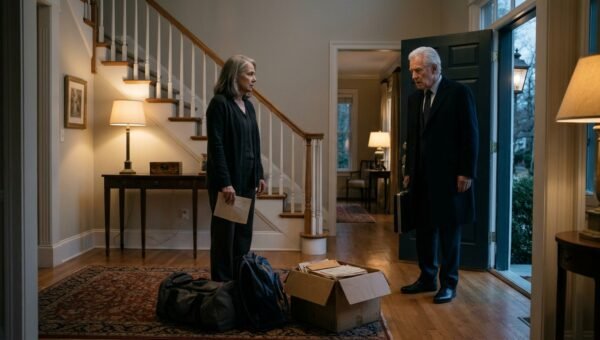
He arrived on foot this time, his hands shoved deep into the pockets of an oversized jacket that had clearly belonged to an older, broader man. His eyes were red-rimmed, and he kept his chin tucked down against his collar as he walked up the freshly painted steps.
I didn’t invite him inside to make him comfortable. I pointed to the bench on the porch and sat down opposite him.
“Your father kept these receipts,” I said, laying the yellow papers on the table between us. “Why didn’t you say something when you failed the midterm last month? Why didn’t you mention his name when you walked into my classroom in August?”
Julian rubbed his knuckles against his jeans. “Because my dad always told me you don’t trade on old favors. He said a favor is something you do because it’s right, not because you want to cash it in later when you mess up. If I told you who I was, you would’ve felt sorry for me. I didn’t want your pity. I just… I couldn’t understand the formulas, Mrs. Miller. Every time I look at those physics problems, my head locks up. My dad was the one who understood how machines worked. He was supposed to teach me the shop. When he died, the bank took the garage, and I realized I didn’t have a trade, I didn’t have grades, and I didn’t have him.”
He wiped his sleeve across his nose, his voice cracking with an anger that wasn’t directed at me, but at the sheer unfairness of his empty hands.
“You wrote that you would do anything,” I said quietly.
“I was being an idiot,” he muttered.
“No,” I replied, standing up and opening the kitchen door. “You were being reckless because you thought nobody was paying attention. But you spent six hours rebuilding my porch steps and sorting David’s tools. That is not nothing. That is work. But it does not buy a high school diploma.”
I reached into my bag and pulled out a fresh, uncreased physics test packet, exactly forty pages long, covering kinematics, thermodynamics, and force vectors from the first twelve weeks of school.
“This is not extra credit,” I told him, setting the thick stack down beside his father’s invoices. “This is every single concept you slept through. You will sit at my dining room table every Tuesday and Thursday from four to six until you can explain to me, in plain English and correct math, how every lever in that garage worked. If you miss one session, the thirty-two goes into the book. If you finish this packet with an eighty or better, I will submit a grade change form for a seventy. A passing mark. Nothing more, nothing less.”
Julian looked at the thick stack of paper, then up at me. The cocky bravado from forty-eight hours ago was completely gone. In its place was something raw, tentative, and honest.
“Why would you do that?” he asked. “I insulted you.”
“Your father fixed David’s truck so my husband could drive himself to radiation treatments with some dignity,” I said. “Now I am going to teach you how force and resistance actually work, so you can walk across that stage in June with yours.”
ENDING
We spent nineteen weeks at that scarred oak table.
Some afternoons were brutal. Julian would sit with his pencil gripped so tightly his knuckles turned white, staring at parabolic trajectories until his eyes watered with frustration. More than once, he threw his pencil down and told me he wasn’t smart enough to get it. Every time he did, I pointed to the window, toward the front yard where the grass was neatly trimmed and the porch railings stood plumb and square.
“You calculated the load-bearing weight of those two-by-fours without even realizing it,” I would tell him. “Now put the numbers on the paper.”
By April, the red marks on his practice sheets began to shrink. He stopped slouching into third-period physics. He didn’t make cheeky jokes from the back row anymore, though he still had that easy grin whenever he managed to balance an equation on the chalkboard before anyone else could find the variable.
On the second Tuesday of June, Julian walked into my empty classroom after the final bell. Graduation was forty-eight hours away. He held an official school envelope in his hand.
He didn’t say a word. He just laid it on my desk, beside my red pens and my grade log.
Inside was a single sheet of paper from the registrar. His final semester average in physics was seventy-two percent. Across the bottom of the form, where the student signature belonged, Julian had written his name in clean, careful cursive. Right beside it, he had sketched a tiny, neat drawing of a wrench.
“I returned your husband’s socket set,” Julian said quietly, shifting his weight by the door. “It’s back in the crate on your porch. Everything’s accounted for.”
“I know,” I said, looking up from the paper. “I checked it this morning.”
He lingered for a second, nodding once with the quiet, measured dignity of a young man who had finally earned his ground. Then he turned and walked down the hallway toward the summer sun.
I picked up my red pen, placed the final transcript into his permanent file, and closed the drawer.