PART 1
My husband slid the divorce papers across the granite counter and didn’t even look down at them. He just smiled.
“You’re no use to me anymore,” Craig said.
Then he tilted his head toward the hallway behind him, where a younger woman stood leaning against the doorframe. “Pack your things. She’s moving in.”
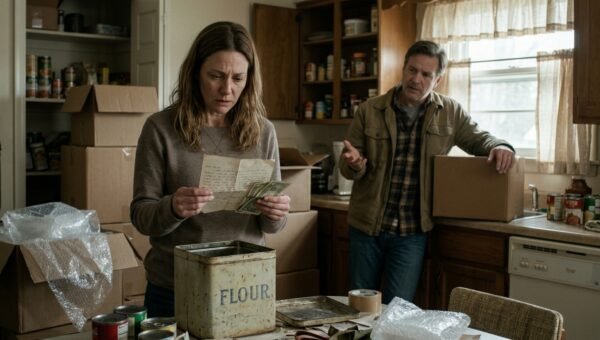
Over by the dining room archway, Craig’s mother, Evelyn, was already taping the bottom of a brown cardboard box.
His father, Arthur, was taking my blue willow plates down from the upper cabinets, stacking them without newspaper between the rims.
I didn’t cry. I didn’t raise my voice. I had spent twenty-six years putting dinner on that table and keeping peace, and I certainly was not going to give any of them the pleasure of watching me break.
Instead, I looked directly at the woman standing in the hallway.
“First,” I said, “take off my robe.”
She pulled the belt tighter around her waist. It was the emerald silk robe my sister had sent me from San Francisco for my fifty-second birthday. She had the sash knotted so tight the fabric puckered at her ribs.
“Craig bought this,” she said.
“My sister bought it,” I said. “And you have three minutes to take it off before I take it back myself.”
Then I turned to Craig. “Second, you should probably look at your phone before you let your father pack another dish.”
Craig let out a short, dry laugh. He picked up his coffee mug. “Lydia, don’t embarrass yourself.
You paid the bank. The lien on the building is cleared. You did what you were supposed to do. You don’t have any leverage here.”
Five minutes later, nobody was smiling. And his mistress was shouting loudly enough for the whole street to hear.
It had all begun the previous morning. At exactly 9:02 a.m., I had sat at my desk and approved a $150,000 transaction.
Craig had spent the last eight months begging me for that money. He owned an auto parts supply warehouse on the south side of town that his grandfather had started fifty years ago. According to Craig, a supplier dispute and two bad quarters had put him under a $150,000 balloon payment note held by First State Bank. He said if the bank called the note, the warehouse was gone, the family name was ruined, and his credit would be shredded forever.
He came into our bedroom two weeks ago, sat on the edge of the mattress, and actually wept into his hands.
He told me that my private inheritance from my mother, the money sitting in my sole savings account at Midland Trust, was the only thing standing between him and financial ruin.
“You’re my wife,” he told me that night. “Who else am I supposed to turn to?”
I had hesitated because Craig had grown cold over the past two years. He worked late, he took weekend trips to regional trade shows that never seemed to generate any orders, and he snapped whenever I asked basic household questions. But I remembered the man I had married at twenty-four, and I hated the thought of his grandfather’s business going under on our watch.
So on Thursday afternoon, I agreed. I told him I would wire the $150,000 on Friday morning.
Craig kissed my forehead, poured himself a scotch, and slept until nine the next morning.
At 8:45 on Friday morning, I logged into my Midland Trust account.
But right before I hit the wire department link, I stopped. A small thing bothered me. Craig had handed me a routing number and an account number written on a scrap of yellow legal pad. The note had said “First State Payoff Escrow.”
I had worked as an office manager for an accounting firm for fourteen years before I retired. When you pay off a commercial bank note, you get a formal payoff demand letter on bank letterhead with a per diem interest calculation and an officer’s signature. You do not wire six figures to a handwritten note on a yellow pad.
Instead of hitting transfer, I picked up my landline and called the branch manager at First State Bank, Tom Miller, whom I had known since high school.
“Tom,” I said, “Craig gave me wiring instructions for the balloon note payoff on the warehouse. I just want to verify the escrow account number before I send the funds.”
There was a long pause on the other end of the line. Paper rustled.
“Lydia,” Tom said carefully. “Craig’s warehouse mortgage was satisfied six months ago. He doesn’t owe us a dime.”
PART 2
Tom’s words hung in the kitchen while the refrigerator hummed behind me.
“Say that again, Tom,” I said.
“The commercial note on the warehouse was paid off in full back in October,” Tom told me. “Craig took out a private loan against something else, but it wasn’t with First State. We don’t have an escrow account under that number you’re reading me.”
I wrote down the account number from Craig’s yellow slip on a clean envelope. “Tom, whose account is this?”
“I can’t give you private account details, Lydia. You know that.” He hesitated, his voice dropping an octave. “Look. As a friend, all I can tell you is that routing number belongs to Coastal Title and Escrow down in Savannah. That’s a residential real estate closing firm. Not a commercial bank.”
I thanked him, hung up the phone, and looked at the clock. It was 8:58 a.m.
My hands were steady, which surprised me. When you discover your husband has lied to your face about losing his grandfather’s life work, you expect to feel a surge of panic. I didn’t feel panic. I felt a cold, clear stillness.
I called Coastal Title and Escrow immediately. I told the receptionist I was calling about the closing file tied to Craig Miller’s pending transaction and needed to confirm the wire instructions for the remaining $150,000 down payment.
“Yes, Mrs. Miller,” the clerk said cheerfully. “We have the file right here. The property on Palmetto Point Road. The contract is in the names of Craig Miller and Chloe Vance. Closing is scheduled for next Tuesday at eleven. We were just waiting on the buyer’s balance to clear.”
Chloe Vance.
Chloe was twenty-eight. She had worked as the front-desk bookkeeper at Craig’s warehouse for nineteen months. Craig had hired her without asking me, saying the business needed modern software input.
He was using my mother’s life savings to buy a beach cottage in Savannah with his bookkeeper.
I sat at my desk and looked at my screen. At exactly 9:02 a.m., I made a transaction. But I did not wire $150,000 to Coastal Title.
Instead, I logged into our joint household checking account. Over twenty-six years, I had deposited my quarterly distributions from my family’s farm trust into that account to cover our living expenses while Craig put his salary back into his warehouse. Over the last four years, Craig had slowly drained that joint account down to $12,000, claiming inventory costs were choking him.
I transferred $150,000 from my personal Midland account into a brand-new, solo trust account at a completely different bank downtown. Then I printed out the confirmation page, folded it into thirds, and walked into the living room where Craig was drinking his coffee.
“It’s approved,” I told him. “The full hundred and fifty thousand.”
He let out a huge breath, came over, and pulled me into an awkward hug. “You saved me, Lydie. You saved the whole family. I won’t forget this.”
“I know you won’t,” I said.
He left the house twenty minutes later, claiming he had an urgent supplier meeting in Macon.
That night, he didn’t come home for dinner. When he finally walked in around ten, he barely spoke. He seemed distracted, checking his watch every five minutes. I went upstairs, locked our bedroom door, and packed my jewelry, my family photographs, and my legal records into my hard-shell suitcase under the bed.
The next morning, I woke up at seven to the sound of heavy footsteps on the hardwood stairs.
When I opened my bedroom door and walked down into the kitchen, the circus was already in full swing. Evelyn and Arthur had two large wardrobe boxes set up near the pantry. Arthur was boxing my china. Evelyn was pulling my copper pots down from the hanging rack.
And standing by the stove, leaning back against the island with a mug in her hand, was Chloe Vance. She was wearing my emerald silk robe.
PART 3
Craig was standing right next to her, holding a manila folder with two white sheets inside.
“You’re no use to me anymore,” he said, sliding the papers toward me. “Pack your things. She’s moving in.”
Arthur wouldn’t look at me. He kept his back turned, wrapping my dinner plates in brown grocery bags. Evelyn paused with a skillet in her hand, her face completely pinched.
“Don’t make this difficult, Lydia,” Evelyn muttered. “Craig needs a fresh start. A younger woman can give him children. You never did. We’re keeping the house for them.”
The house was deeded in my name and Craig’s name jointly, but the original down payment had come from my parents when we married in 1998. Craig had always convinced himself that because he paid the property taxes out of his company account, the roof over our heads belonged entirely to him.
“First,” I said to Chloe, “take off my robe.”
When Chloe sneered and claimed Craig bought it, I told her she had three minutes.
Then I turned back to Craig. “Second, check your phone.”
Craig gave that smug laugh and told me I had no leverage because I had paid the bank note.
“Call Coastal Title, Craig,” I said quietly. “Call Savannah.”
His smile stopped instantly. The color didn’t leave his face, but his jaw locked. He looked down at the divorce papers on the counter, then quickly reached into his front pocket for his phone.
Chloe set her coffee mug down with a sharp clatter on the granite. “What is she talking about, Craig?”
Craig unlocked his phone. His screen already had three missed calls and a voice memo from an 912 area code. He tapped the voicemail icon and put the phone to his ear.
I stood there with my arms crossed, watching his eyes dart back and forth across the kitchen floor.
“Mr. Miller,” the escrow officer’s voice leaked out of the earpiece into the quiet room. “This is Coastal Title. We are calling to inform you that the escrow wire of $150,000 was never received by our office yesterday. The seller’s attorney has issued a formal notice of default as of eight this morning. Your $20,000 earnest money deposit has been forfeited under paragraph twelve of the contract, and the property is being relisted.”
Chloe took a step toward Craig, her face twisting. “What did she just say? Craig, what did that woman just say?”
Craig dropped his arm to his side. The phone stayed loose in his fingers.
“You told me the wire cleared,” Craig whispered, staring at me. “You told me you approved the hundred and fifty thousand.”
“I did approve it,” I said. “I transferred it into my own private trust account at First National. Why on earth would I send my mother’s money to Coastal Title to buy a three-bedroom marsh house on Palmetto Point for you and your twenty-eight-year-old bookkeeper?”
Evelyn dropped the copper skillet onto the floor. It hit the hardwood with a deafening ring.
“What?” Evelyn snapped, looking between Craig and Chloe. “What marsh house? Craig, you said Lydia was bankrupting you!”
“Shut up, Mom,” Craig hissed.
“Don’t tell your mother to shut up!” Arthur barked, turning around from the cabinet with a plate still in his hand. “Craig, did you lose the warehouse or not?”
“The warehouse was paid off in October, Arthur,” I said. “Ask your son where the twenty thousand dollars in earnest money came from. He pulled it from your retirement loan account last month, didn’t he?”
Arthur’s face went completely gray. He set the plate down so hard on the counter that the edge chipped off with a sharp snap. “Craig? You told me that twenty thousand was an equity bond for the parts inventory.”
Chloe wasn’t paying attention to Arthur or Evelyn. She lunged forward, grabbing Craig’s arm with both hands. “You said she was paying the balance! You told me her trust money was already locked into escrow! I gave my notice at the office on Wednesday! My lease in town ends next week!”
“Get off me!” Craig shoved her hands away.
“You promised me that house!” Chloe screamed, her voice cracking so loud the dog next door started barking through the fence. “You said she was an old fool who didn’t know how to read an account sheet! You swore the deed was going into my name!”
Evelyn stared at Chloe in pure disgust. “Who is this girl? Craig, who is this girl in our family kitchen?”
“She’s your son’s future,” I said. “And all of you need to get out of my house.”
ENDING
Craig tried to grab the manila folder off the counter. “This house is marital property, Lydia! You can’t throw me out of my own home! My name is on the deed!”
“Your name is on the deed,” I agreed, pulling my own paperwork from my cardigan pocket. “Which is why my attorney filed an emergency petition for exclusive possession of the marital residence at eight-thirty this morning, based on financial fraud and abandonment. Sheriff’s Deputy Coleman is parked at the end of the driveway right now. If your car isn’t out of this turn-around in ten minutes, he’s walking through that front door to serve you.”
Craig looked out the kitchen window above the sink. Through the blinds, the white cruiser was sitting under the big oak tree by the mailbox, idling quietly.
Nobody said another word.
Chloe didn’t wait. She turned, ran down the hall toward the guest bath, ripped my emerald robe off over her head, and threw it onto the floor in the hallway. She came out wearing her sneakers and jeans, grabbed her purse from the entryway table, and slammed the front door behind her so hard the sidelight glass rattled. We heard her tires spin on the wet gravel as she backed down the lane.
Evelyn and Arthur spent five silent minutes unpacking my blue willow plates and putting them back onto the shelves. Arthur wouldn’t meet my eyes. Evelyn kept her lips pressed into a thin, white line, her hands trembling as she folded her empty cardboard boxes flat.
“We didn’t know, Lydia,” Arthur muttered as he reached the front door.
“You knew enough to bring packing tape at seven in the morning, Arthur,” I said.
He looked down at his shoes and pulled the door shut behind him.
Craig was the last to leave. He stood in the kitchen doorway with his coat in his hands, staring at me. The smugness was completely gone. He looked smaller, the lines around his eyes deep and tired, like a stranger who had walked into the wrong house.
“Lydia,” he started, his voice cracking. “We can talk about this. The money is still in your account. We can fix the business. We can go to counseling. Twenty-six years has to mean something.”
“It did mean something,” I told him. “Until yesterday morning at 9:02.”
I pointed to the door.
He took a slow breath, turned around, and walked out to his truck. The cruiser followed him all the way to the county line.
The divorce took seven months. Craig had to sell his grandfather’s warehouse to settle his private debts and pay back the money he had borrowed under