PART 1
The padlock on unit 412 was stiff with rust, and it took three hard twists of the key to get the cylinder to pop open. When I finally rolled the metal door up, the smell hit me first. It smelled like old motor oil, damp cardboard, and the spearmint gum my father used to chew on his mail route.
It was my fifty-eighth birthday, a Wednesday morning in late October, and the sky over Akron was the color of a wet sidewalk.
I had taken the day off from my job at the county records office. Dad passed away four months earlier from congestive heart failure at eighty-one. The facility manager had called twice reminding me that the rent was due on the first, and I could not justify paying eighty-five dollars a month just to store junk I had not looked at since my mother died back in the nineties.
Arthur Miller was a quiet, practical man. For thirty-two years, he carried mail for the United States Postal Service out of the five-points station. He wore the same gray cardigan around the house until the elbows wore through, repaired his lawnmower with wire coat hangers, and never threw away a clean mayonnaise jar. Whenever I asked him why he kept a storage locker three miles from his little ranch house on Brittain Road, he always gave me the same answer: “Just some overflow, Maggie. Nothing for you to fuss over.”
I expected to find lawn tools, broken lawn chairs, and stacks of old magazines. For the first hour, that was mostly what it was. I stacked three plastic crates of National Geographics by the door and threw away two boxes of rotted work boots.
Near the back wall, behind a rusted metal shelving unit, sat a wooden footlocker painted dark green. Inside, neatly folded, were four of his light-blue postal carrier short-sleeve shirts, each with the blue eagle patch on the sleeve, pressed so stiffly the creases still held.
Underneath the last shirt sat an ordinary brown shoebox from an old pair of Florsheim loafers. The lid was held down with two thick rubber bands that had dried out and snapped the moment I touched them.
Inside the box were two things.
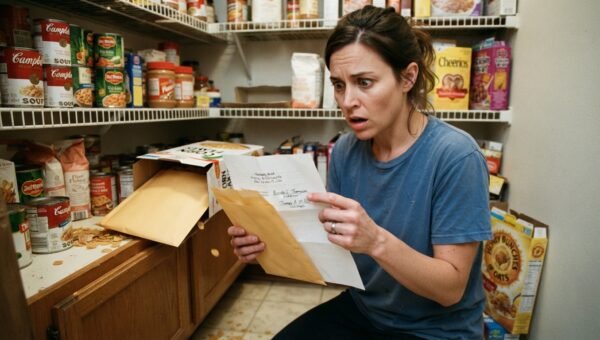
On top lay a heavy manila envelope, sealed with dried glue and yellowed cellophane tape across the flap.
Across the front, in my father’s careful, slanted cursive handwriting, was written: “For Margaret. Open when you truly need it. Love, Dad.”
Beneath the envelope was a folded cashier’s check issued by First National Bank of Ohio, dated August 14, 1998. The ink was slightly faded, but the numbers were unmistakable. It was made out to Margaret Ann Miller in the exact amount of $18,500.
I sat down on an overturned plastic milk crate, holding the paper by its edges. In 1998, eighteen thousand five hundred dollars was nearly half what my father earned in an entire year carrying the mail. That was the year my first marriage fell apart, the year I had to move into a tiny duplex on East Market Street with my eight-year-old son, Kevin, scraping together money for heating oil while working part-time at a dry cleaner.
Dad had helped me buy groceries back then, slipping twenty-dollar bills into my coat pockets when he came over to fix a leaky faucet.
But he had always acted like money was tight. He never once mentioned a cashier’s check.
With shaking fingers, I took my pocketknife and slit open the top of the sealed manila envelope. Inside were two folded sheets of lined legal pad paper and a smaller, faded business document from 1968.
The legal pad paper had Dad’s handwriting on it. The first sentence did not talk about money at all.
It said: “Maggie, if you are reading this, I am gone, and you deserve to know why you never had a birth certificate with your mother’s name on it.”
PART 2
My chest tightened so hard it felt like the air had been sucked out of the locker.
All my life, I knew our family was small. It was just Dad, Mom, and me. My mother, Helen, had been an anxious, quiet woman who rarely left our house except for church on Sunday mornings and trips to the Acme grocery store. She had severe rheumatoid arthritis that kept her mostly confined to her recliner by the time I entered middle school, and she passed away from a stroke when I was twenty-seven. Whenever I needed my birth certificate for school sports or my first driver’s license, Dad had always handled the paperwork himself. He gave me a certified state transcript that listed Arthur Miller as my father, but the mother’s section had simply read: “Record Amended by Court Order, Summit County Probate.”
When I was sixteen, I asked Mom why it said that. She had looked down at her swollen knuckles and said, “Your father handled all the legal filings when you were a baby, honey. It was just legal red tape because we lived in Canton for a few months.”
I had never questioned it again. You did not push my parents on private matters. That was just how things were done in an Ohio working-class home in the seventies.
Now, sitting in the cold concrete locker under a single hanging lightbulb, I unfolded the handwritten letter.
“Dear Maggie,” my father wrote, his handwriting steadier here than it had been in his later years. “The money with this letter is yours. It has been yours since August of 1968. I put it into this check in 1998 because the old savings certificate matured, and I did not know how to bring this to you without breaking everything we built.”
The letter explained that in the summer of 1968, my father was thirty-three years old and had been working his postal route in downtown Akron for seven years. He and Helen had been married for eight years and had tried without success to have children. Helen had suffered three miscarriages and had fallen into a deep depression that worried everyone who knew her.
In June of 1968, a young woman named Clara Evans was staying in a boarding house on Prospect Street, right along my father’s daily walking route. She was nineteen years old, unmarried, and seven months pregnant. She had come to Akron from a small farming community near Wooster to hide her pregnancy from her family.
Clara worked the evening shift at a laundry downtown. She saw my father every morning when he delivered the mail to the boarding house porch. One morning in July, she was sitting on the steps crying because the landlord had told her she could not stay once the baby arrived.
My father sat down on the porch steps beside her, gave her a clean handkerchief, and listened to her story.
When Clara went into labor on August 3, 1968, at the old St. Thomas Hospital, she had no money and nowhere to take the child. My father went to the hospital after his shift. He talked to Clara, and then he went home and talked to Helen.
According to Dad’s letter, Clara did not want an agency involved because her father was a deacon in a conservative church in Wayne County, and an official state placement would have created public records in Wooster. She wanted her baby to go to good, steady people who would love her, but she also needed money to leave Ohio and start over in California.
My father withdrew every penny he had saved from six years of overtime shifts, combined with an inheritance his own grandfather had left him: four thousand dollars in cash. He gave it to Clara to pay her hospital bill and buy a train ticket west. In exchange, Clara signed a private consent agreement before an attorney downtown, allowing Arthur and Helen Miller to petition for a direct private adoption.
I unfolded the document that had been tucked behind the letter. It was an original carbon copy of an agreement dated August 12, 1968, signed by Clara Evans and witnessed by an attorney named Robert J. Harmon on South Main Street.
Clara Evans was my biological mother. Helen was the only mother I had ever known, but she had not carried me.
PART 3
I sat on that milk crate for nearly twenty minutes, listening to the rain drumming against the metal roof of the storage building. My whole sense of who I was felt like it was shifting under my feet.
I looked at the second sheet of legal pad paper. Dad had continued writing, explaining the check.
“Clara never asked for another dime,” the letter went on. “She went out to San Diego. But in 1982, fourteen years later, a lawyer from California contacted me. Clara had married a man who owned an auto parts business, and when he died, she inherited his estate. She had no other children. She had set up a trust that paid out eighteen thousand dollars to be held for you until you turned thirty.”
The lawyer had sent the funds to my father because the trust specified that the adoptive father had sole discretion on when to release it, based on my maturity and need.
“By 1998, when you turned thirty, Helen had been gone four years,” Dad wrote. “Your marriage to Tom was ending, and you were struggling with little Kevin. Every day I looked at that money and wanted to hand it to you. But I knew if I gave you eighteen thousand dollars out of nowhere, you would ask where it came from. You would demand the truth about Clara, and I was terrified. I was terrified that if you knew Helen and I took you in through a private lawyer and paid Clara’s bills, you would think we bought you. I was terrified you would look at me and see a liar instead of your father.”
A teardrop fell onto the legal pad, making the blue ballpoint ink bleed into the yellow paper.
“I bought this cashier’s check in August of 1998,” he wrote at the end. “I told myself that if you ever faced eviction, or if Kevin needed surgery, or if you were truly on the street, I would swallow my pride and give it to you, no matter what it cost me. But you worked two jobs, Maggie. You went to night school for that records clerk job. You raised Kevin with your own two hands, and you never gave up. You were stronger than I was. I kept this in the locker because I was a coward. I am sorry, Maggie. You were never bought. You were prayed for, and you were loved every hour of every day.”
I folded the letters carefully and placed them back inside the envelope. My hands were steady now.
I did not feel anger toward the man who had raised me. I thought about him walking up the steps of our little house on Brittain Road with his postal satchel over his shoulder, his back aching from forty pounds of mail, coming through the screen door to check on Mom and make sure my homework was done. I thought about him sitting at my kitchen table in 1998, quietly fixing Kevin’s broken bicycle chain while I cried about a car repair bill I could not afford. He had carried the weight of that secret for fifty-six years just to protect my memory of my mother.
I took the shoebox, the letters, and the check, put them into my purse, and locked the storage locker.
The next morning, I drove down to the First National Bank branch on West Market Street. The teller looked at the cashier’s check from 1998 with wide eyes. A check that old could not simply be cashed at the window; the bank had undergone two mergers since then, becoming part of a national financial institution. The branch manager, a patient woman named Mrs. Davis, spent an hour searching archive records before confirming that the original funds were still held in an abandoned escrow ledger linked to Arthur Miller’s name.
Because I was the named payee and the sole executor of his estate, they were able to re-issue the funds into my savings account.
ENDING
Three days later, I took a Friday afternoon off and drove thirty miles south to the Wayne County courthouse in Wooster.
Working in records myself, I knew how to navigate death registries and property records. It did not take long to find what I was looking for. Clara Evans had passed away in California in 2004 at the age of fifty-five. She had been buried in a memorial park in Escondido, near the coast.
According to her obituary in the local paper, which the library clerk pulled up on microfilm for me, Clara had spent her later years volunteering at a community center for teenage mothers. The article quoted a woman who had worked with her: “Clara always believed that every young woman who made a hard choice deserved grace, not judgment.”
Standing by the microfilm machine, reading those words about a woman whose face I had never seen, I felt a deep, quiet peace settle over me. Clara had not abandoned me out of carelessness. She had made the only choice she had in 1968, and she had spent the rest of her life trying to help other girls in the same position.
That evening, I drove out to Greenlawn Memorial Park in Akron, where my father and mother were buried side by side beneath an oak tree. The autumn leaves were falling thick over the grass, covering the bronze markers.
I knelt down beside Dad’s stone. The date carved into the bronze read *1943–2026*. Beside him, Mom’s stone read *Helen M. Miller, 1945–1995*.
I ran my fingers over the cold metal letters of his name.
“You weren’t a coward, Dad,” I whispered to the empty cemetery. “You were just a father who loved his daughter.”
On Monday morning, I transferred the eighteen thousand five hundred dollars into a dedicated savings fund for my grandson, Kevin’s two-year-old boy, Liam. When Liam is old enough, that money will pay for his trade school or college tuition.
And when the time comes, I will tell him the whole story. I will tell him about Clara, who had the courage to give me life; about Helen, who gave me a home; and about Arthur Miller, the mailman who walked fifteen miles a day in the Akron snow, holding on to a secret because he loved me too much to let me doubt where I belonged.