PART 1
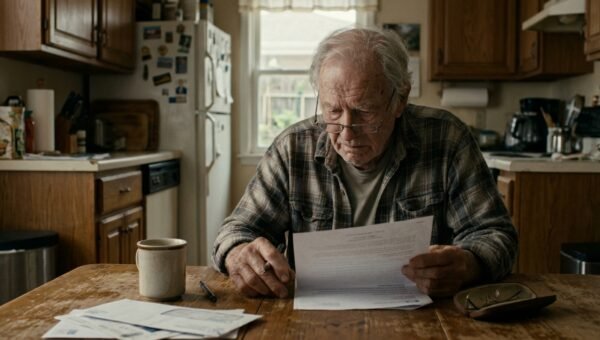
Martha had been gone three weeks when I finally sat down at her rolltop desk. The house was quiet in a way that felt unnatural. For thirty-eight years, there had always been the sound of her humming in the kitchen, the clatter of her metal baking sheets, or the television running an old mystery film in the background. Now, there was just the hum of the refrigerator and the ticking of the grandfather clock in the hall.
She passed away in her sleep at sixty-four from a sudden heart failure that the doctors said she never felt. That was the only blessing in the whole nightmare. We had met in Carson City back in 1986, bought our three-bedroom ranch outside Sparks in 1992, and settled into the kind of steady, dependable rhythm that people take for granted. I worked thirty years as an estimator for a commercial paving company, and Martha worked as an administrative clerk for the Washoe County records office until she retired five years ago.
From day one of our marriage, Martha handled the household money. It was never a fight or a power struggle. I was outdoors all day in the dirt and gravel, tracking tonnage and asphalt spreads, and when I came home, my hands were stiff and my brain was fried. Martha was meticulous. She kept a small green notebook inside the center drawer of the desk, every utility payment, property tax installment, and insurance premium logged in her tight, neat cursive.
When digital banking took over in the late 2000s, she set up automatic withdrawals for everything. She would hand me a printed summary once every quarter showing our checking balance, our certificates of deposit, and what we owed on the truck. She always smiled and patted my shoulder, telling me, “We are right on schedule, Arthur. You build the roads, and I keep the lights on.”
I never had a single reason to doubt her. Our credit score was over eight hundred. The mortgage had been paid off four years early. We took two weeks every September to drive up to the Oregon coast. We had a peaceful, comfortable life.
After the memorial service and the casseroles stopped coming, our daughter, Sarah, went back to Sacramento with her two boys. She offered to stay and help me go through the paperwork, but I told her I needed the routine. A man who worked fifty hours a week for four decades cannot just sit in a silent living room staring at an empty recliner.
I opened her laptop, entered the password she had written on a sticky note tucked inside her green ledger, and began the process of closing her accounts.
Everything looked exactly as she had presented it for years. The water district, the power company, her modest public employee pension, and our joint retirement accounts were all in perfect order. But as I went line by line through her personal Visa statement to cancel her subscriptions, small recurring charges started popping up.
There was the local paper, a gardening magazine, five dollars for cloud storage, and ten dollars to a streaming service we used on weekends. I clicked through them, confirming cancellations one by one.
Then my eyes caught a monthly charge of forty-four dollars.
It was billed to a vendor named MailPort Services, located on the commercial frontage road off Interstate 80, just east of Reno.
I leaned closer to the monitor. Forty-four dollars was not a lot of money, but the merchant category said Commercial Mail Receiving Agency.
The charge had cleared on the fourth of every single month for as long as the online statements went back.
We had a standard black metal mailbox sitting on a wooden post at the end of our gravel driveway. We had lived at the same address for over three decades. Our carrier, Gary, knew us by name and would honk whenever a package was too heavy to carry to the porch. Why on earth would Martha be paying forty-four dollars a month for a private mailbox twelve miles away from our home?
During thirty-eight years of marriage, she had never mentioned MailPort once. She never asked me to drop an envelope there. She never said she had packages routed away from the house.
I pulled up the local directory on my phone and dialed the number for MailPort Services. A man answered on the second ring with a clipped, busy tone, the sound of cardboard tape dispensers running in the background.
“MailPort, this is Wayne.”
“Hello,” I said, clearing my throat. “My name is Arthur Vance. My wife, Martha Vance, passed away recently, and I am reviewing our credit card statements. There is a monthly forty-four-dollar charge to your business. I am trying to figure out what service she was receiving.”
The typing on the other end stopped.
“One moment, sir. Let me pull up the customer directory.” A minute ticked by. The tape gun fired again in the background. Then Wayne came back on the line. “Yes, Mr. Vance. I see the account here. Box 51. It has been active and paid up to date since April of 2013.”
2013. That was eleven years ago.
“She had a box there for eleven years?” I asked. My chest felt tight.
“Yes, sir,” Wayne replied casually. “Standard small business lockbox with package forwarding options, though she never used forwarding.”
He paused, and then he added, “She came almost every week to collect her mail.”
PART 2
Wayne’s words hung in the telephone receiver like a stone.
“Every week?” I repeated.
“Almost every Tuesday or Thursday afternoon,” Wayne said. “She was one of our regulars. Quiet lady. Always parked on the side by the bay door, used her key, and left. If you have the death certificate and letters of administration, Mr. Vance, you can bring them in to close the account and collect whatever is currently sitting in the box.”
“Is there mail in it right now?”
“Two letters came in yesterday,” Wayne told me. “I can’t tell you who they are from over the phone, but the box is not empty.”
I told him I would be there within an hour.
I hung up the receiver and sat frozen in Martha’s desk chair. For eleven years, my wife had driven out to an industrial strip mall outside Reno once a week to open a private metal door. Eleven years covered the end of her career at the county records office, her retirement, our trips to the coast, and every quiet evening we had spent watching television on our sofa.
She had gone every Tuesday or Thursday. Tuesdays were the days she told me she was volunteering at the botanical gardens library. Thursdays were her grocery mornings in town. She had built that small errand into the normal geography of our week, so seamless and ordinary that I had never questioned a single mile on her odometer.
I went into our bedroom, took the certified copy of her death certificate and our marriage license from the fireproof lockbox under the bed, grabbed my truck keys, and walked out the door.
The drive down Interstate 80 felt like moving through water. The November wind was coming down hard off the Sierra Nevada mountains, blowing dust across the highway.
MailPort Services sat squeezed between an auto glass repair shop and a commercial supply warehouse. It was a low concrete building with blue painted trim and a gravel lot. Inside, the walls were lined with rows of small, bronze-colored metal doors with combination dials and keyholes.
Wayne was a man in his late fifties with thinning gray hair and reading glasses hanging from a black cord around his neck. When I laid the death certificate, my driver’s license, and our joint tax return on the laminate counter, he studied them quietly.
“I am sorry for your loss, Mr. Vance,” he said, his tone softening. “She was always very pleasant to us. She brought us a tin of lemon cookies every Christmas.”
“Did she ever say what she used the box for, Wayne?”
He shook his head as he unlocked the drawer behind the register. “People rent private boxes for a lot of reasons, sir. Small business side hustles, privacy from roommates, estate paperwork. We don’t ask as long as the payment clears and nothing hazardous comes through the sorting facility.”
Wayne walked over to the bank of boxes, slid a master key into the edge of Box 51, and pulled out two envelopes. He walked back to the counter and laid them flat in front of me.
The first envelope was an official communication from the State of California Department of Health Care Services, postmarked from Sacramento five days prior. It was addressed to Martha Vance, Box 51.
The second envelope was thicker, made of heavy cream linen paper. There was no printed postage mark. It had been sent through standard first-class mail from an address in Auburn, California. The handwriting on the front was small, slanted, and written in green ink:
*For Martha. Update inside.*
My hands were shaking as I picked up the cream envelope. I did not open it in front of Wayne. I signed the cancellation paperwork, collected her brass key from the ring, and walked back out to my pickup truck.
I sat in the driver’s seat with the engine off, the wind rocking the truck frame, and slid my pocketknife under the flap of the linen envelope.
Inside was a single folded sheet of stationery and a color photograph.
I looked at the photograph first. It showed a young man in his late twenties with dark brown hair, wearing a white button-down shirt and a navy tie, standing on a wooden back deck with his arm around a young woman holding a golden retriever puppy. The young man had Martha’s exact chin, that distinct, small cleft right in the center, and her deep-set, hazel eyes.
My heart felt like it was trying to punch through my ribs.
I unfolded the letter.
“Dear Martha,” it read.
“Julian passed his licensing exam on the first attempt last Thursday. He is officially registered as a physical therapist with the regional clinic here in Placer County. We had a small dinner at the house to celebrate.
He asked about you again, as he always does when a major milestone hits. I showed him the card you sent for his birthday and told him you were still keeping your promise from the beginning. He understands why things have to remain at a distance, but he wanted you to have this picture from his graduation.
The medical support fund you set up has ninety-two dollars remaining after his final board fees. We will close that account by the end of the month. Thank you for thirty years of quiet grace.
With love,
Claire.”
PART 3
I sat in the cab of my truck for thirty minutes, unable to turn the key in the ignition.
Thirty years.
Thirty years ago was 1994. Martha and I had been married for eight years. Our daughter, Sarah, was six years old, just starting first grade at the elementary school down the road.
In the spring of 1994, Martha had taken an unexpected six-week leave of absence from the county records office. She had told me her older sister, Clara, who lived in Idaho, was recovering from a complicated gall bladder surgery and needed someone to help manage the house. I had stayed in Sparks with Sarah, working double shifts on the paving crew, sending Martha money orders every Friday to help cover her travel.
She had not gone to Idaho.
I started the truck, pulled out of the MailPort lot, and did not drive back to Sparks. I got on the westbound ramp for Interstate 80, heading up into the mountains toward California.
Auburn was eighty miles west, just past the foothills on the other side of Donner Pass. The drive took an hour and fifteen minutes. My mind raced through three decades of memories, looking for cracks, looking for lies, looking for any clue I had missed while I was busy spreading gravel and worrying about tire wear.
Martha had never been cold. She had never been secretive in an obvious way. She kissed me every morning before I left for the yard, she made pot roast every Sunday, and she sat beside me on our porch swing every summer evening listening to the crickets. But there had always been a private room inside her mind, a quiet space she never opened to anyone.
The address on the cream envelope was a small, well-kept single-story craftsman home on a quiet, tree-lined street three blocks from the historic Auburn courthouse. There were red geraniums in clay pots on the porch and a wind chime hanging from the eaves.
I parked my truck at the curb, took a deep breath, and walked up the front steps. My knees felt hollow.
I knocked on the wooden screen door.
After a few moments, the interior door opened. A woman with short, silver hair and spectacles pushed up onto her forehead looked out at me. She was about sixty-five, wearing a canvas gardening apron over a blue flannel shirt.
“Can I help you?” she asked politely.
I held up the cream envelope in my hand.
“My name is Arthur Vance,” I said. “I am Martha’s husband.”
The woman froze. The color drained from her cheeks in an instant. Her hand went to the wooden frame of the door, her knuckles tightening until the skin turned pale.
“Arthur,” she whispered.
“You wrote this letter to my wife’s private mailbox in Reno,” I said, keeping my voice as steady as I could manage. “Martha died three weeks ago. I found the box today. Who is Julian?”
Claire closed her eyes. Her shoulders dropped, and she let out a long, shuddering breath that sounded like twenty years of held tension finally giving out.
“Come inside, Arthur,” she said softly, pushing open the screen door. “You deserve the truth. You should have had it a long time ago.”
Her living room was warm, filled with books, braided rugs, and framed landscape prints. On the mantle above the brick fireplace was a photograph of the same young man from the letter, pictured at about ten years old, holding a baseball glove.
Claire went into the kitchen, poured two glasses of cold water, and set them on the wooden coffee table. She sat down in the armchair across from me, her hands folded in her lap.
“Julian is Martha’s son,” Claire said directly. “And he is my adopted boy.”
The words landed on the floor between us like heavy timber.
“When?” I asked. My throat was so dry I could barely force the syllable out. “When was he born?”
“May twenty-second, 1994,” Claire said.
“We were married in 1986,” I said, my voice rising slightly. “We had Sarah in 1988. Martha had an affair?”
“No, Arthur,” Claire said firmly, leaning forward to look me straight in the eyes. “Martha never had an affair. Julian was conceived in November of 1993, when Martha was working late at the county courthouse records annex.”
Claire stopped. Her chin trembled, and she looked down at her hands.
“A county contractor who had a contract with the facilities department cornered her in the basement archives late on a Friday evening after the public doors were locked. Martha was thirty-two years old. She fought him, Arthur. But he was twice her size.”
The room went completely, terrifyingly silent. The hum of the refrigerator in Claire’s kitchen sounded deafening.
“Why didn’t she tell me?” I choked out, tears finally burning the corners of my eyes. “Why didn’t she go to the police? Why didn’t she tell her own husband?”
“Because in 1993, the man who did it was the nephew of the presiding county district judge,” Claire said, her voice hard with an old, cold rage. “And because Martha was terrified of two things. She was terrified that if she told you, you would take your shotgun from the closet, drive down to the county yard, and spend the rest of your life in a state penitentiary for murder. And she was terrified that if people found out, the shame would follow six-year-old Sarah for the rest of her life in that small town.”
ENDING
I sat in that chair in Auburn, California, and buried my face in both of my calloused hands.
The shame of not knowing hit me like a physical blow to the ribs. All those years, I thought I was protecting my family because I worked fifty hours a week in the summer heat, paid the bills, and kept the roof from leaking. But while I was paving highways, my wife had been carrying a private, solitary grief so vast it must have felt like a lead weight inside her heart every single hour of the day.
“She came to me in early 1994,” Claire explained quietly. “My late husband, David, and I had been trying to have children for ten years with no success. Martha didn’t believe in abortion, but she knew she could not bring that child home to your marriage without destroying everything you had built. We arranged an independent, closed private adoption through a confidential family attorney in Sacramento. I took custody of Julian the day he was born at Mercy General Hospital.”
“Did she ever see him?” I asked, looking up with tears running down my cheeks.
“Three times,” Claire said softly. “Once when he was six months old, to sign the final legal custody release. Once when he was eight, from across the street at his Little League tournament in Roseville, just watching from her car behind the outfield fence. And once four years ago, when he graduated from college. She sat in the very back row of the auditorium. She never approached him. She never disrupted his life or mine.”
“Then why the mailbox?”
“Because when Julian turned eighteen, he discovered his original birth certificate in our safe deposit box,” Claire said. “He wanted to know where he came from. He wanted to know if the woman who gave birth to him was alive. I contacted Martha through our family attorney. Martha agreed to receive letters, but she made a strict condition: Julian must never contact her at your home address, and she would never ask for a single penny of your marital money to help him.”
Claire reached into a drawer beneath the end table and pulled out a small black ledger book, nearly identical to the green ones Martha had kept in our desk in Sparks.
“For twelve years, Martha sent forty-four dollars a month from her own small pension allowance to keep that box open,” Claire said. “And every six months, she sent two hundred dollars from her personal gardening plant sales to deposit into Julian’s college book fund. Not a single cent came from your joint savings. She refused to use your sweat to pay for her survival.”
I looked at the black ledger, then down at the photograph of the young man with Martha’s eyes.
He was twenty-nine years old. He had her quiet smile, her strong shoulders, and an honest life built out of a tragedy that had almost destroyed her.
“Does he know about me?” I asked.
“He knows Martha was married to a good, hardworking man,” Claire said. “He knows Martha kept the truth hidden because she loved her family too much to watch it burn down. Julian is a good boy, Arthur. He holds no bitterness. None of us do.”
I stayed at Claire’s house until five that afternoon. We drank black coffee, and she showed me Julian’s baby pictures, his high school diploma, and the letters Martha had sent over the years. Martha’s letters were short, warm, and full of quiet encouragement. She never complained about her burden. In every single letter, she ended with the exact same sentence:
*Be honest, work hard, and treat people with kindness.*
When I walked out to my truck, the Sierra sky was turning deep purple and orange over the mountains. The drive back across Donner Pass was quiet, but the hollow ache in my chest had shifted into something else. It was not anger. It was not betrayal.
It was a profound, humbling awe for the woman who had slept beside me for thirty-eight years. She had absorbed the darkest storm of her life in total silence, shielding me from my own violent temper, protecting our daughter from public scandal, and ensuring that an innocent child was raised in a warm, loving home, all while making sure dinner was on our table at six o’clock every single evening.
I pulled into our gravel driveway in Sparks at nine that night.
The house was dark. I walked inside, hung my keys on the brass hook by the door, and went straight to the rolltop desk in the study.
I picked up the small framed photograph of Martha that sat beside the lamp. She was smiling in her sunhat, holding a basket of yellow squash from our garden, her eyes crinkling in the sunlight.
“I know now, Marty,” I whispered to the empty room. “I know what you carried for us.”
Two days later, I drove back to Auburn.
I didn’t go to see Claire. Claire had arranged for Julian to meet me at a small coffee shop near the regional medical clinic where he worked.
When he walked through the door, wearing his dark scrubs and carrying a canvas messenger bag, he hesitated, looking around the room until his eyes met mine.
He didn’t run. He didn’t look away.
I stood up from the booth, walked over to him, and held out my calloused right hand.
“Hello, Julian,” I said, my voice steady and warm. “I’m Arthur. Your mother was the bravest woman I ever knew, and I’d like to buy you a cup of coffee.”
He looked at my hand, then up at my face, and a slow, familiar smile touched his eyes.
“I’d like that, Arthur,” he said.
We sat down together by the window, and for the first time in thirty-eight years, the secret was finally out in the clean, open light.