PART 1
The tall grandfather clock in the front hall clicked through its gears and chimed ten times. Arthur stood right in the center of the marble floor, checking the gold links at his wrists. His suit was custom charcoal wool from Savile Row, five thousand dollars without the vest, pressed so clean that not a single fold fell out of place. He was seventy-six years old, retired fourteen years from a private equity firm in midtown, and he carried himself like a man who believed the world was divided into two groups: people who gave orders and people who swept up after them.
I was sixty-one, wearing faded canvas gardening pants and an old cotton blouse with the sleeves rolled to my elbows. I was holding a basket of fresh laundry that smelled of lemon detergent.
“It is him or me, Emily,” Arthur said. He did not raise his voice. He never did. He spoke in that low, clipped tone he used when he was terminating a vendor contract. “I will not discuss it a second time. We are done accommodating this chaos.”
The air in the front hall went so cold my chest tightened.
“Arthur, he is ten years old,” I said. “He is my son. He has lived here for three months.”
“And those three months have ruined my house,” he said. He picked up his leather commuter folio from the cherry console table by the door. “I did not spend forty years building a retirement in Greenwich to walk around plastic building bricks on the parquet.
I did not buy five acres of quiet woods to hear a soccer ball bouncing off the garage door at seven in the morning. My home is meant for peace, reflection, and order. I want silence. No toys. No interruptions. No excuses.”
“He lost his father last winter,” I said, my voice shaking. “He has had his entire life pulled out from under him. You knew I was bringing him here when we sat in the lawyer’s office in March. You told me we had six bedrooms and more than enough room for a family.”
“I told you we would see how the arrangement functioned,” Arthur replied, looking at the thin gold face of his Patek Philippe watch. “It does not function. A ten-year-old boy belongs in a structured boarding academy, not running through my dining room while I am reviewing private trust filings. His father’s family has cousins in New Hampshire.
Send him there, or place him in the school we discussed in Litchfield. Either Toby is gone by the end of next week, or I instruct Robert to draft separation papers and freeze the household accounts. Choose.”
A tiny board creaked on the second-floor landing.
I looked up through the white wooden balusters. Toby was sitting on the fourth step from the top. He had his knees pulled up inside his oversized gray fleece sweatshirt, his thin arms locked tight around his shins. His hair was messy from sleep, sticking up on one side, and his dark eyes were wide and completely still.
He had heard every word.
Arthur followed my gaze, looked up at Toby for a single, indifferent second, and did not say a word to the boy. He did not soften his expression. He simply pulled his gloves from his pocket, opened the heavy oak front door, and stepped out toward the waiting sedan that drove him to the Greenwich station three mornings a week for his luncheon club in Manhattan.
“Have your answer ready when the seven-fifteen train gets in,” Arthur said, and the latch clicked shut behind him.
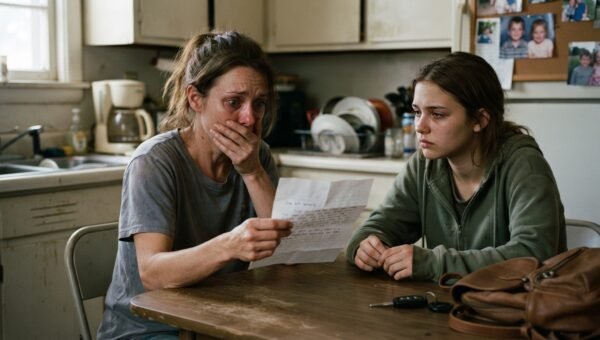
I set the heavy laundry basket on the bottom step and walked up to Toby. He did not cry. That was what made my stomach turn over into a hard knot. Ever since his father died in that sudden highway crash out near Scranton, Toby had learned to hide when grown people got loud. He just pulled himself tighter into a ball, waiting to see where he would be shipped next.
“Did you pack my room yet, Mom?” he whispered.
I sat down on the step beside him, pulled him against my ribs, and buried my nose into his hair.
“Nobody is shipping you anywhere, Toby,” I told him, keeping my voice as firm as concrete. “You are my boy. You are staying with me.”
“Uncle Arthur said you have to choose.”
“Then the choice is already made,” I said.
That afternoon, while Toby was in the kitchen doing his summer reading worksheet at the table, I went up to his room. I pulled his navy blue canvas backpack out of the closet. I folded five pairs of jeans, his soft cotton shirts, his clean socks, and the little wooden box where he kept his father’s old pocket compass and fishing lures. I packed everything he loved into two bags.
Then I walked down the hall to the small cedar-lined linen closet behind the master bath.
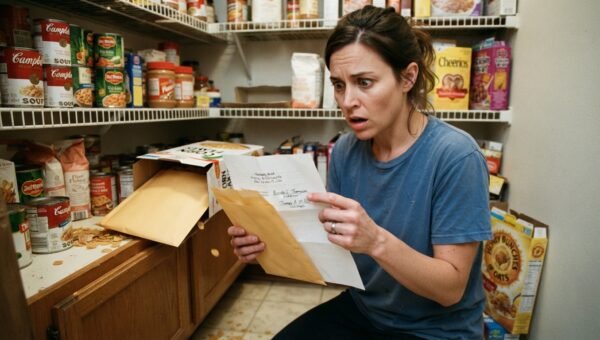
Three weeks ago, while searching for spare wool blankets for Toby’s bed during a cold rainstorm, I had reached all the way to the back of the highest shelf, behind the extra down pillows. My hand had struck something hard and rectangular, shoved under a piece of scrap cedar paneling.
It was a battered green metal lockbox, the kind people used forty years ago for petty cash in small businesses. It had no key in the lock, but the latch had been pried loose long before I found it.
Inside was a single folded sheet of cream-colored stationery, dated July 14, 2018, eight years before my first husband died, six years before Arthur ever knocked on my front door pretending to be a lonely widower who wanted to take care of me.
I carried the box down the stairs, set it directly on the marble table beside Toby’s packed backpack, pulled a wooden chair up against the wall, and waited for the sound of tires on the pea gravel.
PART 2
The town car dropped Arthur off at twenty past seven.
The front door opened with its familiar brass rattle. Arthur stepped across the threshold, shaking the evening dampness from his dark umbrella, his leather briefcase tucked under his left arm. He was whistling a quiet, satisfied tune, the way he always did when he came back from a long afternoon of martinis and portfolio reviews at his university club on Forty-Fourth Street.
He took three steps onto the black-and-white marble tiles, looked toward the console table, and stopped dead.
Sitting side by side under the hall chandelier were Toby’s navy blue backpack, his small red canvas duffel, and the scratched green metal cash box with the broken brass latch.
Beside the table, sitting straight in a straight-backed mahogany chair with my coat folded over my knees, was me.
Arthur let his umbrella tip rest against the stone floor. A small, tight smirk touched the corners of his mouth.
“I see good sense prevailed,” he said. He set his briefcase on the floor and began peeling off his calfskin driving gloves. “I called the admissions director at St. Jude’s in Litchfield during my ride home. They have an opening in their junior dormitory starting next Monday. You can drive him up over the weekend, drop his bags, and return home in time for dinner with the Hendersons. It is for the best, Emily. You will realize within a month that your life is vastly simpler without the noise.”
I did not move from the chair. I kept my hands folded over the dark wool of my coat.
“Toby isn’t going to St. Jude’s, Arthur,” I said.
Arthur stopped working at his gloves. His gray eyebrows pulled together into a sharp, impatient line. “Do not start this again, Emily. We settled this at breakfast. If the boy is not leaving, then you are making an impossible situation for yourself. You know the terms of our premarital agreement. You signed it in Stamford with your own independent counsel. If you leave this marriage, you leave with the personal property you brought into it, and not a single dollar of my estate.”
“I am not asking for a single dollar of your estate,” I replied.
He let out a short, nasal laugh, the sound he made when a junior associate made an error on an earnings spreadsheet. “Then what is that luggage doing by the front door? If you are not sending him to school, what game are you playing?”
“I packed his bags because Toby and I are walking out that door in ten minutes,” I said. “And we are never coming back.”
Arthur’s face shifted. The smugness did not disappear entirely, but it turned brittle, like dry paper. He stepped closer to the console table, looking from the small canvas backpack to my face, then back again.
“You are sixty-one years old, Emily,” he said, lowering his voice into that slow, warning register. “Your first husband left you a four-room vinyl-sided house in Danbury with a leaky asphalt roof and eight thousand dollars in credit card balances. You spent twelve years working fifty hours a week as a receptionist at an auto collision shop just to pay for groceries and heat. You live in a six-bedroom stone manor on five acres of landscaped lawns. You have two full-time housekeepers, an unlimited card for the market, and a luxury SUV in the three-car bay. You are going to give up all of this to go back to scrubbing your own floors in a rented duplex?”
“Yes,” I said.
“Over a child who is not even mine?” he spat. “Over a ten-year-old boy who leaves grass clippings in the mudroom?”
“He is my child,” I said. “And you knew that long before you ever asked me out for coffee at the diner in Bethel.”
Arthur’s mouth twitched. He looked down at the table, and for the first time, his gaze dropped to the battered green box sitting right next to Toby’s backpack.
PART 3
Arthur took half a step backward. His hand came off the console table as if the polished wood had turned hot.
“Where did you get that?” he asked. His voice was suddenly thin, stripped of the heavy authority he had worn all day.
“It was tucked behind the cedar boards on the top shelf of the linen closet,” I told him. “Behind the down comforters you told the cleaning service never to touch.”
“That is private business from my previous partnership,” he said quickly, reaching his hand out toward the metal lid. “That belongs to my personal archives. Give it here.”
“Don’t touch it,” I said.
I stood up from the mahogany chair. I am not a tall woman, but in that moment, looking at a man with twenty million dollars in municipal bonds and four decades of corporate power, I felt ten feet tall.
I lifted the lid of the box, reached inside, and pulled out the single sheet of cream stationery.
“This letter is from my first husband, David,” I said. “Written eight years ago, when he was working as the site foreman on your private equestrian barn down in North Castle.”
Arthur’s face went completely gray, the color of wet sidewalk slate.
“David did the timber framing on your four-stall barn,” I continued, reading from the page in front of me. “He was thirty-eight years old, working twelve-hour days in July heat to save money for Toby’s birth. On July tenth, 2018, the rear roof truss gave way because your structural contractor used sub-standard pine brackets to save seven thousand dollars on the framing bill. The truss fell thirty feet. It crushed David’s left shoulder, shattered three of his ribs, and ruined his spine so badly he could never swing a framing hammer again for the rest of his life.”
Arthur swallowed hard, his throat clicking in the quiet hallway. “That was an industrial accident. The general contractor was fully insured. It had nothing to do with me.”
“David wrote this letter to you personally,” I said, holding the paper up so the hall chandelier caught the ink. “Because you visited him in the hospital room in White Plains while I was home sick with morning sickness. You told him that if he filed a third-party negligence suit against your development trust, you would tie him up in federal appellate court for seven years, run his legal bills past fifty thousand dollars, and make sure no commercial framing outfit in Fairfield County ever hired him again.”
“David was an unstable man looking for a corporate payout,” Arthur muttered, but his eyes were darting toward the front door.
“David took the twenty-five thousand dollar private settlement check you shoved across his hospital bed because we had a baby due in eight weeks and four hundred dollars in the bank,” I told him. “And then he spent the next six years drinking cheap whiskey in our basement to kill the pain in his ruined shoulder, until his heart gave out on the highway last year.”
“Emily, that was business,” Arthur whispered, taking a step toward me, his hands held out with the palms up. “It was eight years ago. I did not even know who you were back then. When I met you at the diner in Bethel three years later, it was an accident. I saw a hardworking, dignified woman who deserved a better life.”
“It was not an accident,” I said.
I reached into the box one more time and pulled out a small black leather notebook tucked under the letter.
“You kept David’s insurance file in this box, Arthur. Along with the private investigator’s reports you ordered on our house in Danbury after David died. You had a man watch me for six weeks. You knew every shift I worked at the collision shop. You knew what time I picked Toby up from daycare. You knew our mortgage was four months delinquent, and you knew the bank was preparing to foreclose.”
Arthur stared at the black notebook. The breath went out of him in a long, rattling hiss.
“You didn’t marry me because you loved me,” I said, looking straight into his cold, frightened eyes. “You married me because you were seventy-four years old, sitting alone in this empty house with your millions and your five-thousand-dollar suits, and every time you looked in the bathroom mirror, you saw the man who destroyed a young carpenter’s body to save seven thousand dollars on some barn lumber. You thought if you put me in silk blouses, gave me an SUV, and let me arrange flowers in your Greenwich mansion, God would forget what you did to my husband.”
ENDING
Arthur stood in the middle of his great hall, completely cornered by his own history. The wealth, the custom tailoring, the club memberships, and the sharp, arrogant voice were gone. All that remained was an old, desperate man who had spent his entire life buying people off, standing in a house so big it echoed every time someone took a breath.
“Emily,” he begged, his voice cracking like dry kindling. “Listen to me. Please. Don’t do this. You don’t have to send Toby anywhere. He can stay. He can keep his toys in the den. I will build him a playroom over the garage. I will hire a private tutor, a driver, whatever he needs. Just put the papers back in the box and stay.”
“You don’t get to buy my boy,” I said.
I picked up the cream stationery, folded it in half, and slipped it into the inside pocket of my wool coat, right next to my car keys. Then I picked up Toby’s navy blue backpack by the straps and lifted the red duffel with my other hand.
“Where are you going?” Arthur cried out, his voice rising in panic as I reached for the brass latch of the front door. “You have no money! You have nowhere to go in this county!”
“I have my hands,” I told him, looking over my shoulder one last time. “And I have the small savings account my brother set up for Toby in Scranton. We are moving into my sister’s guest cottage near the Delaware River tonight. I already signed the lease on a small storefront near the lumberyard where I’m opening a sewing repair shop. It is three rooms with a wood stove and an iron bed, and every square inch of it belongs to us.”
“You will die poor, Emily!” he yelled, though there was no strength left in the words, only the hollow sound of an empty room. “You will regret this before the week is out!”
“I would rather eat dry toast on a wooden crate with my son,” I said, “than eat caviar off your gold plates with a ghost sitting between us.”
I turned the brass knob, pushed the heavy door wide, and walked out onto the stone veranda.
The night air was cold and sweet, smelling of fallen oak leaves and wet pines. Down at the bottom of the front steps, sitting on the low stone garden wall with his hands stuffed deep into the pockets of his gray fleece, was Toby. He had his sneakers laced tight, watching the driveway with steady, patient eyes.
When he saw me walking down the steps with his two bags in my hands, his face opened up. The tight, terrified look around his mouth completely disappeared, replaced by a grin that made him look like his father used to look on Sunday mornings by the lake.
“We leaving, Mom?” he asked, jumping down onto the gravel.
“We are leaving, baby,” I said, handing him his navy backpack.
He swung the straps over his shoulders, took the handle of the red duffel with his right hand, and reached up to take my fingers with his left. His grip was small, warm, and entirely steady.
Behind us, the massive front door of the Greenwich house clicked shut, the heavy deadbolt sliding into place with a dry, metallic thud that signaled the end of thirty-four years of fear and twenty-six months of lies.
We walked down the long driveway together, under the dark maples, past the five-acre fence line, and got into my old station wagon parked on the shoulder of the public road.
I turned the key, the engine caught with a steady, honest hum, and I pulled out toward the state line without looking back in the rearview mirror once.