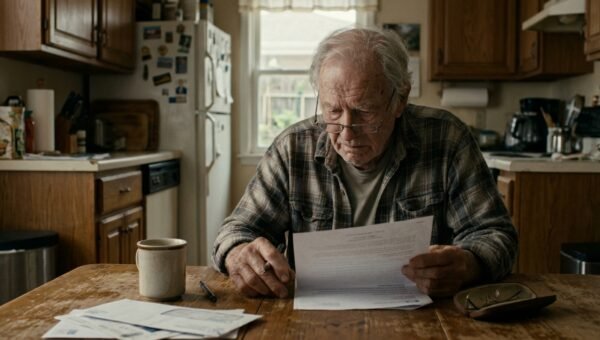
PART 1
The laminated chore sheet was taped to the microwave at six in the morning on my sixty-sixth birthday.
My son, Kevin, had printed it in color. Pink rows for morning routines, blue for afternoon maintenance, and green for yard tasks. Across the top, in bold black ink, his wife Amanda had written: “House rules while we are away! 12 days to keep the property clean!”
Beside the microwave sat their matching hard-shell rolling bags. Kevin came down the stairs in polo shirt and khakis, checking his watch every thirty seconds.
Behind him came Amanda, holding four-year-old Lily’s hand while eight-year-old Mason dragged his tablet by its rubber cord.
“Uber is four minutes out, Kev,” Amanda said. She didn’t look at me. She set a stack of dirty breakfast bowls right into the porcelain sink I had spent an hour scrubbing the night before.
Kevin grabbed his passport wallet off the counter. “Hey Dad. You saw the list? The gutters on the north side are catching pine needles again. Make sure you get up on the ladder before Thursday because rain is coming. And Mason’s soccer practice is Tuesday and Thursday at four-thirty sharp. Don’t be late picking him up like last month.”
“Kevin,” I said, holding my ceramic mug with both hands. “Do you know what day it is?”
He glanced up from his phone screen, annoyed by the pause. “It’s Saturday, Dad. We’ve got a flight out of Dulles in three hours. We’re already cutting it close.”
“It’s my birthday,” I said.
Amanda let out a small, tight breath through her nose, checking the lock screen on her phone. “Kevin, the driver just turned onto the cul-de-sac. Let’s go.”
Kevin reached out, patted my shoulder twice through my flannel shirt, and gave me a distracted nod. “Happy birthday, Dad. We’ll celebrate when we get back. Keep an eye on the garage door, the sensor has been sticking.”
They kissed the two kids, told Mason to listen to his grandfather, and walked out the heavy front door.
I stood by the window of the big house on the quiet cul-de-sac in Leesburg, Virginia. Outside, the lawn was cut to an exact two inches, the colonial lamppost stood straight by the driveway, and the morning sun reflected off the hood of the black town car waiting at the curb. Through the driver’s side window, I saw the trunk lid close over four large suitcases bearing luggage tags for a luxury cruise line.
Kevin had bragged to our neighbors at the block party two weeks ago about the private balcony suite he booked for the trip: an $11,200 Mediterranean cruise through Greece and Italy.
No birthday card. No slice of supermarket cake. Just the color-coded list and two young children sitting on the living room sofa eating dry cereal out of plastic cups.
I have lived in the small apartment over the three-car garage for five years. The neighbors on our quiet street see an older, gray-haired man in work gloves raking the leaves, carrying the trash bins to the curb every Tuesday night, and walking the kids to the elementary bus stop. Most of them assume I am an aging father whose generous tech-consultant son took him in out of pity so I wouldn’t end up in an institution.
That night, after I made mac and cheese for Mason and Lily, helped them with their bath, and tucked them into their bunk beds, I walked down to the kitchen to turn off the lights.
Mason’s school laptop was sitting open on the island, plugged into the wall.
Kevin had used it that morning to print their boarding passes before leaving. When I reached over to close the screen, the email client was still open in the background.
The subject line caught my eye: “Follow-up: Senior Placement Assessment & Timeline for 412 Sycamore.”
412 Sycamore was the address of the house we were standing in.
I clicked the tab. The email was a thread between Kevin and a senior care placement coordinator at a private assisted-living facility out in Winchester.
The coordinator’s message was dated Friday afternoon: “Mr. Henderson, we received the preliminary intake evaluation. Given your father’s age and your desire to convert the detached garage into a dedicated rental suite for additional income, our November 15th bed vacancy would be ideal. As discussed, once the facility contract is executed, the transfer of your primary residence deed can proceed without family encumbrances.”
Beneath it was Kevin’s reply, sent at eleven o’clock the night before, while I was downstairs in his living room folding his laundry:
“The timing works out. We return from Europe on the 12th. I’ll have the medical power of attorney paperwork pre-signed by the local notary. He doesn’t drive on highways anymore and spends all his time in the yard anyway. He won’t put up a fight once he realizes the decision is already made.”
PART 2
I didn’t yell. I didn’t drop my mug. I stood by the kitchen island with the refrigerator hum filling the dark room, reading that message three times until every sentence burned into my mind.
Kevin thought I was an encumbrance. He thought I was a quiet old man living on his charity who could be packed into a sedan and delivered to a facility in Winchester so he could rent out my living quarters for two thousand dollars a month.
He had forgotten who bought the land.
In 2018, after my wife, Martha, died of heart failure, Kevin came to me with an investment proposal. He had just married Amanda. He wanted to build a large custom home in Leesburg where they could raise a family, but his credit was still battered from a failed business venture in Richmond.
I had forty years of equity from our family home in Arlington, along with my state pension reserves. I sold the Arlington house for $610,000 in cash. I purchased the two-acre lot on Sycamore Lane outright. When the builder broke ground, I funded sixty percent of the construction costs, with Kevin taking out a modest secondary builder’s loan for the remainder.
Because I wanted Kevin to feel pride in the home, and because Martha and I had always planned on leaving everything to him eventually, we drew up a joint property agreement. The house was placed into a family revocable trust. Under the trust provisions, Kevin and Amanda had the right to occupy the main house as long as they paid the annual property taxes and the loan payments.
I retained a lifetime tenancy interest in the entire property, along with sole voting authority as the primary trustee.
Kevin had lived in the main house so long, acting like the master of the manor in front of his golf buddies, that he had convinced himself the house was his. Over five years, he had slowly pushed my things out of the main rooms. First, my recliner went out to the garage apartment. Then my bookshelves. Then Martha’s china cabinet. He treated me like a resident caretaker, and I had tolerated it because I loved my son and I wanted to be close to my grandchildren.
On Monday morning, after walking Mason and Lily to the school bus stop at the corner, I did not climb the ladder to clear the north gutters.
I got into my ten-year-old Subaru and drove into the historic district of Leesburg. At nine-thirty, I walked into the brick townhouse office of Frank Miller, an estate and property attorney who had handled teacher retirement wills in Loudoun County since the late 1980s.
Frank put on his wire-rimmed glasses and reviewed the deed, the trust charter, and the printout of Kevin’s email to the Winchester facility.
“Larry,” Frank said, leaning back in his leather chair. “Did you ever sign a delegation of trustee powers over to Kevin?”
“Never,” I said. “He asked for power of attorney two years ago when I had knee replacement surgery. I told him no. I can balance my own checkbook.”
Frank tapped his pen against the trust agreement. “Then Kevin has no legal standing whatsoever to enter into a contract with a residential care facility on your behalf. More importantly, look at Section 8 of your trust charter.”
He turned the page toward me. Section 8 was labeled: “Material Breach and Revocation of Occupancy License.”
“Under this clause,” Frank explained, “the secondary occupants maintain their license to live in the primary dwelling strictly at the pleasure of the trustee, contingent upon respectful maintenance and the absence of hostile encumbrance actions against the life tenant. Attempting to involuntarily commit the life tenant to seize property rights constitutes gross bad faith and an immediate trigger for lease revocation.”
“What does that mean, Frank?” I asked.
“It means you don’t have to pack a bag for Winchester,” Frank said. “It means Kevin and Amanda have thirty days to find another place to live, unless you choose to exercise your immediate administrative removal rights as trustee.”
I looked out the window at the autumn trees along Market Street. I thought about the color-coded chore list taped to my microwave. I thought about the $11,200 cruise he bought while planning to dump me eighty miles away.
“Draft the revocation, Frank,” I said. “And prepare the listing paperwork for the house.”
PART 3
For the remaining eight days of their cruise, I followed my own routine.
I picked Mason and Lily up from school every afternoon. We baked chocolate chip cookies in the kitchen. We sat on the living room rug and read through four chapters of Charlotte’s Web. I took them to the park by the library, pushed Lily on the swings until she laughed so hard she had hiccups, and listened to Mason talk about his third-grade science project.
I didn’t mention the cruise, and I didn’t mention Winchester. The kids didn’t know anything about their parents’ plans, and I was not going to poison their childhood with adult cruelty.
On Thursday morning, November 12th, a white rental van pulled up to the driveway. Two professional movers spent four hours packing every single piece of my furniture, my books, Martha’s old quilt collection, and my tools from the garage apartment.
By two in the afternoon, the apartment was swept clean.
At four-fifteen, a yellow airport cab pulled into the cul-de-sac.
Kevin and Amanda stepped out, their skin tan from the Mediterranean sun, wearing new sunglasses and matching windbreakers. Amanda had a shopping bag from an Italian boutique over her arm. Kevin stretched his arms, looking up at the high gables of the main house with a contented grin.
Mason and Lily were sitting on the low stone wall by the mailbox, eating apples I had sliced for them.
“Hey, buddy!” Kevin called out, walking over to ruffle Mason’s hair. “Did you take good care of the house while Dad was away?”
Mason pointed a small finger toward the front porch. “Grandpa’s lawyer is sitting in the rocking chairs.”
Kevin stopped. His sunglasses slid down his nose.
Sitting on the porch beside me was Frank Miller, wearing his wool overcoat and holding a heavy manila expansion folder across his knees.
Kevin walked up the concrete steps, frowning, his smile vanishing completely. Amanda stayed at the bottom of the stairs, holding her purse against her ribs.
“Dad, what is this?” Kevin asked. “Who is this guy? Why are the garage doors open?”
I stayed seated in my wooden rocker. I didn’t raise my voice. I handed him a single sheet of paper from the top of Frank’s folder.
“That’s a formal notice of trust revocation and immediate lease termination, Kevin,” I said.
Kevin looked at the document, his eyes darting across the legal text. His face lost its tan color in less than five seconds. “What are you talking about? You can’t evict us from our own house.”
“It isn’t your house,” Frank Miller said calmly from his chair. “The deed is held by the Henderson Family Trust, of which Larry is the sole governing trustee. Your right of occupancy was conditioned upon Section 8 compliance. That license was terminated effective nine o’clock this morning.”
“On what grounds?” Amanda shouted from the walkway, her voice turning shrill. “We pay the property taxes! Kevin’s name is on the secondary note!”
I reached into the folder and pulled out the printout of the email thread with the Winchester facility. I held it out toward Kevin.
“On the grounds that you spent Thursday night booking a bed for me in a senior home so you could turn my apartment into rental cash,” I said.
Kevin stared at the paper in his hand. He didn’t look up at me. His mouth opened slightly, but no sound came out.
“Kevin?” Amanda said, walking up two steps. “What is that?”
“He found the Winchester emails,” Kevin whispered.
“You went through my laptop?” Kevin snapped, trying to summon some defensive anger, but his hands were shaking so hard the corner of the paper fluttered in the breeze. “That was just preliminary research, Dad! We were worried about you living out here alone as you get older! It was for your own safety!”
“You booked the intake for November 15th, three days from now,” I told him. “You had a notary lined up to sign away my authority while I was supposed to be clearing your gutters. You didn’t do it for my safety. You did it because you wanted the house.”
“This is my family’s home!” Kevin yelled, his voice cracking. “Where are Mason and Lily supposed to live? You’re going to put your own grandchildren on the street?”
“Mason and Lily are not going on the street,” I said, looking him dead in the eye. “You have thirty days under Virginia law to vacate the premises. You just spent eleven thousand dollars sipping wine on a boat in the Mediterranean. You make two hundred thousand dollars a year in enterprise software. You can rent an apartment in town tonight if you have to.”
Amanda took a step backward, looking at the stone facade of the house, then at our neighbors across the street, who were glancing out their front windows at the shouting on the porch.
“Larry, please,” Amanda pleaded, her voice dropping all its cold authority. “We made a mistake. We can talk about this. We can hire someone to do the yard. We can remodel the upstairs suite for you.”
“The arrangement is over, Amanda,” I said. “The house goes on the market with a local broker on Monday morning. The equity from the sale will be divided strictly according to the original contribution percentages. My sixty percent will be placed into an independent trust that neither of you will ever have authority over. Kevin will receive his forty percent after the builder’s loan payoff, and you can buy whatever home you can qualify for on your own.”
Kevin leaned against the porch railing, his head hanging low. “Dad, don’t do this. Please.”
“You made the choice on Friday morning, Kevin,” I said. “When you taped a chore list to my microwave on my sixty-sixth birthday and kissed your kids goodbye.”
ENDING
The house sold seven weeks later for $845,000 to an engineer who worked at the defense complex in Reston.
The closing was handled entirely through Frank Miller’s office. I did not sit in the same conference room with Kevin and Amanda. My distribution cleared on a Tuesday in mid-January: $507,000 wired directly into my private retirement trust account at the local credit union.
Kevin used his remaining share of the proceeds to make a down payment on a four-bedroom townhouse two miles south, near the toll road. It has a tiny fenced patch of grass in the back, no garage apartment, and an HOA fee of four hundred dollars a month.
I bought a small, one-story brick bungalow on a quiet street near downtown Leesburg, three blocks from the town library. It has a covered front porch with two white rocking chairs, a small workshop in the basement where I keep my carpentry tools, and a guest bedroom painted pale blue with two twin beds for the kids.
I see Mason and Lily every other weekend. Kevin drops them off at the curb on Friday afternoons. He doesn’t get out of his car, and he doesn’t look at my front door. He pulls away the moment the kids are on the walkway with their backpacks.
They don’t have chore lists at my house. On Saturday mornings, Mason helps me water the tomato plants along the fence line, and Lily sits on the kitchen stool watching me flip blueberry pancakes on the griddle.
Last Saturday, Mason walked into the workshop while I was sanding down the edge of a pine birdhouse. He picked up an old brass compass that had belonged to my father, turning it over in his small hands.
“Grandpa?” he asked.
“Yes, buddy?”
“Are you going to stay in this house for a long time?”
I set down the sandpaper, reached over, and smoothed down the cowlick on his forehead.
“I’m staying right here, Mason,” I told him. “Nobody is moving me anywhere.”
He smiled, satisfied with the answer, and went back to watching the compass needle settle toward the north.