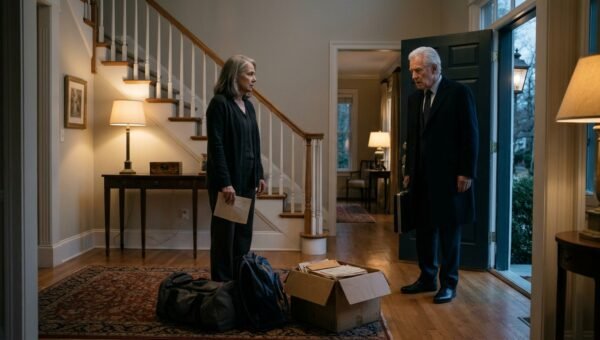
Six weeks before Thanksgiving, Nell sent me a screenshot that started with my son-in-law’s father sitting in my chair.
I read it once in the truck, then again at the kitchen table. The message had gone to the wrong family thread. Candace meant it for her relatives. In it, she talked about putting Stuart at the harbor-facing end of my table, then about moving Finch Outdoor Services into the family’s hands by spring.
I called Nell.
“Should I say something to her?” she asked.
“No. Keep the screenshot.”
I didn’t sleep much that night. The message was only a few lines, but each time I read it, I noticed something else. Candace didn’t write as if she were asking. She wrote as if the hard part was already settled and I simply hadn’t been told yet.
I had six weeks to find out how much of it was talk.
Finch began with one used truck and a mower I bought from a man moving south. I was twenty-eight, renting a garage and writing estimates in a notebook because I couldn’t afford an office. We grew one job at a time. By the time Trey was old enough to ride along on Saturday mornings, he knew the sound the truck made when I changed gears and asked what every switch did.
When he came to work for me full-time, I thought I was handing him a future.
I didn’t think I was handing him the keys to everything without limits. There’s a difference. I know that now.
The first changes were small enough that I let them pass. Candace rerouted Finch’s mail to Trey’s office because, she said, it would be easier to keep things together. She had my name removed from a household service account, calling the paperwork outdated. When she spoke about Finch, she called it Trey’s company.
I corrected her once.
“You know what I mean,” she said, smiling.
I let it go. I wanted to be easy to deal with. That’s not the same as being wise.
A few months before Thanksgiving, Ben, my accountant, called about charges he couldn’t match to company work. I asked him to check the last several months. His first list included restaurant bills and personal purchases. His second list was worse. Several charges on Trey’s company-linked card matched deposits at an online sports-betting site registered in Trey’s name.
Ben read the total to me over the phone. I wrote it on the back of an old invoice, though he’d already emailed the number.
“That’s enough to put payroll in trouble if it keeps going,” he said.
“Don’t talk to Trey yet.”
I hated saying that. I hated it more when Ben found unauthorized withdrawals tied to a high-interest credit line Trey had opened under Finch’s name. I cross-checked the bank statements against the betting account records. The dates matched. The money was gone.
I kept telling myself there might be a plain explanation. I didn’t want to be the father who saw a few bad choices and turned them into a case against his own kid. But the records kept adding up, and the screenshot from Nell sat in my desk drawer. So I began keeping copies of everything. Dates, amounts, emails, notes from calls. I was careful not to tell myself that paperwork meant I wasn’t hurt.
I called Dan Miller, my attorney, and asked him to help me put a wall between Trey’s mistakes and the company. We prepared the corporate changes. I spoke with Vic, who’d worked with me for nearly thirty years, about taking over daily operations. Ben locked down the ledgers. I also called Clark, one of Finch’s oldest and largest clients, and asked him to wait for my word before renewing the seasonal grounds contract.
Clark didn’t ask for the family story.
“Vic’s the person I’ll call,” he said. “I’ll keep the contract where it is.”
That was the part I could control. The rest sat in my chest like a stone I carried from room to room.
Thanksgiving morning, I got up before dawn and started the turkey. I’d done it for years. I know the old boards in the house by their creaks, and the one outside the pantry still gives a little squeal if you step on it wrong. I know the thyme smell when it hits the butter. These are small things, but when you’ve built a home, you keep track of them.
Candace arrived with her parents, Stuart and Connie. Their wet coats ended up in a heap by the side door. Stuart took my chair at the harbor-facing end of the table. Connie passed him the gravy.
I was standing in the dining-room entrance with a plate when Candace looked toward the kitchen.
“The table is set for my family, Martin. You can eat in the kitchen.”
Trey had his hand around a water glass. He looked down at his napkin. He didn’t ask her to make room. Didn’t say my name.
I’d spent most of my adult life making sure there was a place for everyone at my table. I could have reminded them whose house it was. I could have told Candace to move Stuart. Instead I said, “All right.”
She gave me a small nod, like I’d finally understood.
I carried my plate through the side kitchen and set it on the narrow scullery counter beside the catering trays. The dining-room voices carried through the doorway. Stuart told a story about a marina renovation. People laughed at the pauses.
I sat at the little table by the window and took out my phone.
I called Vic first.
“Are you at the depot?”
“I am. What’s happening?”
“I’m putting you in charge of daily operations. The paperwork is ready.”
He paused. “Understood.”
Then I called Ben.
“Start the access change. Trey is no longer authorized on the operating account.”
“I’ve got it.”
I opened the bank’s secure page and confirmed the change myself. Trey’s name disappeared from the account permissions. I also submitted the notice suspending my personal guarantee on the credit line he’d opened for supposed equipment purchases.
The confirmation came before I’d finished my first bite of turkey.
I called Clark and told him Vic now held operational authority. Finch would honor every term of the contract.
“Then Vic is the person I’ll call,” Clark said. “I’ll keep the contract where it is.”
I thanked him. For a few minutes, the only sound in the scullery was the dinner talk and rain tapping the back door. The turkey tasted like nothing.
Then a notification appeared on my phone. A card had been declined.
A chair scraped in the dining room.
Candace’s voice carried through the doorway. “Try it again.”
Trey said something too low for me to hear. Then the scullery door swung open. He stood there with his phone clenched in one hand.
“Dad, what did you do?”
“I protected the company.”
“You took me off the account?”
“I removed your access.”
He looked past me toward the dining room, as if the answer might change with an audience.
“What about the credit line?”
“I’m no longer guaranteeing it.”
Candace stepped in behind him. Her cheeks were flushed, but she kept her voice measured.
“You couldn’t wait until after dinner?”
“You told me to eat in here,” I said. “So I handled my business in here.”
Trey moved closer. “We were working something out. You didn’t have to lock everything down.”
“Was that what the spring transfer was? Something you were working out?”
His mouth opened, then closed.
Stuart and Connie came in behind Candace. The four of them filled the narrow space among the trays and damp coats. Stuart looked more annoyed than worried.
I set my fork down.
“Finch belongs to me,” I said. “Vic will run the operation. The crews will be paid, and the contracts will be honored. You don’t get to spend company money as if it’s yours.”
Candace’s expression changed a little. Not surprise. More like she’d just realized I knew about the plan.
The doorbell rang.
I stood. Nell and Dan were at the front door. I’d asked them to arrive after the access change, with the documents in hand. The room went quiet as I passed the family in the narrow kitchen corridor.
Dan held a leather portfolio. Nell had a folder tucked under her arm. Rain clung to their coats.
“You ready?” Dan asked.
“I am.”
He and Nell followed me into the dining room. Stuart was still in my chair. Dan put his portfolio on the table beside the gravy boat. Nell set down her folder and took the seat nearest me.
Dan didn’t raise his voice. “I’m serving formal notice of the corporate changes and the audit findings.”
Candace stepped forward. “This is a private family misunderstanding.”
“It isn’t,” Dan said.
He laid out the papers one at a time. The first was the resolution removing Trey’s authority as an officer of Finch and ending his check-signing access. The next was Ben’s certified audit summary. I watched Trey look at the figures. He knew what they meant before Dan finished explaining them.
The pages showed the company-card charges and transfers to the betting accounts. They showed the credit line, too. The high-interest loan hadn’t been for equipment. The company records showed no equipment purchase matching it.
Candace reached toward the papers. “He was going to pay it back.”
“Then he can pay it back,” I said. “But he can’t hide it in the company.”
Dan explained that my personal assets had been the guarantee on the credit line, and that I’d legally detached myself from it. Trey was responsible for what he had signed for. The operating account was protected. Payroll was protected. Vic would be at the depot the next morning.
Candace stared at me. “You planned this.”
“I prepared for what I found.”
“You’re doing this to your own son.”
I looked at Trey. He still hadn’t looked me in the eye.
“I’m doing this because he’s my son,” I said. “I’m not going to help him dig deeper.”
Nell opened her folder and slid the screenshot across the table. I saw the line about Stuart sitting in my chair. Then the line about Finch and the spring transfer. I’d read it so often the words felt worn down, but there they were in black on white.
Stuart pushed his chair back. “This is ridiculous.”
“No,” I said. “You’re in my chair.”
I pointed toward the side door, where their coats were piled.
“Get your coats. You and Connie need to leave my house tonight.”
Connie looked at Stuart, then at Candace. None of them moved right away.
Dan placed the written notice to vacate on the table. He made clear that the house belonged to me and that if they refused to leave, he’d take the next legal steps. There was no need for that. Stuart stood, and Connie gathered both their coats. Candace took her purse.
She paused beside Trey. “I’m not staying here.”
He didn’t answer. She walked out with her parents into the November rain.
Then it was just me, Nell, Dan, and my son.
I told Trey what his choices were. He could work as an entry-level crewman under Vic and repay every dollar on a set plan, with the full audit kept on file. Or I could turn the records over for legal referral. Being my son wouldn’t erase the account. It wouldn’t make the money reappear.
“I can’t believe you’d do this,” he said.
“I can’t believe you let it get this far.”
He looked at the papers. “You’d put me on a crew?”
“If that’s what it takes to earn back what you took.”
I didn’t offer to cover the debt. I didn’t promise we’d be all right. I wanted to say something softer, but I’d spent too many years using softness to avoid a hard talk.
The next morning, Vic took over at the depot. Clark’s contract stayed in place. The crews got paid. Trey didn’t come to work that first day. He called two days later and told Vic he’d take the road-crew job. I left the terms where they were.
That night, Nell helped me clear the cold plates. She started to lift Stuart’s gravy boat, then looked at me.
“Leave it,” I said. “I’ll get it.”
After Dan and Nell left, I sat at the harbor-facing end of the table. My chair was still pulled slightly away from it. I pushed it in, set my hands on the worn oak, and watched the harbor lights blink across the rain-streaked glass.