PART 1
My brother, David, and I disagreed about Mom’s funeral from the minute the hospice nurse called us into the hallway.
David wanted a traditional church service at First Baptist. He talked about the stained glass, the choir, and having Pastor Miller give a proper eulogy. He said it was about dignity and showing people our family had standards. But Mom had stopped attending services over ten years ago.
Toward the end of her life, her community wasn’t in a pew. It was at the oak folding tables in the county community center, where she spent every single Friday afternoon playing bridge and pinochle with women who knew her real laugh.
I told David that holding her service in a formal sanctuary felt dishonest. He argued that a community hall looked cheap, like we couldn’t be bothered to spend his commission money or honor our parents’ upbringing. We went back and forth for two days in the kitchen of her small ranch house, running our fingers over old receipts and cold coffee cups, until we finally compromised on a memorial gathering at the community center.
We scheduled it for a Tuesday morning before the regular card league met.
The morning of the service was damp and overcast. The custodian had set out eighty metal folding chairs on the linoleum floor, and I was arranging two grocery store bouquets beside her framed portrait when the center director, Marcus, walked over.
He was carrying a brown paper grocery bag folded neatly at the top.
Marcus told me Mom had come into his office about six months earlier, right around the time the doctor told her the treatments weren’t keeping the cancer back anymore. She had handed him the bag and asked him to keep it in his metal filing cabinet behind his desk until the day of her wake. She made him promise not to give it to either of her children until people were actually arriving.
I carried the bag over to the corner table under the bulletin board. David saw me opening it and walked over, his dark suit crisp, checking his gold watch like he had somewhere else to be.
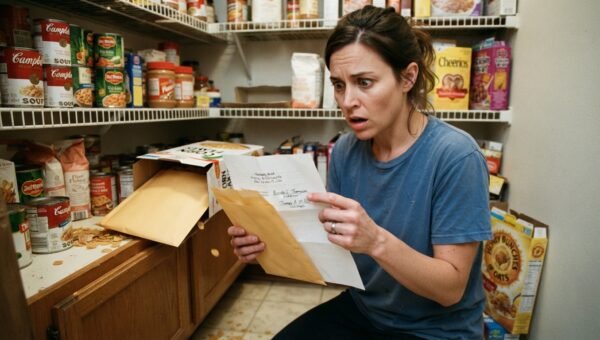
Inside the bag were two decks of worn bicycle cards wrapped in thick rubber bands, smelling of menthol and spearmint gum, and a sheet of yellow legal pad paper folded into quarters.
It was a handwritten guest list in Mom’s shaky script.
At the very top, she had listed her Friday card circle: Evelyn, Martha, Clara, and Mrs. Higgins.
But three lines down, written in heavy black ballpoint ink, was the name Sarah Henderson.
Sarah was David’s first wife. Our family had not laid eyes on Sarah in fifteen years.
Back then, their breakup had split our family into jagged pieces. David had claimed Sarah walked away from their marriage without warning, emptying their savings account and moving two states over to avoid facing him. He told Mom and me that Sarah was unstable, selfish, and bitter. He remarried two years later, built a successful real estate career, and forbade anyone in the family from ever mentioning Sarah’s name in his house.
Yet Mom had always kept a quiet, stubborn habit. Every single Thanksgiving and Christmas, she set an extra place at the dining table. When relatives asked who the empty chair was for, Mom would simply say, “For family who couldn’t find their way home yet.” David had hated it.
He used to roll his eyes and refuse to look at the empty china plate.
Now, looking down at the legal pad, David’s face lost all its color. The tight, polished look he wore like armor cracked.
He grabbed the paper out of my hands. His fingers were trembling so hard the edge of the paper rattled against his cufflink.
“Cross it off, Karen,” he whispered, his voice sharp and hoarse. “Cross her name off right now. Don’t you dare put that out on the sign-in registry.”
I stared at him, bewildered by the pure panic in his eyes over a simple invitation list for a woman who was already gone. I asked him why Mom would write Sarah’s name after all these years, and why it bothered him so much that our mother remembered his first wife.
Instead of answering, David jabbed his blunt finger toward the bottom of the yellow sheet.
“Look at the last line,” he said.
Beneath the names, Mom had written three short sentences:
“Give Sarah the blue metal lockbox from under my sewing machine. The keys are taped under the bridge table in closet B. She paid for this roof when nobody else would.”
PART 2
I stood frozen by the bulletin board, holding that yellow sheet of paper while David stared at me with an expression that bordered on fury.
“She was losing her mind toward the end, Karen,” he insisted, his voice dropping into a harsh whisper so the early arrivals near the entryway wouldn’t overhear. “You know how confused she got on the pain medication. Sarah ruined our family. Mom didn’t know what she was writing.”
“Mom wrote this six months ago, David,” I said quietly. “She was completely lucid then. She drove herself here to see Marcus.”
Before David could snatch the paper back, the double glass doors swung open. A woman stepped inside, shaking raindrops from a dark trench coat. Her hair was cut short and streaked with gray, but the kind curve of her jaw was unmistakable.
It was Sarah.
David saw her and stiffened, stepping backward as if he had run into a pane of glass. He turned his back immediately, pretending to inspect the floral arrangement by Mom’s portrait, but his shoulders were hiked all the way to his ears.
Sarah spotted me and walked across the linoleum, her heels clicking softly. When she reached the table, her eyes were wet. She didn’t hesitate; she reached out and pulled me into a tight, warm hug.
“I’m so sorry, Karen,” she whispered. “Marcus called my office yesterday morning like your mom asked him to. He told me today was the day.”
“You knew Marcus?” I asked, pulling back to look at her.
“Your mom stayed in touch with me for fifteen years,” Sarah said. She glanced sideways toward David’s rigid back, her expression sad rather than angry. “She wrote me letters every month. She sent pictures of your kids when they were born. She was the only person from this town who ever treated me fairly.”
I felt a cold pit form in my stomach. Fifteen years ago, David had painted Sarah as a thief who took everything and ran. He had moved on, married his current wife, Patricia, and bought a brick home on the north side of the hill, while Mom remained in the drafty ranch house on Maple Street, struggling to pay her heating bills every winter. Whenever I brought up Mom’s finances to David, he had shrugged and told me he had his own mortgage to carry and that Mom had always been careless with Dad’s life insurance payout.
“Sarah,” I said, keeping my voice level. “Mom left a note in this bag. She mentioned a blue lockbox under her sewing table, and she said you paid for her roof.”
Sarah let out a slow, quiet breath. She looked around the hall as more of Mom’s bridge partners walked through the doors, greeting each other in muted, respectful tones.
“We shouldn’t do this in the middle of her service,” Sarah said. “Let people pay their respects first. But after this is over, Karen, you and I need to go to her house. There are things you need to see, because David certainly won’t tell you the truth.”
David lingered on the opposite side of the room the entire morning. He shook hands with the neighbors, gave a brief, rehearsed eulogy about his mother’s traditional values, and completely avoided the table where Mom’s Friday card friends sat sharing stories about how Mom used to sneak peppermint schnapps into the thermos during high-stakes tournament games. Every few minutes, his eyes darted to Sarah, tracking her movements with pure apprehension.
When the service concluded at noon and the last of the ladies from the card league hugged me goodbye, David walked briskly to my side.
“I’m heading straight to Mom’s house to secure her paperwork,” he said, pulling his car keys from his pocket. “As the executor named in Dad’s old will, I have legal responsibility for the premises. You don’t need to worry about anything today.”
“Dad’s will was drafted twenty-five years ago, David,” I said, looking him dead in the eye. “And Mom updated her affairs after Dad died. I’m going to the house right now. Sarah is coming with me.”
“If you bring that woman onto our mother’s property, I’ll call the sheriff,” David hissed.
“Go right ahead,” I said. “Let’s see what the sheriff thinks of Mom’s handwritten instructions.”
PART 3
We drove over in separate cars. When Sarah and I pulled into the gravel driveway of Mom’s little house, David’s silver sedan was already idling by the mailbox. He got out and stood on the porch, his jaw clenched, but he didn’t call the sheriff. He knew how bad that would look in a neighborhood where everyone knew our family.
I unlocked the front door. The house still smelled like her: lavender lotion, old paperbacks, and stale tea.
David pushed past us into the hallway, heading straight for the back bedroom where Mom kept her sewing machine. But Sarah didn’t follow him there. Instead, she walked straight into the utility room off the kitchen, reached behind the water heater, and pulled out an old metal key attached to a faded yellow ribbon.
“She kept the backup right here,” Sarah said softly. “She told me about it three years ago when she started getting sick.”
David reappeared in the hallway, holding the heavy blue metal lockbox by its steel handle.
“This is estate property,” David declared, holding it close to his chest like a child guarding a toy. “It has to be opened in front of an attorney. Nothing leaves this house.”
“Put it on the kitchen table, David,” I said. “Put it on the table right now, or I swear to God I’ll walk over to Mrs. Gable’s house next door and borrow her phone to call the town clerk.”
David looked between me and Sarah. The sheer stubbornness in my voice must have told him I wasn’t backing down. He slammed the box onto the formica tabletop with a heavy thud.
Sarah walked over, inserted the key into the small brass lock, and turned it. The mechanism gave a sharp click.
Inside the box was a thick Manila folder labeled *Maple Street Property & Loans*, a stack of cancelled cashier’s checks, and a signed legal agreement dated fifteen years ago.
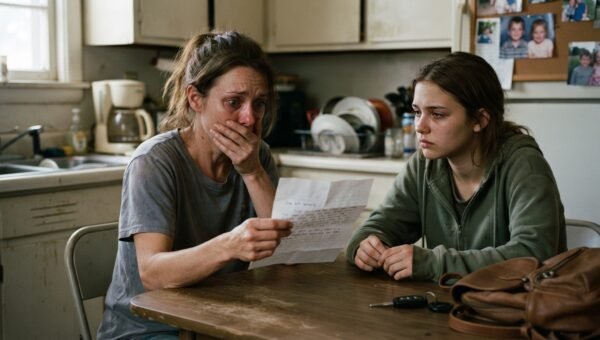
I pulled the documents out and began reading through them. The truth hit me with the force of a physical blow.
Fifteen years ago, David hadn’t been the victim of an unstable wife. He had run up nearly eighty thousand dollars in high-interest business debts through a failed commercial framing venture he had kept hidden from everyone. To keep his creditors from taking him to court, he had convinced our widowed mother to take out an adjustable-rate second mortgage on the family home to bail him out. He had promised to make every single monthly payment himself.
Six months after the money went through, David stopped paying. The bank sent Mom a foreclosure warning.
Sarah had discovered the default by accident when an auction notice arrived in the mail. When she confronted David about leaving his own mother out to dry, he told her it was just business and that Mom could easily move into a county-run senior home. That was the real reason Sarah filed for divorce. She couldn’t stomach living with a man who would throw his mother out on the street to protect his own credit score.
The cancelled checks in the box told the rest of the story.
Sarah had taken her share of their marital home equity from the divorce settlement and paid off the entire delinquent balance on Mom’s house. Every single dime of it. For fifteen years, Sarah had quietly covered the property taxes and paid for a new asphalt roof when the old one started leaking into the kitchen ceiling.
Mom had kept every carbon copy, every receipt, and every letter of gratitude she had sent to Sarah.
Taped to the inside lid of the lockbox was a quitclaim deed prepared by an attorney four months before Mom passed away. It transferred the title of the house directly to Sarah Henderson and me, as joint tenants with right of survivorship.
David was completely excluded.
ENDING
David stood against the kitchen counter, his eyes fixed on the thick pile of bank stamps and legal seals spread across the table. For all his fine suits and talk of family dignity, he looked hollowed out and pathetic in the gray kitchen light.
“She couldn’t do that,” he said, though his voice lacked any real conviction. “The house was supposed to be split between us. Dad built this place.”
“Dad built this place for Mom,” I said, my voice shaking with an anger I hadn’t felt in years. “And you almost let a bank tear it away from her so you could keep driving your new car. You told me Sarah stole your savings. You told me she ruined you.”
“I was trying to keep our family together, Karen,” he pleaded, taking a half-step toward me. “I was young. I got over my head with the framing company. I was going to pay it back eventually.”
“You had fifteen years, David,” Sarah said calmly. She wasn’t yelling. She looked at him with the cool detachment of someone who had long since grieved the loss and moved past the pain. “You made sixty thousand dollars on that subdivision deal four years ago. Your mother was sitting here in this kitchen with an electric space heater because the oil furnace was failing, and you didn’t give her a single dollar.”
David didn’t have an answer for that. He reached for his car keys on the counter, his mouth working silently, looking for an excuse that simply did not exist.
“Don’t come back here,” I told him. “Don’t come around looking for furniture, or family silver, or anything else. Mom left this house to the two people who actually cared if she had a roof over her head. If you challenge this deed, I will take every single one of these cancelled checks and bank statements to the probate court, and I’ll make sure every friend and client you have in this county finds out what you did.”
David grabbed his keys, shoved past the kitchen chairs, and let the front screen door slam behind him. A few seconds later, his tires spun on the gravel driveway as he pulled out onto the road and sped away.
The house fell completely quiet.
Sarah and I sat down together at the old kitchen table, just like Mom used to sit with her Friday bridge partners. We spread the yellowed papers out, smoothing the edges where Mom’s fingers had folded and filed them away for safekeeping.
Mom hadn’t wanted a church service because she didn’t care about putting on a show for people who only cared about appearances. She wanted her truth told in the place where people actually played the hands they were dealt.
Sarah looked across the table at me and squeezed my hand. For the first time in fifteen years, that empty chair at our holiday table didn’t feel lonely anymore. It was finally filled.